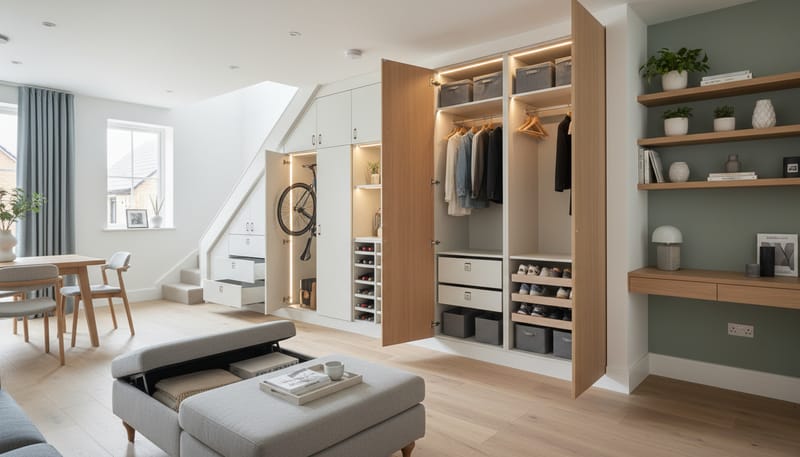
Why New Build Homes Need Storage Solutions
New build homes are designed with contemporary lifestyles in mind, and developers have become increasingly skilful at incorporating efficient layouts into their floor plans. Rooms flow logically, natural light is maximised, and living spaces feel generous and well-proportioned. That said, the national trend towards higher density housing means plot sizes and individual room dimensions have gradually reduced over the past two decades. According to LABC Warranty data, the average new build three-bedroom semi-detached house offers roughly 85 to 95 square metres of internal floor area, compared with 100 square metres or more for an equivalent property built in the 1970s.
The result is that new build homeowners often find themselves with fewer built-in cupboards, shallower wardrobes and smaller utility areas than they might expect. This is not a criticism of developers — the homes are designed to meet modern building regulations, energy standards and buyer expectations brilliantly. It simply means that smart aftermarket storage becomes essential for keeping your home organised as possessions accumulate. For a broader guide to settling into a new build, see our article on decorating a new build home.
What Your Developer Provides as Standard
Before investing in additional storage, it is worth understanding what most developers include in a standard specification. Specifications vary between housebuilders and developments, so always check your sales particulars for exact details.
- Kitchen cabinetry: A full set of base and wall units with worktop, typically from a mid-range kitchen supplier. Most include a mix of drawers and cupboards, but internal organisers are rarely fitted as standard.
- Principal bedroom wardrobe: Many developers now include a single fitted wardrobe with shelf and hanging rail in the main bedroom. Second and third bedrooms usually have no wardrobe provision.
- Under-stairs cupboard: Houses with stairs almost always include an under-stairs cupboard, though it is usually a simple open void with a door and no internal shelving or racking.
- Bathroom mirror: A basic wall-mounted mirror, but not a mirrored cabinet with storage behind.
- Loft hatch: A basic loft hatch is provided, but no boarding, no ladder and no light. The loft is insulated but not set up for storage.
- Garage (if applicable): An empty shell with power sockets. No shelving, racking or wall systems are included.
- Garden shed: Rarely included. Some developments offer a small store as an optional upgrade, but the garden is typically handed over as a blank lawn.
Understanding this baseline helps you identify the biggest storage gaps in your home and prioritise your spending where it will have the most impact. For insight into which developer upgrades are worth paying for before completion, see our guide to developer upgrades worth choosing.
Storage Solutions by Room: Built-In vs Freestanding
The table below provides a snapshot of the main storage options for each room in a new build home, comparing built-in solutions with freestanding alternatives and their typical UK costs.
| Room | Built-In Option | Typical Cost | Freestanding Option | Typical Cost |
|---|---|---|---|---|
| Kitchen | Pull-out larder unit, internal drawer organisers | £150 – £600 | Freestanding pantry cupboard, trolley | £80 – £400 |
| Main Bedroom | Bespoke fitted wardrobe (wall-to-wall) | £2,500 – £8,000 | IKEA PAX system, freestanding wardrobe | £300 – £1,500 |
| Bathroom | Vanity unit with drawers, recessed shelf niche | £150 – £600 | Mirrored cabinet, over-toilet shelving | £30 – £200 |
| Hallway | Built-in boot room bench with hooks | £300 – £1,000 | Slim shoe cabinet, coat rail, console table | £40 – £200 |
| Under-Stairs | Bespoke pull-out drawers | £800 – £2,500 | DIY shelving and hooks | £50 – £150 |
| Loft | Professional boarding with raised legs | £300 – £600 | DIY boarding and plastic storage boxes | £100 – £250 |
| Garage | Wall-mounted slatwall panel system | £200 – £500 | Freestanding heavy-duty shelving | £30 – £80 per unit |
| Living Room | Bespoke alcove cabinets and shelving | £500 – £1,500 per alcove | TV unit, floating shelves, Kallax | £50 – £400 |
Kitchen Storage: Internal Organisers, Pull-Outs and Larder Units
The kitchen is the hardest-working storage space in any home. New build kitchens are well designed and typically generous with cabinetry, but the interiors of those cabinets are often basic — single shelves in wall units, empty cavities in base units, and drawers with no dividers. For a full guide to kitchen design, see new build kitchen design.
Quick-Win Kitchen Storage Additions
- Bamboo drawer dividers: Transform a chaotic cutlery drawer into neat compartments. £8 – £20 from Lakeland, Joseph Joseph or Amazon.
- Pull-out wire baskets: Retrofit inside base cabinets so you can reach the back without crouching. £20 – £60 per unit from Screwfix or B&Q.
- Lazy Susan turntable: Place inside corner base units to make every centimetre accessible. £15 – £30.
- Over-door basket rack: Hooks onto the inside of a cupboard door for spices, foil and cling film. £8 – £15.
- Magnetic knife strip: Frees up an entire drawer while keeping knives safely accessible on the wall. £10 – £30 from ProCook.
- Pan lid organiser: A vertical rack that holds lids upright, reclaiming space from the messiest cupboard in the kitchen. £10 – £20 from Lakeland.
- Freestanding larder cupboard: If floor space allows, a tall pantry unit provides huge additional capacity for dry goods, tins and small appliances. £100 – £400 from IKEA (Havsta) or Dunelm.
- Tension rod under the sink: Creates a hanging rail for spray bottles, freeing the cupboard floor for bins and cleaning products. £5 – £10.
Built-In Kitchen Upgrades
For homeowners prepared to invest more, replacing a standard base unit with a pull-out larder (approximately £300 – £600 from Howdens, Wren or Magnet) is one of the most transformative kitchen upgrades. These tall, narrow units pull out to reveal multiple shelves on both sides, storing an astonishing quantity of food and household items in a footprint of just 300 to 400 millimetres wide. Corner carousel units (£80 – £150 fitted) and internal pull-out bins (£40 – £80) are also worthwhile investments.
Bedroom Storage: Fitted Wardrobes, Ottomans and Over-Bed Solutions
The bedroom is where storage shortfalls are felt most acutely in new builds. A single wardrobe in the principal bedroom is a solid starting point, but second bedrooms and children's rooms typically have no wardrobe at all. Building a comprehensive bedroom storage system — combining fitted wardrobes, ottoman beds and clever over-bed solutions — can transform daily life. For more bedroom styling ideas, see our guide to new build bedroom design.
Fitted Wardrobe Providers: UK Comparison
| Provider | Type | Cost (Double Bedroom) | Lead Time | Key Features |
|---|---|---|---|---|
| Sharps | Bespoke fitted | £3,000 – £6,000 | 4 – 6 weeks | Free 3D design visit, wide style range, handleless and shaker options |
| Hammonds | Bespoke fitted | £2,500 – £5,500 | 4 – 8 weeks | Soft-close drawers, illuminated interiors, pull-out trouser rails |
| IKEA PAX | Modular flat-pack | £600 – £1,500 | Immediate (self-assembly) | 236 cm tall frames, KOMPLEMENT inserts, sliding or hinged doors |
| Neville Johnson | Premium bespoke | £4,000 – £8,000+ | 6 – 10 weeks | Handcrafted, real wood veneers, classic and contemporary finishes |
| Spaceslide | Made-to-measure doors | £400 – £1,200 (doors only) | 2 – 3 weeks | Custom sliding doors for existing openings, mirror and glass options |
IKEA Hacks for New Build Wardrobes
The IKEA PAX system offers outstanding value and can be made to look remarkably like a bespoke installation with a few simple tweaks.
- Filler panels: Cut MDF filler strips to close the gap between the PAX frame and the wall, then paint to match the wall colour. Cost: £10 – £25 in materials.
- Crown moulding: Add a strip of coving or moulding along the top to bridge the gap to the ceiling. Cost: £15 – £30.
- Plinth at the base: A matching MDF plinth gives a fully fitted look. Cost: £10 – £20.
- Upgraded handles: Replace standard IKEA handles with premium brass, leather or matt-black alternatives from Plank Hardware or Superfront. Cost: £5 – £15 per handle.
- Interior LED lighting: Battery-operated IKEA NORRFLY LED strips (approximately £20) illuminate the interior beautifully.
- KOMPLEMENT inserts: Add pull-out trays, jewellery inserts, trouser hangers and shoe shelves to customise the interior layout. Cost: £5 – £25 each.
Ottoman and Divan Beds
An ottoman bed lifts on gas struts to reveal a storage compartment spanning the entire bed footprint — approximately 1.2 cubic metres in a standard double. This is ideal for seasonal clothing, spare duvets, suitcases and bulky items. Prices range from £250 (Happy Beds, Bed Kingdom) to £700 (Silentnight) and £1,500+ (Hypnos, Vispring). Divan beds with four drawers offer more accessible day-to-day storage for £200 – £500 from Dreams, Bensons for Beds or John Lewis.
Over-Bed Storage
The wall above the headboard is prime real estate for floating shelves (£15 – £40 from B&Q or Habitat) or a bridging cabinet that spans the top of the bed like a shallow overhead cupboard. Bridging units from fitted wardrobe companies add approximately £300 – £600 to an installation and are perfect for storing items you rarely access, such as spare pillows or out-of-season clothing.
Bathroom Storage: Vanity Units, Mirror Cabinets and Recessed Shelving
New build bathrooms are well-appointed but typically compact, and cluttered surfaces can make even a generous bathroom feel cramped. Effective storage keeps toiletries, cleaning products and towels organised while preserving the clean, spa-like feel. For complete design guidance, see new build bathroom design.
- Vanity unit with drawers: Replacing a pedestal basin with a wall-hung vanity unit is one of the single best bathroom upgrades. Prices range from £150 – £600 from Victoria Plum, Bathstore or Big Bathroom Shop. Wall-hung designs keep the floor clear and are easy to clean beneath.
- Mirrored cabinet: A mirrored cabinet provides both a reflection and concealed shelving for medicines, skincare and razor blades. Basic models cost £30 – £60 (B&Q, IKEA); illuminated LED cabinets with demister pads cost £100 – £400 (HiB, Roper Rhodes).
- Recessed shower niche: If you are renovating the bathroom, ask your tiler to create a recessed niche in the shower wall for shampoo and body wash. Materials cost around £20 – £50; the labour is part of the tiling job.
- Over-toilet shelving: A freestanding unit (£25 – £60 from Dunelm or Wayfair) or a pair of floating shelves uses the wall space above the toilet for towels and baskets.
- Towel ladder or rail: A decorative towel ladder (£15 – £40) stores several towels vertically while adding a boutique-hotel aesthetic.
- Under-bath panels with access: If your bath has a side panel, a hinged access panel (approximately £40 – £80) turns the void beneath the bath into usable storage for cleaning supplies and bulk-buy toiletries.
Hallway and Entrance Storage
The hallway is the first impression of your home and one of the most cluttered spaces in daily life. Shoes, coats, bags, keys, school bags, dog leads — everything passes through this space twice a day. In a new build, the hallway is well-proportioned but rarely has any built-in storage beyond the under-stairs cupboard. For styling ideas, see hallway and entrance styling in new builds.
- Slim shoe cabinet (IKEA Bissa): Only 17 – 20 cm deep, so it fits even the narrowest hallway. Two-compartment: £40; four-compartment: £70 – £100. Holds 8 – 16 pairs.
- Wall-mounted coat hooks: A set of 4 – 6 sturdy hooks at adult and child height. £15 – £40 from John Lewis, Habitat or Cox & Cox.
- Hallway storage bench: Combines a seat for putting on shoes with lift-up storage or drawers beneath. £60 – £200 from Dunelm, IKEA (Hemnes) or Wayfair.
- Console table with drawers: A narrow console (max 35 cm deep) provides a landing surface for keys and post, with drawers for gloves, sunglasses and other small items. £60 – £200.
- Wall-mounted key cabinet: A small lockable cabinet keeps keys tidy and secure. £10 – £25.
- Pegboard or Shaker-style peg rail: A classic peg rail offers flexible hanging for hats, bags, umbrellas and coats. £15 – £35.
Under-Stairs Solutions: Pull-Out Drawers, Cloakroom Conversion and More
The under-stairs cupboard is arguably the most underused space in any new build house. Developers provide a door and a void, but the awkward triangular shape means most homeowners end up piling items in until the cupboard becomes an inaccessible jumble. With a little investment, this space can be completely transformed.
Under-Stairs Conversion Options and Costs
| Conversion Type | Description | Typical Cost | Best For |
|---|---|---|---|
| Pull-out drawer system | Bespoke drawers on runners that slide out, making the full depth accessible | £800 – £2,500 | Shoes, cleaning supplies, household items |
| Adjustable shelving | Brackets and melamine shelves at varying depths to match the staircase angle | £50 – £150 (DIY) | General storage, tools, sports kit |
| Wine cellar | Purpose-built wine racking taking advantage of the cool, stable temperature | £50 – £500 | Wine enthusiasts |
| Downstairs cloakroom conversion | Install a compact WC and basin in the larger section of the under-stairs area | £1,500 – £4,000 | Homes without a ground-floor WC |
| Reading nook | A cushioned bench with lighting and bookshelves in the taller section | £200 – £600 | Families with children, book lovers |
| Home office nook | A compact desk, task light and shelving enclosed behind the door | £150 – £400 | Remote workers needing a tucked-away workspace |
| Dog den | A comfortable bed, hooks for leads, and shelf for treats and grooming supplies | £50 – £200 | Dog owners |
For the highest-impact conversion, bespoke pull-out drawers from specialists like Clever Closet or a local joiner make the entire depth of the cupboard accessible. Each drawer can be designated for a category — shoes, cleaning products, sports equipment — so everything has a clear home. For home office ideas, see our guide to home office design in new builds.
Loft Storage and Boarding
The loft is the single largest untapped storage resource in most new build houses. However, new build lofts are heavily insulated to meet current energy-efficiency standards (typically 270 mm of mineral wool or equivalent), and that insulation must not be compressed if you want to maintain your home's thermal performance and EPC rating. For more on energy performance, see our guide to EPC ratings for new build homes.
Loft Storage Options
| Option | Materials Cost | Professional Install | Coverage | Key Consideration |
|---|---|---|---|---|
| Raised loft legs + chipboard | £80 – £150 | £300 – £500 | 8 – 10 m² | Must raise above insulation; never compress it |
| LoftZone StoreFloor system | £150 – £250 | £400 – £600 | 8 – 12 m² | BBA-approved; adjustable height; preserves full insulation depth |
| Pull-down loft ladder | £50 – £120 | £100 – £180 | N/A | Essential for safe access; aluminium 3-section is the most popular type |
| Battery-powered LED light | £10 – £20 | N/A (DIY) | N/A | Motion-sensor models are most convenient |
| Stackable plastic storage boxes | £5 – £12 each | N/A | N/A | Use clip-lid boxes, not cardboard (which deteriorates in loft conditions) |
| Vacuum storage bags | £10 – £20 (pack of 6) | N/A | N/A | Compress duvets, pillows and seasonal clothing by up to 75% |
A complete loft storage setup — boarding on raised legs, pull-down ladder and light — typically costs £300 – £600 professionally installed by companies like Instaloft or The Loft Boys. A confident DIYer can complete the same project for £100 – £250 in materials from B&Q or Screwfix.
Important: Do not overload the loft. Ceiling joists in new builds are engineered to support the ceiling and insulation, not heavy storage. Distribute weight evenly, avoid very heavy items, and never block eave ventilation points, as this can cause condensation.
Garage Organisation
A new build garage is essentially a blank canvas — four walls, a concrete floor, a few power sockets and an up-and-over door. Without a system in place, it quickly becomes a dumping ground. The golden rule is: get everything off the floor and onto the walls or ceiling.
- Heavy-duty boltless shelving: Five-tier units from BiGDUG, Racking Solutions or Costco cost £30 – £60 per unit and hold up to 175 kg per shelf. Line the side and back walls and keep the centre clear.
- Slatwall panel system: Slotted wall panels accept interchangeable hooks, baskets and brackets for tools, garden hoses, sports equipment and bicycles. £40 – £80 per panel from Gladiator, Elfa or StoreWALL.
- Ceiling-mounted storage racks: Overhead platforms for roof boxes, camping gear and seasonal decorations. £30 – £80 from Amazon or Screwfix.
- Bicycle ceiling hoists: Lift bikes vertically to the ceiling, freeing floor and wall space. £15 – £25 per bike.
- Pegboard tool wall: Classic and cost-effective. A 1200 mm × 600 mm sheet of metal pegboard costs £15 – £30 and accepts an unlimited range of hooks and holders.
- Workbench with storage: A sturdy bench with pegboard above and shelves below. £60 – £500 depending on size and specification.
- Clear labelled storage bins: Transparent boxes with clip lids so you can see contents without opening. £5 – £12 each.
- Garden tool wall rack: Wall-mounted clips and hooks for spades, rakes, brooms and shears keep long-handled tools upright and off the floor. £10 – £20.
Garden Storage: Sheds, Stores and Outdoor Solutions
New build gardens are typically compact and handed over as a simple lawn, so external storage usually needs to be added by the homeowner. For a comprehensive guide to setting up your garden, see new build garden setup guide and new build garden design.
- Timber garden shed (6 ft × 4 ft): The classic choice for mowers, garden tools and outdoor furniture cushions. £200 – £600 from Wickes, B&Q or Forest Garden. Treat annually with wood preservative.
- Plastic storage shed (Keter, Lifetime): Maintenance-free and weatherproof. £300 – £800. Does not require annual treatment.
- Slim wall-mounted store: Fits against a fence or wall and stores long-handled tools, hose reels and barbecue accessories. £80 – £200.
- Deck box or outdoor storage bench: A weatherproof box that doubles as garden seating. Ideal for cushions, children's outdoor toys and barbecue charcoal. £40 – £150 from Keter or Rowlinson.
- Wheelie bin store: A timber or composite enclosure that hides bins from view. £60 – £200. Check your development's management guidelines before installing, as some new build estates have restrictions on outdoor structures.
For homeowners considering a more substantial garden building, see our guide to garden rooms and outbuildings for new build properties.
Living Room Storage: TV Units, Floating Shelves and Alcove Units
The living room needs to balance display, media equipment, books and general clutter with a calm, uncluttered aesthetic. New builds often have clean, unbroken walls that are perfect for fitted or modular furniture. For open-plan layouts, see open-plan living in new build homes.
- TV media unit: A low unit with a mix of open and closed compartments hides cables, consoles, set-top boxes and remotes. £80 – £400 from IKEA (Besta), Dunelm or Swoon.
- Floating shelves: Simple timber or MDF shelves for books, photos and decorative objects. £15 – £40 each. Group in odd numbers (three or five) for visual balance.
- Bespoke alcove cabinets: Where alcoves exist (near chimney breast features or in bay windows), fitted base cabinets with open shelving above create beautiful, integrated storage. £500 – £1,500 per alcove from a local joiner or Jali.
- IKEA Kallax as media centre: The four-by-two Kallax (£55 – £65) with door and drawer inserts serves as a versatile TV stand and general storage unit. Add baskets for a warm, textured look.
- Coffee table with storage: An ottoman-style coffee table with a lift-up top or drawers stores blankets, magazines and board games. £80 – £300.
- Window seat with storage: Where bay windows or wide sills exist, a fitted bench with lift-up lid creates seating and hidden storage in one. £300 – £800 bespoke or £80 – £150 using an IKEA Kallax base with cushion.
Children's Room Storage
Children's rooms face a unique challenge: a constantly evolving mix of toys, books, craft supplies, school equipment and clothing that changes dramatically as children grow. The best storage systems are accessible (so children can tidy independently), flexible (so they adapt over time), and robust (so they survive enthusiastic daily use). For full design guidance, see nursery and children's room design.
- Start with the IKEA Trofast system — timber or painted frames with pull-out plastic bins in small, medium and large sizes. £35 – £55 per unit, plus £3 – £5 per bin. Colour-code bins by category (Lego, cars, craft, dressing up).
- Add forward-facing bookshelves — book slings from Great Little Trading Company (£30 – £45) or IKEA Mosslanda picture ledges (£9 each) display covers outward so young children can browse independently.
- Install wall-mounted shelving at the child's height for current favourites, and higher up for display items and keepsakes.
- Use labelled bins and baskets — picture labels for pre-readers, word labels for readers. Woven or canvas baskets from The Holding Company or Great Little Trading Company cost £10 – £30 each.
- Hang an over-door pocket organiser for hair accessories, stationery, small toys and art supplies. £8 – £15.
- Use a cabin bed with storage below for children aged six and above. A mid-sleeper with desk and shelves beneath creates a combined sleep, study and storage zone. £200 – £500 from IKEA, Argos or Dreams.
Home Office Filing and Organisation
With hybrid working now standard for many UK households, a well-organised home office is essential. Even a small desk area benefits from proper filing and storage. For a full guide, see home office design in new build homes.
- Desktop filing trays: Stackable letter trays for incoming post, bills and documents. £8 – £20.
- Drawer filing cabinet: A two-drawer filing cabinet for A4 suspension files. £40 – £100 from Argos or Viking Direct. Choose one that fits under the desk.
- Wall-mounted shelving: Float two or three shelves above the desk for reference books, lever-arch files and decorative items. £15 – £40 each.
- Cable management box: A simple box that hides the tangle of charger and monitor cables beneath the desk. £10 – £20.
- Shredder and recycling bin: A compact cross-cut shredder (£25 – £50) ensures sensitive documents are destroyed rather than piling up.
- Go paperless where possible: Switch to digital bank statements, utility bills and payslips to reduce the volume of paper entering your home in the first place.
Decluttering Before Organising
No amount of clever storage will help if you are trying to store items you no longer need. Decluttering must come before organising — otherwise you are simply tidying clutter into neater piles. Follow these principles before investing in any storage system.
- The one-in, one-out rule: For every new item that enters the house, one similar item leaves. This prevents gradual accumulation and keeps possessions manageable.
- The 12-month test: If you have not used something in the past twelve months and would not buy it again today, it is time to donate, sell or recycle it.
- Category by category: Work through possessions by type (all clothing, then all books, then all kitchen items) rather than room by room. This prevents shuffling clutter between rooms.
- The four-box method: Use four boxes labelled Keep, Donate, Sell and Bin. Every item must go into one box. No "maybe" pile.
- Sentimental items last: Start with the easiest categories (expired food, worn-out cleaning products) and build momentum before tackling sentimental items.
- Use Vinted, eBay and Facebook Marketplace: Sell items that have value. Charity shops accept clothing, books, kitchenware and electronics in good condition.
- Textile recycling: Clothing and soft furnishings beyond resale can be recycled via textile banks at most supermarket car parks.
Seasonal Rotation System
A seasonal rotation system ensures that only the items you need right now are taking up prime, easily accessible storage space. Items for other seasons move to deep storage (loft, high wardrobe shelves, under-bed) and are swapped twice a year.
- Spring (March – April): Pack away heavy winter coats, boots, thermals and thick duvets. Bring out light jackets, summer shoes and thinner bedding.
- Autumn (September – October): Reverse the swap. Store summer clothing, garden cushions and paddling pools. Bring out winter coats, scarves, hats, gloves and heavier duvets.
- Use vacuum bags to compress out-of-season duvets and clothing before moving them to the loft or under the bed.
- Label everything clearly with the season and contents. Use colour-coded labels: blue for winter, yellow for summer.
- Combine with a declutter — each seasonal swap is an opportunity to assess whether items still fit, still work and are still wanted.
This system is particularly powerful in new builds where wardrobe and cupboard space is finite. By rotating seasonally, you effectively double your accessible storage capacity without buying a single piece of furniture.
Common Mistakes to Avoid
Even well-intentioned storage efforts can go wrong. Here are the most common pitfalls new build homeowners encounter.
- Buying storage before decluttering: You end up organising items you do not need. Always declutter first.
- Compressing loft insulation: Laying boards directly onto insulation compresses it, reduces thermal performance and can invalidate your EPC rating. Always use raised loft legs.
- Ignoring wall fixings: New build internal walls are typically plasterboard on timber studs. Heavy shelving and wall-mounted cabinets must be fixed into studs or use appropriate heavy-duty plasterboard anchors (such as spring toggles or gripit fixings). Standard plastic plugs will pull out under load.
- Overloading the loft: Ceiling joists are not designed for heavy storage. Distribute weight evenly and avoid storing very heavy items overhead.
- Blocking ventilation: Do not block eave vents in the loft or airbricks in the garage. Blocked ventilation causes condensation and damp.
- Mismatched systems: Buying random storage pieces creates visual clutter. Choose a consistent style, material or colour palette across each room.
- Forgetting vertical space: Most people store at waist height and below, ignoring the space above head height. Use the full height of every wall, cupboard and wardrobe.
- Cardboard boxes in the loft: Cardboard absorbs moisture, deteriorates and attracts pests. Use clip-lid plastic storage boxes with clear sides for loft and garage storage.
Whole-House Storage Audit and Cost Guide
The table below provides a room-by-room audit checklist with typical UK costs, so you can assess your storage needs and build a realistic budget for your entire home.
| Room / Area | Storage Priority | Recommended Solution | Budget Option | Mid-Range Option | Premium Option |
|---|---|---|---|---|---|
| Kitchen | High | Internal organisers + larder unit | £50 – £100 | £200 – £400 | £500 – £1,000 |
| Main Bedroom | High | Fitted wardrobe + ottoman bed | £600 – £1,000 (PAX + ottoman) | £2,000 – £4,000 | £5,000 – £10,000 |
| Second Bedroom | Medium | PAX wardrobe + bed with drawers | £300 – £600 | £800 – £1,500 | £2,500 – £5,000 |
| Bathroom | Medium | Vanity unit + mirrored cabinet | £60 – £120 | £200 – £400 | £500 – £1,000 |
| Hallway | High | Shoe cabinet + hooks + bench | £60 – £120 | £150 – £300 | £400 – £1,000 |
| Under-Stairs | Medium | Shelving or pull-out drawers | £50 – £150 | £500 – £1,000 | £1,500 – £2,500 |
| Loft | High | Boarding + ladder + storage boxes | £100 – £200 (DIY) | £300 – £500 | £500 – £800 |
| Garage | Medium | Shelving + wall panels + ceiling racks | £80 – £150 | £200 – £400 | £500 – £1,000 |
| Garden | Medium | Shed or outdoor storage box | £40 – £100 (deck box) | £200 – £400 (timber shed) | £500 – £800 (plastic shed) |
| Living Room | Low – Medium | TV unit + floating shelves | £80 – £150 | £200 – £500 | £800 – £2,000 (bespoke alcove) |
| Children's Room | High | Trofast + bookshelves + labelled bins | £60 – £120 | £150 – £300 | £400 – £800 |
| Home Office | Medium | Filing cabinet + wall shelves | £50 – £100 | £100 – £250 | £300 – £600 |
Whole-House Budget Summary
Based on the table above, here is what a typical three-bedroom new build homeowner might expect to spend on a comprehensive storage overhaul.
- Budget approach (DIY + IKEA): £1,500 – £3,000 for the entire house.
- Mid-range approach (mix of IKEA, mid-range retailers and one or two professional installations): £4,000 – £8,000.
- Premium approach (bespoke fitted furniture throughout, professional loft and garage installations): £10,000 – £25,000+.
Most homeowners take a phased approach, tackling the highest-priority rooms first (typically the hallway, kitchen and main bedroom) and adding storage to other rooms over the first one to two years. This spreads the cost and allows you to live in the home before committing to permanent installations, ensuring the solutions you choose match how you actually use each space. Well-chosen storage also adds value when it comes time to sell — see our guide to styling a new build for resale.
Final Thoughts
Great storage is not about having more space — it is about using the space you have more intelligently. New build homes provide an excellent foundation, with thoughtful layouts, clean walls and consistent dimensions that respond beautifully to both built-in and freestanding solutions. The key is to take a whole-house approach: assess every room, prioritise the areas causing the most daily frustration, declutter before you organise, and choose systems that can adapt as your household evolves.
Many of the most effective solutions cost remarkably little — a set of drawer dividers, a few wall hooks, some labelled storage boxes and a seasonal rotation routine. These small, affordable changes often make a bigger practical difference than expensive fitted furniture, though both have their place. Start small, build methodically, and enjoy the calm that comes with knowing everything in your home has a place.