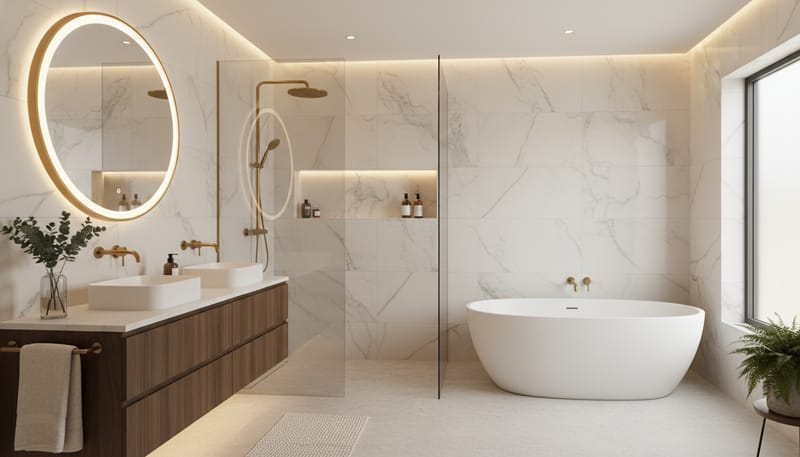
Developer Standard Specifications: What You Actually Get
The starting point for any bathroom decision is understanding exactly what your developer provides. Specifications vary by price band and by builder, but they follow recognisable patterns across the UK market. Developers have raised bathroom standards considerably in recent years, and even entry-level homes now include sanitaryware and tiling that would have been considered upgrades a decade ago.
The table below compares typical developer bathroom specifications across three price tiers. Use it as a benchmark when evaluating what your particular developer offers and identifying where upgrades will deliver the greatest impact.
| Feature | Budget (up to £280k) | Mid-Range (£280k–£450k) | Premium (£450k+) |
|---|---|---|---|
| Toilet | Close-coupled, dual flush | Back-to-wall or wall-hung, concealed cistern | Wall-hung rimless, Geberit frame, slim flush plate |
| Basin | Pedestal basin, 500–550mm | 600mm vanity unit with soft-close doors | Countertop basin on premium vanity with drawers |
| Taps | Chrome single-lever mixer | Branded chrome mixer (Roca, Ideal Standard) | Crosswater, Hansgrohe, or Grohe in chrome or brushed finish |
| Shower | Thermostatic bar mixer over bath | Concealed valve, 200mm overhead + handset | 250–300mm rainfall head, dual outlet, frameless enclosure |
| Bath | Standard acrylic 1700 × 700mm | Wider-profile acrylic, wall-mounted filler | Premium acrylic or composite; freestanding in master en-suite |
| Wall Tiles | Ceramic 200–250mm, shower area only | Porcelain 300 × 600mm, full-height throughout | Large-format porcelain or natural stone, full room |
| Floor Tiles | Ceramic or vinyl | Porcelain tile or premium vinyl | Porcelain with underfloor heating |
| Heated Towel Rail | Basic chrome (sometimes optional extra) | Chrome ladder rail, standard | Designer rail; underfloor heating also standard |
| Mirror | Not included | Basic plain mirror | LED illuminated mirror or mirror cabinet |
| Typical Brands | Unbranded or Lecico, Bristan | Roca, Ideal Standard, Grohe | Villeroy & Boch, Duravit, Hansgrohe, Crosswater |
Regardless of which tier your home falls into, the plumbing infrastructure, waterproofing, and wall preparation in a new build are excellent foundations for future upgrades. The work has been done to current Building Regulations standards, and the substrate behind the tiles is clean, straight, and true — a genuine advantage over older properties.
- Check your specification document: Your developer should provide a detailed specification sheet listing every item in every room. Request this before reservation if possible.
- Ask about upgrade deadlines: Developer upgrades must typically be requested 8–12 weeks before plastering. Once walls are closed, structural changes become significantly more expensive.
- Photograph everything at handover: Record the make, model, and condition of all sanitaryware, tiles, and fittings. This is invaluable for warranty claims and future replacement sourcing.
- Keep spare tiles: Ask your developer for any leftover tiles. Replacement tiles from the same batch ensure a perfect colour match for future repairs.
Bathroom Layout Types in New Builds
Modern new build homes typically include between two and four bathrooms depending on the number of bedrooms, and each type serves a different purpose. Understanding the layout type helps you prioritise upgrades and allocate your budget where it delivers the greatest daily benefit.
- Master en-suite: Accessed directly from the main bedroom. Typically 3–5m². Usually includes a shower (walk-in or enclosure), WC, and basin. Premium homes may include a bath. This is your most-used private bathroom — prioritise it for spa-style upgrades.
- Family bathroom: The shared bathroom, usually 4–7m². Almost always includes a bath (essential for young children), a shower over the bath or separate enclosure, WC, and basin. Needs to be robust, practical, and easy to clean.
- Jack-and-Jill bathroom: Shared between two bedrooms with a door on each side. Increasingly common in four- and five-bedroom homes. Requires careful thought about locking mechanisms and privacy.
- Second en-suite: Typically smaller (2–3.5m²), serving a guest or secondary bedroom. Often a shower, WC, and basin only. A good candidate for a compact wet-room conversion.
- Downstairs cloakroom / WC: Usually just a WC and small basin. Compact but high-impact — guests see this room more than any other bathroom. Premium tiles and a statement basin make a strong impression here.
When planning upgrades, consider how many people use each bathroom and how often. An en-suite used twice daily by two adults deserves more investment than a guest bathroom used a few times a month. For broader guidance on prioritising home improvements, see our guide to developer upgrades worth choosing.
Tile Options: Materials, Styles, and Costs
Tiles define the visual character of your bathroom more than any other single element. They set the colour palette, determine the texture, and establish whether the room reads as contemporary, classic, warm, or dramatic. New build walls provide an ideal tiling substrate — flat, properly waterproofed, and ready for adhesive. The table below compares the main tile materials available in the UK.
| Tile Material | Cost per m² | Water Absorption | Best For | Maintenance | Fitting Cost per m² |
|---|---|---|---|---|---|
| Ceramic | £12–£60 | 3–10% | Walls, low-traffic areas | Low — wipe clean | £30–£50 |
| Porcelain | £25–£120 | Less than 0.5% | Walls, floors, wet rooms, showers | Very low — no sealing required | £35–£55 |
| Natural Stone (Marble) | £60–£200 | Variable (porous) | Feature walls, vanity tops, luxury en-suites | High — seal before use, reseal every 1–2 years | £50–£80 |
| Natural Stone (Limestone) | £50–£90 | Variable (porous) | Floors, feature areas, classic styles | High — seal and reseal regularly | £50–£75 |
| Large-Format Slab (600–1200mm+) | £40–£110 | Less than 0.5% (porcelain) | Feature walls, minimal-grout look, modern design | Very low — fewer grout lines to clean | £50–£80 |
| Mosaic | £30–£150 | Varies by material | Shower niches, feature strips, wet-room floors | Medium — more grout lines to maintain | £55–£85 |
| Zellige (Handmade) | £60–£130 | Variable (glazed terracotta) | Feature walls, basin splashbacks, artisan look | Medium — irregular surface traps less dirt than expected | £55–£80 |
Porcelain is the professional’s choice for modern bathrooms. Its near-zero water absorption makes it ideal for every wet surface, it works brilliantly with underfloor heating, it never needs sealing, and it can convincingly replicate marble, concrete, terrazzo, and timber. Brands like Porcelanosa, Mandarin Stone, Ca’ Pietra, and Marazzi offer outstanding ranges.
- Always order physical samples: Tiles look dramatically different in person than on screen. View samples in the actual bathroom under both natural and artificial light.
- Order 10–15% extra: Wastage from cutting, breakages, and future repairs means you should always over-order. Batch colours can vary, making later matching difficult.
- Consider grout colour carefully: White grout with white tiles creates a seamless look. Colour-matched grout minimises grid lines. Epoxy grout (£15–£25/kg) is waterproof and mould-resistant — well worth the premium over cement grout (£5–£10/kg) in wet areas.
- Check slip ratings for floors: Look for tiles rated R10 or R11 for bathroom floors. Polished porcelain looks stunning on walls but can be treacherous underfoot when wet.
- Large-format tiles need flat walls: Tiles above 600mm require a perfectly level substrate — new build walls typically deliver this, but always check with a spirit level before committing.
Popular Tile Formats for 2026
- 300 × 600mm porcelain: The versatile standard — works on walls and floors, wide range of designs, manageable for most tilers.
- 600 × 1200mm slab porcelain: Delivers a near-seamless look with minimal grout lines. Particularly effective in marble-effect finishes like Calacatta and Statuario.
- 75 × 300mm metro/subway: A timeless format in elongated proportions. Stack-bonded (horizontal, aligned) for a modern look; herringbone for character.
- Zellige 100 × 100mm squares: Handmade charm with light-catching irregular surfaces. Perfect for feature walls behind basins and in shower niches.
- Hexagonal porcelain: Adds geometric interest to floors. Available in small mosaic sheets or larger 200mm formats.
For a practical and budget-conscious approach, use porcelain on floors and in the shower zone where water resistance matters most, and ceramic or zellige on dry feature walls where the aesthetic impact is high but the moisture exposure is lower. UK retailers like Topps Tiles, Tile Giant, Walls and Floors, and Fired Earth carry extensive ranges to suit every budget.
Sanitaryware: Brands, Types, and Costs
The quality of your sanitaryware — toilets, basins, baths — determines how the bathroom feels to use every single day. A smooth-operating tap, a comfortable basin height, and a toilet that flushes quietly and cleanly are not luxuries; they are everyday quality-of-life factors. The table below compares the major UK-available brands across different price points.
| Brand | Price Tier | Basin (wall-hung) | Wall-Hung WC (inc. frame) | Key Ranges |
|---|---|---|---|---|
| Ideal Standard | Budget–Mid | £120–£280 | £300–£500 | Tesi, i.life, Connect Air |
| Roca | Mid | £150–£350 | £350–£600 | The Gap, Inspira, Ona |
| Britton Bathrooms | Mid | £180–£400 | £350–£550 | Trim, Sphere, Curve2 |
| Villeroy & Boch | Mid–Premium | £200–£550 | £450–£900 | Subway 2.0, Avento, Finion |
| Duravit | Premium | £250–£700 | £500–£1,200 | ME by Starck, Happy D.2, Viu |
| Laufen | Premium | £280–£650 | £550–£1,100 | Kartell, Val, Pro S |
Toilet Types Explained
- Close-coupled: The traditional configuration with a visible cistern bolted to the pan. Functional and affordable (£100–£300). The most common type in budget new builds.
- Back-to-wall: The pan sits flush against a furniture unit that conceals the cistern. Cleaner lines than close-coupled (£200–£500 including furniture).
- Wall-hung: The pan is mounted on a concealed steel frame (typically Geberit Duofix) within the wall, leaving the floor completely clear. The sleekest look and the easiest to clean around (£300–£1,200 complete).
- Rimless designs: No rim around the inner bowl means water flushes the entire surface. More hygienic and easier to clean — now standard in most mid-range and premium developments.
- Smart toilets: Integrated bidet wash, warm-air drying, automatic lid, and deodorising. Roca In-Wash Inspira and Villeroy & Boch ViClean lead the UK market (£1,500–£3,000). Smart seats that retrofit onto existing pans start from approximately £400.
The single most impactful sanitaryware upgrade in most new builds is switching from a close-coupled to a wall-hung toilet. The visual difference is striking, and the practical benefit of being able to mop underneath the pan without obstruction is genuinely life-improving. If you can arrange this as a developer upgrade during the build (when the frame is easy to install), the cost saving over retrofitting is typically £300–£500.
Shower Options Compared
For many households, the shower is the most-used fixture in the bathroom. Getting it right transforms your daily routine. New build homes typically use mixer showers fed from the home’s hot water supply (combi boiler or unvented cylinder), delivering far better flow rates and temperature stability than the electric showers common in older properties.
| Feature | Electric Shower | Thermostatic Mixer | Digital Shower |
|---|---|---|---|
| How It Works | Heats cold mains water electrically | Blends hot and cold supply via a valve | Electronically controlled mixer with digital interface |
| Flow Rate | Moderate (limited by element power) | Good to excellent (depends on system pressure) | Good to excellent (same as mixer, digitally managed) |
| Temperature Stability | Can fluctuate with demand | Excellent — thermostatic valve compensates automatically | Excellent — precise digital control to 0.5°C |
| Key Features | Independent of boiler; instant hot water | Concealed or exposed valve; overhead + handset options | Presets, app control, eco mode, warm-up alerts |
| Brands (UK) | Triton, Mira, Aqualisa | Crosswater, Hansgrohe, Grohe, Bristan | Aqualisa Quartz/Q, Mira Mode, Crosswater |
| Unit Cost | £100–£350 | £150–£1,500 | £400–£1,200 |
| Installation Cost | £150–£300 | £200–£500 | £250–£500 |
| Best For | Second bathrooms, backup shower | Most new build bathrooms — the standard choice | Tech-forward homes, families wanting personalised presets |
For a spa-style shower experience, the optimal configuration is a concealed thermostatic valve with dual outlets feeding a 250–300mm rainfall overhead head (ceiling- or wall-mounted) and a separate slide-rail handset. This gives you the full-body rainfall sensation for relaxation and a targeted handset for practical rinsing. Budget £500–£1,200 for the complete setup including valve, heads, and fitting.
- Check your water pressure first: Mixer and digital showers need at least 1.0 bar for a satisfying flow. Combi boilers typically deliver 1.0–2.0 bar; unvented cylinders deliver 2.0–3.0 bar.
- Concealed valves look cleaner: The valve body sits behind the wall with only the control plate visible. Far sleeker than an exposed bar valve, but requires wall access for installation and maintenance.
- Rainfall heads need flow: A 300mm head requires significantly more water than a 100mm handset. Ensure your system can deliver 12–15 litres per minute for a satisfying rainfall experience.
- Shower enclosures vs walk-in panels: Frameless walk-in panels (£250–£500) create a more open, spacious feel than fully enclosed cubicles. Minimum recommended walk-in width is 900mm, with 1,200mm being ideal.
Bath Options and Styles
Despite the growing popularity of walk-in showers, the bath remains highly valued in UK homes — essential for families with young children and prized by anyone who appreciates a restorative soak. New builds typically include a bath in the main family bathroom, with en-suites more likely to be shower-only at standard specification.
- Standard acrylic (1700 × 700mm): The developer default. Functional and lightweight. Thicker acrylic (5–8mm) feels more solid and retains heat better. £100–£300.
- Double-ended acrylic: Symmetrical design with central waste, allowing two people to bathe. A more contemporary look. £200–£500.
- Steel enamel: Extremely durable with a premium feel and excellent heat retention. Heavier than acrylic. £150–£500. Brands: Kaldewei, Bette.
- Freestanding acrylic: The centrepiece bath. Requires floor space to walk around on three sides (200mm clearance minimum). £300–£800. Brands: Clearwater, BC Designs, Waters Baths of Ashbourne.
- Freestanding composite stone: Heavier, more substantial feel with superb heat retention. £600–£1,500. Check floor load capacity on upper storeys — a filled composite bath can weigh over 400kg.
- Freestanding cast iron: The ultimate in heat retention and solidity. Traditional roll-top or contemporary profiles. £800–£2,500. Brands: Burlington, Heritage.
- Japanese soaking tub: Deep, compact baths designed for seated immersion. Ideal for smaller en-suites where a standard bath won’t fit. £800–£2,000.
If you are considering a freestanding bath, think carefully about tap placement. Floor-mounted freestanding bath fillers create a dramatic sculptural statement (£300–£800 from Crosswater, Burlington, or Hansgrohe). Wall-mounted taps behind the bath offer a cleaner, more minimalist alternative at £150–£400. Either way, ensure the plumbing is planned before tiling begins.
Vanity Units and Basin Choices
A vanity unit is the single most practical piece of bathroom furniture, combining a basin with essential under-sink storage. If your developer has provided a pedestal basin (which offers zero storage), replacing it with a vanity unit is one of the most worthwhile upgrades you can make. Wall-mounted vanity units are particularly effective — the visible floor beneath makes the room feel larger and simplifies cleaning.
- 600mm wall-mounted vanity with basin: The standard upgrade size. Provides useful drawer or cupboard space. £200–£500 (Roca, Ideal Standard, Britton Bathrooms).
- 800–900mm wall-mounted vanity: More generous storage and countertop space. Works in family bathrooms and larger en-suites. £350–£800 (Duravit, Villeroy & Boch).
- 1200mm+ double vanity: Two basins side by side for shared en-suites. A genuine luxury that eliminates morning bottlenecks. £500–£2,000.
- Countertop basin on timber shelf: A floating timber or stone shelf with a bowl basin creates a boutique-hotel aesthetic. £250–£700 for shelf, basin, and wall-mounted tap.
What to Look For in a Vanity Unit
- Soft-close drawers and doors: Essential — they protect the unit from slam damage and reduce noise. Standard on quality units.
- Internal drawer organisers: Keep toiletries, cosmetics, and cleaning products tidy. Available as add-ons from most brands.
- Water-resistant construction: Look for moisture-resistant MDF or solid surface construction. Standard MDF will swell and degrade if water penetrates the surface.
- Integrated handles vs push-to-open: Handle-free fronts create a minimal, contemporary look. Push-to-open mechanisms or recessed grip channels avoid visible hardware.
- Consistent finish with other furniture: If you are also using a tall boy unit, mirror cabinet, or WC furniture, ensure all pieces come from the same range for a coordinated look.
Heated Towel Rails
A warm towel after a shower is one of life’s simplest luxuries. Most new build bathrooms include a basic chrome heated towel rail, but upgrading to a designer model in a coordinated metalwork finish can transform the visual impact of the room. The choice between central heating, electric, and dual-fuel operation depends on how and when you want warm towels.
| Type | How It Works | Cost Range | Running Cost (Annual) | Best For |
|---|---|---|---|---|
| Central Heating | Connected to your radiator circuit — heats when the boiler runs | £50–£350 | Included in heating bill | Family bathrooms used primarily in heating season |
| Electric | Independent element — operates year-round regardless of boiler | £100–£400 | £20–£45 | En-suites, cloakrooms, summer use |
| Dual Fuel | Connected to central heating + switchable electric element for summer | £150–£500 | £15–£40 | Any bathroom — the most versatile option |
- Match the metalwork finish: Carry your chosen finish (brushed brass, matt black, brushed nickel, anthracite) across the towel rail, taps, shower fittings, flush plate, and accessories for a cohesive, designed look.
- Size matters: A rail that is too small for the room will struggle to warm towels effectively. For a family bathroom, choose a rail at least 500mm wide and 1,000mm tall.
- Add a timer: A simple plug-in timer or a smart plug ensures your electric towel rail is warm when you need it without running all day. Expect £10–£30 for a timer.
Leading UK brands include Crosswater (MPRO range in multiple finishes), Reina (extensive range at competitive prices), Vogue (premium designer options), and Blyss (B&Q’s own-brand, good value for chrome models).
Lighting for Bathrooms
Lighting is the most underestimated element in bathroom design. A beautifully tiled, well-furnished bathroom can feel flat and clinical with a single ceiling light, or atmospheric and spa-like with a thoughtful layered scheme. Most new builds hand over bathrooms with one central ceiling fitting — functional but entirely lacking in mood.
The Three Layers of Bathroom Lighting
- Ambient (general) lighting: Recessed LED downlights rated IP65 provide even, shadow-free illumination. Space them 600–800mm apart. Choose warm white (2,700–3,000K) rather than cool white — the atmosphere difference is remarkable. £15–£30 each installed.
- Task lighting: Illuminated mirrors or mirror cabinets with integrated LED strips deliver shadow-free light for grooming, shaving, and makeup application. Brands: HiB, Sensio, Roper Rhodes. £100–£600.
- Accent lighting: LED strip lights concealed beneath a floating vanity, along the base of a bath panel, or inside a recessed shower niche create a soft, atmospheric glow. Waterproof LED strip kits cost £20–£60; hardwired installations run £100–£300.
- Always install a dimmer switch: Being able to lower the lights for an evening bath transforms the room. A dimmer costs £15–£40 and takes an electrician minutes to fit. Ensure your LEDs are dimmable-compatible.
- Respect IP ratings: Bathroom lighting must comply with BS 7671 zones. Zone 1 (directly above bath/shower) requires IP65 minimum. Zone 2 (within 600mm of bath/shower) requires IP44 minimum.
- Consider a warm-glow night light: A motion-activated LED strip at floor level (£15–£40) provides just enough light for night-time visits without fully waking you up.
- Demisting mirror pads: A heated pad behind the mirror prevents fogging after a shower. Often built into illuminated mirrors, or available as a separate pad for £20–£40.
For guidance on smart lighting controls that integrate with your wider home system, see our guide to smart home features in new builds.
Ventilation: Getting It Right
Proper ventilation is non-negotiable in any bathroom. Without it, moisture accumulates, condensation forms on cold surfaces, mould develops, and premium finishes deteriorate prematurely. New build bathrooms are equipped with mechanical ventilation as required by Building Regulations (Approved Document F), but understanding your system helps you maintain a healthy environment.
Most new builds use one of two systems: intermittent extract fans (individual fans that activate with the light switch and run for a 15–30 minute overrun) or whole-house MVHR (Mechanical Ventilation with Heat Recovery), which continuously extracts moist air and recovers up to 90% of the warmth. MVHR is increasingly standard in energy-efficient homes built to Part L 2021+ standards.
- Upgrade to a humidity-sensing fan: Activates automatically when moisture rises and switches off when the air normalises. More effective than a timer. £50–£150 from Vent-Axia, Xpelair, or Envirovent.
- If you have MVHR, do not block the vents: The ceiling extract valves in your bathroom are part of a whole-house system. Blocking or covering them compromises ventilation throughout the home.
- Keep the bathroom door closed during and after bathing: This contains moisture within the room where the extract fan can remove it, preventing it from spreading to bedrooms and landing areas.
- Heated surfaces reduce condensation: Underfloor heating and heated towel rails warm the surfaces where condensation would otherwise form. This is a functional benefit beyond comfort.
- Window trickle vents should remain open: New build windows include trickle vents for background ventilation. Keep them open even in winter — they are designed to provide fresh air without significant heat loss.
For a deeper look at how ventilation systems work in energy-efficient new builds, see our guide to maximising your new build’s energy efficiency.
En-Suite vs Family Bathroom: Different Design Priorities
New build homes typically include at least one family bathroom and one en-suite. The design priorities, budget allocation, and fixture choices for each are quite different. The table below highlights the key distinctions to help you plan each room appropriately.
| Consideration | Family Bathroom | Master En-Suite |
|---|---|---|
| Primary Users | Children, guests, all household members | Master bedroom occupants only |
| Typical Size | 4–7m² | 3–5m² |
| Bath | Essential (critical for young children) | Optional — shower-only is common and practical |
| Shower | Over-bath or separate enclosure | Walk-in or frameless enclosure — ideal for spa-style upgrade |
| Design Priority | Robust, easy-clean, timeless, well-organised | Personal, indulgent, spa-inspired |
| Tile Choice | Hard-wearing porcelain, practical colours | Premium finishes, feature tiles, mood-setting palette |
| Storage | Generous — multiple users need ample space | Streamlined — fewer users, curated essentials |
| Lighting | Bright, practical, good task lighting | Layered with dimmable ambient and accent options |
| Budget Priority | Durability and functionality first | Experience and aesthetics first |
If your budget is limited, prioritise the en-suite for spa-style upgrades since you use it daily and it is entirely your personal space. Focus the family bathroom on quality, durable essentials that will withstand years of use by multiple people. For ideas across the rest of your home, see our guide to new build kitchen design.
Storage Solutions
Insufficient storage is the number one frustration in bathrooms of every size. Toiletries, towels, cleaning products, medicines, and everyday essentials accumulate quickly, and without adequate storage the bathroom feels cluttered regardless of how well it is designed. The most effective solutions are built-in rather than added on.
- Vanity unit with drawers: The primary storage workhorse. Deep drawers are more practical than cupboard doors with shelves — you can see everything at a glance. £200–£800.
- Mirror cabinet: Combines the mirror with concealed shelving for toiletries and medicines. Recessed models sit flush within the wall for the sleekest look. £150–£800. Brands: HiB, Roper Rhodes, Crosswater.
- Recessed shower niches: Shelving formed within the wall and tiled to match. Eliminates hanging caddies and creates a clean, integrated look. Typically 300mm × 400mm × 100mm deep. Cost: £150–£350 per niche including tiling.
- Tall boy unit: A slender floor-standing or wall-mounted cupboard (300–400mm wide, 1,400–1,700mm tall). Provides significant capacity in a minimal footprint. £150–£500.
- Floating shelves: For towels, plants, candles, and display items. Simple to install and budget-friendly. £10–£40 each.
- Over-toilet shelving unit: Utilises otherwise wasted space above a back-to-wall WC. Available as freestanding ladder units (£30–£120) or custom floating shelves.
- In-shower bottle shelf: A narrow stainless-steel or tiled shelf within the shower area. Tidier and more hygienic than a corner caddy. £20–£80.
The golden rule is: plan storage before you finalise the layout. Retrofitting storage into a finished bathroom is always more limited and more expensive than incorporating it from the start. If your developer offers a vanity unit upgrade or recessed niches, these are among the best-value selections you can make.
Full Bathroom Upgrade Cost Breakdown
The table below provides a realistic cost breakdown for upgrading a new build bathroom in 2026. Costs assume the plumbing positions remain unchanged (moving a WC, basin, or shower to a new location adds £500–£2,000 per fixture for rerouting waste and supply pipes). All prices include supply and professional fitting unless noted.
| Item | Quick Refresh | Mid-Range Upgrade | Full Spa Transformation |
|---|---|---|---|
| Tiling (walls + floor) | — | £800–£2,500 (feature wall + floor retile) | £2,000–£5,000 (full room, premium porcelain or stone) |
| Toilet | — | £350–£600 (wall-hung with frame) | £500–£1,200 (premium wall-hung, rimless) |
| Basin + Vanity Unit | — | £300–£800 | £500–£1,500 (premium unit, countertop basin) |
| Shower (valve + heads) | £50–£150 (new head only) | £400–£900 (concealed valve + rainfall head) | £700–£1,500 (digital or premium dual-outlet) |
| Bath | — | £200–£500 (upgraded acrylic or steel) | £600–£2,000 (freestanding composite or cast iron) |
| Taps / Brassware | — | £200–£500 (basin + bath taps) | £400–£1,000 (premium finish throughout) |
| Heated Towel Rail | — | £150–£400 (designer finish, fitted) | £250–£500 (dual fuel, premium design) |
| Underfloor Heating | — | £300–£600 (electric mat + thermostat) | £300–£600 |
| Lighting Scheme | £50–£200 (dimmer + LED strips) | £200–£500 (downlights + illuminated mirror) | £400–£800 (full layered scheme) |
| Mirror / Mirror Cabinet | £100–£300 | £200–£500 | £300–£800 |
| Accessories (coordinated set) | £80–£250 | £100–£300 | £150–£400 |
| Wet-Room Conversion | — | — | £2,500–£5,000 (tanking, gradient, linear drain) |
| Labour (plumber + tiler) | £0 (DIY items) | £1,500–£3,000 | £3,000–£6,000 |
| TOTAL ESTIMATE | £300–£1,000 | £3,000–£8,000 | £8,000–£18,000+ |
- Get three quotes: Always obtain at least three itemised quotes from experienced bathroom fitters. Ask for references and photographs of previous work.
- Expect a 5–10% contingency: Hidden issues (corroded pipes, uneven substrate) can arise once work begins. Budget accordingly.
- VAT-registered tradespeople: Ensure your fitter is VAT-registered if the quote exceeds the VAT threshold. Always get a written contract specifying the scope, timeline, payment schedule, and warranty.
- Timeline: A full family bathroom renovation typically takes 7–12 working days. An en-suite takes 5–8 days. Factor in time for tile delivery (2–4 weeks from order for specialist tiles).
Developer Upgrade Checklist
If you are buying off-plan or during construction, certain bathroom upgrades deliver dramatically better value when arranged during the build rather than retrofitted afterwards. The reason is access: while the walls are open and the floors bare, installing concealed cistern frames, rerouting pipework, and laying underfloor heating is straightforward. Once the bathroom is finished and tiled, these same changes require demolition and rebuilding.
Priority Order for Developer Upgrades
- Wall-hung toilets with concealed cisterns: The Geberit Duofix frame is built into the wall during construction. Retrofitting requires removing tiles, cutting into the wall, installing the frame, replastering, and retiling. Developer upgrade cost: £200–£400 extra. Retrofit cost: £800–£1,500.
- Full-height tiling throughout: Walls are bare during the build, so full-height tiling is simply more tile and adhesive. No removal or preparation cost. Developer upgrade cost: £200–£600 extra. Retrofit cost: £800–£2,000 (removal + retiling).
- Underfloor heating: Electric mats are installed beneath tiles during the build. Impossible to add later without removing all floor tiles. Developer upgrade cost: £200–£400 extra. Retrofit cost: £600–£1,200 (removal + reinstallation).
- Upgraded shower valve and overhead fitting: Pipework is accessible before walls are closed. Developer upgrade: £150–£400 extra. Retrofit: £400–£800.
- Recessed shower niches: Formed in the stud wall before tiling. Developer upgrade: £100–£200 per niche. Retrofit: £250–£500 per niche.
- Additional electrical sockets: For electric toothbrushes, shavers, and towel rail timers. Wiring is accessible during the build. Developer upgrade: £50–£100 per socket. Retrofit: £150–£300.
Upgrades Usually Better Done Independently After Completion
- Accessories: Towel hooks, toilet roll holders, soap dispensers, robe hooks. Far wider choice and typically lower cost when sourced independently (£80–£300 for a coordinated set).
- Mirrors and mirror cabinets: Developer options tend to be limited. The aftermarket offers vastly more choice.
- Towel rail upgrades: Swapping a basic chrome rail for a designer model is straightforward post-completion and requires no building work if the connections are in the same position.
- Lighting additions: LED strips, dimmer switches, and decorative wall lights can all be added without disruption.
- Styling and soft furnishings: Plants, candles, premium towels, bath mats, and reed diffusers. These items personalise the space and cost very little.
For a complete guide to developer upgrade decisions across your entire home, see our dedicated article on developer upgrades worth choosing.
2026 Bathroom Trends
Bathroom design in the UK is moving decisively towards warmth, natural materials, and sensory calm. The clinical all-white and cool-grey bathrooms that dominated for a decade are giving way to spaces that feel nurturing, textured, and deeply personal. Here are the key trends shaping new build bathrooms this year.
- Warm, earthy colour palettes: Sage green, olive, terracotta, warm taupe, and soft blush are appearing in tiles, vanity units, and even sanitaryware. White remains a timeless base, but it is being paired with warm accents rather than cool greys.
- Textured and tactile surfaces: Fluted tiles, ribbed vanity fronts, textured porcelain with a linen or stone-like feel, and handmade zellige tiles add depth and sensory richness. The bathroom is increasingly designed to feel good to the touch.
- Curves and organic shapes: Rounded basin profiles, oval bath silhouettes, arched shower niches, and curved mirrors. Softer forms feel more natural and more inviting than sharp angular geometry.
- Brushed and matt metalwork: Brushed brass, brushed nickel, and matt black finishes create a softer, more sophisticated look than polished chrome. They also show fewer water marks and fingerprints.
- Biophilic design: Living plants, natural stone, timber accents, and nature-inspired colours create a connection to the natural world. A potted fern, a eucalyptus bundle on the shower head, or a timber bath caddy all contribute.
- Smart bathroom technology: Digital showers with app control, smart mirrors with integrated displays, voice-activated lighting, and automated extraction. See our guide to smart home features in new builds.
- Spa-inspired wellness features: Chromotherapy shower heads, aromatherapy steam generators, and built-in Bluetooth speakers for music or guided meditation during bathing. These were once five-star hotel luxuries; they are now available for domestic installation.
- Sustainability-conscious choices: Water-saving dual-flush mechanisms, aerated taps that maintain pressure while reducing flow, and tiles made from recycled materials. See our guide to heat pumps in new build homes for how efficient heating systems complement sustainable bathroom design.
The most enduring advice: choose timeless quality over fleeting fashion. Invest in neutral, high-quality tiles and sanitaryware that will look elegant for 15–20 years, and introduce trends through accessories, paint colours, and soft furnishings that can be changed inexpensively when your taste evolves.
Common Mistakes to Avoid
Even well-planned bathroom projects can go wrong. These are the most frequently repeated mistakes in new build bathroom upgrades — learn from them before you start.
- Choosing tiles from photos alone: A tile looks dramatically different in person. Always order physical samples and view them in the actual bathroom under both natural and artificial light. This is especially critical for natural stone, where batch variation is significant.
- Ignoring grout colour: Grout has an outsized impact on the finished appearance. White grout with white tiles creates a seamless look. Dark grout with light tiles creates a bold grid effect. Epoxy grout is waterproof and mould-resistant — worth every penny in wet areas.
- Underestimating lighting: A beautifully tiled bathroom feels flat with a single ceiling light. Plan ambient, task, and accent layers as carefully as you plan tiles and fixtures.
- Overlooking ventilation: A stunning bathroom that suffers from condensation and mould is not a retreat. Ensure ventilation is adequate before investing in premium finishes.
- Forgetting practical storage: It is easy to focus on visual impact while forgetting that a bathroom must store toiletries, towels, cleaning products, and everyday essentials. Built-in solutions are always more effective than afterthoughts.
- Mixing too many materials: The most elegant bathrooms use a restrained palette — two or three tile types, one metalwork finish, and a limited colour range. Too many finishes create visual noise rather than calm.
- Not checking water pressure before choosing a shower: A large rainfall head on an underpowered system delivers a disappointing dribble. Test your system’s flow rate before committing to a particular shower head size.
- Skipping the written contract with your fitter: Always agree scope, timeline, payment schedule, and defects liability in writing. Never pay the full amount upfront. A typical payment structure is 25% deposit, 50% at midpoint, and 25% on satisfactory completion.
- Not planning for the future: If you might want a walk-in shower later, ask the developer to install the waste in the shower position now, even if you start with a standard enclosure. Planning ahead saves thousands.
Final Thoughts
Your new build bathroom starts with outstanding foundations — modern plumbing, reliable water pressure, proper waterproofing, and a clean, well-planned layout. Whether you choose a few carefully selected upgrades or a complete spa-style transformation, the key is designing a bathroom that serves your daily routine effortlessly while offering moments of genuine relaxation.
Focus first on the practical fundamentals: good ventilation, adequate storage, quality fixtures, and a shower that delivers the temperature and coverage you need. Then layer in the spa-style touches that turn the everyday into something special — a rainfall shower that makes you smile every morning, a warm floor beneath your feet, soft lighting that makes an evening bath feel like an escape.
Take your time. Visit showrooms like Porcelanosa, Topps Tiles, Mandarin Stone, and Fired Earth. Feel the tiles, turn the taps, and sit in the baths. Your bathroom is one of the most personal spaces in your home — design it to be perfectly, comfortably, enduringly yours.