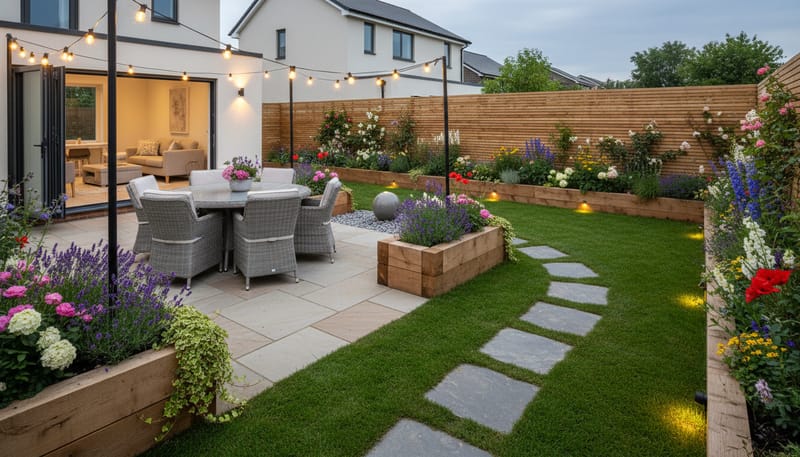
What Your Developer Provides
Volume house builders across the UK — including Barratt Homes, Taylor Wimpey, Persimmon, Bellway, and Redrow — deliver a functional outdoor space that gives you a genuine head start. Understanding exactly what is included helps you budget accurately and prioritise the improvements that matter most to your household.
- Turfed rear lawn: Utility-grade turf laid over a layer of imported topsoil, providing an even green surface from move-in day.
- Boundary fencing: Typically 1.8 m close-board timber panels between neighbouring properties, offering privacy and a consistent finish across the development.
- Starter patio: A concrete block-paved or slabbed area extending 2–3 m from the rear elevation, sized for a small table and chairs.
- Side-access path: A paved route connecting front and rear gardens, usually 600–900 mm wide.
- Front garden landscaping: Turfed areas, a paved driveway, and sometimes ornamental shrub planting designed to create an attractive streetscape across the development.
- External tap: Most new builds include at least one outdoor cold-water tap, usually on the rear or side elevation.
- External power socket: Higher-specification plots increasingly include a weatherproof outdoor socket to the rear.
Some developers offer garden upgrade packages at reservation stage — extended patios, premium paving, additional planting beds, or a basic lighting scheme. These are worth considering because the work is finished before you move in, and the cost can often be added to the mortgage. Always ask for the full specification and compare like-for-like with independent quotes. For more on making the most of your developer options, see our guide to personalising your new build home.
New Build Soil Quality & Improvement
During construction, heavy machinery compacts the subsoil across the plot. The topsoil is stripped before building work begins and replaced afterwards, but the underlying ground will be denser than in an established garden. This is entirely normal — not a defect — and is something every new build garden goes through. With straightforward preparation, your soil will support healthy plant growth within a single season.
Common signs of compacted soil include surface pooling after rain, slow grass establishment, and shallow root growth. Clay-heavy regions — the Midlands, parts of the South East, and Yorkshire — tend to show this more than free-draining sandy soils in East Anglia and the South West.
Steps to Improve New Build Soil
- Test your soil pH — a £5–£15 kit from any garden centre tells you whether it is acidic, neutral, or alkaline, guiding plant choice.
- Aerate compacted areas — push a garden fork to its full depth every 150 mm across affected zones, or hire a mechanical aerator for £40–£70 per day from HSS or Jewson.
- Add organic matter — work 2–4 cubic metres of well-rotted compost or manure into the top 200–300 mm. Bulk bags cost roughly £60–£160 delivered.
- Apply horticultural grit to heavy clay — mixing sharp sand or fine gravel with organic matter breaks up clay structure and improves drainage.
- Mulch all bare soil — a 50–75 mm layer of bark mulch suppresses weeds, retains moisture, and feeds the soil as it breaks down.
- Let nature help — earthworm populations increase rapidly once organic matter is present, naturally aerating and enriching the soil over the following months.
Landscaping Cost Breakdown
Before you start any project, it helps to understand the typical cost per square metre for each major garden element. The table below covers materials and professional installation where relevant, based on average UK prices for 2026.
| Element | Cost Per m² (Supply Only) | Cost Per m² (Supply & Install) | Notes |
|---|---|---|---|
| Patio — concrete slabs | £15–£30 | £50–£75 | Budget-friendly; wide colour range |
| Patio — porcelain | £28–£55 | £80–£120 | Low maintenance; frost-proof |
| Patio — natural stone | £18–£50 | £70–£110 | Unique character; weathers over time |
| Lawn care (first year) | £1–£3 | — | Feed, seed, and weed treatment per m² |
| Planting (budget borders) | £8–£18 | £20–£40 | Small pots and plug plants |
| Planting (premium borders) | £25–£60 | £50–£100 | Larger specimens in 5–10 L pots |
| Fencing (close-board panels) | £20–£35 per panel | £40–£65 per panel | Standard 1.8 m × 1.8 m panels |
| Garden lighting (solar) | £3–£15 per unit | — | No wiring; push-in or stake |
| Garden lighting (low-voltage) | £25–£60 per fitting | £40–£80 per fitting | 12 V system; DIY-friendly |
| Decorative gravel | £5–£12 per bulk bag | £15–£25 | Per m² at 40 mm depth over membrane |
Patio & Hard Landscaping Options
The patio is the social hub of any garden — the spot where you dine, entertain, and unwind. Your developer provides a starter area, but upgrading or extending it is routinely the single most impactful improvement you can make. The UK market offers materials at every price point, so the right choice depends on your budget, style preferences, and appetite for ongoing maintenance.
| Material | Cost Per m² (Installed) | Maintenance | Lifespan | Best For |
|---|---|---|---|---|
| Concrete slabs | £50–£75 | Annual pressure wash | 15–25 years | Tight budgets; quick installation |
| Porcelain paving | £80–£120 | Occasional soapy wash | 30+ years | Low maintenance; contemporary look |
| Indian sandstone | £70–£110 | Annual clean; optional sealant | 25–40 years | Natural character; warm tones |
| Resin-bound gravel | £60–£90 | Occasional sweep/jet wash | 15–25 years | Permeable; seamless finish |
| Block paving | £60–£90 | Re-sand joints every 2–3 years | 20–30 years | Pattern flexibility; permeable options |
| Composite decking | £100–£180 | Occasional wash | 25+ years | Raised areas; timber look, no rot |
| Timber decking (softwood) | £55–£90 | Annual oil or stain | 10–15 years | Budget decking; natural feel |
Porcelain paving from Marshalls (Symphony range from ~£45/m²) and Bradstone (Aspero range from ~£40/m²) has become the most popular premium choice thanks to its near-zero maintenance. For natural stone lovers, calibrated Indian sandstone in Raj Green or Kandla Grey offers beautiful variation at a lower material cost — though it benefits from sealing (£30–£50 per 5 L tin). Budget porcelain from B&Q and Wickes starts from approximately £28/m² and performs well for the price.
For composite decking, Millboard remains the premium UK benchmark at £80–£110/m² for materials alone, while Trex offers strong mid-range performance at £55–£80/m². Budget composite from Cladco (from ~£30/m²) provides good value. Any deck platform over 300 mm above ground level may require Building Regulations approval — always check with your local authority.
Lawn Care in the First Year
Your developer-laid turf provides an instant green lawn, which is a genuine advantage of buying new. With the right attention during the first twelve months, this turf roots deeply and thickens into a lawn you will enjoy for years. Neglect it in year one, however, and patchy growth and weeds can take hold.
Quick Wins for a Healthy Lawn
- Water daily for 2–4 weeks: Soak through to the soil beneath during dry weather; early morning or evening is most effective.
- First mow at 50–75 mm: Wait until the turf has rooted (gently tug a corner to check), then mow on a high setting, removing no more than one-third of the height.
- Feed three times a year: Spring/summer feed (high nitrogen) in April and June, autumn/winter feed (high potassium) in October. Brands like Miracle-Gro EverGreen cost £10–£25 per application.
- Overseed thin patches: Scatter quality lawn seed (Johnsons or Rolawn, £8–£20/kg) over bare spots in spring or early autumn and keep moist.
- Aerate in autumn: Push a garden fork in every 150 mm to relieve compaction and help water reach the roots.
- Weed by hand early: Pull broadleaf weeds before they set seed; spot-treat with a selective weedkiller if needed.
- Keep mower blades sharp: Blunt blades tear grass, leaving brown tips and inviting disease.
- Avoid heavy use for 6 weeks: Let the turf knit into the soil before heavy foot traffic or play.
Lawn Alternatives
If mowing every week is not for you, or if your garden has deep shade where grass struggles, several alternatives deliver an attractive finish with far less upkeep.
| Alternative | Cost Per m² (Installed) | Maintenance | Best For | Drawbacks |
|---|---|---|---|---|
| Artificial grass | £55–£85 | Brush/rinse monthly | Small gardens; dog owners; shade | Heat in full sun; environmental concerns |
| Clover lawn | £2–£5 (seed) | Mow 3–4 times/year | Eco-conscious; pollinators | Not hard-wearing for heavy play |
| Chamomile lawn | £8–£15 (plugs) | Occasional trim | Small feature areas; fragrance | Slow to establish; prefers sun |
| Thyme lawn | £8–£15 (plugs) | Trim after flowering | Sunny, well-drained spots | Does not tolerate heavy foot traffic |
| Decorative gravel | £15–£25 | Top up every 2–3 years | Contemporary schemes; xeriscaping | Migrates; uncomfortable underfoot for children |
Fencing & Boundaries
Your developer installs boundary fencing that provides a clean, functional perimeter. There are many ways to enhance, personalise, or extend these boundaries to gain greater privacy, wind shelter, or visual interest — all without replacing what is already there.
Adding 300–600 mm trellis toppers (£10–£25 per 1.8 m panel from B&Q or Wickes) increases overall height and supports climbing plants. Staining panels with Cuprinol Garden Shades (~£25–£30 for 5 L, covering ~30 m²) or Ronseal Fence Life Plus (~£12–£18 for 5 L) transforms the backdrop for planting. Always check your development's covenants before increasing fence height; the general permitted development rule allows up to 2 m at the rear without planning permission.
| Fence Type | Cost Per Panel (1.8 m) | Lifespan | Privacy | Notes |
|---|---|---|---|---|
| Close-board (developer standard) | £25–£45 | 15–20 years | High | Solid; can be stained any colour |
| Lap panel | £18–£30 | 8–12 years | High | Budget option; less wind-resistant |
| Slatted contemporary | £40–£80 | 15–20 years | Medium | Modern horizontal look; partial screening |
| Composite fence panels | £60–£120 | 25+ years | High | Zero maintenance; uniform finish |
| Willow/hazel hurdle | £20–£40 | 5–8 years | Medium | Natural look; biodegradable |
| Native mixed hedge (per metre) | £5–£15 (bare root) | 50+ years | High (once mature) | Wildlife-rich; takes 3–5 years to fill |
| Laurel hedge (per metre) | £15–£35 | 50+ years | High | Evergreen; fast-growing; 2 trims/year |
Planting Beds & Borders
Planting is where a new build garden truly comes alive. Well-chosen plants deliver colour, fragrance, texture, and seasonal interest while softening hard landscaping and supporting wildlife. The beauty of planting is that you can start small and build up gradually — you do not need to fill every border in one go.
Aim for a layered structure: tall shrubs and grasses at the back, mid-height perennials in the middle, and low ground cover or bulbs at the front. Include at least 30 % evergreen plants so borders look furnished even in midwinter. For detailed guidance on personalising your interiors as well as your garden, see our article on new build kitchen design.
What to Plant by Season
- Spring (March–May): Plant container-grown perennials, shrubs, ornamental grasses, and summer bedding. Divide established clumps of hardy geraniums, hostas, and asters to fill gaps for free.
- Summer (June–August): Focus on watering and deadheading. Take softwood cuttings of lavender, rosemary, and hydrangea to propagate new plants at zero cost.
- Autumn (September–November): The prime season for planting trees, hedging, roses, and spring bulbs. Soil is warm, rainfall is increasing, and plants establish well before winter dormancy. A bag of 50 mixed daffodil bulbs costs £8–£15 and multiplies year after year.
- Winter (December–February): Order bare-root trees, hedging, and roses at 30–50 % less than container-grown equivalents. Plan and design next year's projects while the garden rests.
Reliable UK performers that earn their space in any new build border include Geranium 'Rozanne' (flowers May–November, ~£8–£12), Lavandula 'Hidcote' (~£4–£8), Hydrangea paniculata 'Limelight' (~£15–£25), Miscanthus sinensis 'Morning Light' (~£10–£15), Rosa 'Gertrude Jekyll' from David Austin (~£18–£28), and Photinia 'Red Robin' (~£12–£20). Buying small plants in 9 cm pots or plug plants is the most cost-effective route — they catch up surprisingly quickly.
Raised Beds
Raised beds solve the challenge of compacted new build soil by letting you fill them with fresh, nutrient-rich growing media. They also add structure to a flat garden, define zones, and make gardening more accessible by raising the working height.
- Timber sleepers: Pressure-treated softwood sleepers at £8–£15 each from B&Q or Wickes. A 1.8 m × 0.9 m bed, two sleepers high, costs roughly £60–£120 in materials.
- Corten steel planters: Develop a beautiful rust patina. Specialist suppliers price them at £150–£400 depending on size.
- Composite kits: Match composite decking; maintenance-free. Cladco kits from ~£80–£200.
- Brick or stone walls: The most permanent option at £80–£200 per linear metre including labour.
Fill beds with a 50:50 mix of topsoil and compost (~£50–£80 per m³ in bulk bags). A single 1.8 × 0.9 m bed provides enough room for salad leaves, herbs, tomatoes, courgettes, and strawberries through the growing season.
Garden Lighting
Lighting extends your garden's usable hours, enhances security, and transforms the mood after dark. A well-lit garden feels larger and more inviting, and the range of options in 2026 suits every budget.
- Solar path lights (£3–£15 each): Push into soil along paths and borders. Zero wiring, zero running cost.
- Solar festoon strings (£15–£35 for 10 m): Warm-white LEDs; ideal for dining areas and pergolas.
- Low-voltage 12 V systems (£120–£300 starter kit): Techmar and Lightpro offer plug-and-play kits with transformer, four to six fittings, and expandable connectors. Safe to install yourself.
- Mains-powered 240 V (£200–£500 circuit + fittings): Must be installed by a NICEIC, NAPIT, or ELECSA-registered electrician. Ideal for wall-mounted coach lights, recessed ground lights, and PIR security floods.
For a comprehensive approach to illuminating your home inside and out, see our guide to new build lighting design.
Water Features
Moving water adds sound, movement, and a focal point that draws the eye. Even a modest feature brings a garden to life and attracts wildlife within weeks.
- Self-contained fountain (£50–£200): Plug-and-play units from B&Q, Wickes, or Primrose. No plumbing; just a power source or solar panel.
- Wall-mounted water blade (£150–£500): Contemporary stainless-steel or corten blades that cascade water into a reservoir below.
- Wildlife pond (£30–£300): Even a sunken washing-up bowl attracts frogs and dragonflies. Use a butyl liner for larger ponds at £3–£6/m². Include sloping edges and native aquatic plants.
- Bubbling boulder (£100–£400): A drilled stone with a hidden reservoir — safe for gardens with small children, no open water.
Shed & Storage
New build homes rarely include a garden shed, yet outdoor storage is a practical necessity. Plan it into your design early to position it sensibly and keep it visually integrated.
A standard 6 × 4 ft (1.8 × 1.2 m) timber shed costs £250–£500 from B&Q, Wickes, Waltons, or Tiger Sheds. Larger 8 × 6 ft or 10 × 8 ft models run £400–£1,200. Secure bike stores from Asgard (steel, Sold Secure rated) cost £400–£800, while timber bike stores range from £200–£600. Wheelie bin enclosures tidy the front of the house for £100–£300. Under permitted development, sheds must be single-storey, no taller than 2.5 m if within 2 m of a boundary, and must not cover more than 50 % of the garden area.
Garden Paths
Paths connect zones, protect the lawn from foot traffic, and add structure to your layout. They can also be one of the most affordable improvements you make.
- Stepping stones through lawn (£3–£8 each): Simple concrete or sandstone rounds set flush with the grass for easy mowing.
- Gravel path over membrane (£15–£25/m²): Cost-effective and quick to install. Choose 10–20 mm angular gravel for stability underfoot.
- Block paving (£60–£90/m² installed): Matches a block-paved patio for a cohesive look.
- Porcelain planks (£80–£120/m² installed): Timber-effect porcelain creates a striking contemporary path.
Outdoor Dining
Creating a dedicated dining zone turns your garden into a genuine extension of your living space. Position it close to the kitchen for convenience, on a hard surface for stability, and with some form of overhead cover or shelter if budget allows.
A quality six-seater aluminium dining set costs £300–£900 from retailers like Argos, John Lewis, or Garden Trading. Rattan-effect sets range from £200–£700 and are weather-resistant. For cooking outdoors, a charcoal or gas barbecue runs £80–£500, while outdoor pizza ovens — from portable Ooni models at £250–£400 to built-in wood-fired designs at £1,000–£3,000 — have surged in popularity. A simple pergola or sail shade (£80–£300 for a basic structure) provides welcome shelter from sun and light rain, extending the season for outdoor dining from April through to October.
Children's Play Areas
If you have young children or are planning a family, weaving play into the garden design creates a space the whole household enjoys. The key is balancing play features with an attractive overall design so the garden works for adults too.
Child-Friendly Features
- Safety surfacing: Rubber bark mulch (£30–£60 per bulk bag, covering 3–4 m² at 75 mm depth) or rubber play tiles (£15–£30/m²) under climbing frames.
- Climbing frames and swings: TP Toys and Plum Play offer sets from £80 (simple swings) to £1,200 (multi-activity towers).
- Playhouses: Wooden models from £100–£500; spark imaginative play for years.
- Trampolines: Above-ground with enclosure £150–£500; in-ground (sunk into a pit) £400–£800 plus excavation — safer and far more attractive.
- Sandpits with lids: £30–£100; adored by toddlers and preschoolers.
- Chalkboard fence panel: A sheet of exterior chalkboard paint (~£15) on a section of fence creates an instant art wall.
- Mud kitchen: Build from old pallets or buy a kit for £40–£120; a favourite for sensory play.
- Visible sightlines: Position the play zone where it is visible from the kitchen window for easy supervision.
For older children, consider a basketball hoop (£30–£100), a slackline between posts (£20–£40), or a permanent cricket/football practice net (£50–£150). Growing sunflowers and vegetables together is a classic family gardening activity that costs almost nothing and provides genuine excitement through the season.
Low-Maintenance Ideas
Not everyone wants to spend weekends mowing, weeding, and pruning. A well-designed low-maintenance garden can be just as beautiful — it simply demands more thought at the planning stage to minimise recurring tasks.
Strategies That Cut Workload
- Increase hard landscaping: Porcelain paving (virtually zero maintenance) plus composite decking replaces large lawn areas.
- Mulch every border: A 50–75 mm layer of bark mulch (£60–£100/m³ bulk) suppresses weeds by 80–90 % and only needs topping up every 1–2 years.
- Choose naturally tidy plants: Pittosporum, Hebe, Carex 'Evergold', Bergenia, and Sarcococca need minimal pruning or deadheading.
- Install automated irrigation: Hozelock or Gardena drip kits (£30–£80) with a battery tap timer (£20–£40) water beds automatically.
- Use weed-suppressing membrane: Lay under gravel paths and around shrubs to prevent weed establishment.
- Opt for evergreen structure: A backbone of evergreens means the garden looks presentable year-round with no seasonal replanting.
- Artificial grass for pet areas: Saves mowing, eliminates muddy paws, and drains well if installed correctly.
- Self-binding gravel paths: Compact to a firm, weed-resistant surface and blend naturally into planting.
For broader guidance on keeping your whole property effortless, see our new build home maintenance checklist.
Wildlife-Friendly Additions
UK wildlife faces increasing pressure from habitat loss, and domestic gardens collectively represent a huge potential refuge. The wonderful thing about wildlife-friendly gardening is that it usually makes your garden more beautiful, not less.
Simple Steps for Wildlife
- Plant for pollinators: Lavender, Salvia, Verbena bonariensis, Sedum, Echinops, Nepeta, and single-flowered dahlias provide nectar and pollen from spring through autumn.
- Create a hedgehog highway: Cut a 130 mm square gap in the base of a fence panel so hedgehogs can travel between gardens.
- Install bird feeders and nest boxes: A feeding station costs £20–£50 to set up; nest boxes £8–£25 each, positioned 2 m+ high, facing north to east.
- Add a mini wildlife pond: Even a sunken container attracts frogs, newts, and dragonflies within a season. Include a sloping edge for safe access.
- Build a bug hotel: Stack logs, bamboo canes, pine cones, and old bricks in a quiet corner for solitary bees, ladybirds, and beetles.
- Leave a wild patch: Allow a small section of grass and native wildflowers to grow long — it costs nothing and supports dozens of species.
- Plant berry-bearing shrubs: Pyracantha, Cotoneaster, and Sorbus provide natural food for birds in autumn and winter.
- Avoid pesticides where possible: Encourage natural predators like ladybirds, hoverflies, and hedgehogs to manage pests organically.
Front Garden & Kerb Appeal
The front garden is the first thing visitors and future buyers see, yet many homeowners focus exclusively on the back. A few targeted improvements make a disproportionate difference to your home's street presence.
- Repaint or replace the front door: A bold colour like Farrow & Ball 'Hague Blue' or 'Railings' lifts the entire elevation for under £50.
- Add planters either side of the entrance: A pair of galvanised or glazed pots planted with topiary box balls or standard bay trees costs £60–£150 and creates an instant focal point.
- Edge the lawn crisply: A half-moon edger (£8–£15) creates sharp, defined lawn edges that make the whole garden look cared for.
- Upgrade the house number: A modern brushed-steel or slate house number plaque costs £15–£40 and adds a finishing touch.
- Plant evergreen structure: Low hedging (Buxus or Euonymus) along the path, a specimen shrub by the door, and seasonal bulbs in borders provide year-round interest.
- Install a solar path light set: Illuminating the path to the front door improves safety and looks welcoming after dark. A set of 4–6 costs £20–£40.
Essential Tools
You do not need a shed full of specialist equipment to get started. The following covers 90 % of new build garden tasks and represents a one-off investment of roughly £150–£350.
- Spade and fork: The foundation tools for digging, aerating, and planting. Budget £15–£30 each; Spear & Jackson and Bulldog are reliable UK brands.
- Hand trowel and fork: For planting, weeding, and working in tight spaces. £5–£15 per set.
- Secateurs: Felco or Darlac for clean cuts on stems up to 15 mm. £10–£30.
- Lawn mower: A cordless electric mower suits most new build lawns. Bosch and Flymo models cost £100–£250.
- Garden rake: For levelling soil, spreading mulch, and clearing leaves. £10–£20.
- Half-moon edger: Creates crisp lawn edges. £8–£15.
- Wheelbarrow: For moving soil, compost, gravel, and plants. £30–£70.
- Hose and spray gun: A 30 m hose reel with connectors costs £25–£50; essential for watering new turf and planting.
- Loppers: For cutting thicker branches up to 40 mm. £15–£30.
- Spirit level and tape measure: Indispensable when building raised beds, laying paths, or checking patio levels. £10–£20.
Phased Garden Plan
Trying to do everything at once is overwhelming and expensive. A phased approach lets you spread costs, learn what works in your specific garden, and adjust plans as your household's needs evolve.
- Year 1 — Foundation: Improve soil across all planting beds. Feed and care for the developer lawn. Stain fencing. Add solar lighting and a basic shed. Plant a few key shrubs and climbers against boundaries. Budget: £500–£1,500.
- Year 2 — Structure: Upgrade or extend the patio. Build raised beds. Install a low-voltage lighting system. Add a garden path. Plant remaining borders. Budget: £1,500–£4,000.
- Year 3 — Finishing touches: Add a water feature, outdoor dining furniture, children's play equipment, or a garden building. Commission mature specimen plants for instant impact. Budget: £1,000–£5,000+.
This three-year approach means your garden improves visibly every season without any single year requiring a massive outlay. It also lets you observe sunlight patterns, prevailing wind, and drainage before committing to permanent features.
Budget Tier Comparison
The table below shows what is realistic at each spending level for a typical three or four-bedroom new build rear garden in the UK in 2026. All figures include materials and professional labour where noted.
| Budget Tier | Total Spend | What You Get | Professional Help Needed? |
|---|---|---|---|
| Starter | £500 | Soil improvement & mulch for borders. Lawn feed programme. Fence staining. 10–15 budget plants. Solar lighting. Basic garden furniture. | No — all DIY |
| Confident DIY | £2,000 | Everything above plus timber raised beds, a small timber shed, trellis & climbers on boundaries, 25–35 plants, gravel path, bin store. | Optional for shed base |
| Mid-Range | £5,000 | Upgraded 15–20 m² patio (Indian sandstone or porcelain), low-voltage lighting, quality shed, comprehensive planting scheme, garden path, outdoor dining set. | Yes — landscaper for patio |
| Premium | £10,000+ | Professional garden design. Large porcelain patio with steps. Composite decking zone. Specimen trees & mature planting. Mains-powered lighting. Water feature. Automated irrigation. Premium garden building or summerhouse. | Yes — designer + landscaper + electrician |
A well-designed garden adds measurable value to your property. Estate agents consistently report that quality landscaping can add 5–15 % to a home's value — on a £350,000 new build, that represents £17,500–£52,500 of additional value. For a deeper look at the investment potential of new builds, see our guide to new builds as investments.
Common Mistakes to Avoid
Even experienced gardeners can trip up in a new build setting. These are the pitfalls seen most often — and all of them are easy to avoid with a little forethought.
- Planting too early in compacted soil: Invest time in soil preparation first; plants in well-prepared ground outperform expensive specimens in poor soil every time.
- Ignoring the first-year lawn programme: Newly laid turf needs consistent watering and feeding to root properly. Neglect now means patchy grass later.
- Choosing plants for the wrong conditions: Sun-lovers in shade and moisture-lovers in dry spots will struggle regardless of how much you spend. Test your soil and observe light patterns before buying.
- Underestimating patio size: A table and six chairs with room to pull out seats needs at least 4 m × 3 m. Measure your furniture before finalising the patio footprint.
- Forgetting about drainage: Hard landscaping increases run-off. Plan permeable surfaces or drainage channels to prevent waterlogging in planted areas.
- Skipping the membrane under gravel: Without weed-suppressing membrane, gravel paths and beds become weeding nightmares within a season.
- Not checking covenants: New build developments often have covenants covering fence heights, outbuildings, and even front-garden changes. Read your deeds before building.
- Buying everything from one place: Compare prices across B&Q, Wickes, Screwfix, local garden centres, and online specialists — savings of 20–40 % on identical products are common.
Final Thoughts
Your new build garden is one of the most exciting blank canvases you will ever work with. Unlike an older property, there are no overgrown shrubs to clear, no crumbling paths to dig up, and no inherited mistakes to undo. Your developer provides a solid, functional starting point — a green lawn, secure boundaries, and a basic patio — and from there the direction is entirely yours.
You do not need to do everything at once. Some of the most beautiful gardens in the UK were created gradually over several years, with each season bringing a new project, a new border, or a new feature. Start with the essentials — good soil, a healthy lawn, and a clear idea of how you want to use the space — then add elements as inspiration strikes and budget allows. Whether you invest £500 or £10,000+, the time you spend designing and nurturing your garden repays you many times over in daily pleasure, family memories, and genuine relaxation.
The UK climate supports an extraordinary range of plants, from Mediterranean lavender and olive trees to lush woodland ferns and spectacular autumn acers. Your new build plot, however modest in size, can become a place of real beauty, a sanctuary for wildlife, a playground for children, and a retreat at the end of a busy day. Take your time, enjoy the process, and remember that every great garden started exactly where yours is now — with bare earth and a vision.