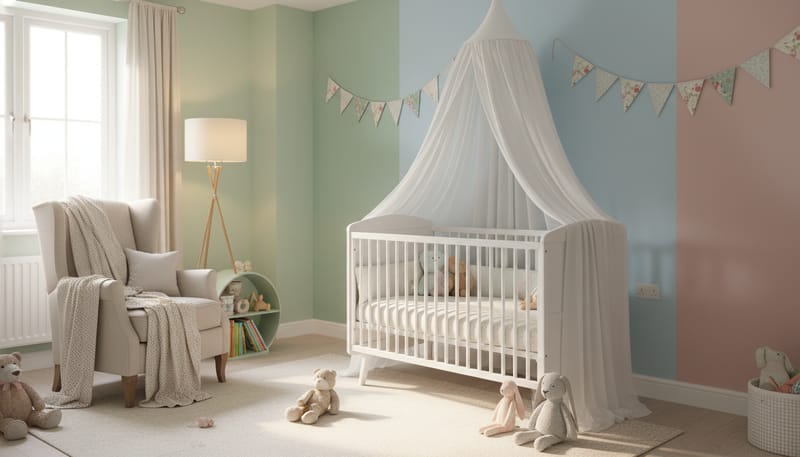
Planning a Nursery That Grows With Your Child
The smartest approach to children's room design is to think long-term from day one. A nursery set up with adaptability in mind can transition smoothly through toddlerhood, the primary school years, and beyond — saving you hundreds of pounds and days of redecorating. New build homes are particularly well suited to this approach because the rooms are clean, modern, and free from the quirks of older properties.
Before you order a single item of furniture or pick up a paint brush, work through this planning checklist. It will save you money, time, and the frustration of buying items that need replacing within a year.
What to Plan Before Baby Arrives
- Room dimensions: Measure the nursery precisely, including window and door positions, radiator location, and built-in wardrobe footprint — new build bedrooms typically range from 6.5 m² to 9 m² for a second or third bedroom
- Heating type: Identify whether your new build has radiators, underfloor heating, or a heat pump system — this affects furniture placement and temperature management
- Plaster drying time: If your home is newly completed, the walls need 9 to 12 months to fully dry before wallpapering; use breathable paint during the drying-out period
- Electrical sockets: Count the sockets and note their positions — you may need an extension lead for a baby monitor, night light, and white noise machine
- Window orientation: A south-facing nursery will need robust blackout solutions; a north-facing room stays cooler and darker naturally
- Cot bed vs standard cot: Decide now whether you want a convertible cot bed that lasts until age four or five, or a standard cot you will replace sooner
- Budget ceiling: Set a firm total budget before browsing — nursery spending can escalate quickly when emotions run high
- Future children: If you plan more children, invest in quality neutral pieces that will serve multiple babies
Cot Selection, Placement, and the Bed Transition Timeline
The cot is the single most important purchase for any nursery. Your choice here affects safety, sleep quality, and how much you spend over the next five years. A standard cot suits babies from birth to around two years. A cot bed converts into a toddler bed and typically lasts until age four or five, offering considerably better long-term value.
Position the cot away from windows (to avoid draughts, direct sunlight, and blind cord hazards), away from radiators (to prevent overheating), and away from wall shelves that could fall. In a new build nursery, the best position is usually against the wall opposite the window, where the temperature is most consistent.
The table below maps out the full bed transition from birth to the teenage years, including the type of bed, typical cost, and key room considerations at each stage.
| Age Range | Bed Type | Typical UK Cost | Room Considerations |
|---|---|---|---|
| 0–6 months | Moses basket or bedside crib | £50–£200 | Placed beside parents' bed for the first months; compact footprint |
| 0–2 years | Standard cot | £80–£250 | Three mattress height positions; 60 × 120 cm mattress; needs replacing at around 2 years |
| 0–5 years | Convertible cot bed | £130–£800 | Converts to toddler bed by removing side panel; 70 × 140 cm mattress; best long-term value |
| 2–5 years | Toddler bed or converted cot bed | £70–£200 (standalone) | Low height for safe independent access; add a bed guard rail (£15–£30) for the first months |
| 4–10 years | Single bed (90 × 190 cm) | £100–£400 | Choose a simple, timeless frame; consider under-bed storage drawers if floor space is limited |
| 4–10 years | Cabin or mid-sleeper bed | £170–£650 | Raised mattress with desk, storage, or play den underneath; minimum ceiling height 2.4 m |
| 6+ years | Bunk bed (shared rooms) | £200–£700 | Top bunk for ages 6+ only; must meet BS EN 747; guard rails at least 26 cm above mattress |
| 10+ years | High sleeper or loft bed | £300–£700 | Full desk and wardrobe beneath; check child can sit upright without hitting the ceiling |
| 12+ years | Small double (120 × 190 cm) or double (135 × 190 cm) | £200–£600 | Future-proof for teenage years and beyond; ensure the room width accommodates the footprint |
Nursery Furniture Essentials and Costs
Beyond the cot, a nursery needs just a handful of well-chosen items to function beautifully. Resist the urge to overfill the room — the most calming nurseries are those with clear floor space and minimal clutter. The table below lists every essential item, with budget, mid-range, and premium options alongside real UK costs.
| Item | Budget Option | Mid-Range Option | Premium Option |
|---|---|---|---|
| Cot bed | IKEA Sundvik — £130 | Snuz SnuzKot Skandi — £350–£400 | Silver Cross Nostalgia — £700–£800 |
| Cot mattress | Mothercare Airflow Pocket Spring — £80–£100 | Little Green Sheep Natural — £170–£200 | Little Green Sheep Twist Natural — £200–£250 |
| Changing unit | Topper for existing drawers — £40–£70 | Mamas & Papas Atlas dresser changer — £350–£400 | Silver Cross Coastline dresser — £500–£650 |
| Chest of drawers | IKEA Hemnes 6-drawer — £200 | Mamas & Papas Melfi — £300–£400 | Silver Cross Bromley — £450–£550 |
| Nursing chair | IKEA Poäng + sheepskin — £100 | Tutti Bambini Oscar rocking chair — £200–£250 | Nursery Works Sleepytime Rocker — £600–£800 |
| Blackout blind (per window) | Tommee Tippee portable — £25–£35 | Made-to-measure roller blind — £50–£120 | Bespoke lined curtains + blind — £200–£400 |
| Rug | IKEA Stoense — £40–£65 | Lorena Canals washable — £100–£200 | The White Company nursery rug — £200–£350 |
| Baby monitor | BT Audio Baby Monitor 400 — £30–£40 | BT Smart Video Monitor — £100–£150 | Nanit Pro camera — £250–£300 |
Changing Station Options
You have three practical approaches to the changing area, each with different trade-offs in terms of space, cost, and longevity.
- Standalone changing table: A dedicated unit at the correct height (85–95 cm) with storage shelves beneath. Brands like IKEA (Sundvik at £95) and Mamas & Papas (Atlas at £350) offer excellent options. Takes up floor space but provides the best ergonomics.
- Changing topper on a chest of drawers: A removable topper (Snuz at £40 or Tutti Bambini at £60) turns any suitable dresser into a dual-purpose changing unit. The most space-efficient option, and the drawers continue to serve long after nappy changes end.
- Wall-mounted fold-down changer: Ideal for very compact nurseries at £80–£150 from brands like Bybo. Folds flat against the wall when not in use, freeing precious floor space entirely.
Safety Standards and Regulations
New build homes are constructed to the latest Building Regulations, giving you a strong safety foundation. However, there are still nursery-specific precautions every parent must address. Work through this safety checklist before your baby arrives — and revisit it as your child moves through each developmental stage.
New Build Nursery Safety Checklist
- Window restrictors: Verify all upper-floor windows have restrictors limiting the opening to 100 mm — required by Building Regulations but worth confirming in person
- Blind cords: Replace any blinds with looped cords immediately — looped cords are a strangulation risk; cordless or spring-loaded blinds are the only safe option
- Socket covers: Fit covers on all unused sockets (approximately £3–£5 for a pack of twelve); most new builds have shuttered sockets, but check yours
- Furniture anchoring: Secure every freestanding item over 60 cm tall to the wall using anti-tip straps (£5–£10 per pair); use plasterboard fixings or locate timber studs with a stud finder (£10–£20)
- Smoke alarms: Test the interconnected smoke alarm system monthly by pressing the test button — new builds have these fitted as standard
- Carbon monoxide detector: Confirm a CO detector is installed if your home has a gas boiler; most new builds include one as standard
- Cot mattress fit: The gap between the mattress edge and cot sides must be less than 3 cm on all sides to prevent entrapment
- Radiator temperature: Set the nursery TRV (thermostatic radiator valve) lower than other rooms; if you have underfloor heating, check individual zone controls
- Room thermometer: Install a room thermometer (£5–£15) and maintain the nursery between 16 °C and 20 °C as recommended by The Lullaby Trust
- Stair gate readiness: Identify where stair gates will be needed once your baby becomes mobile; new build staircases with open spindles may require a specialist gate
For a broader look at equipping your new build with smart safety technology, see our guide to smart home features in new builds.
Wall Colours and VOC-Free Paints
Choosing nursery paint involves two decisions: the colour and the chemistry. VOCs (volatile organic compounds) are chemicals released as paint dries. They can irritate airways, and in a small bedroom where a baby sleeps up to 16 hours a day, minimising exposure matters. The good news is that most premium UK paint brands now offer low-VOC or zero-VOC formulations as standard.
The table below compares the leading UK paint brands suitable for nurseries, including their VOC levels, approximate cost, and the most popular nursery shades each brand offers.
| Brand | VOC Level | Price per Litre (approx.) | Popular Nursery Shades | Finish Options |
|---|---|---|---|---|
| Farrow & Ball | Low VOC (all finishes) | £50–£58 | Mizzle, Skylight, Setting Plaster, Elephants Breath | Modern Emulsion, Estate Emulsion, Estate Eggshell |
| Little Greene | Low VOC (most finishes) | £45–£53 | Sage Green, Rolling Fog, Pale Wedgwood, Slaked Lime | Absolute Matt, Intelligent Matt, Intelligent Eggshell |
| Lick | Low VOC (all finishes) | £30–£38 | Green 02, Pink 02, Blue 02, White 03 | Matt, Eggshell |
| Dulux Easycare | Low VOC | £18–£24 | Willow Tree, Coastal Grey, Soft Truffle, Natural Calico | Matt, Soft Sheen |
| Crown Breatheasy | Zero VOC (99.9% solvent free) | £15–£20 | Mellow Sage, Stepping Stone, Milk White | Matt, Mid Sheen |
| Earthborn | Virtually zero VOC | £38–£45 | Rosie Posie, Straw, Gregory's Den, Jemima | Claypaint (breathable), Lifestyle (wipeable) |
| Edward Bulmer | Zero VOC (natural pigments) | £48–£55 | Invisible Green, Jonquil, Pebble | Matt, Eggshell |
If your new build is still in its drying-out period (first 9–12 months), use a breathable paint on fresh plaster. Trade matt emulsion or Earthborn Claypaint allows moisture to escape without trapping it behind a film. For detailed guidance on painting new plaster, see our post on colour schemes for new build homes.
Colour Palette Ideas for 2026
- Sage green and warm white: The most popular nursery palette in the UK — calming, gender-neutral, and pairs beautifully with natural wood furniture; try Farrow & Ball Mizzle or Dulux Willow Tree
- Warm clay and soft terracotta: Creates a cocooning, nurturing atmosphere that works especially well in south-facing rooms; Farrow & Ball Setting Plaster or Lick Pink 02 are excellent starting points
- Pale blue-grey and cloud white: Serene and airy, ideal for east-facing nurseries that catch warm morning light; Farrow & Ball Skylight or Little Greene Pale Wedgwood
- Oat and mushroom neutrals: Ultra-soft warm neutrals let colourful toys, books, and artwork become the focal points; Farrow & Ball Elephants Breath or Little Greene Rolling Fog
- Soft green and peach: A fresh, modern combination that feels uplifting without being overstimulating; Lick Green 02 with accents in Lick Pink 03
- Navy feature wall with white: One deep navy wall behind the cot creates drama and cosiness while white on the remaining three walls keeps the room bright; Little Greene Basalt with Slaked Lime
- Dusky pink and natural linen: Sophisticated and warm, moving far beyond traditional baby pink territory; Edward Bulmer Jonquil Rose paired with a warm off-white
- All-white with natural textures: A Scandinavian-minimal approach where colour comes from natural wood, rattan, plants, and textiles rather than from the walls; Crown Breatheasy Milk White throughout
Flooring: Soft, Practical, and Safe
New build homes are typically fitted with either carpet or laminate/LVT flooring in bedrooms, depending on the developer's specification. Both have advantages for children's rooms, and the right choice depends on the child's age and your priorities around hygiene, warmth, and noise reduction.
| Flooring Type | Best For | Pros | Cons | Cost to Add or Upgrade |
|---|---|---|---|---|
| Carpet (developer standard) | Nurseries, toddler rooms | Warm, soft for crawling and falls, absorbs sound | Stains easily, harbours dust mites, hard to deep clean | Usually included by developer |
| Carpet (upgraded, stain-resistant) | All children's ages | Brands like Stainaway or Abingdon offer bleach-cleanable fibres | Higher initial cost than builder-grade | £15–£30 per m² fitted |
| Laminate | Children 5+, teens | Easy to wipe clean, durable, good for allergy sufferers | Cold underfoot, noisy, hard surface for falls | £12–£25 per m² fitted |
| LVT (luxury vinyl tile) | All ages | Waterproof, warm, quieter than laminate, scratch-resistant | Higher cost than basic laminate | £25–£50 per m² fitted |
| Engineered wood | Older children, teens | Natural beauty, can be refinished, timeless look | Scratches easily, expensive, noisy without underlay | £40–£70 per m² fitted |
| Cork | Nurseries, playrooms | Naturally warm, cushioned, hypoallergenic, sound-absorbing | Can dent, limited style range, needs sealing | £30–£50 per m² fitted |
Whatever the base flooring, add a generous washable rug in the play area. Lorena Canals (£100–£200) makes machine-washable rugs specifically designed for children's rooms. For hard floors in nurseries, interlocking foam play mats (£15–£40 for a set) provide cushioning for crawling babies and can be removed once the child is older. For broader advice on new build flooring, see our guide to decorating a new build home.
Lighting: Blackout Solutions and Night Lights
Sleep is everything in a nursery, and controlling light is a critical part of healthy sleep patterns. New build windows are often larger than those in older homes — wonderful for daytime brightness, but challenging when your baby needs to nap at 2 pm in June and the sun does not set until after 9 pm.
Blackout Solutions Compared
- Made-to-measure roller blind: The most effective permanent solution, fitted within the window recess with minimal light gaps; suppliers like Blinds2Go and English Blinds offer them from £50–£120 per window
- Blackout-lined curtains: Floor-length curtains with a blackout lining; IKEA Majgull (£30–£50) or John Lewis made-to-measure (£100–£250); layering curtains over a blackout blind provides the ultimate darkness
- Portable suction-cup blind: Tommee Tippee Sleeptime (£25–£35) or Gro Anywhere Blind (£20–£30); attaches directly to glass with no drilling — perfect for travel or as a temporary solution
- Blackout window film: Self-adhesive film applied directly to the glass; cheap at £8–£15 per window but blocks light entirely with no option to let light in during the day
- Combined approach: A recess-fitted blackout roller blind for total darkness, plus sheer voile curtains for diffused daytime light and a softer aesthetic — the most versatile and attractive arrangement overall
Night Lights
A dim, warm-toned night light helps during feeds without fully waking you or the baby. Choose one with a red or amber tone — blue-white light suppresses melatonin production and disrupts sleep. The Tommee Tippee Groegg2 (£15–£20) doubles as a room thermometer with a colour-changing display. The VAVA Night Light (£18–£25) is rechargeable, dimmable, and has a warm amber setting ideal for nurseries.
Temperature Regulation in New Build Nurseries
New builds are extremely well insulated, which is excellent for energy bills but can make bedrooms warmer than ideal for baby sleep. The Lullaby Trust recommends a nursery temperature of 16 °C to 20 °C. In a well-insulated new build — particularly one with underfloor heating — maintaining the lower end of that range requires deliberate management.
- Set the nursery TRV lower: Turn the thermostatic radiator valve on the nursery radiator to a lower setting than other rooms — typically position 2 or 2.5 rather than 3
- Use zone controls for underfloor heating: Most new build UFH systems allow room-by-room temperature settings; set the nursery zone to 18 °C and monitor with a separate room thermometer
- Ventilate daily: Open the nursery window for 15–20 minutes each morning to refresh the air, especially during the drying-out period when new build walls release moisture
- Choose appropriate bedding: Use sleeping bags with the correct tog rating for the room temperature rather than loose blankets; a 1.0 tog bag suits rooms at 20–24 °C, while a 2.5 tog bag suits 16–20 °C
- Keep the cot away from heat sources: Position the cot at least 50 cm from radiators, underfloor heating vents, and direct sunlight through windows
For more on managing heating efficiently in your new build, read our guide to heat pumps in new build homes.
Storage Solutions by Age
Children accumulate belongings at an astonishing rate, and what they need access to changes dramatically as they grow. The most effective storage systems adapt with each stage rather than requiring wholesale replacement every few years.
- Newborn (0–12 months): Chest of drawers for clothes and muslins, open baskets for nappies and changing supplies, under-cot storage boxes for bulk items, over-door organiser for small frequently used items such as bibs, dummies, and thermometers
- Toddler (1–3 years): Low open shelving at child height (IKEA Kallax laid sideways at £30–£55), labelled toy bins they can access independently, forward-facing book slings (GLTC Canvas Book Sling at £30–£45), a low coat hook by the door for their jacket
- Pre-school (3–5 years): Art supply caddy or trolley (IKEA Råskog at £25), dress-up storage with hooks and a low rail, construction toy bins for Duplo and LEGO, puzzles and board games on accessible shelves
- Primary school (5–10 years): Desk with drawers for stationery, a bookshelf for a growing book collection, under-bed drawers for seasonal clothes, a pinboard or magnetic board for school timetables and artwork display
- Pre-teen (10–12 years): Full-height bookcase, wardrobe with internal organisers, desk with cable management for a laptop, display shelves for collections and personal interests
- Teenager (13+ years): Full wardrobe system with hanging and shelving, a large desk with multiple power points, a bedside charging station, lockable storage for personal items, and a mirror area for getting ready
Toy Storage Systems
The most effective toy storage is visible, accessible, and easy to tidy. The IKEA Trofast system (frames from £30, bins from £3 each) remains the UK's most popular children's storage solution — the removable bins make tidying intuitive for children and are easy to label with pictures or words. For a more premium aesthetic, the Great Little Trading Co offers canvas storage cubes, stackable toy boxes, and personalised toy chests from £15 to £80.
Implement a toy rotation system: store two-thirds of toys out of sight in labelled boxes and rotate the available selection every two to four weeks. This reduces visual clutter, keeps toys feeling fresh and exciting, and makes daily tidying far more manageable.
Montessori-Inspired Room Design
Montessori principles translate beautifully into new build children's rooms, where the clean modern architecture provides the perfect canvas. The core idea is a room designed from the child's perspective — everything accessible, nothing overwhelming, and the space encouraging independence rather than reliance on adults.
Key Montessori Design Principles
- Floor bed: A mattress on a low frame or directly on the floor lets toddlers get in and out independently; purpose-built Montessori house frame beds cost £100–£300 from UK sellers on Etsy and brands like WoodandRoom
- Child-height mirrors: A shatterproof acrylic mirror mounted at baby or toddler height supports self-recognition and sensory development; place near the floor bed with a pull-up bar for pre-walkers
- Open, low shelving: Five to eight carefully chosen activities displayed on low open shelves with clear spacing between each item; rotate materials every one to two weeks to maintain engagement
- Natural materials: Wooden toys, cotton textiles, wicker baskets, and wool rugs rather than plastic; natural materials are more tactile, more durable, and more visually calming
- Muted colour palette: Soft sage, warm cream, and natural wood tones; the room should feel calm rather than stimulating — the activities themselves provide intellectual engagement
- Real-world images: Art prints of animals, plants, and nature rather than cartoon characters; framed photographs and botanical prints support vocabulary development and real-world connection
- Independence stations: A low hook for their coat, a small basket with their shoes, a step stool in the bathroom — every opportunity for the child to say "I can do it myself"
- Minimal and uncluttered: A Montessori room deliberately limits visible items; if the shelves look slightly empty, you are probably getting it exactly right
Toddler Room Transition (18 Months to 3 Years)
The move from nursery to toddler room typically happens when your child outgrows the cot or begins climbing out — usually between 18 months and 3 years. If you chose adaptable furniture and a neutral colour scheme from the start, this transition can be seamless and inexpensive.
- Convert the cot bed: Remove the side panel to create a toddler bed; add a removable bed guard rail (£15–£30 from BabyDan or Lindam) for the first few months until your child is confident
- Repurpose the changing area: Remove the changing topper from the dresser; the surface becomes a display area for toys or a lamp, while the drawers continue as clothing storage
- Lower the accessible storage: Move toy storage and book displays down to toddler height; open bins and forward-facing book slings encourage independent play and reading
- Add a small table and chairs: A child-height table for drawing, puzzles, and snacks; IKEA Lätt table and chairs (£20) or the GLTC Junior Table (£80–£120)
- Update the wall art: Swap newborn mobiles for age-appropriate prints, removable wall decals, or a height chart; keep the base wall colour if it still works well
- Reassess safety: As mobility increases, recheck furniture anchoring, socket covers, window restrictors, and blind cord safety; add cupboard locks if needed
The nursing chair naturally becomes a reading nook. Add a book sling, a reading lamp, and a cosy throw to create a bedtime story corner that encourages a love of reading from an early age.
Children's Bedroom Design (Ages 5–10)
Starting school introduces new requirements. The bedroom must now accommodate school uniform storage, a growing book collection, homework space, and display areas for artwork and certificates — all while remaining a comfortable, personal retreat.
- Bed: A standard UK single (90 × 190 cm) replaces the toddler bed; choose a timeless frame in solid wood or metal — the IKEA Sniglar (£60) or GLTC Classic Single with trundle (£350–£450) are both excellent
- Desk area: A small desk near the window for homework; the IKEA Flisat (£60) suits younger children with its adjustable tilting top, while the IKEA Micke (£70–£90) suits older primary children with cable management and drawers
- Bookshelf: Reading takes off during these years; a dedicated bookcase or series of wall-mounted shelves ensures books are accessible and displayed invitingly
- Display space: A pinboard, magnetic strip, or clip rail for rotating displays of school artwork, certificates, and personal creations; children take real pride in seeing their work displayed
- School uniform station: Hooks at child height for tomorrow's uniform, a labelled drawer for PE kit, and a shelf for the school bag; this creates a morning routine that practically runs itself
This is the age where children begin requesting themed rooms. Resist committing the entire room to a character theme that dates within a year. Instead, add themes through bedding, cushions, removable wall stickers, and accessories — items that cost £30–£60 to refresh rather than the £200+ required to repaint and refurnish an entire room.
Teenager Room Design
A teenager's bedroom must function as a private retreat, study space, and social area — all within the same four walls. The room needs to feel grown-up enough that they are comfortable when friends visit, while remaining practical and well-organised for increasingly demanding schoolwork.
- Bed upgrade: A small double (120 × 190 cm) or full double (135 × 190 cm) is now standard; this fits comfortably in most new build bedrooms and lasts well into adulthood
- Serious desk space: A full-size desk (at least 100 × 60 cm) with task lighting, built-in cable management, and enough surface area for a laptop alongside textbooks; the IKEA Malm (£100–£130) or Habitat Pepper (£120–£150) are popular choices
- Ergonomic desk chair: A height-adjustable chair with proper lumbar support; budget options start at £80, while mid-range ergonomic chairs from Buro or Argos Home cost £120–£200
- Wardrobe organisation: Internal wardrobe dividers, hanging shelves, and door-mounted mirrors; teenagers have significantly more clothing than younger children and need systematic storage
- Power and connectivity: A bedside USB charging station, a desk with multiple power points, and strong WiFi signal for schoolwork and streaming; see our guide to smart home features in new builds
- Personal expression: Let them choose their own bedding, wall art, and accent colours within an agreed framework; removable poster strips and clip-frame gallery walls allow personalisation without damaging new build walls
Adaptable Furniture That Grows With Your Child
The most cost-effective long-term strategy is buying fewer, better pieces that adapt through multiple stages. The following brands and products are specifically designed to grow with your child, saving you the expense and waste of frequent replacements.
- Snuz SnuzKot Skandi (£350–£400): Converts from cot to toddler bed to day bed — up to seven years of use from one purchase
- Silver Cross Nostalgia (£700–£800): Triple-converting cot bed in heirloom quality; many families use it for two or three children
- Stokke Tripp Trapp chair (£200–£230): The iconic adjustable high chair that converts from baby seat to adult chair with simple plate adjustments
- IKEA Påhl desk (£55–£75): Height-adjustable legs that raise as the child grows, taking them from primary school through to GCSEs
- IKEA Kallax shelving (£30–£120): Modular cubes that can be configured horizontally for toddlers, vertically for older children, or combined into desk-height workstations for teenagers
- Stompa Uno S range (£350–£700): Modular cabin and high sleeper system with interchangeable desk, shelf, and storage components that reconfigure as needs change
- GLTC Classic bed range (£300–£700): Timeless bed frames that work from age four through to adulthood; bunk versions can be separated into two standalone singles when children eventually get their own rooms
- Lorena Canals rugs (£100–£200): Machine-washable, non-toxic children's rugs that last from the nursery years through to the pre-teen stage thanks to timeless, versatile designs
Wall Art, Decor, and Personal Touches
Wall art is where a children's room gains its personality. In a new build, the key constraint is avoiding unnecessary wall damage — command strips and picture hooks are preferable to screws and nails wherever possible.
- Framed prints: Alphabet prints, animal illustrations, personalised name art, and nature prints from UK Etsy sellers; budget £10–£30 per print plus £10–£25 per frame; a gallery wall of four to six small prints above the cot creates a beautiful focal point
- Removable wall decals: Woodland animals, rainbows, clouds, and tree silhouettes from brands like Stickerscape and Made of Sundays at £15–£60; applied and removed cleanly without damaging paintwork
- Hand-painted murals: Professional nursery mural artists charge £300–£1,000 depending on wall size and complexity; nature themes such as mountains, forests, and oceans outlast character themes by years
- Height charts: A wall-mounted or hanging height chart becomes a treasured family keepsake; wooden rulers or fabric roll-up charts from £15–£35
- Hanging mobiles: Handmade felt mobiles from The Butter Flying or Etsy makers at £25–£60; position at least 30 cm above the highest mattress setting and ensure it is firmly secured
Homework and Desk Areas
A dedicated study zone supports concentration, good homework habits, and academic achievement. Position the desk near the window for maximum natural light, and ensure task lighting is available for evening study sessions.
- Choose the right desk size: For ages 5–8, a desk width of 80–100 cm is sufficient; from age 8 upward, aim for at least 100 × 60 cm to accommodate a laptop alongside textbooks
- Get the chair height right: The child's feet should rest flat on the floor with knees at approximately 90 degrees; height-adjustable chairs grow with the child and protect posture
- Manage cables: A desk with built-in cable holes or a cable tidy box (£8–£15) keeps the workspace looking uncluttered and prevents trip hazards
- Add a pinboard or magnetic board: Wall-mounted above the desk for timetables, revision notes, and inspiration; a cork pinboard costs just £10–£25
- Install a proper desk lamp: The IKEA Tertial (£10) is an excellent budget option; the BenQ MindDuo (£100–£120) offers automatic brightness adjustment and wide light spread to reduce eye strain
- Organise supplies within reach: A desk tidy, pencil pot, and a small set of shelves within arm's reach keeps everything accessible without cluttering the main work surface
Budget Breakdown by Age Group
Understanding total costs at each stage helps you plan ahead and avoid budget surprises. The table below shows realistic UK costs across three spending levels for each major age group.
| Room Stage | Budget Setup | Mid-Range Setup | Premium Setup | Key Items Included |
|---|---|---|---|---|
| Newborn nursery (0–2 years) | £800–£1,200 | £1,500–£2,500 | £3,000–£5,000 | Cot bed, mattress, changing unit, nursing chair, blackout, paint, bedding, monitor, accessories |
| Toddler room refresh (2–4 years) | £100–£250 | £250–£500 | £500–£900 | Bed guard, small table and chairs, updated storage, new bedding, wall art refresh |
| Children's bedroom (5–10 years) | £300–£600 | £600–£1,200 | £1,200–£2,500 | Single bed and mattress, desk and chair, bookshelf, new bedding, repaint, rug |
| Pre-teen refresh (10–12 years) | £200–£400 | £400–£800 | £800–£1,500 | Desk upgrade, ergonomic chair, bookcase, updated decor and bedding |
| Teenager room (13+ years) | £400–£800 | £800–£1,500 | £1,500–£3,000 | Double bed and mattress, full desk setup, wardrobe organisers, repaint, soft furnishings, lighting |
If you choose adaptable furniture from the nursery stage — a convertible cot bed, modular shelving, and a timeless bed frame — the toddler refresh and primary school transition costs drop significantly, often to under £200 at the budget level since you are simply reconfiguring existing pieces rather than buying replacements.
Common Mistakes and How to Avoid Them
Even the most thoughtful parents make predictable errors when setting up children's rooms. This table captures the most frequent mistakes we see, along with simple, practical solutions.
| Common Mistake | Why It Is a Problem | Better Approach |
|---|---|---|
| Committing to a character theme on walls and furniture | Children outgrow characters in 1–2 years, requiring a full redecoration | Neutral walls + themed bedding, cushions, and removable stickers that cost £30–£60 to refresh |
| Buying a standard cot instead of a cot bed | Standard cots last only around 2 years; cot beds last 4–5 years | Invest £130–£400 in a convertible cot bed for years of additional use |
| Skipping the blackout solution | UK summer daylight from 4:30 am to 9:30 pm destroys baby sleep patterns | Fit a proper blackout blind before the baby arrives — not after weeks of broken sleep |
| Overheating the nursery | New builds retain heat extremely well; rooms above 20 °C increase SIDS risk | Lower the TRV, install a room thermometer, and use appropriate tog sleeping bags |
| Not anchoring tall furniture to walls | Furniture tip-overs cause serious injuries when toddlers start climbing | Anti-tip straps (£5–£10 per pair) on every item over 60 cm tall, using proper plasterboard fixings |
| Filling every surface with toys | Visual clutter overstimulates children and makes tidying up impossible | Implement toy rotation: display 30% of toys, store 70%, and rotate every 2–4 weeks |
| Placing the cot against a window wall | Draughts, direct sunlight, overheating risk, and blind cord hazards | Position the cot against an internal wall, well away from windows and radiators |
| Wallpapering during the drying-out period | New plaster releases moisture for 9–12 months; wallpaper traps it and peels off | Use breathable paint in year one; wallpaper feature walls only after the plaster has fully cured |
| Ignoring the desk area until secondary school | Good homework habits start in primary school and are harder to establish later | Set up a small desk area from age five, even if it is only used for drawing and reading initially |
| Using high-VOC paint in a nursery | VOC off-gassing irritates airways in the room where baby sleeps 16 hours a day | Choose low-VOC or zero-VOC paint (Farrow and Ball, Earthborn, Crown Breatheasy) and ventilate for 48–72 hours before use |
Final Thoughts
Designing a nursery or children's room in a new build home is one of the most rewarding projects you will undertake as a parent. The clean, modern foundation of a new build — smooth walls, efficient heating, up-to-date wiring, and generous window proportions — gives you the ideal starting point. By choosing adaptable furniture, a timeless colour palette, and safety-first fundamentals, you create a room that evolves with your child rather than requiring expensive overhauls every few years.
The principles are consistent regardless of budget: prioritise the mattress and the blackout solution (the two items that most directly affect sleep quality), invest in one or two pieces of furniture that convert or grow, and build personality through accessories that can be refreshed affordably — bedding, prints, rugs, and removable decals. Whether you are setting up a first nursery for under a thousand pounds or designing a dream room with bespoke murals and heirloom furniture, your new build home provides the perfect canvas. Everything from here is about making it uniquely, wonderfully yours.