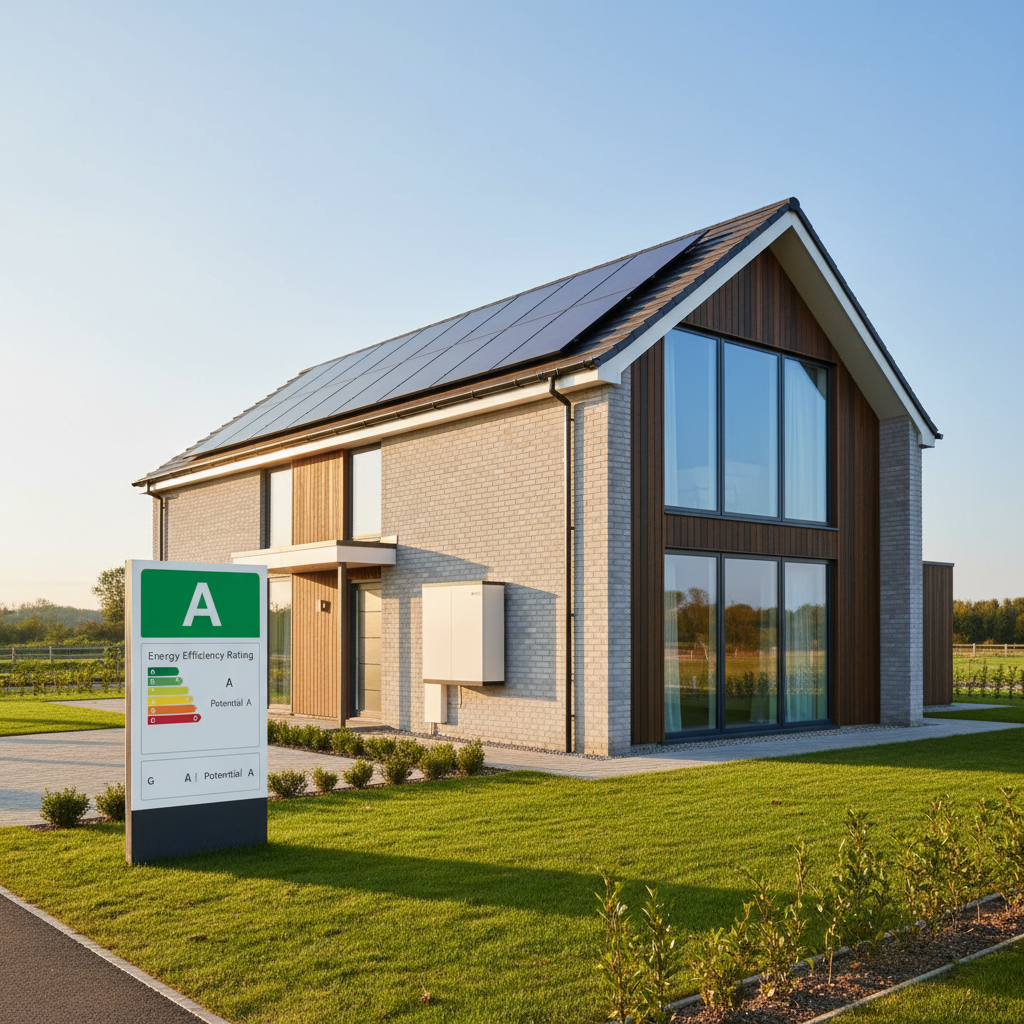
What Is an Energy Performance Certificate (EPC)?
An Energy Performance Certificate is a legal document that rates the energy efficiency of a property on a scale from A (most efficient) to G (least efficient). Every property in England and Wales that is built, sold, or rented must have a valid EPC, and these certificates last for ten years from the date of issue. The rating is expressed as a number from 1 to 100, with higher numbers indicating better efficiency, and each number falls within a lettered band.
The EPC was introduced in the UK as part of the European Union's Energy Performance of Buildings Directive, which was transposed into English law through the Energy Performance of Buildings (England and Wales) Regulations 2012. Although the UK has left the EU, the EPC system remains a cornerstone of domestic energy policy and continues to be updated and refined by the UK government.
An EPC contains two key pieces of information. The first is the energy efficiency rating itself, which estimates how much the property will cost to heat, light, and run based on standardised assumptions about occupancy and energy use. The second is the environmental impact rating, which estimates the property's carbon dioxide emissions. Both ratings use the same A-to-G scale, but they can differ for the same property because a home might be cheap to run but still produce significant carbon emissions, or vice versa.
For new build homes, EPCs are particularly important because they are not just a marketing tool — they are a regulatory requirement that directly influences the design, specification, and construction of the property. Developers must demonstrate compliance with Part L of the Building Regulations, which sets minimum energy efficiency standards for new buildings, and the EPC is one of the key documents that proves this compliance.
The EPC Rating Bands Explained
The EPC scale runs from 1 to 100, divided into seven bands. Here is what each band represents:
| Band | Score Range | Description |
|---|---|---|
| A | 92–100 | Extremely efficient. The lowest possible energy bills. Very rare, even among new builds. |
| B | 81–91 | Highly efficient. The most common rating for new build homes built to current regulations. |
| C | 69–80 | Above average efficiency. Some new builds fall into this band, particularly larger detached homes. |
| D | 55–68 | Average efficiency. The most common rating for the overall UK housing stock. Unusual for new builds. |
| E | 39–54 | Below average. Common in older properties. A new build should never fall into this band. |
| F | 21–38 | Poor efficiency. High energy bills and significant heat loss. Illegal to rent in England and Wales. |
| G | 1–20 | The least efficient properties. Extremely high running costs. Also illegal to rent. |
For context, the average EPC rating across all UK homes is band D, with a score of around 60-65. New build homes are required to significantly exceed this, and the vast majority achieve at least a B rating. However, as we will explore later in this article, achieving an A rating remains surprisingly difficult and uncommon.
How EPCs Are Assessed for New Build Homes: SAP vs RdSAP
One of the most important things to understand about EPCs on new build homes is that they are assessed using a completely different methodology to existing homes. This distinction is crucial because it affects the accuracy and reliability of the rating.
SAP: The Standard Assessment Procedure for New Builds
New build homes are assessed using the full Standard Assessment Procedure, known as SAP. This is a detailed calculation methodology developed by the Building Research Establishment (BRE) on behalf of the UK government. The current version used for Building Regulations compliance is SAP 10.2, which was introduced alongside the Part L 2021 uplift.
SAP assessments for new builds are carried out at the design stage, before the home is built. The assessor uses the architectural plans, construction specifications, and mechanical and electrical system details to model the home's predicted energy performance. This means the EPC you see when you reserve a new build is a prediction based on what the developer plans to build, not a measurement of what has actually been built.
The SAP calculation takes into account a wide range of factors, including:
- The building fabric: Wall construction type and U-values (a measure of how quickly heat passes through a material), roof insulation levels, floor construction and insulation, window specifications including glazing type and frame material, and door specifications.
- Thermal bridging: The heat loss that occurs at junctions in the building fabric, such as where walls meet floors, where walls meet roofs, and around window and door openings. This is calculated using psi-values for each junction type.
- Airtightness: The rate at which air leaks through the building fabric, measured in cubic metres per hour per square metre of envelope area at a pressure of 50 Pascals (m³/h/m² @ 50Pa). New builds must achieve a maximum air permeability of 8 m³/h/m² @ 50Pa, but many achieve much better than this.
- Heating system: The type and efficiency of the main heating system, whether that is a gas boiler, heat pump, electric heating, or district heating. For boilers, the PCDB (Product Characteristics Database) efficiency is used. For heat pumps, the Seasonal Coefficient of Performance (SCOP) is used.
- Hot water system: How hot water is generated and stored, including the efficiency of the system and any heat losses from storage cylinders and pipework.
- Ventilation: The type of ventilation system, whether natural, mechanical extract, or mechanical ventilation with heat recovery (MVHR). MVHR systems recover heat from stale extract air and use it to warm incoming fresh air, significantly reducing heating demand.
- Lighting: The proportion of fixed lighting that uses low-energy fittings (LED or compact fluorescent).
- Renewable energy systems: Solar photovoltaic panels, solar thermal hot water systems, wind turbines, or any other on-site renewable energy generation.
- Orientation and shading: The direction the home faces and any significant shading from adjacent buildings, trees, or terrain, which affects solar heat gains.
The SAP calculation uses standardised assumptions about occupancy patterns, internal temperatures (21°C in the living room, 18°C elsewhere), and energy tariffs. This standardisation means that the EPC does not predict your actual energy bills — it predicts what a typical household would spend in a typical home of that specification. Your actual bills will depend on how you use the home, how many people live there, what temperature you prefer, and the energy tariffs you are on.
RdSAP: The Reduced Data Standard Assessment Procedure for Existing Homes
Existing homes are assessed using RdSAP (Reduced Data Standard Assessment Procedure), which is a simplified version of the full SAP methodology. RdSAP uses default assumptions and age-based estimates where detailed construction information is not available. For example, if the assessor cannot determine the exact wall construction type, RdSAP will assume a default U-value based on the age of the property.
This means that EPC ratings on new build homes (assessed using full SAP with detailed specifications) are generally more accurate than those on existing homes (assessed using RdSAP with assumptions and defaults). However, even the full SAP assessment has limitations, which we will discuss later.
The As-Built SAP Assessment
While the initial EPC is produced at the design stage, Building Regulations also require an as-built SAP assessment to be completed after construction. This updated assessment should reflect any changes made during construction, including the actual airtightness test result rather than the design estimate. The as-built EPC is the final, official certificate that is lodged on the EPC register.
In practice, developers sometimes fail to update the as-built SAP to reflect construction changes, or the as-built assessment may be completed before all on-site tests (such as airtightness testing) have been finalised. This can lead to discrepancies between the predicted and actual performance of the home. As a buyer, you should always ask to see both the design-stage and as-built EPC to check for any differences.
Running Cost Differences Between EPC Ratings: Real Annual Figures
The most practical question most buyers have about EPC ratings is simple: how much will this home cost me to run? While the EPC itself provides estimated energy costs, these figures use standardised assumptions that may not match your actual usage. Nevertheless, they provide a useful basis for comparing properties.
Based on current energy prices (as of the January 2025 Ofgem price cap) and typical new build home specifications, here are realistic annual energy cost estimates for a three-bedroom semi-detached new build home at different EPC ratings:
| EPC Rating | Estimated Annual Energy Cost | Monthly Cost | Difference vs Band A |
|---|---|---|---|
| A (92+) | £650 – £850 | £54 – £71 | — |
| B (81–91) | £900 – £1,200 | £75 – £100 | £250 – £350 more per year |
| C (69–80) | £1,200 – £1,600 | £100 – £133 | £550 – £750 more per year |
| D (55–68) | £1,600 – £2,200 | £133 – £183 | £950 – £1,350 more per year |
These figures are indicative and will vary depending on the size of the home, the heating system type, energy tariffs, and how the home is used. However, they illustrate a crucial point: the difference between an A-rated and a C-rated home can be £500 to £750 per year. Over a typical 25-year mortgage term, that amounts to £12,500 to £18,750 in additional energy costs — a significant sum that should be factored into your purchasing decision.
How Property Size Affects Running Costs
The running cost differences become even more pronounced for larger homes. A five-bedroom detached new build with an EPC rating of C might cost £2,000 to £2,500 per year to run, while the same home built to A-rated standards might cost only £1,000 to £1,400. For larger families in larger homes, the financial incentive to buy the most efficient property possible is substantial.
Conversely, for smaller properties such as one-bedroom apartments, the absolute cost differences between ratings are smaller, though the percentage difference remains significant. A one-bedroom flat rated B might cost £500 to £700 per year to run, while the same flat rated A might cost £400 to £550.
The Impact of Heating System Type on Running Costs
One factor that significantly affects running costs regardless of the EPC rating is the type of heating system installed. New builds with gas boilers benefit from the lower unit cost of gas compared to electricity (currently around 6-7p per kWh for gas versus 24-25p per kWh for electricity at standard tariffs). However, heat pumps — which are increasingly common in new builds — can achieve efficiencies of 250-350%, meaning that for every unit of electricity consumed, they produce 2.5 to 3.5 units of heat. This means the effective cost per unit of heat from a well-performing heat pump can be comparable to or even lower than gas.
The key phrase there is "well-performing." As we will discuss in more detail, the actual performance of heat pumps in new build homes can vary significantly from the design assumptions used in the SAP calculation. If your heat pump achieves a lower coefficient of performance (COP) than predicted, your running costs will be higher than the EPC suggests.
Why Most New Builds Get a B or C Rating — Not an A
One of the most common misconceptions among new build buyers is that a brand new home should automatically achieve the highest possible EPC rating. After all, it is built with modern materials, meets current building regulations, and has never been lived in. So why do the vast majority of new builds achieve a B rating, with some only managing a C, and very few reaching the coveted A?
The answer lies in a combination of regulatory requirements, economic considerations, and the limitations of the SAP methodology itself.
Building Regulations Set a Minimum, Not a Maximum
Part L of the Building Regulations sets minimum energy efficiency standards for new buildings. The 2021 update to Part L (which came into force in June 2022) requires new homes to produce approximately 31% less carbon emissions than the previous standard. However, this minimum standard typically results in an EPC rating of around 81-86 — solidly in band B, but well short of an A rating.
To achieve an A rating (92+), a developer would need to go significantly beyond the minimum regulatory requirements. This means specifying more expensive insulation, higher-performance windows, more efficient heating systems, and potentially adding renewable energy generation such as solar panels. All of this adds cost to the build, and most developers will only invest in efficiency measures that are either required by regulations or that add demonstrable value to the property.
The Economics of Building to A-Rated Standards
The additional cost of building a new home to A-rated standards can range from £5,000 to £15,000 per plot, depending on the starting specification and the measures needed. For a large development of several hundred homes, this could represent an additional investment of millions of pounds.
While more efficient homes can command a premium in the market, research suggests that this premium is typically 5-8% at most — and buyers are often more focused on location, layout, and finish quality than on energy efficiency. Developers, therefore, face a rational economic decision: invest just enough in energy efficiency to meet regulations and achieve a respectable B rating, rather than spending significantly more to achieve an A that may not translate into proportionally higher sale prices.
Detached Homes Are Harder to Rate Highly
The form factor of a building — its ratio of external surface area to internal floor area — has a significant impact on energy efficiency. Detached homes have four external walls, all of which lose heat, plus a fully exposed roof and floor. Semi-detached homes share one wall, terraced homes share two, and apartments in the middle of a block may only have one or two external walls.
This means that a three-bedroom detached house needs significantly more insulation, better glazing, and a more efficient heating system to achieve the same EPC rating as a three-bedroom mid-terrace or apartment of the same floor area. For this reason, detached new builds are more likely to receive a B or even a C rating, while apartments and terraced homes more commonly achieve high B or even A ratings.
The SAP Methodology Can Work Against Certain Home Types
The SAP calculation methodology has certain quirks that can work against particular types of new build homes. For example:
- Large homes with many rooms: SAP assumes that all rooms are heated to standard temperatures. A large five-bedroom detached house will have a higher calculated heating demand than a two-bedroom flat, even if the occupants of the larger house only heat the rooms they use.
- Homes with lots of glazing: While large windows can provide beneficial solar heat gains, they also increase heat loss. SAP balances these factors, and in many cases, large windows result in a net negative impact on the rating.
- Electric heating without renewables: Electricity has a higher carbon factor than gas in the SAP calculation, so homes with electric heating (including heat pumps, depending on the SAP version) can sometimes score lower than gas-heated homes on the environmental impact rating, even if they are cheaper to run.
- Homes in exposed locations: Wind exposure increases heat loss through infiltration and convection. Homes on hilltops or coastal locations may achieve slightly lower ratings than identical homes in sheltered valleys.
Developer Choices That Reduce Ratings
Some design and specification choices that developers make for aesthetic, marketing, or cost reasons can negatively impact the EPC rating. These include:
- Bi-fold or sliding doors: Popular with buyers for their visual appeal and connection to outdoor spaces, but they typically have higher U-values than standard doors or walls, increasing heat loss.
- Vaulted ceilings: Attractive but increase the volume of space to be heated without a proportional increase in floor area, reducing efficiency.
- Roof windows and skylights: Can cause significant heat loss, especially if not triple-glazed, and can also cause overheating in summer.
- Downlighters (recessed spotlights): If not properly sealed, these can create air leakage paths through the ceiling, compromising airtightness.
- Standard rather than enhanced specifications: Using minimum-compliance insulation, standard double glazing rather than triple glazing, and basic mechanical ventilation rather than MVHR all result in a lower rating than would be achieved with enhanced specifications.
How to Read Your New Build EPC Certificate
An EPC certificate contains a wealth of information beyond the headline rating, and understanding this information can help you make better decisions about your purchase and how you use your home. Here is a section-by-section guide to reading your new build EPC.
Page 1: The Energy Efficiency Rating
The first page shows the familiar coloured bar chart with the property's current rating highlighted. For a new build, there is no "potential" rating column (as there would be for an existing home), because the home is already built to its current specification. The page also shows the estimated energy costs for heating, hot water, and lighting separately, giving you a breakdown of where your energy spend will go.
Page 2: The Environmental Impact Rating
The second page shows a similar bar chart but for the property's environmental impact, measured in carbon dioxide emissions. This rating uses the same A-to-G scale but the numbers may differ from the energy efficiency rating. A home heated by a heat pump, for example, may have a high environmental rating (because heat pumps produce no direct carbon emissions) but a slightly lower energy efficiency rating (because electricity is more expensive per unit than gas).
Page 3: Summary of Energy Features
This page provides a summary table of the home's energy-related features, rating each one on a five-star scale from very poor to very good. The features listed include:
- Walls: The construction type and insulation level
- Roof: The insulation type and thickness
- Floor: The construction type and insulation
- Windows: The glazing type (double, triple) and frame material
- Main heating: The type of heating system and its efficiency rating
- Main heating controls: The type and sophistication of the controls
- Secondary heating: Any additional heating systems (e.g., a wood-burning stove)
- Hot water: How hot water is generated and stored
- Lighting: The proportion of low-energy lighting
For a new build, most of these should be rated as "good" or "very good." If any feature is rated as only "average" or lower, this is a potential area for improvement and something worth questioning with the developer.
Page 4: Recommendations
For existing homes, the recommendations page suggests improvements that could increase the rating. For new builds, this page may be blank or may contain limited recommendations, since the home is already built to a modern standard. However, if recommendations are listed, they can provide useful insights into areas where the home's efficiency could be further improved — for example, adding solar panels or upgrading to triple glazing.
The recommendations include estimated costs of each improvement and the potential rating after implementation. While these figures are broad estimates, they can help you prioritise future upgrades if you want to improve your home's efficiency after purchase.
EPC Requirements for Selling and Renting
Understanding the legal requirements around EPCs is important not just for buying a new build, but for your future plans with the property.
Selling Your Home
If you decide to sell your new build in the future, you will need a valid EPC. Since EPCs last for ten years, the certificate you receive when you buy the property may still be valid when you come to sell, depending on how long you own it. If the EPC has expired, you will need to commission a new one from an accredited energy assessor.
It is worth noting that if you sell within ten years using the original EPC, the rating will reflect the home as it was built, not any improvements or changes you may have made. If you have added solar panels, improved insulation, or upgraded the heating system, it may be worth getting a new EPC to reflect the improved rating, as this could help your sale price.
Renting Your Home
If you plan to rent out your new build as a buy-to-let investment, the EPC rating is particularly important. Since April 2020, it has been illegal to let a property in England and Wales with an EPC rating below E (the Minimum Energy Efficiency Standards, or MEES). The government has consulted on raising this minimum to C by 2028 for new tenancies and 2030 for existing tenancies, although the timeline and implementation details remain subject to change.
For new build buy-to-let investors, this is generally not a concern, since all new builds should comfortably achieve at least a C rating. However, it does mean that your new build's EPC rating could become a selling point if you market the property to tenants or a future buy-to-let purchaser, as it demonstrates compliance with both current and proposed future regulations.
The Proposed EPC Reforms
The UK government has been working on significant reforms to the EPC system. These proposed changes include updating the SAP methodology, making EPCs more accurate and user-friendly, and potentially integrating smart meter data to provide more realistic energy cost estimates. The reforms also aim to address some of the known limitations of the current system, such as the reliance on standardised assumptions and the difficulty of comparing homes with different heating system types. While the exact timeline for these reforms remains uncertain, they are likely to result in changes to how new build EPCs are calculated and presented within the next few years.
The Impact of EPC Ratings on Mortgage Rates: Green Mortgages
One of the most significant financial benefits of buying a new build with a high EPC rating is access to preferential mortgage rates through green mortgage products. An increasing number of UK lenders now offer green mortgages that provide lower interest rates, cashback, or fee-free deals to borrowers purchasing energy-efficient homes.
What Is a Green Mortgage?
A green mortgage is a mortgage product that offers better terms to borrowers purchasing or remortgaging a property that meets certain energy efficiency criteria. The specific criteria vary by lender, but most require an EPC rating of A or B, with some accepting C-rated properties. The rationale from the lender's perspective is that energy-efficient homes have lower running costs, making borrowers less likely to default on their mortgage payments, and more resilient property values.
Which Lenders Offer Green Mortgages?
As of early 2025, numerous UK lenders offer some form of green mortgage incentive. Major high-street lenders including Barclays, NatWest, Nationwide, Halifax, and HSBC all have green mortgage products, as do specialist lenders such as Ecology Building Society and Kensington Mortgages. The specific products and rates change frequently, so it is always worth checking the latest offerings when you are ready to apply.
How Much Can You Save with a Green Mortgage?
The savings from a green mortgage typically come in one of three forms:
- Lower interest rates: Some lenders offer rates that are 0.1% to 0.25% lower than their standard products for green-eligible properties. On a £250,000 mortgage over 25 years, a 0.2% reduction in interest rate would save approximately £25 to £30 per month, or £7,500 to £9,000 over the full term.
- Cashback: Some lenders offer a lump sum cashback payment upon completion, typically ranging from £500 to £2,000. This can help offset the costs of moving and furnishing your new home.
- Fee waivers: Some green mortgage products waive arrangement fees or valuation fees that would normally apply. This can save £500 to £1,500 depending on the lender and product.
When combined with the lower running costs of an energy-efficient home, the total financial benefit of a high EPC rating can be substantial. A new build with an A rating rather than a C could save you £500 to £750 per year on energy bills and £300 to £360 per year on mortgage payments, adding up to £800 to £1,100 per year — or £20,000 to £27,500 over a 25-year mortgage term.
How EPC Ratings Affect Property Value
Research consistently shows that higher EPC ratings are associated with higher property values, though the strength of this correlation varies by region, property type, and market conditions.
A study by the Department of Energy and Climate Change (now part of the Department for Energy Security and Net Zero) found that homes with an EPC rating of A or B sold for approximately 5% more than comparable homes rated D. Similarly, research by the Royal Institution of Chartered Surveyors (RICS) found that energy efficiency was an increasingly important factor in buyers' decision-making, particularly following the energy price rises of 2022-2023.
For new build homes specifically, the impact of EPC ratings on value is somewhat different. Since most new builds achieve at least a B rating, the differentiation between new builds is less pronounced than between existing homes. However, a new build that only achieves a C rating when comparable new builds on the same development achieve a B may be viewed less favourably by buyers, potentially affecting its resale value.
Looking ahead, the expected tightening of Minimum Energy Efficiency Standards for rental properties and the ongoing push towards net zero are likely to increase the premium placed on highly rated properties. Buying a new build with the highest possible EPC rating is therefore not just about saving on current energy bills — it is about future-proofing your investment.
Part L Building Regulations and New Build Energy Standards
Part L of the Building Regulations is the section that governs the conservation of fuel and power in buildings. It is the primary mechanism through which the UK government sets energy efficiency standards for new homes, and its requirements directly determine the EPC ratings that new builds are likely to achieve.
Part L 2021: The Current Standard
The most recent update to Part L came into force in June 2022 and represents a significant step up from the previous 2013 standard. Known as the "interim uplift" (because it is a stepping stone towards the full Future Homes Standard), Part L 2021 requires new homes to produce approximately 31% less carbon emissions than under the 2013 standard.
In practical terms, Part L 2021 has resulted in the following typical specifications for new build homes:
- Walls: U-values of around 0.18-0.20 W/m²K (compared to 0.26-0.30 under Part L 2013)
- Roof: U-values of around 0.11-0.13 W/m²K
- Floor: U-values of around 0.13-0.15 W/m²K
- Windows: U-values of around 1.2-1.4 W/m²K (high-performance double or triple glazing)
- Airtightness: Typical results of 3-5 m³/h/m² @ 50Pa (well below the maximum of 8)
- Heating: Gas boilers must be at least 92% efficient, or heat pumps with a SCOP of at least 2.8
- Ventilation: MVHR systems are increasingly common, particularly in homes with heat pumps
- Renewables: Many developments include solar PV panels to meet the carbon reduction targets
The Future Homes Standard: What Comes Next
The full Future Homes Standard is expected to take effect from 2025, requiring new homes to produce 75-80% less carbon emissions than under Part L 2013. This will effectively mean no new gas boilers, higher insulation levels, and a much greater emphasis on renewable energy generation. We explore this in detail in our dedicated article on the Future Homes Standard.
How New Builds Compare to Older Homes on Energy Efficiency
To appreciate the energy efficiency of new build homes, it is helpful to compare them to the wider UK housing stock. The contrast is stark.
| Property Age | Typical EPC Rating | Typical Annual Energy Cost (3-bed semi) | Key Issues |
|---|---|---|---|
| Pre-1919 | E-F (25-50) | £2,500 – £3,500+ | Solid walls (no cavity to insulate), single glazing, poor airtightness, old boiler |
| 1919-1944 | D-E (40-60) | £2,000 – £3,000 | Cavity walls but often uninsulated, original windows, limited loft insulation |
| 1945-1964 | D-E (45-60) | £1,800 – £2,800 | Variable construction quality, some asbestos, basic insulation |
| 1965-1982 | D (50-65) | £1,500 – £2,200 | Better than earlier homes but still below modern standards |
| 1983-2002 | C-D (60-75) | £1,200 – £1,800 | First generation of Building Regulations, cavity wall insulation standard |
| 2003-2013 | B-C (72-85) | £900 – £1,400 | Part L 2006/2010 standards, condensing boilers, better insulation |
| 2014-2022 | B (80-88) | £800 – £1,200 | Part L 2013 standards, good insulation and airtightness |
| 2023 onwards | A-B (82-95) | £650 – £1,100 | Part L 2021 standards, heat pumps increasingly common, solar PV |
As the table illustrates, a modern new build home built to Part L 2021 standards is typically three to five times more energy efficient than a Victorian or Edwardian property, and roughly twice as efficient as homes built in the 1990s. This is a significant advantage that translates into real financial savings and greater comfort.
However, it is also worth noting that a well-renovated older home with modern insulation, new windows, and an efficient heating system can achieve a similar EPC rating to a new build. The advantage of a new build is that this efficiency is built in from the start, rather than requiring expensive retrofit work.
What to Check Before You Buy: EPC Red Flags and Smart Questions
Armed with an understanding of EPC ratings and what they mean, here are the key things to check and questions to ask before committing to a new build purchase.
Before Reserving
- Ask for the predicted EPC rating. Most developers will be able to provide this at the reservation stage. If they cannot or will not, consider this a red flag.
- Ask which SAP methodology has been used. Homes built under Part L 2021 should use SAP 10.2. If the developer mentions SAP 2012, this may indicate the home was designed under the older Part L 2013 standard.
- Compare ratings across the development. Different house types on the same development may achieve different ratings. Detached homes will typically rate lower than terraced homes or apartments.
- Ask about the heating system. Whether the home has a gas boiler or heat pump will significantly affect the EPC rating and your running costs. Make sure you understand what is being installed and its implications.
- Ask about solar panels. Some homes on a development may have solar panels while others do not, affecting the EPC rating. Find out whether your specific plot includes solar PV.
During the Purchase Process
- Request the full SAP calculation. This document is more detailed than the EPC certificate and shows all the assumptions and inputs used in the calculation. Your solicitor or surveyor can review this for accuracy.
- Check the assumed airtightness value. The design-stage SAP may assume a more optimistic airtightness figure than the home actually achieves. Ask if the as-built assessment will be updated with the actual test result.
- Verify the ventilation system. If the SAP assumes MVHR (mechanical ventilation with heat recovery), check that this is actually being installed. MVHR is more expensive than basic mechanical extract ventilation and some developers may substitute a cheaper system.
- Look at the thermal bridging assumptions. The SAP can use either calculated psi-values (more accurate) or default values (less accurate and often more pessimistic). If default values have been used, the actual performance may be better than the EPC suggests — but this also means the developer may not have paid close attention to junction details.
After Completion
- Request the as-built EPC. This should be provided as part of the handover documentation. Compare it to the design-stage prediction — if the as-built rating is lower, ask the developer to explain why.
- Check the airtightness test certificate. Every new build home must undergo an airtightness test (unless it is part of a large development where sampling is used). The result should be consistent with or better than the figure used in the SAP calculation.
- Monitor your actual energy use. After living in the home for a full year, compare your actual energy bills to the estimates on the EPC. If your bills are significantly higher than predicted, there may be a performance gap that needs investigating.
- Keep the EPC certificate safe. You will need it if you sell or rent the property. A copy is also available on the national EPC register at gov.uk.
Common Reasons for Lower-Than-Expected EPC Ratings on New Builds
Despite being brand new, some new build homes achieve lower EPC ratings than buyers expect. Here are the most common reasons:
1. The Home Was Designed Under Older Regulations
Building Regulations include transitional arrangements that allow developers to build homes under the old rules if certain conditions are met (typically, if a building control initial notice or full plans application was submitted before the new rules came into force). This means that some homes completed in 2023 or 2024 may have been designed and approved under the less stringent Part L 2013 standard, resulting in a lower EPC rating than homes designed under Part L 2021.
You can check which version of the regulations a home was built under by looking at the SAP calculation or asking the developer directly. If you are buying a new build in 2025 and the developer mentions Part L 2013 or SAP 2012, ask why the older standard is being used and what impact this has on the EPC rating.
2. Large or Detached Home with High Form Factor
As discussed earlier, detached homes and large homes with complex shapes (lots of corners, extensions, or bay windows) have a higher ratio of external surface area to floor area, which increases heat loss and reduces the EPC rating. A five-bedroom detached house may only achieve a mid-B rating (82-84) even when built to a high specification, while a two-bedroom apartment on the same development might achieve an A (92+).
3. No Renewable Energy Generation
Solar PV panels can significantly boost an EPC rating by providing on-site electricity generation that reduces the home's net energy consumption. A typical 3-4kWp solar array on a new build home might add 5-10 points to the SAP score. Homes without solar panels will therefore have a lower rating than equivalent homes with panels, all else being equal.
4. Gas Boiler Rather Than Heat Pump
Under SAP 10.2, heat pumps are treated more favourably than gas boilers because of the updated carbon emission factors for electricity. The carbon factor for grid electricity in SAP 10.2 is significantly lower than in SAP 2012, reflecting the decarbonisation of the electricity grid. This means that homes with heat pumps tend to score higher on both the energy efficiency and environmental impact ratings than homes with gas boilers, even if the gas-heated home has lower actual running costs.
5. Poor Airtightness Test Result
If the actual airtightness test result is worse than the figure assumed in the design-stage SAP, the as-built EPC rating will be lower. Common causes of poor airtightness include poorly sealed service penetrations (where pipes and cables pass through the building fabric), gaps around window and door frames, and inadequate sealing at wall-ceiling and wall-floor junctions.
6. Design Features That Compromise Efficiency
Certain design features that developers include for aesthetic or marketing reasons can reduce the EPC rating. Large areas of glazing, vaulted ceilings, open-plan layouts with high ceilings, and feature walls with lower insulation levels all contribute to higher energy demand and a lower rating.
The Performance Gap: Why Your Actual Bills May Differ from the EPC
One of the most important things to understand about EPCs is that they predict performance under standardised conditions, not actual performance in practice. Research has consistently shown a "performance gap" between the predicted and actual energy performance of buildings, and this gap can be significant.
A landmark study by the Zero Carbon Hub in 2014 found that many new build homes used 50-100% more energy than their design predictions suggested. While building quality and testing have improved since then, a performance gap still exists in many cases.
The main causes of the performance gap include:
- Construction quality: Gaps in insulation, poorly fitted windows, and inadequate sealing can all reduce the actual performance of the building fabric below the designed specification.
- Thermal bridging: Heat loss at junctions in the building fabric is notoriously difficult to eliminate entirely, and actual thermal bridging losses are often higher than the calculated values used in the SAP.
- Occupant behaviour: The SAP assumes standardised occupancy and heating patterns. In practice, some households heat their homes to higher temperatures, leave windows open, use more hot water, or have more electrical appliances than the standard assumptions.
- Heating system performance: The actual efficiency of heating systems, particularly heat pumps, can differ from the design values used in the SAP. Heat pumps are particularly sensitive to installation quality, system design, and how they are controlled.
- Commissioning issues: Mechanical and electrical systems that are not properly commissioned — that is, set up and adjusted to operate correctly — may not achieve their design efficiency. MVHR systems that are not balanced correctly, for example, can actually increase energy use rather than reduce it.
For new build buyers, the key takeaway is that the EPC rating is a useful comparison tool but should not be treated as a precise prediction of your actual energy bills. Your actual costs will depend on how you use the home, the quality of the construction, and the performance of the installed systems.
Real Examples of Running Costs by EPC Rating
To bring the EPC ratings to life, here are some real-world examples of annual running costs for different new build home types and ratings. These figures are based on typical new build specifications and current energy prices as of early 2025.
Example 1: Two-Bedroom Apartment, EPC Rating A (Score 93)
A modern two-bedroom apartment with a heat pump, MVHR, triple glazing, and 2kWp solar PV. Floor area approximately 65m². Located in the south of England.
- Estimated annual heating cost: £250-£320
- Estimated annual hot water cost: £120-£160
- Estimated annual lighting cost: £50-£70
- Solar PV generation offset: -£100 to -£150
- Net estimated annual energy cost: £320-£400
Example 2: Three-Bedroom Semi-Detached, EPC Rating B (Score 84)
A three-bedroom semi-detached house with a gas boiler (92% efficient), double glazing with low-e coating, mechanical extract ventilation, and no solar panels. Floor area approximately 95m². Located in the Midlands.
- Estimated annual heating cost: £550-£650
- Estimated annual hot water cost: £180-£220
- Estimated annual lighting cost: £80-£100
- Net estimated annual energy cost: £810-£970
Example 3: Four-Bedroom Detached, EPC Rating B (Score 82)
A four-bedroom detached house with a heat pump, underfloor heating on the ground floor, MVHR, double glazing, and 3kWp solar PV. Floor area approximately 140m². Located in the north of England.
- Estimated annual heating cost: £650-£800
- Estimated annual hot water cost: £200-£260
- Estimated annual lighting cost: £100-£130
- Solar PV generation offset: -£120 to -£180
- Net estimated annual energy cost: £830-£1,010
Example 4: Five-Bedroom Detached, EPC Rating C (Score 75)
A large five-bedroom detached house with a gas boiler, standard double glazing, natural ventilation with trickle vents, bi-fold doors to the rear, vaulted ceiling in the master bedroom, and no solar panels. Floor area approximately 200m². Located in the south-east of England.
- Estimated annual heating cost: £1,050-£1,250
- Estimated annual hot water cost: £280-£340
- Estimated annual lighting cost: £130-£170
- Net estimated annual energy cost: £1,460-£1,760
These examples illustrate how property size, heating system type, and the presence or absence of renewables combine with the EPC rating to determine actual running costs. A large detached home with a C rating can still cost two to three times more to run than a small apartment with an A rating, even though both are brand new.
Tips for Maximising Energy Efficiency in Your New Build
Even if your new build achieves a B or C rating rather than an A, there are steps you can take to minimise your energy use and running costs.
- Learn how to use your heating controls properly. Many new build owners do not take the time to understand their heating controls, resulting in the heating running when it is not needed. If your home has a heat pump, this is particularly important — heat pumps work most efficiently when set to a lower, constant temperature rather than being turned on and off.
- Use your MVHR system correctly. If your home has mechanical ventilation with heat recovery, keep it running at its normal setting — do not switch it off to save electricity, as this can lead to condensation and poor air quality. Use the boost function only when needed (cooking, bathing) and ensure the filters are cleaned regularly.
- Avoid blocking radiators or underfloor heating. Placing furniture over or against radiators reduces their efficiency. With underfloor heating, avoid laying thick rugs or carpet over large areas, as this insulates the heat source from the room.
- Use LED lighting throughout. New builds should come with LED light fittings, but if you replace any fittings, ensure you continue to use LED bulbs.
- Consider adding solar panels if not already installed. If your home does not have solar PV, this is one of the most effective improvements you can make. A typical 3-4kWp system costs £6,000 to £9,000 installed and can save £300 to £600 per year on energy bills while also earning income through the Smart Export Guarantee.
- Consider a time-of-use electricity tariff. If your home has a heat pump and/or solar panels, a time-of-use tariff (such as Octopus Agile or Intelligent Octopus Go) can significantly reduce your electricity costs by charging lower rates during off-peak hours.
- Keep windows and doors closed when the heating is on. This seems obvious, but new build homes with good airtightness and ventilation systems do not need windows open for fresh air — the ventilation system provides this. Opening windows while the heating is on wastes energy.
- Report any defects promptly. Gaps around windows, drafts from doors, and damp patches can all indicate defects in the building fabric that are reducing energy efficiency. Report these to the developer under your warranty as soon as you notice them.
Frequently Asked Questions About New Build EPC Ratings
Can I negotiate on a new build with a lower EPC rating?
While you cannot negotiate the EPC rating itself (it is an objective assessment of the property's specification), you may be able to negotiate additional energy efficiency measures as part of the purchase. Some developers will agree to add solar panels, upgrade glazing, or improve insulation if asked, particularly on homes that are struggling to sell. This is more likely on bespoke or small-scale developments than on large national housebuilder sites.
Does the EPC rating include my electricity for appliances and cooking?
No. The EPC only considers regulated energy use — heating, hot water, lighting, and ventilation. It does not include unregulated energy use such as cooking, electrical appliances, televisions, computers, or electric vehicle charging. Your actual total energy bill will therefore be higher than the EPC estimates, regardless of the rating.
Can the developer change the EPC rating after I have reserved?
The design-stage EPC is based on the planned specification. If the developer changes the specification during construction (for example, substituting a different window supplier or changing the heating system), this could affect the as-built EPC rating. Your reservation agreement and contract should specify the expected EPC rating, and any material changes should be communicated to you. If the as-built rating is lower than promised, you may have grounds for a claim against the developer.
Are new build EPCs more accurate than existing home EPCs?
Generally, yes. New build EPCs are produced using the full SAP methodology with detailed construction specifications, while existing home EPCs use the simplified RdSAP methodology with assumptions and defaults. However, new build EPCs are still predictions based on design specifications, and the actual performance may differ due to construction quality, commissioning issues, and the performance gap.
What is the minimum EPC rating for a new build home?
There is no explicit minimum EPC rating for new build homes. However, compliance with Part L of the Building Regulations effectively requires new homes to achieve at least a mid-to-high B rating. In practice, it would be very unusual for a compliant new build home to achieve less than a C rating (score of 69), and this would typically only happen for very large detached homes with certain design features.
How does the EPC rating affect stamp duty?
Currently, the EPC rating does not directly affect stamp duty land tax (SDLT). However, various proposals have been put forward over the years to link stamp duty rates to energy efficiency, either through rebates for efficient homes or surcharges for inefficient ones. While none of these proposals have been implemented as of early 2025, it remains a possibility for the future.
Conclusion: Making EPC Ratings Work for You
EPC ratings are an imperfect but valuable tool for comparing the energy efficiency of new build homes. Understanding what the ratings mean, how they are calculated, and what they do and do not tell you about actual running costs puts you in a much stronger position as a buyer.
The key takeaways from this guide are:
- Most new builds achieve a B rating (81-91), with A ratings being rare and C ratings being more common on larger detached homes.
- The difference between an A-rated and C-rated new build can be £500-£750 per year in energy costs, adding up to £12,500-£18,750 over a 25-year mortgage term.
- Green mortgages can provide additional savings of £300-£360 per year for highly rated homes.
- The EPC is a prediction, not a guarantee — actual running costs will depend on how you use the home and the quality of construction.
- Always ask to see the full SAP calculation and compare the design-stage and as-built EPCs.
- Consider the EPC rating alongside other factors such as location, layout, build quality, and the developer's reputation.
For more information on the running costs you can expect in a new build home, see our detailed guide to utility bills and running costs in new builds. And if your new build comes with a heat pump, our guide to heat pumps in new build homes explains everything you need to know about this increasingly common technology.