What Is the Future Homes Standard?
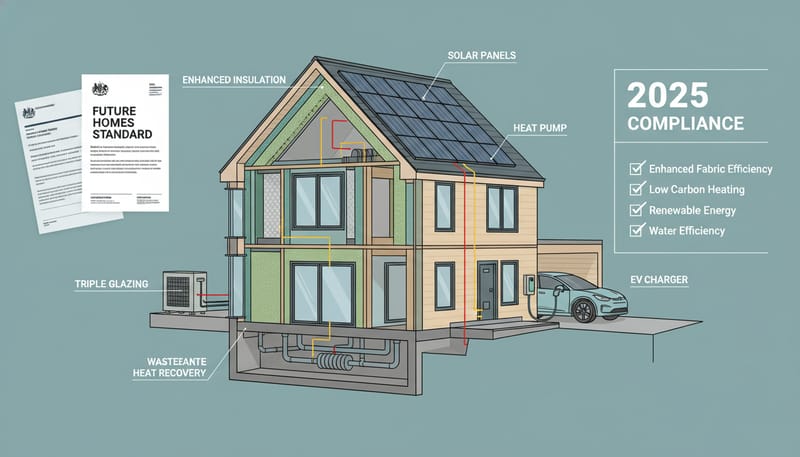
The Future Homes Standard (FHS) is a set of building regulations being introduced by the UK government that will require all new homes built from 2025 onwards to produce 75–80% less carbon dioxide emissions than those built under the 2013 Building Regulations. It represents the most significant change to how homes are built in England since the introduction of Part L energy efficiency requirements, and it will fundamentally reshape what new build buyers can expect from their properties.
At its core, the Future Homes Standard is designed to ensure that every new home built in England is “zero carbon ready” — meaning it will not require any further energy efficiency retrofits to become a net zero carbon home as the electricity grid decarbonises over the coming decades. In practical terms, this means the end of gas boilers in new builds and a dramatic improvement in the thermal performance of the building fabric.
For buyers, the Future Homes Standard is overwhelmingly positive news. Homes built to FHS will have significantly lower running costs, higher EPC ratings (typically A), and better comfort levels than any previous generation of new build housing. They will also hold their value better as energy regulations tighten and buyer expectations evolve.
Timeline and Implementation
The Future Homes Standard has been developed over several years through a process of consultations, interim updates, and transitional arrangements. Here is the complete timeline:
Key Milestones
| Date | Event | Impact |
|---|---|---|
| October 2019 | FHS consultation launched | Government set out two options for carbon reduction levels |
| January 2021 | Government response published | Confirmed 75–80% CO2 reduction target and key requirements |
| June 2022 | Part L 2021 takes effect | Interim uplift: 31% CO2 reduction over 2013 standards (current regulation) |
| September 2023 | FHS technical specification consultation | Detailed standards for fabric, heating, ventilation published for review |
| 2025 | Full FHS regulations published | Final technical specifications confirmed with implementation date |
| 2025–2026 | FHS takes effect | All new building regulation applications must comply with FHS |
Transitional Arrangements
The transition between the current Part L 2021 and the full Future Homes Standard is critical for buyers to understand:
- Homes with planning permission before the FHS date: These may be built to the current Part L 2021 standard, provided construction begins within a specified period (typically 12 months). This means homes on developments that received planning permission before the FHS could still be built to the older standard.
- Homes with building regulation applications after the FHS date: These must comply fully with the Future Homes Standard, regardless of when planning permission was granted.
- No local authority override: The FHS will include provisions preventing local planning authorities from setting their own energy standards that differ from the national standard. This creates a level playing field for all developers.
If you are buying a new build in 2025 or 2026, it is essential to ask whether the development is being built to Part L 2021 or the full Future Homes Standard. The difference in energy performance and running costs is substantial.
Part L 2013 vs Part L 2021 vs Future Homes Standard
The evolution from Part L 2013 through the 2021 interim uplift to the full Future Homes Standard represents a step-change in building performance. Here is a comprehensive comparison of the key requirements:
Carbon and Energy Performance Requirements
| Requirement | Part L 2013 | Part L 2021 (Current) | Future Homes Standard |
|---|---|---|---|
| CO2 reduction target | Baseline (0%) | 31% below 2013 | 75–80% below 2013 |
| Primary energy target | Not specified | Yes (kWh/m²/year) | Tighter target (kWh/m²/year) |
| Heating system | Gas boiler permitted | Gas boiler still permitted (with upgrades) | No fossil fuel heating; heat pump or equivalent required |
| Typical EPC rating | C (69–80) | B (81–88) | A (92+) |
| Estimated annual energy cost (3-bed) | £1,100 – £1,400 | £700 – £950 | £400 – £600 |
Fabric Performance Requirements
| Building Element | Part L 2013 U-value | Part L 2021 U-value | Future Homes Standard U-value |
|---|---|---|---|
| External walls | 0.30 W/m²K | 0.26 W/m²K | 0.15–0.18 W/m²K |
| Roof | 0.20 W/m²K | 0.16 W/m²K | 0.11–0.13 W/m²K |
| Floor | 0.25 W/m²K | 0.18 W/m²K | 0.11–0.13 W/m²K |
| Windows | 2.00 W/m²K | 1.40 W/m²K | 0.80–1.00 W/m²K (triple glazing likely) |
| Doors | 2.00 W/m²K | 1.40 W/m²K | 1.00 W/m²K |
| Air permeability | ≤10 m³/hr/m² | ≤8 m³/hr/m² | ≤5 m³/hr/m² (with MVHR likely required) |
Key Differences Explained
The U-value figures above tell a clear story: each iteration significantly reduces heat loss through the building envelope. Lower U-values mean less heat escapes, requiring less energy to keep the home warm. The Future Homes Standard’s wall U-value of 0.15–0.18 W/m²K is roughly half that of the current Part L 2021 standard, meaning walls in FHS homes will lose heat at half the rate.
The air permeability target of 5 m³/hr/m² or below is particularly significant. At this level of airtightness, mechanical ventilation with heat recovery (MVHR) becomes essential to maintain indoor air quality while recovering up to 90% of the heat from outgoing air. This is a step-change from current practice, where most new builds rely on natural ventilation through trickle vents.
The End of Gas Boilers in New Homes
Perhaps the most significant change under the Future Homes Standard is the effective ban on gas boilers (and all fossil fuel heating) in new homes. While the government has been careful not to use the word “ban,” the 75–80% carbon reduction target makes it mathematically impossible to achieve compliance with a gas boiler, even a highly efficient condensing model.
In practice, this means every new home built to the Future Homes Standard will need a low-carbon heating system. The primary options are:
- Air source heat pumps (ASHPs): The most common choice, extracting heat from outdoor air with a COP of 3.0–4.5. Expected to be the default heating system for the vast majority of FHS homes.
- Ground source heat pumps (GSHPs): Higher efficiency but significantly more expensive. Suitable for larger developments where shared ground loops reduce costs.
- Heat networks (district heating): Centralised heating systems serving multiple homes from a shared energy centre. Common in urban apartment developments.
- Direct electric heating: Only viable in very well-insulated homes with extremely low heat demand (approaching Passivhaus levels). Not expected to be widely used.
For buyers, this shift to heat pumps brings several benefits: lower running costs (heat pumps are typically 50% cheaper to run than gas boilers), zero direct carbon emissions, and future-proofing against the continued decarbonisation of the electricity grid. As more renewable energy comes online, the carbon intensity of electricity falls, making heat pump homes even greener over time.
Developers have been preparing for this transition since the Part L 2021 uplift, with many major housebuilders already installing heat pumps on selected developments. The supply chain for heat pump equipment and skilled installers has grown substantially, and costs have fallen as volumes increase.
The Enhanced Fabric-First Approach
The Future Homes Standard places enormous emphasis on the fabric-first approach — the principle that the building envelope (walls, roof, floor, windows) should be the primary means of reducing energy demand, with renewable technologies and efficient heating systems then added to an already well-performing shell.
This approach has several advantages for homeowners:
- Passive performance: A well-insulated, airtight home stays warm longer when the heating is off and cool longer on hot days. This reduces the overall energy needed, regardless of the heating system.
- Comfort: Higher insulation standards and better airtightness eliminate cold spots, draughts, and temperature variations between rooms.
- Longevity: Building fabric lasts the lifetime of the home (50+ years), while heating systems and renewable technologies need replacing periodically. Investing in fabric performance delivers benefits for decades.
- Noise reduction: Better insulation and triple glazing significantly reduce external noise transmission, creating a quieter living environment.
What This Means in Practice
A home built to the Future Homes Standard will feature:
- Enhanced wall insulation: Thicker cavities filled with high-performance insulation (PIR or similar), achieving U-values of 0.15–0.18 W/m²K — roughly equivalent to a wall with 150mm+ of high-performance insulation.
- Superior roof insulation: Increased loft or rafter insulation depth, targeting U-values of 0.11–0.13 W/m²K.
- High-performance windows: Triple glazing is expected to become the norm, with U-values of 0.80–1.00 W/m²K compared to 1.40 for current double glazing.
- Reduced thermal bridging: Enhanced construction details at junctions (wall-floor, wall-roof, around windows) to minimise cold spots where heat escapes.
- Airtightness with MVHR: Homes will be built to much tighter airtightness standards (5 m³/hr/m² or below), with mechanical ventilation with heat recovery providing fresh air while recovering up to 90% of outgoing heat.
Wastewater Heat Recovery and Other Technologies
Beyond the headline changes to heating and insulation, the Future Homes Standard introduces or encourages several other technologies that buyers should be aware of:
Wastewater Heat Recovery (WWHR)
Wastewater heat recovery systems capture heat from shower drain water and use it to pre-heat incoming cold water. A vertical pipe system installed alongside the shower waste pipe can recover 50–65% of the heat that would otherwise go down the drain. This is a simple, passive technology with no moving parts and a lifespan exceeding 30 years.
WWHR is already included in many Part L 2021 compliant homes because it provides a significant SAP benefit at relatively low cost (£400–£800 per shower). Under the Future Homes Standard, it is expected to become standard in most new builds as developers maximise every opportunity to reduce energy consumption.
Solar PV as Standard
While not explicitly mandated, the carbon reduction targets under the FHS make it very likely that most new homes will include solar PV panels as standard. The SAP methodology gives significant credit for on-site renewable electricity generation, and solar PV remains one of the most cost-effective ways for developers to close the gap between fabric performance and the required carbon target.
Smart Home Integration
Smart energy management systems will play an increasingly important role in Future Homes Standard properties. Smart thermostats, energy monitoring, and automated controls help homeowners optimise their energy use and respond to time-of-use tariffs. When combined with solar PV, battery storage, and a heat pump, smart controls can coordinate these systems to minimise grid electricity consumption and reduce costs further.
Water Efficiency
The FHS is expected to include tighter water efficiency standards, potentially reducing the maximum consumption from the current 125 litres per person per day to 100 litres or below. This will require water-efficient fixtures, fittings, and potentially rainwater harvesting or greywater recycling systems in some developments.
What Buyers Should Look For Now
If you are buying a new build home in the transition period between the current regulations and the full Future Homes Standard, here is what to look for and what questions to ask:
Developments Being Built Now (Part L 2021)
- Ask about the heating system: If the development uses gas boilers, consider whether you would want to replace it with a heat pump in future. If it already has a heat pump, you are getting a significant head start on FHS performance.
- Check the EPC rating: A B rating is standard under Part L 2021. If the developer is achieving A ratings, they are likely going beyond minimum requirements and offering a more future-proof home.
- Look for solar panels: Not all Part L 2021 homes have solar, but those that do will have lower bills and a better EPC.
- Ask about insulation specifications: Some developers exceed minimum insulation requirements. Higher insulation means lower bills for the life of the home.
- Check ventilation type: Homes with MVHR are more airtight and efficient than those relying on trickle vents.
Developments Being Built After FHS Implementation
- Expect a heat pump: All FHS homes will have low-carbon heating. Ask about the brand, COP rating, and whether it comes with underfloor heating.
- Expect triple glazing: Most FHS homes will need triple-glazed windows to meet U-value targets.
- Expect MVHR: Mechanical ventilation with heat recovery will be standard, providing fresh filtered air throughout the home.
- Expect solar PV: Most FHS homes will include solar panels as standard. Ask about system size and battery options.
- Expect EPC A: The combination of these features should deliver an A-rated home with annual energy costs well below £600.
Key Questions to Ask Your Developer
| Question | Why It Matters |
|---|---|
| Is this development built to Part L 2021 or the Future Homes Standard? | Determines the overall energy performance specification |
| What heating system is installed? | Heat pump vs gas boiler has a major impact on running costs and carbon |
| What is the expected EPC rating for my plot? | Directly indicates energy efficiency and qualifies you for green mortgages |
| Are solar panels included or available as an upgrade? | Solar PV is the single biggest improvement to running costs |
| What type of ventilation is installed? | MVHR offers superior air quality and energy recovery |
| What are the airtightness and insulation specifications? | Higher specifications mean lower bills for the lifetime of the home |
| Is the home EV charger-ready? | All new homes must have EV charging provision under current rules |
Frequently Asked Questions
When exactly does the Future Homes Standard come into force?
The government has confirmed the FHS will take effect in 2025, with the full technical regulations published alongside an implementation date. There will be transitional arrangements allowing homes already in the planning or construction pipeline to be completed under the current Part L 2021 standard, provided certain conditions are met.
Will my existing new build need to be upgraded to meet the FHS?
No. The Future Homes Standard applies only to new homes built after the implementation date. If you already own a new build home, you are not required to make any changes. However, many of the technologies used in FHS homes (heat pumps, solar panels, improved insulation) can be retrofitted if you wish to improve your home’s performance.
Will Future Homes Standard homes be more expensive?
Initial estimates suggest an additional build cost of £5,000–£10,000 per home for the enhanced specifications. However, this is offset by significantly lower running costs (£300–£600 per year less than current Part L 2021 homes) and higher resale values. Over a 25-year mortgage, the energy savings more than compensate for any purchase price increase.
Does the Future Homes Standard apply in Scotland, Wales, and Northern Ireland?
The Future Homes Standard as described applies to England only. Scotland, Wales, and Northern Ireland have their own building regulations, though all are moving towards similar low-carbon standards. Scotland already has some of the most stringent energy efficiency requirements in the UK. Wales introduced its own enhanced Part L in 2022 with similar CO2 reduction targets.
Will the FHS affect house prices?
Properties built to the Future Homes Standard are expected to command a premium compared to older housing stock, as they offer significantly lower running costs, better comfort, and compliance with the latest regulations. Research from the Department for Energy Security and Net Zero suggests energy-efficient homes already attract a 5–14% price premium. As the FHS becomes the norm, homes built to older standards may see their relative resale value decline.
The Future of New Build Housing
The Future Homes Standard represents a generational shift in how UK homes are built. For buyers, it means access to homes that are warmer, cheaper to run, and significantly better for the environment than anything previously available. The combination of heat pump heating, superior insulation, triple glazing, and MVHR ventilation will deliver homes with annual energy costs potentially below £500 for a typical 3-bedroom property.
Whether you are buying now or waiting for FHS-compliant homes, understanding these standards helps you make informed decisions about your purchase. Homes built to higher energy standards hold their value better, cost less to live in, and contribute to the UK’s critical net zero targets.
For more on the technologies that will feature in Future Homes Standard properties, explore our guides on heat pumps, solar panels, insulation, and EPC ratings. Ready to find your next home? Browse available new build homes across the UK.