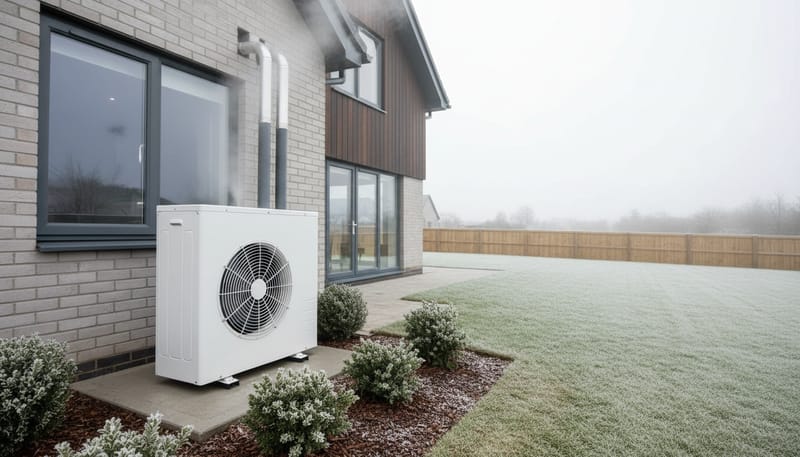
What Is a Heat Pump and How Does It Work?
A heat pump is a highly efficient heating system that extracts low-grade heat from the air, ground, or water outside your home and concentrates it to provide space heating and hot water. Think of it as a refrigerator working in reverse — instead of removing heat from inside a box, a heat pump draws heat from the outdoor environment and transfers it indoors. Even when outside temperatures drop below freezing, there is still sufficient thermal energy in the air or ground for a heat pump to operate effectively.
Heat pumps have become the default heating technology for an increasing number of UK new build developments. With the government’s push towards net zero carbon homes and the upcoming Future Homes Standard set to ban gas boilers in new properties, understanding heat pump technology is essential for anyone considering a new build purchase.
Unlike a gas boiler that burns fossil fuel to generate heat, a heat pump uses a small amount of electricity to move heat from one place to another. For every 1 kWh of electricity consumed, a modern heat pump typically delivers between 2.5 and 4.5 kWh of heat. This ratio is known as the Coefficient of Performance (COP) and is the key metric for assessing heat pump efficiency.
The Heat Pump Cycle
Every heat pump operates using a refrigeration cycle with four stages:
- Evaporation: A refrigerant fluid circulates through an outdoor evaporator coil (or underground loop), absorbing heat from the surrounding air or ground and evaporating from a liquid into a gas.
- Compression: An electrically driven compressor increases the pressure and temperature of the gas — raising it to 50–65°C, sufficient for domestic heating.
- Condensation: The hot gas passes through an indoor heat exchanger, releasing its heat into underfloor heating pipes or radiators. The gas condenses back into a liquid.
- Expansion: The liquid passes through an expansion valve, reducing its pressure and temperature, and the cycle begins again.
Modern inverter-driven heat pumps modulate their speed rather than simply switching on and off, which improves efficiency and provides more consistent temperatures throughout the property.
Types of Heat Pumps for New Build Homes
There are three main types of heat pump used in UK residential properties: air source heat pumps (ASHPs), ground source heat pumps (GSHPs), and air-to-air heat pumps. For new build homes, ASHPs and GSHPs are the most common, with ASHPs being by far the most popular due to their lower installation cost and simpler fitting requirements.
Air Source Heat Pumps (ASHPs)
An air source heat pump sits outside the property — typically at the side or rear — and extracts heat from the outdoor air. Modern ASHPs can operate efficiently in temperatures as low as −15°C to −25°C, making them perfectly suitable for the UK climate. They account for over 85% of all heat pump installations in UK new builds.
ASHPs come in two configurations. Air-to-water systems heat water that circulates through radiators or underfloor heating and provides hot water via a cylinder. Air-to-air systems blow warm air directly into rooms but do not provide hot water, so a separate system is needed. For new builds, air-to-water systems are the standard choice.
Ground Source Heat Pumps (GSHPs)
A ground source heat pump extracts heat from the ground via buried pipes filled with a water and antifreeze mixture. Because ground temperatures below 1.5 metres remain constant at 10–12°C year-round in the UK, GSHPs achieve higher and more consistent efficiency than ASHPs, particularly during the coldest winter months.
GSHPs use either horizontal loops (laid in trenches at 1–2 metres depth, requiring a large garden) or vertical boreholes (drilled 60–200 metres deep, suitable for smaller plots). For new build developments, developers sometimes install shared ground loop arrays serving multiple properties, reducing per-unit costs significantly.
Comparison Table: ASHP vs GSHP
| Feature | Air Source Heat Pump (ASHP) | Ground Source Heat Pump (GSHP) |
|---|---|---|
| Installation cost | £8,000 – £14,000 | £15,000 – £35,000 |
| Typical COP | 3.0 – 3.8 | 3.5 – 4.5 |
| Seasonal efficiency (SCOP) | 2.8 – 3.5 | 3.2 – 4.2 |
| Space required | Small outdoor unit (approx. 1m × 0.7m) | Large garden for loops or borehole access |
| Noise level | 40–50 dB at 1 metre | Virtually silent (indoor unit only) |
| Lifespan | 15 – 20 years | 20 – 25 years (ground loop 50+ years) |
| Cold weather performance | Slightly reduced below −5°C | Consistent year-round |
| Planning permission | Usually permitted development | Usually permitted development |
| Maintenance | Annual service (£100–£200) | Annual service (£100–£150) |
| Best suited for | Most new builds, apartments, terraces | Larger detached homes with garden space |
For the majority of new build buyers, an air source heat pump is the most practical and cost-effective choice. Ground source systems make more financial sense for larger properties where the higher upfront cost is offset by greater long-term efficiency.
Installation Costs and the Boiler Upgrade Scheme Grant
The cost of installing a heat pump varies depending on the type, property size, and whether it is part of a new build or a retrofit. Here is a detailed breakdown of typical costs:
Detailed Cost Breakdown
| Cost Component | ASHP (3-bed home) | GSHP (3-bed home) |
|---|---|---|
| Heat pump unit | £3,500 – £6,000 | £5,000 – £9,000 |
| Hot water cylinder | £800 – £1,500 | £800 – £1,500 |
| Pipework and fittings | £1,200 – £2,000 | £1,200 – £2,000 |
| Ground works / loops | N/A | £5,000 – £15,000 |
| Controls and thermostat | £300 – £600 | £300 – £600 |
| Installation labour | £1,500 – £3,000 | £2,000 – £4,000 |
| Commissioning and MCS cert | £300 – £500 | £300 – £500 |
| Total before grant | £8,000 – £14,000 | £15,000 – £35,000 |
| BUS grant deduction | −£7,500 | −£7,500 |
| Total after grant | £500 – £6,500 | £7,500 – £27,500 |
The Boiler Upgrade Scheme (BUS)
The Boiler Upgrade Scheme is a UK government initiative offering grants of £7,500 towards the installation of air source or ground source heat pumps in England and Wales. The scheme has been extended to 2028, giving homeowners greater certainty about the financial support available.
Key eligibility requirements include:
- The property must have a valid EPC rating with no outstanding loft or cavity wall insulation recommendations
- The heat pump must be installed by an MCS-certified installer
- The property must not be a new build where the developer installed the heat pump as part of Building Regulations compliance
- The grant is available for self-build projects where the homeowner commissions the installation separately
For new build buyers, the BUS grant is most relevant if you are purchasing a home with a gas boiler and wish to upgrade, or if you are involved in a self-build or custom-build project. When developers install heat pumps at scale, they benefit from bulk purchasing discounts, meaning the cost added to your purchase price is typically just £3,000–£5,000 for an ASHP system.
Running Costs: Heat Pump vs Gas Boiler vs Other Systems
One of the most compelling reasons to choose a heat pump is the significant reduction in annual heating costs. While electricity costs more per unit than gas, the efficiency of a heat pump means you use far less energy overall. Here is how the annual running costs compare for a typical 3-bedroom new build home:
Annual Heating Cost Comparison
Based on a 3-bed semi-detached home with 12,000 kWh annual heat demand. Electricity at 24.5p/kWh, gas at 6.2p/kWh, oil at 65p/litre. Heat pump COP of 3.2 (seasonal average). Figures at 2024/25 rates.
A heat pump costs approximately £330 less per year to run than a gas boiler, despite electricity being roughly four times more expensive per unit. At a seasonal COP of 3.2, your heat pump turns 1 kWh of electricity into 3.2 kWh of useful heat, making the effective cost per kWh of heat just 7.7p — competitive with gas at 6.2p/kWh through a 92% efficient boiler (effective cost 6.7p/kWh).
For homes not connected to the gas grid — which includes many rural new build developments — the savings are even more dramatic. Replacing an oil boiler saves over £620 per year, and replacing direct electric heating saves over £1,090 per year.
Heat Pump Home vs Gas Boiler Home: Full Comparison
Over a 25-year mortgage term, the cumulative saving of choosing a heat pump over a gas boiler is approximately £8,250. Combined with a higher EPC rating, potential green mortgage discounts, and improved resale value, the total financial benefit is substantial.
COP Ratings and Heat Pump Performance
The Coefficient of Performance (COP) is the most important metric when evaluating a heat pump. A COP of 3.5 means the heat pump produces 3.5 kWh of heat for every 1 kWh of electricity — an efficiency of 350%. By comparison, even the best gas boilers achieve only 92–94% efficiency.
Understanding COP vs SCOP
There is an important distinction between COP and SCOP:
- COP (Coefficient of Performance): Measured under specific test conditions (usually 7°C outdoor, 35°C flow temperature). This is the headline figure quoted by manufacturers.
- SCOP (Seasonal Coefficient of Performance): Average efficiency across a full heating season, accounting for varying outdoor temperatures. SCOP is always lower than COP and gives a more realistic picture.
- SPF (Seasonal Performance Factor): The actual measured efficiency of your installation over a year, including standby losses and defrost cycles. This is the truest measure of performance.
| Heat Pump Type | Manufacturer COP | Typical UK SCOP | Real-World SPF |
|---|---|---|---|
| Budget ASHP | 3.0 – 3.5 | 2.5 – 2.8 | 2.3 – 2.7 |
| Mid-range ASHP | 3.5 – 4.0 | 2.8 – 3.2 | 2.7 – 3.1 |
| Premium ASHP | 4.0 – 4.8 | 3.2 – 3.6 | 3.0 – 3.5 |
| Ground source HP | 4.0 – 5.0 | 3.5 – 4.2 | 3.2 – 4.0 |
Factors That Affect COP
Several factors influence real-world performance:
- Flow temperature: Lower flow temperatures mean higher COP. Underfloor heating operates at 35–45°C (ideal for heat pumps), while radiators traditionally need 55–70°C, reducing efficiency.
- Outdoor temperature: ASHPs work harder when very cold, reducing COP. In the UK this effect is moderate as winters are milder than Scandinavia, where heat pumps are also widely used.
- System design: A properly sized heat pump matched to heat demand operates more efficiently. Good insulation reduces demand, allowing a smaller, more efficient unit.
- Defrost cycles: ASHPs periodically defrost their outdoor coil in cold, humid conditions, temporarily reducing output.
- Hot water production: Heating water to 50–55°C for domestic use requires higher flow temperatures than space heating, reducing COP during hot water cycles.
How Developers Install Heat Pumps in New Builds
When a developer includes a heat pump in a new build, the installation is integrated into the construction process from the ground up. This gives new builds a significant advantage over retrofits, as the entire heating system is designed holistically for maximum efficiency.
Developer Installation Process
- Design stage: Heating engineers calculate heat loss for each house type and specify the correct heat pump size. New builds are designed with excellent insulation and airtightness, reducing the required capacity.
- Ground works: For ASHPs, a concrete base is prepared during the foundation stage. For GSHPs, ground loops are installed before landscaping, making the process far cheaper than retrofitting.
- First fix: Underfloor heating pipes or appropriately sized radiators are installed during plumbing first fix, with pipework routes planned to minimise heat loss.
- Plant room: A dedicated space is allocated for the indoor unit, hot water cylinder, and controls. In apartments, developers may use communal heat pump systems with individual heat interface units.
- Commissioning: The system is connected, commissioned by an MCS-certified engineer, balanced, and tested before handover.
Major developers like Taylor Wimpey, Countryside Partnerships, and Berkeley Group are increasingly making heat pumps standard. This trend will accelerate as the Future Homes Standard takes effect.
Developer Heat Pump Specifications
| Developer | Heat Pump Approach | Typical Brand | Heating Distribution |
|---|---|---|---|
| Taylor Wimpey | ASHP on selected sites | Vaillant, Daikin | Radiators or UFH |
| Barratt / David Wilson | ASHP on new developments | Mitsubishi, Samsung | Radiators with smart controls |
| Countryside Partnerships | ASHP as standard | Vaillant, NIBE | Underfloor heating throughout |
| Berkeley Group | ASHP or communal networks | Daikin, Mitsubishi | Underfloor heating or HIUs |
| Hill Group | ASHP with solar PV | NIBE, Vaillant | Underfloor heating |
| Bellway | Transitioning to ASHP | Samsung, Vaillant | Larger surface area radiators |
When viewing a new build with a heat pump, ask the sales team about the specific brand, expected COP, and whether the system is paired with solar panels or battery storage. These details directly impact running costs and your EPC rating.
Maintenance, Noise, and Practical Considerations
Heat pumps have fewer moving parts than gas boilers and do not involve combustion, meaning lower maintenance requirements and longer lifespans. However, there are practical considerations every buyer should understand.
Maintenance Requirements
- Annual service: A qualified engineer should inspect the system yearly — checking refrigerant levels, cleaning filters, and verifying pressures. Cost: £100–£200.
- Filter cleaning: Indoor air filters should be cleaned every 2–3 months. This is a simple DIY task.
- Outdoor unit clearance: Keep a 300mm clearance around the ASHP outdoor unit for adequate airflow.
- Defrost drain: In winter, check the condensate drain is not blocked or frozen.
- Refrigerant check: Low levels significantly reduce efficiency. Contact your installer if you notice a drop in performance.
Noise Levels
| Sound Source | Noise Level | Comparison |
|---|---|---|
| Modern ASHP at 1 metre | 40–50 dB(A) | Quiet office or library |
| Modern ASHP at 3 metres | 30–40 dB(A) | Whispered conversation |
| ASHP during defrost | 50–55 dB(A) | Normal conversation |
| Gas boiler (indoor) | 40–50 dB(A) | Same as ASHP at 1 metre |
| Permitted night noise | 42 dB(A) at boundary | MCS planning standard |
In new build developments, outdoor unit positioning is carefully planned to minimise noise impact. MCS MIS 3005 regulations require that noise at the nearest neighbouring window does not exceed 42 dB(A) between 23:00 and 07:00.
Hybrid Heat Pump Systems
Some developments offer hybrid systems combining an ASHP with a small gas or electric boiler. The heat pump handles most demand, with the boiler providing backup during peak periods. Hybrids achieve 70–80% of the carbon savings of a full heat pump system. However, under the Future Homes Standard, purely fossil fuel systems will not be permitted, so gas hybrids may have a limited future in new builds.
Compatibility with Heating Distribution
- Underfloor heating: The ideal partner for a heat pump, operating at 35–45°C flow temperature — the sweet spot for efficiency.
- Oversized radiators: Standard radiators need to be larger to compensate for lower flow temperatures (45–55°C). Developers specify appropriately sized units.
- Fan convectors: Use a fan to boost output from a smaller radiator at low flow temperatures. Increasingly popular in apartments.
- Mixed systems: Some new builds use underfloor heating on the ground floor and radiators upstairs — a practical compromise that works well with heat pumps.
Frequently Asked Questions
Do heat pumps work in very cold UK winters?
Yes. Modern ASHPs operate efficiently down to −15°C to −25°C, well below typical UK conditions. Even during the coldest snaps at −5°C, an ASHP achieves a COP of 2.0–2.5. Countries with far colder climates, such as Norway and Sweden, have used heat pumps successfully for decades.
Will a heat pump provide enough hot water for my family?
Yes, but the system works differently to a combi boiler. Heat pump systems use a hot water cylinder (typically 200–300 litres) that heats water in advance. For a family of 4, a 250-litre cylinder is usually sufficient. The heat pump reheats overnight during off-peak electricity periods, and most systems include an immersion heater backup for very high demand.
Can I add solar panels to my heat pump system?
Solar panels and heat pumps are an excellent combination. Solar PV generates free electricity during daylight hours to power the heat pump directly. With battery storage, you can store excess solar electricity for evening use. This combination can reduce heating costs by a further 30–50% and push your EPC rating well into the A band.
What happens if the heat pump breaks down?
Heat pumps are reliable with fewer mechanical components than gas boilers. Most manufacturers offer 5–7 year warranties as standard, with extensions up to 10–12 years available. New build developers typically include a 2-year defects warranty covering the heat pump, followed by the manufacturer’s warranty. MCS-certified engineers are available nationwide for repairs.
Are heat pumps noisy?
Modern ASHPs are remarkably quiet. At 3 metres, most produce 30–40 dB(A) — comparable to a whispered conversation. Planning regulations limit noise at the nearest boundary to 42 dB(A) at night. In new build developments, outdoor unit positioning is designed to minimise impact. Ground source heat pumps are virtually silent.
Making the Right Heat Pump Choice for Your New Build
Heat pumps represent the future of home heating in the UK, and if you are purchasing a new build home, there is an excellent chance your property will be equipped with one. With typical running costs around 50% lower than a gas boiler, a COP of 3.0–4.5, and compatibility with renewable energy systems, heat pumps deliver both financial savings and environmental benefits that are difficult to match.
When evaluating properties, consider how the heat pump integrates with the overall energy strategy. A well-designed system with underfloor heating, good insulation, and the potential to add solar panels will maximise your savings and future-proof your home against rising energy costs and tightening regulations.
For more on energy efficiency in new builds, explore our guides on EPC ratings explained, the Future Homes Standard, and running costs for new build homes. Browse available new build homes across the UK to find your next energy-efficient property.