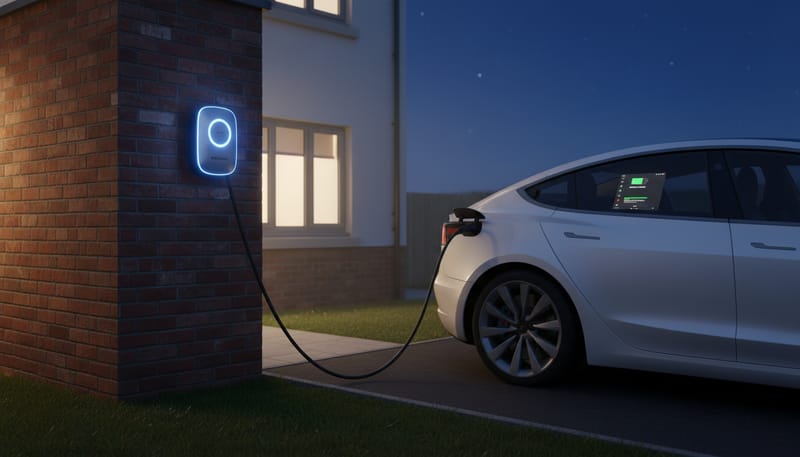
Why EV Charging Matters for New Build Homes
The UK’s transition to electric vehicles is accelerating at a remarkable pace. With the government’s ban on new petrol and diesel car sales taking effect from 2035, and over 1 million pure electric vehicles already on UK roads, having a home charging solution is rapidly shifting from a “nice to have” to an essential feature. For buyers of new build homes, the good news is that legislation now guarantees you will have EV charging infrastructure from day one.
Since June 2022, Part S of the Building Regulations requires all new homes in England with associated parking to be fitted with an electric vehicle charge point. This applies to every new dwelling, whether a detached house, semi-detached, terraced, or apartment with a dedicated parking space. Scotland and Wales have introduced similar requirements. This means that every new build home you consider purchasing will come with a charge point already installed — a significant advantage over older properties where retrofitting can cost between £800 and £1,200.
Home charging is by far the most cost-effective way to power an electric vehicle. Charging at home on a standard electricity tariff costs approximately 3p per mile, compared to around 15p per mile at public rapid chargers and roughly 16p per mile for a petrol car. Over the course of a year, that translates to substantial savings that make a meaningful difference to your household budget.
Beyond the direct cost savings, home charging offers unmatched convenience. You simply plug in when you arrive home and wake up to a fully charged vehicle every morning. There is no need to plan routes around charging stations, queue at rapid chargers, or pay premium rates at motorway services. For most drivers who cover an average of 7,400 miles per year, a home charge point is all you will ever need for your daily driving requirements.
Part S Building Regulations: What Developers Must Provide
The introduction of Approved Document S to the Building Regulations in June 2022 was a landmark moment for EV infrastructure in the UK. Understanding exactly what the regulations require will help you assess the charging provision at any new build development you are considering.
Key Requirements of Part S
- Every new home with associated parking must have at least one EV charge point with a minimum rated output of 7kW. This means a Mode 3 or Mode 4 dedicated EV charger, not a standard 3-pin socket.
- The charge point must be untethered (with a universal Type 2 socket) unless the buyer specifically requests a tethered unit with a fixed cable.
- Cable routes must be installed even where a charge point is not physically fitted — for example, in communal parking areas where each space may not get its own charger immediately. These cable routes ensure future installation is straightforward and affordable.
- The electrical supply must support the charge point without requiring expensive upgrades. The developer must ensure the distribution board and meter have adequate capacity for the 7kW load.
- Apartments and communal parking require cable routes to at least 20% of spaces, with charge points where a 1:1 relationship between parking space and dwelling exists.
- Smart functionality is mandatory — all charge points must be capable of connecting to the internet, responding to grid signals, and allowing users to schedule charging times.
The practical impact is significant. New build purchasers receive a fully compliant charge point at no additional cost, with wiring, circuit protection, and electrical capacity all designed in from the outset — avoiding the £800–£1,200 retrofit cost older homes face.
New Build vs Retrofit: EV Charging Comparison
| Requirement | New Build (Part S) | Older Property (Retrofit) |
|---|---|---|
| Charge point provided | Yes – included as standard | No – must purchase and install separately |
| Minimum power output | 7kW (32A single-phase) | Varies – depends on existing supply |
| Electrical capacity | Pre-designed for EV load | May need supply upgrade (£1,000–£3,000) |
| Cable routing | Built into walls and structure | Surface-mounted or channelled after build |
| Cost to buyer | £0 (included in purchase price) | £800–£1,200 for charger and installation |
| Smart functionality | Required – must be smart-enabled | Optional – depends on unit chosen |
| Building control sign-off | Part of overall building inspection | Separate notification may be required |
Part S also requires charge points to be smart-enabled — capable of connecting to the internet and allowing scheduled charging. This is crucial for off-peak tariffs that can slash charging costs by up to 70%. For the broader regulatory picture, our guide to the Future Homes Standard explains how building regulations are evolving.
Wallbox Types and Specifications
Not all EV chargers are created equal. The type of wallbox installed at your new build home will affect your charging speed, running costs, and overall user experience. Here is a comprehensive breakdown of the main charger types and what they mean for everyday use.
Charging Speeds Compared
| Charger Type | Power Output | Charge Time (60kWh battery) | Typical Use | Cost (Retrofit) |
|---|---|---|---|---|
| 3-pin plug (Mode 2) | 2.3kW | ~26 hours (0–100%) | Emergency only | £0 (uses existing socket) |
| Home wallbox 7kW (Mode 3) | 7kW | ~8.5 hours (0–100%) | Overnight home charging | £800–£1,200 |
| Home wallbox 22kW (Mode 3) | 22kW | ~3 hours (0–100%) | Fast home charging (3-phase) | £1,200–£2,000 + 3-phase supply |
| Public AC charger | 7–22kW | 3–8.5 hours | Destination charging | 25–45p per kWh |
| Public rapid DC | 50–150kW | 30–60 minutes (10–80%) | Motorway services, en route | 60–85p per kWh |
| Ultra-rapid DC | 150–350kW | 15–30 minutes (10–80%) | Fastest public option | 70–90p per kWh |
7kW vs 22kW Home Chargers
The standard home charger installed under Part S regulations is a 7kW unit, which operates on a single-phase electrical supply — the standard supply found in virtually all UK homes. This provides a charging speed that will fully replenish most EV batteries overnight (typically 6–10 hours depending on battery size).
A 22kW charger requires a three-phase electrical supply, which is not standard in UK homes. While some new build developments may offer three-phase connections as an upgrade, it is uncommon and adds significant cost. For the vast majority of new build buyers, a 7kW charger is perfectly adequate. Consider that the average UK driver covers around 20 miles per day — a 7kW charger can replenish that in just over an hour.
Tethered vs Untethered Chargers
- Tethered chargers have a permanently attached cable. You simply grab the cable and plug it into your car. This is the most convenient option if all vehicles in the household use the same connector type (virtually all modern EVs use Type 2 in the UK).
- Untethered chargers have a socket on the unit, and you use your own cable. This is more versatile if different vehicles with different connector types might need to charge, and means the cable can be stored securely when not in use.
Most new build installations are untethered with a Type 2 socket, as this is the Part S default. If you prefer a tethered unit, speak to your developer before completion as some may accommodate this request at no extra cost. For broader guidance on what to ask for, our guide to developer upgrades worth choosing covers the options typically available.
Smart Charging and Electricity Tariffs
One of the most significant financial advantages of home EV charging is the ability to use smart charging combined with an EV-specific electricity tariff. This combination can reduce your per-mile charging cost to as little as 2p per mile — less than a fifth of the cost of driving a petrol car.
How Smart Charging Works
Smart chargers connect to your home Wi-Fi and are controlled via a smartphone app. This allows you to schedule charging for off-peak hours when electricity is cheapest, typically between midnight and 5am. Under Part S, all charge points fitted to new builds must be smart-enabled, so this functionality comes as standard.
Smart charging also enables load management, which is particularly important in new build homes. Load management ensures that the EV charger and other high-power appliances (such as the oven, heat pump, or immersion heater) do not all draw maximum power simultaneously, which could trip the main fuse. The charger automatically reduces its output when other demands are high and increases when capacity is available.
Best EV Tariffs for Home Charging
| Tariff | Provider | Off-Peak Rate | Off-Peak Hours | Peak Rate | Annual Cost (8,000 mi) |
|---|---|---|---|---|---|
| Intelligent Octopus Go | Octopus Energy | 7.5p per kWh | 23:30–05:30 + smart slots | 24.5p per kWh | ~£180 |
| Octopus Go | Octopus Energy | 7.5p per kWh | 00:30–04:30 | 27p per kWh | ~£195 |
| EV Drive | EDF Energy | 8p per kWh | 00:00–07:00 | 25p per kWh | ~£200 |
| EV One | British Gas | 8.5p per kWh | 00:00–05:00 | 26p per kWh | ~£210 |
| Standard variable tariff | Various | N/A (flat rate) | N/A | 24.5p per kWh | ~£590 |
The savings are dramatic. On Octopus Intelligent Go, charging an EV for 8,000 miles per year costs approximately £180. The same distance in a petrol car averaging 40mpg at £1.40 per litre would cost around £1,460. Even on a standard electricity tariff, the EV costs just £590 per year — still a saving of £870 annually.
Annual Fuel Cost Comparison
Based on 8,000 miles per year. EV consumption: 3 miles per kWh. Petrol: 40mpg at £1.40 per litre. Rates as of 2024/25.
Recommended Smart Chargers
Several leading smart charger brands are commonly installed by new build developers, each offering app-based scheduling, energy monitoring, and tariff integration:
- Ohme Home Pro: Designed for EV tariff integration. Automatically shifts charging to the cheapest slots on Intelligent Octopus Go. Real-time cost tracking via app.
- Zappi (myenergi): UK-designed and manufactured. Offers solar diversion mode that prioritises free solar energy for charging. Compatible with the myenergi ecosystem.
- Pod Point Solo 3: Popular with developers for reliability and clean design. 7kW output with built-in smart scheduling. No subscription fees.
- Easee One: Compact Scandinavian design with load balancing built in. Suited to developments with multiple charge points.
- Wallbox Pulsar Plus: Compact unit with Bluetooth and Wi-Fi. Power sharing capability when multiple units are installed.
Solar Integration and Battery Storage
For new build homeowners with solar panels, integrating your EV charger with your solar generation system can make driving almost free. This is particularly appealing in new builds, where solar PV, battery storage, and EV charging can all be designed to work together from the outset.
How Solar EV Charging Works
A solar-compatible EV charger (such as the Zappi) can detect when your solar panels are generating surplus electricity and automatically divert that energy to your car. Rather than exporting excess solar power to the grid at 4–5p per kWh, you use it to charge your vehicle — effectively getting free fuel.
A typical 4kW solar PV system generates approximately 3,400–4,000 kWh per year. Diverting surplus to your EV could realistically provide 3,000–5,000 miles of free driving annually, depending on daytime availability and driving patterns.
Solar + EV Charging Economics
| Scenario | Annual Charging Cost | Miles Charged Free | Total Annual Saving vs Petrol |
|---|---|---|---|
| No solar – standard tariff | £590 | 0 | £870 |
| No solar – EV off-peak tariff | £180 | 0 | £1,280 |
| Solar + off-peak tariff | £95 | ~3,500 | £1,365 |
| Solar + battery + off-peak tariff | £45 | ~5,500 | £1,415 |
Adding a home battery system takes the economics even further. A battery stores surplus solar energy during the day and charges your EV in the evening, even after sunset. Combined with an off-peak tariff for any remaining needs, you can achieve running costs under £50 per year for 8,000 miles.
If your development offers solar panels, the EV charging synergy is well worth considering. Solar PV, battery storage, and an EV charger create a comprehensive energy management system. Our guide to renewable energy in new builds covers all available options.
EV vs Petrol: Complete Running Cost Comparison
The fuel cost savings from an EV are significant, but they are only part of the picture. When you factor in maintenance, road tax, and other running costs, the overall financial case for electric vehicles — particularly when charged at home — becomes even more compelling.
The difference is stark. An EV charged at home on an off-peak tariff can cost as little as £280 per year to run, compared to over £2,000 for an equivalent petrol car. That is a potential saving of up to £1,770 annually, or roughly £150 per month — a meaningful contribution that could help towards your mortgage payments.
Over a 25-year period, those savings accumulate to between £30,000 and £44,000 in today’s money. The combination of a new build home with integrated EV charging puts you in the strongest financial position for the transition to electric motoring.
Developer Installations and Upgrade Options
Different new build developers take different approaches to EV charging. While Part S mandates a minimum standard, many housebuilders go beyond the basics to offer enhanced charging solutions as standard or as optional upgrades.
Developer EV Charging Provisions
| Developer | Standard Provision | Charger Brand | Upgrade Options |
|---|---|---|---|
| Barratt Homes | 7kW smart charger to all houses with parking | Pod Point / Rolec | Tethered cable option available |
| Taylor Wimpey | 7kW smart charger on all homes | Various (site-dependent) | Solar + EV bundle on select sites |
| Persimmon | 7kW charge point as standard | Rolec / EO | Cable routes for second charger |
| Bellway | 7kW untethered smart charger | Pod Point | Solar PV + charger packages |
| Berkeley Group | 7kW smart charger, some sites 22kW | Wallbox / Pod Point | V2G-ready installations |
| Redrow | 7kW charge point with smart functionality | Ohme / Pod Point | Solar integration packages |
| Countryside Partnerships | 7kW with solar diversion capability | Zappi / Ohme | Full energy management system |
When purchasing a new build, it is worth asking your sales advisor several key questions about the EV charging provision:
- Which brand and model of charger is fitted? This affects app functionality, tariff compatibility, and future software updates.
- Is the charger tethered or untethered? Can this be changed if you prefer the alternative?
- Is there capacity for a second charge point? If you have two EVs (or plan to in the future), check whether the electrical supply can support a second charger.
- Is the charger solar-compatible? If solar panels are fitted or available as an upgrade, confirm the charger can accept surplus solar generation.
- What warranty is provided? Most chargers come with a 3-year manufacturer warranty, but some developers offer extended coverage.
- Is load management included? Particularly important if the home has a heat pump, as both devices draw significant power.
Practical Considerations for Home EV Charging
Beyond the technical specifications and cost comparisons, there are several practical factors that new build buyers should consider when thinking about their EV charging setup.
Charging Location and Cable Routing
In a new build home, the charge point is typically positioned on the front or side elevation, close to where you park. For homes with a garage, the charge point is often located inside or on the exterior wall adjacent to it. For homes with driveway-only parking, the charge point is usually mounted on the front elevation of the house.
Weather and Safety
All EV chargers installed under Part S must carry an IP rating of at least IP54, meaning they are protected against water splashes from any direction. You can safely charge in rain, snow, or any weather conditions. The system includes multiple layers of electrical protection including RCD and overcurrent protection.
Charging Habits and Battery Care
- Charge to 80% for daily use: Most EV manufacturers recommend charging to 80% for everyday driving and only charging to 100% before long journeys. Smart chargers can be set to stop at your preferred level automatically.
- Plug in regularly: It is better for battery health to top up frequently rather than letting the battery drain to a low state of charge before doing a full charge.
- Use scheduled charging: Set your charger to operate during off-peak hours (typically midnight to 5am). This not only saves money but reduces strain on the electricity grid during peak demand periods.
- Pre-condition while plugged in: In winter, use your car’s pre-conditioning feature while still connected to the charger. This warms the cabin and battery using mains power rather than depleting the battery, giving you more range for your journey.
- Monitor your usage: Most smart charger apps provide detailed reports on energy consumption and cost per charge. Use these to optimise your charging pattern.
Impact on Your Energy Bill and EPC Rating
Adding an EV will increase your electricity consumption by approximately 2,400–2,700 kWh per year for 8,000 miles of driving. On an off-peak tariff at 7.5p per kWh, this adds just £180–£200 to your annual electricity bill — a fraction of the £1,460 you would spend on petrol.
EV charging does not affect your home’s EPC rating. The EPC measures building energy efficiency, not vehicle energy consumption. Your new build’s rating remains unchanged regardless of charging. For guidance on managing your overall utility bills and running costs in a new build, see our dedicated guide.
Frequently Asked Questions
Do all new build homes come with an EV charger?
Under Part S of the Building Regulations (effective since June 2022), all new homes in England with associated parking must be fitted with at least one EV charge point rated at a minimum of 7kW. Scotland and Wales have similar requirements. If your new build has a driveway or garage, it will come with a charger as standard at no additional cost to you.
Can I choose which EV charger brand is installed?
This varies by developer. Some offer a choice of charger brands, while others install a standardised unit across the development. If you have a strong preference — for example, you want a Zappi for solar integration or an Ohme for tariff optimisation — discuss this with your sales advisor early in the buying process. Changes are easier and cheaper before construction is complete.
How much does it cost to charge an EV at home?
On a standard electricity tariff (approximately 24.5p per kWh), charging an EV costs around 8p per mile. On a dedicated EV off-peak tariff such as Octopus Intelligent Go (7.5p per kWh off-peak), the cost drops to approximately 2.5–3p per mile. For 8,000 miles per year, this translates to between £180 and £590 annually depending on your tariff. Charging a typical 60kWh EV battery from empty to full costs between £4.50 and £14.70 depending on the rate.
Will charging an EV overload my new build’s electrical supply?
No. Under Part S, the developer ensures the electrical supply is adequate for the charge point. New builds are designed with the EV load factored in. Most UK homes have a 100A main fuse, which comfortably supports a 7kW (32A) charger alongside normal household loads. Smart load management provides additional protection by adjusting speed based on demand.
Can I install a second EV charger if I have two electric cars?
Yes, in most cases a second charger can be installed, though you should check the electrical capacity of your supply. Some developers pre-install cable routes for a second charge point. If your home has a 100A supply, running two 7kW chargers simultaneously may require load management. A qualified electrician can assess your situation and recommend the best approach.
Making the Most of Your New Build’s EV Charging
Electric vehicle charging at a new build home represents one of the most practical and financially rewarding aspects of modern house construction. Thanks to Part S Building Regulations, every new home with parking now comes equipped with a smart charge point at no additional cost — an advantage worth £800 to £1,200 compared to retrofitting an older property.
The financial case for home EV charging is compelling. By combining a new build home’s integrated charger with an off-peak electricity tariff, you can drive for as little as 2–3p per mile, saving over £1,200 per year compared to a petrol car. Adding solar panels and battery storage can reduce that cost even further, potentially to under £50 per year.
When evaluating developments, consider the charger brand, solar integration potential, and tariff optimisation. These factors, combined with the excellent energy efficiency of modern new builds, deliver significant savings across energy and transport costs.
Explore our guides on heat pumps, the Future Homes Standard, and insulation. Browse available new build homes or read our first-time buyer guide to understand every step from deposits to completion.