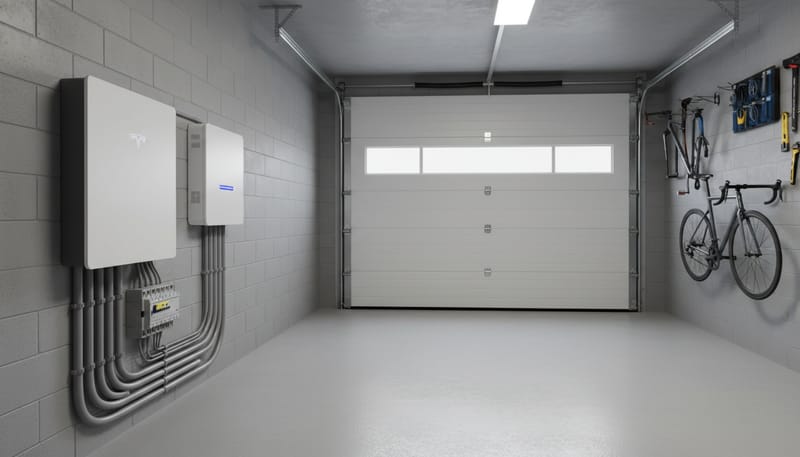
What Is Home Battery Storage?
Home battery storage systems allow you to store electricity for use at a later time, rather than consuming it the moment it is generated or drawn from the grid. In a new build home, a battery typically works alongside solar panels to capture surplus energy generated during daylight hours and release it during the evening when electricity demand (and cost) peaks.
The concept is straightforward: solar panels generate the most electricity during the middle of the day, but most households use the most energy in the morning and evening. Without a battery, surplus solar energy is exported to the grid at a relatively low rate (typically 4–15p per kWh under the Smart Export Guarantee). With a battery, that same energy can be stored and used later, displacing expensive grid electricity that costs 24–30p per kWh. The financial saving is the difference between what you would have been paid for exporting and what you would have paid to import — typically 15–25p per kWh saved on every stored unit.
For new build homeowners, battery storage represents one of the most impactful upgrade investments you can make, particularly when combined with solar PV. It increases your energy self-sufficiency, reduces your energy bills, lowers your carbon footprint, and provides backup power during grid outages.
How Home Batteries Work
A home battery system consists of several key components:
- Battery cells: Lithium-ion cells (the same technology used in electric vehicles) that store electrical energy chemically. These are arranged in modules within a weatherproof enclosure.
- Inverter: Converts DC electricity from the battery and solar panels into AC electricity used by your home. Some batteries have integrated inverters (AC-coupled), while others require a separate hybrid inverter (DC-coupled).
- Battery management system (BMS): Monitors cell voltage, temperature, and state of charge to optimise performance and prevent damage.
- Smart energy management: Software that determines when to charge, discharge, or hold energy based on your usage patterns, electricity tariff, and solar generation forecast.
- Gateway or controller: Connects the battery to your home network and the manufacturer’s cloud platform, enabling remote monitoring via a smartphone app.
Battery Systems Compared: Tesla, GivEnergy, Fox ESS, and More
The UK home battery market has matured significantly, with several well-established manufacturers offering reliable systems suitable for new build homes. Below is a comprehensive comparison of the leading systems available in 2024/25.
Leading Home Battery Systems
| System | Usable Capacity | Power Output | Dimensions | Warranty | Installed Cost (est.) |
|---|---|---|---|---|---|
| Tesla Powerwall 2 | 13.5 kWh | 5 kW continuous / 7 kW peak | 1150 x 753 x 147 mm | 10 years (unlimited cycles) | £7,500–£9,000 |
| Tesla Powerwall 3 | 13.5 kWh | 11.5 kW continuous | 1098 x 609 x 193 mm | 10 years (unlimited cycles) | £8,000–£9,500 |
| GivEnergy 5.2 | 5.2 kWh | 2.6 kW continuous | 480 x 680 x 190 mm | 12 years | £3,500–£4,500 |
| GivEnergy 9.5 | 9.5 kWh | 3.6 kW continuous | 480 x 1010 x 190 mm | 12 years | £5,500–£6,500 |
| Fox ESS ECS 5.76 | 5.76 kWh | 2.88 kW continuous | 480 x 670 x 200 mm | 10 years | £3,000–£4,000 |
| Fox ESS ECS 11.52 | 11.52 kWh | 5.76 kW continuous | 480 x 1170 x 200 mm | 10 years | £5,000–£6,500 |
| SolaX T-BAT 5.8 | 5.8 kWh | 2.5 kW continuous | 476 x 670 x 190 mm | 10 years | £3,200–£4,200 |
| Huawei LUNA 2000 10 | 10 kWh | 5 kW continuous | 670 x 150 x 600 mm (per module) | 10 years | £5,500–£7,000 |
| BYD HVS 10.2 | 10.2 kWh | 10.2 kW continuous | 585 x 298 x 628 mm (per module) | 10 years | £5,000–£6,500 |
Prices shown are approximate installed costs including the hybrid inverter where required. Actual costs depend on your installer, location, and the complexity of the installation. All prices exclude solar panel costs.
Which System Is Best for a New Build?
For most new build homes, the choice between systems depends on three key factors:
- Capacity: A typical 3–4 bedroom home with a 4kW solar system benefits most from a 5–10 kWh battery. Larger batteries (10–13.5 kWh) make more sense for bigger homes or those with higher electricity consumption, such as homes with heat pumps or EV chargers.
- Budget: Systems range from £3,000 for entry-level 5 kWh units to £9,500 for premium 13.5 kWh units. The payback period is typically 7–12 years regardless of size, as larger batteries save proportionally more.
- Integration: If your new build comes with solar panels pre-installed, check which inverter brand is fitted. Choosing a battery from the same manufacturer (or one that integrates seamlessly) simplifies installation and ensures optimal system performance.
Costs, Savings, and Payback Analysis
The financial case for home battery storage has improved substantially over the past two years, driven by rising electricity prices, falling battery costs, and the emergence of smart tariff arbitrage opportunities. Here is a detailed breakdown of the potential savings and payback for different scenarios.
Payback Analysis by Scenario
| Scenario | Battery Cost | Annual Saving | Payback Period | 10-Year Net Saving |
|---|---|---|---|---|
| 5 kWh battery with 4kW solar (standard tariff) | £3,500 | £350–£450 | 8–10 years | £0–£1,000 |
| 10 kWh battery with 4kW solar (standard tariff) | £5,500 | £500–£650 | 8.5–11 years | £0–£1,000 |
| 13.5 kWh battery with 4kW solar (standard tariff) | £8,000 | £550–£700 | 11.5–14.5 years | £-1,000–£-500 |
| 5 kWh battery with solar + Octopus Go | £3,500 | £550–£700 | 5–6.5 years | £2,000–£3,500 |
| 10 kWh battery with solar + Octopus Agile | £5,500 | £700–£950 | 5.8–7.8 years | £1,500–£4,000 |
| 10 kWh battery with solar + heat pump + Octopus Go | £5,500 | £800–£1,100 | 5–6.9 years | £2,500–£5,500 |
The most important takeaway is that time-of-use tariffs dramatically improve the economics of battery storage. With a standard flat-rate tariff, a battery can only save money by storing excess solar energy. But with a time-of-use tariff, the battery can also charge from cheap overnight grid electricity (as low as 7.5p per kWh on Octopus Go) and discharge during expensive peak hours (24–40p per kWh on Octopus Agile). This tariff arbitrage can double the annual savings compared to solar self-consumption alone.
How Savings Break Down
Annual savings from a home battery come from three sources:
- Solar self-consumption increase: Without a battery, a typical home self-consumes 30–50% of solar generation. With a battery, this rises to 70–85%. Each additional kWh self-consumed saves 15–25p versus exporting and reimporting.
- Tariff arbitrage: Charging from cheap overnight electricity (7.5p per kWh on Octopus Go) and using it during the day (avoiding 24–30p per kWh peak rate) saves 16–22p per kWh per cycle. Over a year, a 10 kWh battery cycling daily saves £350–£500 from arbitrage alone.
- Export optimisation: Some smart systems can choose to export solar energy during periods of high grid prices (e.g., 15–30p per kWh on Octopus Agile during winter evenings) rather than at the standard SEG rate of 4–8p per kWh.
Pairing Battery Storage with Solar Panels
Battery storage and solar panels are a natural combination — each technology enhances the value of the other. For new build homes, the opportunity to install both systems from the outset offers several advantages over retrofitting.
Self-Consumption with and without Battery
| System Configuration | Self-Consumption Rate | Grid Dependence | Annual Import Reduction |
|---|---|---|---|
| No solar, no battery | 0% | 100% | — |
| 4kW solar only | 30–50% | 50–70% | 1,200–1,800 kWh |
| 4kW solar + 5 kWh battery | 60–75% | 25–40% | 2,200–2,800 kWh |
| 4kW solar + 10 kWh battery | 70–85% | 15–30% | 2,600–3,200 kWh |
| 6kW solar + 13.5 kWh battery | 75–90% | 10–25% | 3,500–4,500 kWh |
As the table shows, adding a 10 kWh battery to a 4kW solar system can increase self-consumption from around 40% to around 80% — doubling the amount of free solar energy used directly in the home. This not only saves money but also reduces your carbon footprint by displacing grid electricity with clean solar power.
VAT Benefits: 0% on Battery with Solar
One of the most significant financial incentives for battery storage is the 0% VAT rate applied to energy-saving materials installed in residential properties. Since April 2022, battery storage systems installed alongside solar panels benefit from zero-rated VAT, saving you 20% on the total cost. This means a battery system costing £5,500 (including installation) saves you £1,100 compared to the previous VAT rate.
To qualify for 0% VAT, the battery must be installed as part of a solar PV system (either simultaneously or added to an existing solar installation). Standalone battery systems without solar also qualify for 0% VAT under the current rules, which are in effect until at least March 2027.
Installation During Construction vs Retrofit
Installing a battery system during the construction of your new build offers several advantages:
- Lower installation costs: Wiring and mounting can be integrated during the build, avoiding the need to route cables through finished walls and ceilings. This can save £300–£800 on installation labour.
- Optimised placement: The battery, inverter, and consumer unit can be located in the ideal position (typically the garage or utility room) without compromising the interior design.
- Integrated with developer solar: If your new build comes with solar panels pre-installed, the battery can be wired directly into the existing solar inverter system.
- Single warranty coordination: Having the solar and battery installed by the same provider simplifies warranty claims and ongoing support.
Smart Energy Management and Tariff Arbitrage
The real power of a home battery lies not just in storing solar energy but in the smart energy management capabilities that come with modern systems. These intelligent features can maximise your savings well beyond simple solar self-consumption.
Time-of-Use Tariff Arbitrage
Time-of-use electricity tariffs charge different rates depending on when you consume electricity. For battery owners, these tariffs unlock a powerful saving strategy: charge the battery during cheap periods and discharge during expensive ones. The two most popular tariffs for battery owners are:
- Octopus Go: Offers a flat cheap rate of around 7.5p per kWh for four hours overnight (typically 00:30–04:30), with a standard rate of around 24p per kWh at all other times. Ideal for EV owners with an EV charger and battery storage.
- Octopus Agile: A half-hourly variable rate that tracks wholesale electricity prices. Rates can go as low as 0–5p per kWh during overnight periods and as high as 35–100p per kWh during peak demand. Smart batteries can be programmed to charge during the cheapest slots and avoid or export during the most expensive.
Smart Features of Modern Battery Systems
Modern battery management systems offer a range of intelligent features that maximise value:
- Weather-aware charging: Systems like the Tesla Powerwall use weather forecast data to predict solar generation and optimise charging. If a cloudy day is forecast, the battery will charge more from cheap overnight grid electricity to compensate.
- Load shifting: The battery monitors household consumption and automatically discharges during high-demand periods (cooking, heating, EV charging) to avoid drawing expensive peak-rate electricity.
- Export optimisation: On tariffs like Octopus Agile, the system can choose the most profitable time to export surplus solar energy, selling at 20–30p per kWh rather than the standard 4–8p SEG rate.
- Grid services participation: Some battery systems can enrol in grid balancing services, earning additional income by providing flexibility to the National Grid. Schemes like Octopus Energy’s Powerups pay battery owners to charge or discharge at specific times.
- Backup power: Most modern batteries can provide emergency backup power during grid outages. The Tesla Powerwall and GivEnergy systems can detect a power cut within milliseconds and switch to battery power, keeping essential circuits running until the grid is restored.
Battery Degradation, Warranty, and Lifespan
Like all lithium-ion batteries, home energy storage systems gradually lose capacity over time. Understanding degradation rates, warranty terms, and expected lifespan is essential for calculating the true long-term value of your investment.
How Batteries Degrade
Lithium-ion batteries degrade primarily through charge/discharge cycling and calendar aging. Each full charge-discharge cycle causes a small amount of irreversible chemical change in the cells, slightly reducing their capacity. Calendar aging occurs simply through the passage of time, even if the battery is not being used.
In practice, most home batteries will retain 70–80% of their original capacity after 10 years of typical use (one cycle per day). This means a 10 kWh battery will still provide 7–8 kWh of usable storage after a decade — still very functional and financially viable.
Warranty Comparison
| System | Warranty Period | Capacity Guarantee | Cycle Limit | Throughput Guarantee |
|---|---|---|---|---|
| Tesla Powerwall 2/3 | 10 years | 70% of original capacity | Unlimited | 37.8 MWh (Powerwall 2) |
| GivEnergy 5.2/9.5 | 12 years | 70% of original capacity | 6,000 cycles | N/A |
| Fox ESS ECS | 10 years | 70% of original capacity | 6,000 cycles | N/A |
| Huawei LUNA 2000 | 10 years | 70% of original capacity | Unlimited (within warranty) | N/A |
| BYD HVS | 10 years | 60% of original capacity | Unlimited | N/A |
GivEnergy stands out with a 12-year warranty — the longest in the UK residential market. Tesla offers unlimited cycles, which is valuable if you plan to cycle the battery aggressively (for example, two cycles per day with tariff arbitrage and solar self-consumption combined).
Beyond the Warranty
Most home batteries will continue to function well beyond their warranty period. Experience from the electric vehicle industry (which uses identical lithium-ion cell chemistry) suggests that modern NMC and LFP cells can achieve 3,000–8,000 cycles before reaching 70% capacity. For a home battery cycling once per day, that translates to 8–22 years of useful life. Batteries using lithium iron phosphate (LFP) chemistry (used by GivEnergy and BYD, among others) tend to achieve the highest cycle counts and longest lifespans.
At end of life, home battery cells can be recycled to recover valuable materials including lithium, cobalt, nickel, and manganese. Several UK-based recycling companies now accept lithium-ion battery modules, and the regulatory framework for battery recycling is being strengthened under the UK’s post-Brexit battery regulations.
Developer Installation Options for New Builds
An increasing number of UK housebuilders are offering battery storage as a standard feature or optional upgrade on their new developments. This trend is being driven by the Future Homes Standard, which makes it very difficult to achieve the required carbon reductions without on-site renewable energy generation and storage.
What Developers Are Offering
The availability of battery storage varies by developer and development, but the general trend is clear:
- Solar + battery packages: Some developers now offer combined solar panel and battery packages as standard or as a premium upgrade option. Berkeley Group and Countryside Partnerships have been among the leaders in integrating renewable energy into their standard specifications.
- Battery-ready wiring: Even where a battery is not included, many developers are pre-wiring new homes for future battery installation, including space in the garage or utility room and conduit for DC cabling. This significantly reduces the cost of adding a battery later.
- Whole-home energy systems: Premium developments may include fully integrated energy systems combining solar panels, battery storage, a heat pump, an EV charger, and a central smart energy management system that optimises the interaction between all components.
Questions to Ask Your Developer
- Does the development include solar panels as standard? If so, what size system?
- Is battery storage included or available as an upgrade? What brand and capacity?
- If the home is battery-ready, what preparation has been done (wiring, space allocation, consumer unit capacity)?
- What inverter brand is installed? (This affects battery compatibility.)
- Does the warranty for the solar and battery system transfer to the homeowner?
- Can the battery provide backup power during grid outages, or is it grid-tied only?
- Is the system compatible with time-of-use tariffs for tariff arbitrage?
If your developer does not offer battery storage but does include solar panels, it is worth asking about negotiating the inclusion of battery-ready wiring as part of your purchase package. This small addition during construction can save considerable expense if you choose to add a battery in the future.
Frequently Asked Questions
How much does a home battery system cost in the UK?
Home battery systems range from approximately £3,000 for a 5 kWh system to £9,500 for a 13.5 kWh Tesla Powerwall, fully installed. These prices include the battery unit, inverter (where required), installation labour, and commissioning. Prices benefit from 0% VAT when installed alongside solar panels. The overall cost has fallen by approximately 30–40% since 2020 and is expected to continue declining as battery manufacturing scales up globally.
How long does a home battery last?
Most home batteries come with a 10–12 year warranty guaranteeing at least 70% capacity retention. In practice, modern lithium-ion batteries are expected to last 15–20+ years before reaching end of useful life. LFP (lithium iron phosphate) chemistry batteries, used by GivEnergy and BYD, tend to offer the longest lifespans with higher cycle counts than NMC alternatives.
Can a home battery power my whole house during a blackout?
It depends on the system. The Tesla Powerwall 2 and 3 can provide whole-home backup power during grid outages. GivEnergy systems can also provide backup functionality with an additional EPS (Emergency Power Supply) unit. However, the duration of backup depends on your battery capacity and energy consumption — a fully charged 13.5 kWh battery could power essential loads (lights, fridge, router) for 10–24 hours, but would deplete much faster if heating or cooking loads are included.
Is it worth getting a battery without solar panels?
Yes, particularly if you are on a time-of-use electricity tariff like Octopus Go or Agile. A battery can charge from cheap overnight electricity (7.5p per kWh) and discharge during expensive peak hours (24–40p per kWh), saving £300–£500 per year through tariff arbitrage alone. However, the strongest financial case is for battery plus solar, where both self-consumption and tariff arbitrage savings combine.
Do I need planning permission for a home battery?
No. Home battery systems are classed as permitted development in England and Wales, meaning no planning permission is required for domestic installations. The battery must be installed by an MCS-certified (Microgeneration Certification Scheme) installer to qualify for 0% VAT and to meet building regulations requirements. For new builds, the developer’s installer will handle all certifications.
Is Battery Storage Right for Your New Build Home?
Battery storage has moved from a niche technology for early adopters to a genuinely cost-effective investment for UK homeowners, particularly those with solar panels and access to time-of-use electricity tariffs. For new build buyers, the opportunity to install a battery during construction — at lower cost and with 0% VAT — makes the financial case even more compelling.
A well-chosen battery system can increase your solar self-consumption from 40% to over 80%, save £500–£1,100 per year on electricity bills (depending on tariff and usage), reduce your carbon footprint, and provide backup power security. Combined with a heat pump and smart energy management, battery storage is a key component of the emerging net zero home.
When choosing your new build, ask about battery options and renewable energy packages. If the developer does not offer battery storage, ensure the home is at least battery-ready with appropriate wiring and space allocation. For a broader view of how all the energy technologies fit together, explore our guide to renewable energy options for new build homeowners.