Why Water Recycling Matters for New Build Homes
Water is an increasingly precious resource in the UK. Despite the country’s reputation for rain, many regions — particularly the South East and East of England — are classified as seriously water-stressed by the Environment Agency. With the UK population projected to grow by 4 million by 2030 and climate change altering rainfall patterns, the pressure on mains water supply is only going to intensify.
This is where rainwater harvesting and grey water recycling come in. These systems capture and reuse water that would otherwise be lost, reducing your dependence on mains water, lowering your water bills, and helping the environment. For new build home buyers, these technologies are becoming increasingly common as developers respond to tighter Building Regulations, water efficiency targets, and buyer demand for sustainable homes.
The average UK household uses approximately 142 litres of water per person per day. Current Building Regulations require new homes to achieve a target of no more than 125 litres per person per day, and many local authorities in water-stressed areas set an even tighter target of 110 litres. Rainwater harvesting and grey water systems help developers and homeowners meet and exceed these targets while delivering genuine financial savings.
This guide explains how both technologies work, what they cost, how much they save, and what to look for when buying a new build home with these systems. We cover everything from simple water butts to fully integrated underground tank systems and explain the water efficiency regulations that are driving adoption.
How Rainwater Harvesting Works
Rainwater harvesting is the collection, storage, and use of rainwater that falls on your roof. Instead of letting this water flow into the storm drain, it is captured via your gutters and downpipes, filtered, and stored in a tank for non-potable (non-drinking) uses around the home and garden.
Components of a Rainwater Harvesting System
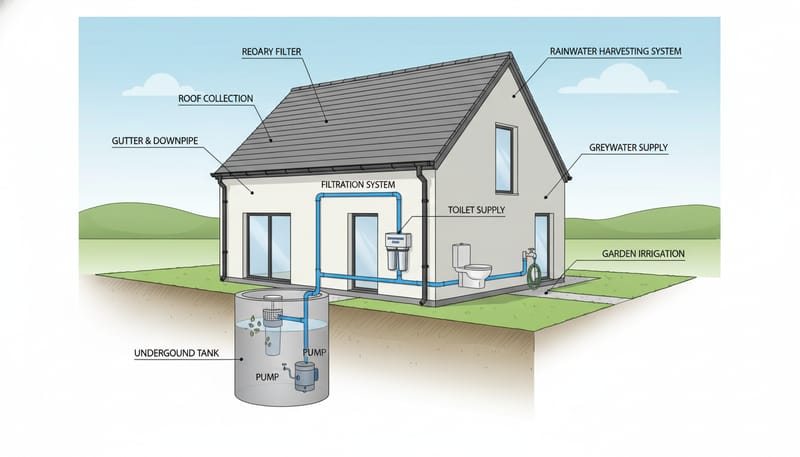
A complete rainwater harvesting system consists of several key components:
- Collection surface: Your roof acts as the collection area. The larger the roof area, the more water you can collect. A typical 3-bedroom house with a 70m² roof can collect approximately 42,000–56,000 litres per year in an average UK rainfall area
- Gutters and downpipes: Standard guttering directs water to the filtration and storage system. A diverter valve or filter unit is fitted to the downpipe
- Filtration: A pre-tank filter removes leaves, debris, and sediment before water enters the storage tank. Self-cleaning filters require minimal maintenance
- Storage tank: Typically an underground polyethylene or concrete tank ranging from 1,500 to 5,000 litres for domestic use. Underground tanks keep water cool and dark, preventing algae growth
- Pump and controls: A submersible or external pump delivers stored rainwater to the home at mains-equivalent pressure. A control unit manages the pump and switches to mains backup when the tank is empty
- Mains backup: A trickle-feed mains water connection ensures supply during dry periods. This must include an appropriate air gap to comply with water regulations
- Distribution pipework: Separate pipework (clearly marked and not connected to the drinking water supply) delivers rainwater to WC cisterns, washing machines, and outdoor taps
Types of Rainwater Harvesting Systems
| System Type | Typical Cost (Installed) | Storage Capacity | Best For | Annual Water Savings |
|---|---|---|---|---|
| Water butt | £30 – £100 | 100 – 300 litres | Garden watering only | Up to 5,000 litres |
| Above-ground tank | £500 – £1,500 | 500 – 2,000 litres | Garden watering and car washing | 5,000 – 15,000 litres |
| Underground direct system | £2,000 – £3,500 | 1,500 – 3,000 litres | WC flushing, garden, washing machine | 25,000 – 40,000 litres |
| Underground indirect system | £3,000 – £5,000 | 3,000 – 5,000 litres | Whole-house non-potable supply | 35,000 – 55,000 litres |
| Commercial/multi-home | £8,000 – £20,000+ | 10,000 – 50,000 litres | Apartment blocks, shared systems | Variable by building size |
Direct systems pump water directly from the underground tank. Indirect systems pump water to a header tank in the loft, which then gravity-feeds to outlets. Indirect systems provide more consistent pressure.
What Can Rainwater Be Used For?
Harvested rainwater is suitable for any non-potable use in and around the home. Here is a breakdown of typical household water usage and which activities can use rainwater:
| Water Use | Daily Usage (Per Person) | % of Total | Can Use Rainwater? |
|---|---|---|---|
| WC flushing | 30 litres | 22% | Yes — the biggest saving opportunity |
| Showering/bathing | 40 litres | 28% | No — requires potable water |
| Washing machine | 15 litres | 11% | Yes — rainwater is naturally soft, good for laundry |
| Drinking & cooking | 8 litres | 6% | No — requires potable water |
| Dishwashing | 12 litres | 8% | No — requires potable water |
| Garden watering | 15 litres (seasonal avg) | 11% | Yes — ideal for garden use |
| Cleaning & other | 20 litres | 14% | Partly — outdoor cleaning, car washing |
In total, rainwater can replace approximately 35–45% of your household mains water usage. For a family of four, this equates to around 70,000–90,000 litres per year of mains water saved, which translates to significant reductions in your water bills.
Grey Water Recycling Systems
Grey water is the gently used water from showers, baths, bathroom sinks, and washing machines. Unlike “black water” (from toilets and kitchen sinks), grey water is relatively clean and can be treated and reused for non-potable applications — primarily WC flushing and garden irrigation.
How Grey Water Systems Work
A grey water recycling system collects water from specific outlets, treats it to remove contaminants, and stores it for reuse. The treatment process typically involves:
- Collection: Grey water is diverted from shower, bath, and basin waste pipes to a treatment unit
- Filtration: Mechanical filters remove hair, lint, and larger particles
- Biological treatment: Aerobic bacteria break down organic matter (soaps, skin cells, detergents)
- Disinfection: UV treatment or chlorine dosing kills remaining bacteria to meet water quality standards
- Storage: Treated water is stored in a tank (typically 100–200 litres) for distribution
- Distribution: A pump feeds treated grey water to WC cisterns and garden taps via dedicated pipework
Grey Water vs Rainwater Harvesting
| Feature | Rainwater Harvesting | Grey Water Recycling |
|---|---|---|
| Water source | Rainfall collected from roof | Used water from showers, baths, basins |
| Availability | Weather-dependent (seasonal variation) | Consistent daily supply year-round |
| Treatment needed | Minimal (filtration only) | More complex (biological + UV/chemical) |
| Installation cost | £2,000 – £5,000 | £3,000 – £6,000 |
| Running costs | £30 – £60/year (pump electricity) | £50 – £100/year (pump + treatment) |
| Maintenance | Annual filter clean, 5-yearly tank inspection | Quarterly filter changes, UV lamp replacement |
| Suitable uses | WC, washing machine, garden, car washing | WC flushing, garden irrigation |
| Water saving potential | 35–45% of household water | 25–35% of household water |
| Space required | Underground tank (garden excavation) | Indoor unit (utility room or under floor) |
Combined Systems
For maximum water savings, some new build developments install combined rainwater and grey water systems that can reduce mains water consumption by up to 50–60%. These systems use rainwater for WC flushing and washing machines, while treated grey water supplements supply during dry periods or provides additional capacity for garden irrigation.
Combined systems are most common in apartment blocks and larger developments, where the shared infrastructure makes them more cost-effective per unit. Developers such as Berkeley Group and Countryside Partnerships have incorporated these systems into several London and South East developments, reflecting the region’s water stress classification.
Costs, Savings, and Payback Period
The financial case for water recycling depends on your water bill, the system cost, and how much water you actually save. Here is a detailed breakdown:
Rainwater Harvesting Cost vs Savings
| Item | Rainwater Harvesting (Underground) | Grey Water Recycling |
|---|---|---|
| Installation cost | £2,500 – £5,000 | £3,000 – £6,000 |
| Annual maintenance | £50 – £100 | £100 – £200 |
| Annual electricity cost | £30 – £60 | £50 – £100 |
| Water saved per year | 35,000 – 50,000 litres | 25,000 – 40,000 litres |
| Annual bill saving | £120 – £200 | £90 – £160 |
| Net annual saving | £60 – £100 | £-40 – £60 |
| Payback period | 15 – 30 years | 25 – 40+ years |
Based on average metered water rates for England and Wales 2024/25. Savings are higher in regions with expensive water (South West Water, Southern Water) and for larger households with higher water consumption.
When Water Recycling Makes Financial Sense
On a purely financial basis, the payback periods for domestic water recycling systems can be long. However, several factors improve the financial case:
- Higher water bills: If you are in a region with expensive water (e.g., South West Water at £574/year average), savings are proportionally higher
- Larger households: A family of four or more uses significantly more water, increasing the volume of savings
- Rising water costs: Water bills in England and Wales have increased by an average of 4–6% per year. As bills rise, the annual saving from recycling increases, shortening the payback period
- Developer installation: If the system is installed by the developer during construction, the cost is typically lower than retrofit and is included in the property price (and mortgage), rather than being an upfront cash expense
- EPC and energy rating benefits: Water-efficient features contribute positively to the SAP assessment and can help achieve a higher EPC rating
- Environmental value: Many buyers value the environmental benefit of reduced water consumption, viewing it as part of a broader commitment to reducing their carbon footprint
Developer Installation vs Retrofit
Installing rainwater harvesting or grey water systems during construction is significantly easier and cheaper than retrofitting. Key advantages of developer installation include:
- Lower cost: 20–40% cheaper when installed during build, as excavation and pipework are part of the construction process
- Better integration: Pipework can be properly routed within walls and floors without disruption
- Warranty coverage: Developer-installed systems are typically covered under the NHBC warranty
- Building Regulation compliance: Systems are designed and signed off as part of the overall building control process
Building Regulations, Water Quality, and Planning
Building Regulations Compliance
Rainwater harvesting and grey water systems in new build homes must comply with several aspects of the Building Regulations:
- Part G (Sanitation, hot water, and water efficiency): Sets the water consumption target of 125 litres/person/day (or 110 litres in water-stressed areas). Rainwater and grey water systems help meet these targets
- Part H (Drainage and waste disposal): Governs the connection of rainwater systems to the drainage network and the disposal of overflow water
- Water Supply (Water Fittings) Regulations 1999: Requires that non-potable water systems are completely separate from the mains drinking water supply, with appropriate backflow prevention (typically a Type AA air gap)
- BS 8515:2009+A1:2013: The British Standard for rainwater harvesting systems, covering design, installation, and maintenance
- BS 8525-1:2010: The British Standard for grey water systems in domestic buildings
Water Quality and Safety
A critical requirement for any water recycling system is maintaining clear separation between recycled water and the mains drinking water supply. This involves:
- Separate pipework: Non-potable water pipes must be clearly distinguishable from mains water pipes, typically using different colours or labelling
- Warning labels: All non-potable outlets (WC cisterns, garden taps, washing machine feeds) must be clearly labelled “Not drinking water”
- Backflow prevention: An air gap must prevent any possibility of recycled water flowing back into the mains supply
- Water quality monitoring: Grey water systems must include treatment to meet the required microbiological standards
- Overflow management: Excess water must be safely directed to the surface water drainage system
Planning Considerations
For most new build installations, rainwater harvesting and grey water systems do not require separate planning permission as they are included in the overall development planning application. However, if you are retrofitting a system to an existing home, be aware that:
- Underground tanks: Generally permitted development, but check if your property is in a conservation area or has specific planning conditions
- Above-ground tanks: May require planning permission if they are visible from the road or exceed certain size limits
- Listed buildings: Any external alterations to listed properties require listed building consent
- Connections to drainage: Notify your local water company before connecting any system to the public drainage network
Maintenance Requirements and What to Look for When Buying
Maintenance Schedule
Both rainwater harvesting and grey water systems require regular maintenance to ensure they continue operating effectively and safely:
| Maintenance Task | Frequency | Rainwater Harvesting | Grey Water Recycling |
|---|---|---|---|
| Filter cleaning/replacement | Every 3–6 months | Clean pre-tank filter of debris | Replace mechanical filters and check screens |
| Pump check | Annually | Test pump operation and pressure | Test pump and treatment unit function |
| UV lamp replacement | Annually | N/A (no UV treatment) | Replace UV disinfection lamp |
| Tank inspection | Every 3–5 years | Check for sediment buildup and structural integrity | Inspect treatment chamber and tank |
| Control unit check | Annually | Test mains backup switchover | Verify treatment cycle and mains backup |
| Water quality test | Annually (recommended) | Optional but advisable | Essential — test microbiological quality |
What to Look for When Buying a New Build
If you are buying a new build home that includes rainwater harvesting or grey water recycling, here are the key questions to ask the developer:
- System specification: What type and brand of system is installed? What is the tank capacity and expected water saving?
- Warranty coverage: Is the system covered under the NHBC warranty or a separate manufacturer’s warranty? What is the warranty period?
- Maintenance plan: Does the developer provide a maintenance schedule and instructions? Is a maintenance contract included for the first year?
- Running costs: What are the expected annual electricity and maintenance costs?
- Service charges: For apartment blocks with shared systems, is the water recycling system maintenance included in the service charge? What happens if the system fails?
- Compliance documentation: Has the system been signed off under Building Regulations? Are certificates available?
- Replacement parts: Are spare parts readily available? Is the manufacturer a reputable UK supplier?
Environmental Benefits
Beyond financial savings, water recycling systems deliver meaningful environmental benefits that align with the broader sustainability credentials of modern new build homes:
- Reduced mains water demand: Every litre of rainwater or grey water used is one less litre extracted from rivers, reservoirs, and aquifers
- Lower carbon footprint: Treating and pumping mains water generates CO2 emissions. Reducing mains consumption reduces these emissions by approximately 0.3kg CO2 per cubic metre saved
- Reduced flood risk: Rainwater harvesting captures surface water runoff, reducing the volume entering storm drains and lowering flood risk during heavy rainfall
- Supports biodiversity: Lower extraction from natural water sources supports river ecosystems and aquatic habitats
- Contribution to sustainable development: Water recycling is a recognised feature in sustainability assessments and certification schemes such as BREEAM
Frequently Asked Questions
Is harvested rainwater safe for toilet flushing and washing clothes?
Yes. Filtered rainwater is perfectly safe for WC flushing, which is the largest single water use in most homes. For washing machines, rainwater actually has an advantage: it is naturally soft, which means you use less detergent and your clothes come out cleaner. The water is not suitable for drinking, cooking, or bathing, which is why the system maintains a completely separate supply from your mains-fed potable water.
How much does a rainwater harvesting system cost to install in a new build?
When installed by the developer during construction, a typical underground rainwater harvesting system for a 3-bedroom house costs approximately £2,000 – £3,500. This is 20–40% cheaper than retrofitting the same system to an existing home, because the excavation, pipework routing, and building control sign-off are integrated into the construction process. Grey water recycling systems typically cost £3,000 – £6,000 installed, with the higher cost reflecting the more complex treatment equipment required.
How much will I save on my water bill with rainwater harvesting?
Savings depend on your household size, water usage, and water company tariff. A typical family of four can save approximately £120 – £200 per year on their metered water bill with an underground rainwater harvesting system. After deducting running costs (electricity for the pump and annual maintenance), the net saving is around £60–£100 per year. Savings are higher in regions with more expensive water tariffs.
Do I need planning permission for a rainwater harvesting tank?
For new build homes, the developer handles all planning requirements as part of the development application. If you are retrofitting a system, underground tanks generally fall within permitted development rights. Above-ground tanks may require permission depending on their size and visibility. Always check with your local planning authority, especially if you live in a conservation area or your property is subject to specific planning conditions.
What happens during a drought when there is no rain?
All properly installed rainwater harvesting systems include a mains water backup. When the rainwater tank is empty or low, the system automatically switches to mains water supply, ensuring you always have water available. The switchover is managed by the control unit and requires no manual intervention. During very dry summers, you may find you use more mains water, but the system still provides savings during the rest of the year when rainfall is more abundant.
Water Recycling and Your New Build Home
Rainwater harvesting and grey water recycling represent a practical step towards more sustainable living in new build homes. While the financial payback period can be lengthy for domestic systems, the combination of rising water costs, tighter Building Regulations, and genuine environmental benefits makes these technologies increasingly relevant for UK homebuyers.
For new build buyers, the key advantage is that developer installation is significantly cheaper than retrofit, and the system is designed and integrated into the property from the outset. As water stress increases across the UK and the Future Homes Standard drives ever-higher sustainability requirements, expect to see rainwater harvesting and grey water recycling become standard features in new developments — particularly in the water-stressed South East and East of England.
When evaluating a new build home, consider water recycling systems alongside other sustainability features such as solar panels, heat pumps, and smart energy management. Together, these technologies can significantly reduce your running costs and environmental impact, while future-proofing your home against rising utility costs and evolving regulations.
For a comprehensive guide to buying a new build home, including how to assess sustainability features, visit our step-by-step buying guide. You can also browse available new build homes across the UK to find developments that match your priorities.