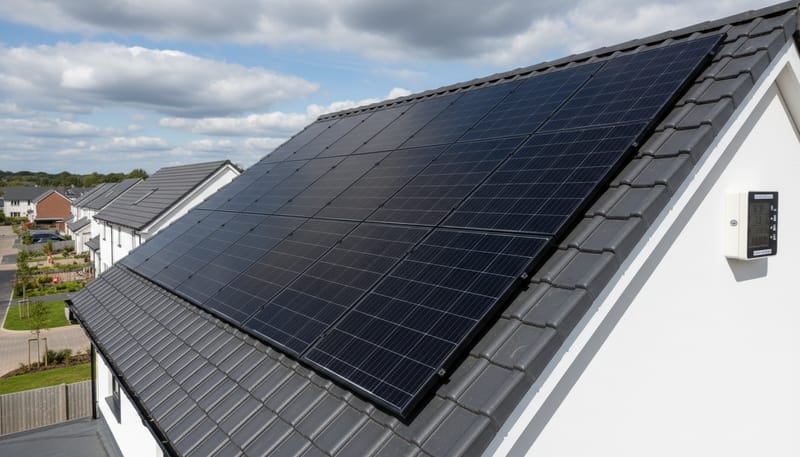
Why Solar Panels Make Sense on New Build Homes
Solar photovoltaic (PV) panels convert sunlight into electricity, providing free, renewable energy for your home. For new build buyers in the UK, solar panels are increasingly common — either installed as standard by the developer or available as an upgrade option. With electricity prices remaining high and the Future Homes Standard pushing new homes towards net zero carbon, solar PV is one of the most cost-effective ways to reduce your energy bills and carbon footprint.
Installing solar panels during construction is significantly cheaper and more straightforward than retrofitting. The roof structure can be designed to optimise panel placement, wiring is integrated during the first fix electrical stage, and there is no disruption to an occupied home. For developers, solar PV is also one of the simplest ways to improve a property’s EPC rating, often pushing a B-rated home into the A band.
This guide covers everything you need to know about solar panels on new build homes, from system sizes and costs to expected generation, payback periods, and how to maximise your return on investment.
Typical Solar Panel Systems for New Build Homes
The size of a solar PV system is measured in kilowatts peak (kWp), which represents the maximum output under ideal conditions. For new build homes, the most common system sizes range from 2kWp to 6kWp, with 3–4kWp being the standard for a typical 3–4 bedroom house.
System Sizes and What They Mean
| System Size | Number of Panels | Roof Area Needed | Annual Generation | Best For |
|---|---|---|---|---|
| 2 kWp | 5–6 panels | 8–10 m² | ~1,900 kWh | Flats, small terraces |
| 3 kWp | 7–8 panels | 12–14 m² | ~2,850 kWh | 2–3 bed homes |
| 4 kWp | 10–11 panels | 16–18 m² | ~3,800 kWh | 3–4 bed homes (most common) |
| 5 kWp | 12–13 panels | 20–22 m² | ~4,750 kWh | 4–5 bed homes |
| 6 kWp | 15–16 panels | 24–27 m² | ~5,700 kWh | Large detached homes |
Modern solar panels typically produce around 370–425 watts each. A standard 4kWp system uses approximately 10–11 panels, requiring about 17 m² of south-facing roof space. Most new build homes have ample roof area, and developers design the roof pitch and orientation to maximise solar gain where panels are planned.
Installation Costs
| System Size | Developer-Installed Cost | Retrofit Cost | With Battery Storage |
|---|---|---|---|
| 2 kWp | £2,500 – £3,500 | £3,500 – £5,000 | + £4,000 – £6,000 |
| 3 kWp | £3,500 – £5,000 | £4,500 – £6,500 | + £4,000 – £6,000 |
| 4 kWp | £5,000 – £7,000 | £6,000 – £8,000 | + £4,500 – £7,000 |
| 5 kWp | £6,000 – £8,000 | £7,000 – £9,500 | + £5,000 – £7,500 |
| 6 kWp | £7,000 – £9,500 | £8,500 – £11,000 | + £5,000 – £8,000 |
Developer-installed solar is typically 15–25% cheaper than retrofit because panels are fitted during construction, avoiding scaffolding costs and roof penetration work. If your developer offers solar as a paid upgrade, it is almost always better value than installing later. Some developers now include solar panels as standard, building the cost into the purchase price.
Monthly Generation and Self-Consumption
Solar generation in the UK varies dramatically throughout the year. Long summer days with high sun angles produce several times more electricity than short, overcast winter days. Understanding this seasonal pattern is essential for realistic expectations and financial planning.
Monthly Generation for a 4kW System (UK Average)
Based on a 4kWp south-facing system at 35° pitch in central England. Total: ~3,650 kWh/year. Southern England generates ~10% more; Scotland ~10% less.
Self-Consumption vs Export
Not all the electricity your panels generate will be used in your home. During sunny daytime hours when generation peaks, you may be out at work, meaning excess electricity is exported to the grid. The proportion you use yourself is called self-consumption, and it is critical to your financial return because electricity you use directly saves you the full retail price (24.5p/kWh), while exported electricity earns only the Smart Export Guarantee rate (typically 4–15p/kWh).
- Without battery storage: Typical self-consumption is 25–40% of generation. You export the rest.
- With battery storage: Self-consumption rises to 60–80%, dramatically improving your return.
- With battery + EV: Self-consumption can reach 80–90% by charging your electric vehicle from solar during the day.
Return on Investment and Payback Period
The financial return from solar panels depends on three factors: how much electricity you generate, how much you use yourself (self-consumption), and how much you earn from exporting the surplus. Here is a detailed ROI comparison for a typical 4kWp system:
ROI Comparison: Solar Only vs Solar + Battery
Both options deliver strong returns over the 25-year panel warranty period. Solar PV only has a faster payback and slightly higher net benefit, but the battery option provides greater energy independence and protection against future electricity price rises. If you have a heat pump, a battery becomes even more valuable as it allows you to power your heating from stored solar energy.
The Smart Export Guarantee and Selling Your Electricity
The Smart Export Guarantee (SEG) is the UK government scheme that requires licensed electricity suppliers with 150,000+ customers to offer a tariff for exported solar electricity. Unlike the old Feed-in Tariff (which closed to new applicants in 2019), SEG rates are set by suppliers and vary considerably.
Current SEG Tariff Comparison
| Supplier | Tariff Name | Export Rate | Notes |
|---|---|---|---|
| Octopus Energy | Outgoing Fixed | 15.0p/kWh | Highest fixed rate; requires Octopus as supplier |
| Octopus Energy | Agile Outgoing | Variable (avg 8–25p) | Half-hourly variable rate; can be very lucrative |
| British Gas | SEG Tariff | 5.6p/kWh | Open to all; no requirement to be a customer |
| EDF | Export Payments | 4.5p/kWh | Straightforward; no smart meter required for some tariffs |
| E.ON Next | Next Export | 4.1p/kWh | Available with compatible smart meter |
| Scottish Power | Smart Export | 3.5p/kWh | Basic SEG rate |
The most lucrative option for many homeowners is Octopus Energy’s Agile Outgoing tariff, which pays a variable rate based on wholesale electricity prices. During peak demand periods, export rates can exceed 30p/kWh, while off-peak rates may drop to 5p/kWh. For smart home owners with battery storage, this creates opportunities to charge the battery from solar during the day and export at peak evening prices.
Developer-Installed Solar: What to Expect
An increasing number of UK housebuilders now include solar panels as standard or as a popular upgrade option. When a developer installs solar during construction, you benefit from lower costs, optimal roof integration, and a system that is fully factored into the home’s SAP calculation and EPC rating.
What Developers Typically Provide
- System size: Most developers install 2–4kWp as standard, with larger systems available as upgrades
- Panel type: Monocrystalline panels are standard (higher efficiency than polycrystalline), typically in all-black designs for aesthetic appeal
- Inverter: Either a string inverter (one unit for all panels) or microinverters (one per panel, better for partially shaded roofs)
- Monitoring: Many systems include app-based monitoring so you can track generation and consumption in real time
- Warranty: Panels typically carry a 25-year performance warranty; inverters are warranted for 10–15 years
- MCS certification: Required for SEG eligibility — ensure the installation is MCS-certified
Planning Permission
Solar panels on new build homes generally fall under permitted development rights, meaning no planning permission is needed provided the panels do not protrude more than 200mm from the roof surface and do not extend above the highest point of the roof (excluding the chimney). In conservation areas, listed buildings, or Areas of Outstanding Natural Beauty, additional restrictions may apply. Your developer will handle all planning considerations as part of the build process.
Pairing Solar with Battery Storage
Battery storage transforms the economics of solar PV by allowing you to store excess daytime generation for use in the evening and overnight. Without a battery, surplus electricity is exported at relatively low SEG rates. With a battery, you can use that same electricity yourself, avoiding the full retail cost of grid imports.
Popular Battery Systems for New Builds
| Battery System | Capacity | Cost (installed) | Warranty | Key Feature |
|---|---|---|---|---|
| Tesla Powerwall 2 | 13.5 kWh | £8,000 – £10,000 | 10 years | High capacity; whole-home backup |
| GivEnergy 5.2 | 5.2 kWh | £3,000 – £4,500 | 12 years | Modular; expandable; UK-based |
| GivEnergy 9.5 | 9.5 kWh | £4,500 – £6,500 | 12 years | Good mid-range option |
| Huawei LUNA2000 | 5–15 kWh | £3,500 – £8,000 | 10 years | Modular; pairs with Huawei inverter |
| Fox ESS ECS | 5.8 kWh | £2,800 – £4,000 | 10 years | Budget-friendly; good value |
For a typical new build with a 4kWp solar system, a 5–10 kWh battery is the sweet spot. This captures most of the daily surplus generation without excessive upfront cost. Larger batteries make more sense if you have a heat pump or charge an EV at home, as these increase evening and overnight electricity demand.
Roof Orientation, Pitch, and Performance Factors
The amount of electricity your solar panels generate depends on several factors beyond system size. Understanding these helps you evaluate how well a new build home is set up for solar generation.
Orientation Impact on Generation
- South-facing (180°): 100% of potential generation — the ideal orientation for maximum annual output
- South-east or south-west (135–225°): 95% of south-facing output — still excellent
- East or west (90° / 270°): 80–85% of south-facing output — viable, especially with split east/west arrays
- North-facing: 55–65% of south-facing output — generally not recommended
Other Performance Factors
- Roof pitch: The optimal angle in the UK is 30–40° from horizontal. Most new build roofs are pitched at 35–45°, which is close to ideal.
- Shading: Even partial shading from trees, chimneys, or neighbouring buildings can significantly reduce output. Microinverters or optimisers mitigate this better than string inverters.
- Panel degradation: Solar panels degrade by approximately 0.5–0.7% per year. After 25 years, panels still produce around 80–85% of their original output.
- Temperature: Solar panels actually perform slightly better in cooler temperatures. UK summers are ideal compared to hotter climates where panels overheat.
- Maintenance: Solar panels require minimal maintenance. Rainfall typically keeps them clean, though an annual visual check and occasional clean improves output by 2–5%.
When assessing a new build, check which direction the main roof slope faces. New build homes designed with solar in mind will have the primary roof facing south or south-west with minimal overshadowing.
Frequently Asked Questions
Do solar panels work on cloudy days?
Yes. Solar panels generate electricity from daylight, not direct sunlight. On an overcast day, a typical system will produce 10–30% of its peak output. The UK’s long summer daylight hours (up to 16 hours) partially compensate for cloud cover, which is why annual generation figures are based on real UK weather data rather than peak conditions.
Do I need planning permission for solar panels on a new build?
In most cases, no. Solar panels fall under permitted development rights provided they do not protrude more than 200mm beyond the roof plane, do not extend above the roof ridge, and the home is not in a conservation area or listed building. Your developer will handle all planning requirements during the build.
Can I add solar panels later if my developer does not include them?
Yes, but it will be more expensive. Retrofitting solar panels costs approximately 15–25% more than developer installation due to scaffolding, roof penetration, and separate electrical work. If your developer offers solar as an upgrade, it is almost always better value to include it at the point of purchase. You may be able to add the cost to your mortgage.
How long do solar panels last?
Solar panels are extremely durable with no moving parts. Most carry a 25-year performance warranty guaranteeing at least 80% output. In practice, panels can continue generating for 30–40 years, though at gradually reducing efficiency. Inverters typically need replacing once during the panel lifetime (after 10–15 years), costing £500–£1,500.
Will solar panels damage my new build roof?
No. When installed during construction, panels are mounted using integrated roof hooks fitted between tiles before the roof is completed. This creates a watertight seal with no penetration of the roof membrane. Retrofit installations use similar methods but require lifting and refitting tiles, which is why developer installation is preferred.
Making the Most of Solar on Your New Build
Solar panels are one of the smartest investments you can make in a new build home. A typical 4kWp system generates around 3,800 kWh of free electricity per year, saving £550–£740 annually depending on whether you add battery storage. Over 25 years, that translates to savings exceeding £14,000 — more than double the initial cost.
When combined with a heat pump, solar panels create a powerful synergy: free electricity from the sun powers your low-carbon heating system, dramatically reducing both running costs and carbon emissions. This combination is rapidly becoming the standard specification for forward-thinking developers building to the Future Homes Standard.
If you are comparing new build developments, ask whether solar panels are included as standard or available as an upgrade. Check the system size, panel orientation, and whether battery storage is offered. For more on reducing your energy bills in a new build, explore our full range of renewable energy guides.