Why New Build Homes Need Mechanical Ventilation
Modern new build homes are constructed to be highly airtight. Current Building Regulations require air permeability testing, and most new builds achieve air leakage rates well below the maximum threshold of 10 m³/hr/m². Many achieve rates of 3–5 m³/hr/m², and homes built to the emerging Future Homes Standard may target even lower figures.
This airtightness is excellent for energy efficiency. It means less heat escapes through gaps, cracks, and uncontrolled draughts, resulting in lower heating bills and higher EPC ratings. However, it also means that the natural ventilation that older, draughtier homes rely upon — air leaking in through gaps around windows, doors, and floorboards — is no longer sufficient to maintain good indoor air quality.
Without adequate ventilation, a tightly sealed home can suffer from:
- Excess moisture and condensation: A typical family of four produces 10–15 litres of moisture per day through breathing, cooking, showering, and drying clothes. In an airtight home, this moisture has nowhere to go and condenses on cold surfaces, leading to mould growth.
- Poor indoor air quality: Volatile organic compounds (VOCs) from furniture, paints, cleaning products, and building materials can accumulate. CO2 levels from breathing can rise above recommended levels (1,000 ppm), causing headaches, fatigue, and reduced concentration.
- Allergens and pollutants: Dust mites, pet dander, and cooking particles remain trapped in the indoor environment without adequate air exchange.
- Odour build-up: Cooking smells, bathroom odours, and general household smells linger without effective extraction.
This is why Building Regulations Part F requires all new homes to have a defined ventilation strategy. The regulations set minimum ventilation rates based on the number of bedrooms and wet rooms, and specify the type of ventilation system that must be installed. For new build buyers, understanding these systems helps you appreciate what your home provides and how to use it effectively.
Types of Ventilation Systems Explained
There are four main types of ventilation systems used in UK new build homes. Each has different characteristics, costs, and suitability depending on the home’s airtightness level and energy performance targets.
Ventilation System Comparison
| System | Full Name | How It Works | Heat Recovery | Typical Cost | Best For |
|---|---|---|---|---|---|
| MVHR | Mechanical Ventilation with Heat Recovery | Supplies fresh air and extracts stale air through ductwork; heat exchanger transfers warmth from outgoing to incoming air | 90–95% | £3,000–£6,000 | Highly airtight homes, premium developments |
| MEV | Mechanical Extract Ventilation | Continuously extracts stale air from wet rooms; fresh air enters via trickle vents in windows | None | £500–£1,500 | Most standard new builds, cost-effective |
| PIV | Positive Input Ventilation | Introduces filtered fresh air from the loft space into the home, creating positive pressure that pushes stale air out | None | £400–£800 | Retrofits, condensation-prone homes |
| Natural | Natural Ventilation with Extract Fans | Relies on trickle vents, opening windows, and intermittent extract fans in bathrooms and kitchen | None | £100–£300 | Less airtight homes, basic compliance |
Which System Does Your New Build Have?
The ventilation system installed in your new build depends on the developer’s specification and the home’s airtightness level:
- Premium and eco-focused developments (Berkeley Group, Countryside Partnerships, Hill Group) increasingly specify MVHR as standard, particularly where homes are built to very high airtightness standards or include heat pumps.
- Volume housebuilders (Barratt, Taylor Wimpey, Persimmon, Bellway) most commonly install MEV systems as standard, which provide effective ventilation at a lower cost.
- Some developments offer MVHR as a developer upgrade option, allowing buyers to choose the enhanced system for an additional cost of £2,000–£4,500 over the standard MEV installation.
MVHR: Mechanical Ventilation with Heat Recovery
MVHR is the most advanced and energy-efficient ventilation system available for residential properties. It is increasingly specified in new builds that target high energy performance, and is expected to become standard in homes built to the Future Homes Standard.
How MVHR Works
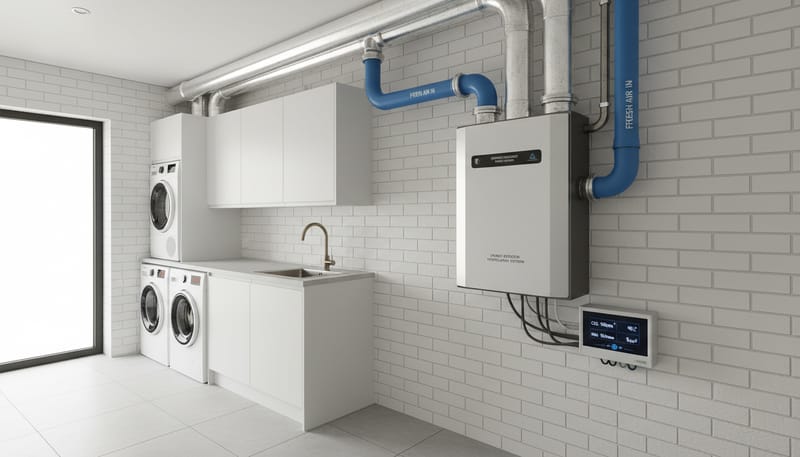
An MVHR system operates continuously, providing a constant flow of fresh, filtered air to habitable rooms (bedrooms, living rooms) while simultaneously extracting stale, moist air from wet rooms (kitchen, bathrooms, utility room). The two air streams pass through a heat exchanger in the central MVHR unit, where up to 90–95% of the heat from the outgoing stale air is transferred to the incoming fresh air — without the two air streams mixing.
This means you get a continuous supply of fresh, warm air without opening windows and losing heat. In winter, incoming air at 0°C can be pre-warmed to 18–20°C by the heat recovery process alone, significantly reducing the energy needed to heat the home.
MVHR Components and Specifications
| Component | Function | Maintenance |
|---|---|---|
| Central unit | Contains heat exchanger, fans, and filters. Usually located in a utility room, loft, or cupboard | Filter replacement every 6–12 months |
| Supply ductwork | Delivers fresh, filtered air to bedrooms and living areas via ceiling or wall vents | Professional clean every 5–7 years |
| Extract ductwork | Removes stale air from kitchen, bathrooms, and utility room via ceiling vents | Professional clean every 5–7 years |
| Heat exchanger | Counter-flow or cross-flow unit that transfers heat between air streams (90–95% efficiency) | Annual inspection, occasional wash |
| Filters (supply) | F7 grade filters remove pollen, dust, and fine particles from incoming air | Replace every 6–12 months (£15–£30 each) |
| Filters (extract) | G4 grade filters capture grease and larger particles from outgoing air | Replace every 6–12 months (£10–£20 each) |
| Controls | Wall-mounted or app-based controller for fan speed, boost mode, and scheduling | None – software updates only |
| Summer bypass | Diverts incoming air around the heat exchanger in warm weather to avoid overheating | Automatic – temperature-activated |
MVHR Advantages
- Energy savings: Heat recovery of 90–95% dramatically reduces the energy lost through ventilation. In a typical new build, MVHR can save £200–£400 per year in heating costs compared to MEV with trickle vents.
- Superior air quality: F7 filters remove 85–95% of airborne particles including pollen, dust, and PM2.5 pollution. Ideal for allergy sufferers and homes near busy roads.
- Condensation prevention: Continuous air exchange maintains low humidity levels throughout the home, virtually eliminating condensation and mould risk.
- Noise reduction: Windows can remain closed while maintaining fresh air supply, reducing noise from roads, railways, or neighbours.
- Comfort: Incoming air is pre-warmed and draught-free, avoiding the cold spots associated with trickle vents on winter mornings.
MVHR Considerations
- Higher upfront cost: £3,000–£6,000 installed in a new build, compared to £500–£1,500 for MEV.
- Requires very good airtightness: MVHR systems work best in homes with air permeability below 5 m³/hr/m². In leakier homes, the heat recovery efficiency is undermined.
- Ductwork space requirements: The duct network requires space in ceilings, walls, or dedicated voids, which must be designed into the home from the outset.
- Filter maintenance: Filters must be replaced every 6–12 months at a cost of £25–£50 per set. This is a straightforward DIY task in most systems.
- Electricity consumption: MVHR fans typically consume 30–60W continuously, adding £65–£130 per year to electricity bills. This is more than offset by heating savings in well-insulated homes.
MEV: Mechanical Extract Ventilation
MEV is the most common ventilation system in standard new build homes across the UK. It is a simpler, more affordable system than MVHR, and is effective for homes built to typical (rather than exceptional) airtightness standards.
How MEV Works
An MEV system uses a central fan unit (usually located in the loft or a utility cupboard) connected to extract points in wet rooms — typically the kitchen, bathroom(s), en-suite(s), and utility room. The fan runs continuously at a low background rate, extracting moist, stale air from these rooms and expelling it outside through a vent.
Fresh replacement air enters the home through trickle vents — small, adjustable openings built into the window frames. As stale air is extracted from wet rooms, a slight negative pressure draws fresh air in through the trickle vents in bedrooms and living areas, creating a controlled airflow pattern through the home.
MEV Advantages and Limitations
- Low cost: £500–£1,500 fully installed in a new build, making it the default choice for volume housebuilders.
- Simple system: Fewer components than MVHR means less to go wrong and lower maintenance costs.
- Effective moisture removal: Continuous extraction from wet rooms is effective at preventing condensation and mould in kitchens and bathrooms.
- Low energy use: A typical MEV fan consumes 5–15W, adding just £10–£30 per year to electricity bills.
The main limitation of MEV is the lack of heat recovery. The warm air extracted from wet rooms is expelled outside, and the cold replacement air entering through trickle vents must be heated by the home’s heating system. In winter, this can result in noticeable cold draughts near trickle vents and increased heating demand. Compared to MVHR, an MEV system loses approximately £200–£400 per year in wasted heat.
Building Regulations Part F: Ventilation Requirements
Approved Document F of the Building Regulations sets out the minimum ventilation requirements for new dwellings in England. Updated in June 2022 alongside the Part L changes, the current Part F provides clearer guidance on whole-dwelling ventilation rates, extract rates, and system specifications.
Minimum Ventilation Rates
| Number of Bedrooms | Whole-Dwelling Ventilation Rate | Kitchen Extract Rate | Bathroom Extract Rate |
|---|---|---|---|
| 1 bedroom | 13 litres/second | 13 litres/second (intermittent) or 13 l/s (continuous) | 8 litres/second |
| 2 bedrooms | 17 litres/second | 30 litres/second (intermittent boost) | 8 litres/second |
| 3 bedrooms | 21 litres/second | 30 litres/second (intermittent boost) | 8 litres/second |
| 4 bedrooms | 25 litres/second | 30 litres/second (intermittent boost) | 8 litres/second per bathroom |
| 5+ bedrooms | 29+ litres/second | 30 litres/second (intermittent boost) | 8 litres/second per bathroom |
These rates ensure sufficient air changes to maintain healthy CO2 levels, control moisture, and remove pollutants. The actual system installed must achieve these rates at the relevant fan speed settings, and Building Control will verify compliance during the final inspection.
Part F also specifies requirements for purge ventilation (the ability to rapidly ventilate a room, typically via openable windows) and background ventilation (continuous low-level airflow via trickle vents or mechanical systems). In a new build, both requirements are addressed through the combination of openable windows and the mechanical ventilation system.
Maintenance and Indoor Air Quality
Proper maintenance of your ventilation system is essential for ensuring it continues to deliver clean, fresh air and operates efficiently. Neglected systems can become less effective, noisier, and may even contribute to poor air quality rather than improving it.
MVHR Maintenance Schedule
- Every 3–6 months: Check filter condition. In dusty environments or homes near construction sites, filters may need more frequent attention.
- Every 6–12 months: Replace supply (F7) and extract (G4) filters. This is a simple DIY task — open the unit, slide out old filters, insert new ones. Cost: £25–£50 per set.
- Annually: Check the heat exchanger for debris, inspect ductwork connections, and verify fan operation at all speed settings.
- Every 5–7 years: Professional duct cleaning to remove any accumulated dust or debris from the ductwork. Cost: £200–£400.
MEV Maintenance Schedule
- Every 3 months: Clean extract grilles in kitchen and bathrooms by wiping with a damp cloth.
- Every 6–12 months: Clean or replace the central fan unit filter (if fitted). Check trickle vents are not blocked or closed.
- Annually: Check fan operation and ensure extract flow rates are adequate. Listen for unusual noises that might indicate bearing wear.
Indoor Air Quality Best Practices
- Keep trickle vents open: In MEV homes, the trickle vents in window frames must remain open for the system to work correctly. Closing them disrupts the designed airflow pattern and can lead to condensation and stale air.
- Use boost mode when cooking and showering: Both MVHR and MEV systems have a boost setting that increases the extraction rate. Use this during and for 15–20 minutes after cooking or showering to remove excess moisture and odours quickly.
- Do not block vents or grilles: Avoid placing furniture directly in front of supply or extract vents, as this restricts airflow and reduces system effectiveness.
- Avoid drying clothes on radiators or airers without ventilation: Drying clothes indoors adds significant moisture to the air. Use a tumble dryer (vented externally or condenser) or ensure good ventilation if drying clothes indoors.
- Consider a CO2 monitor: A simple CO2 monitor (£30–£80) provides real-time feedback on indoor air quality and helps you identify when additional ventilation is needed.
Good ventilation works hand-in-hand with the overall energy efficiency of your new build home. The insulation, airtightness, and ventilation system are designed as an integrated package — each element supports the others. Maintaining your ventilation system ensures you benefit from both excellent air quality and optimal energy performance.
Condensation Prevention in New Build Homes
Condensation is one of the most common concerns for new build homeowners, particularly in the first year or two after construction. New build homes contain significant amounts of construction moisture — water trapped in plaster, screed, concrete, and timber during the building process. As this moisture dries out, it must be managed effectively to prevent condensation and mould.
Why New Builds Can Be Prone to Condensation Initially
A typical new build home contains approximately 5,000–10,000 litres of construction moisture that gradually evaporates over the first 12–24 months. This is perfectly normal and does not indicate a building defect. However, this additional moisture, combined with everyday living activities and the home’s airtight construction, means that ventilation is particularly important during the first year.
Tips for Preventing Condensation
- Run your ventilation system continuously: Whether MVHR or MEV, do not switch off the ventilation system. It is designed to run 24/7 at a low background rate. The electricity cost is minimal (£10–£130 per year depending on system type).
- Use extract fans and boost mode: Activate the boost setting when cooking, showering, or producing steam. Leave it running for 15–20 minutes after finishing.
- Maintain gentle background heating: Keeping the home at a consistent low temperature (16–18°C) rather than allowing it to go cold prevents surfaces reaching their dew point. Underfloor heating is particularly effective for this purpose.
- Open windows briefly for purge ventilation: Opening windows for 10–15 minutes once or twice a day provides a rapid air exchange that helps clear excess moisture, particularly during the drying-out period.
- Wipe down wet surfaces: After showering, wipe down tiles and glass to remove surface water. Use a squeegee on shower screens.
- Monitor humidity: A digital hygrometer (£10–£20) lets you track indoor humidity. Aim for 40–60% relative humidity. Above 65% for prolonged periods increases mould risk.
If condensation persists beyond the first year despite following these practices, contact your developer’s aftercare team. They can check that the ventilation system is operating correctly, verify airflow rates, and identify any installation issues that may need rectifying under your new build warranty.
Frequently Asked Questions
Should I leave my ventilation system running all the time?
Yes. Both MVHR and MEV systems are designed to run continuously at a low background rate. This constant air exchange is what maintains good indoor air quality and prevents moisture build-up. Switching off the system to save electricity is counterproductive — the small electricity cost (£10–£130 per year) is far outweighed by the cost of dealing with mould or damp problems.
Is MVHR worth the extra cost over MEV?
In well-insulated, highly airtight new builds, MVHR typically pays back its additional cost within 7–12 years through heating energy savings. Beyond the financial case, MVHR provides superior air quality (filtered incoming air), better condensation control, and improved comfort (no cold draughts from trickle vents). If your development offers MVHR as an upgrade, it is particularly worthwhile if anyone in your household has asthma, allergies, or respiratory conditions.
My new build has condensation on the windows. Is this a defect?
Not necessarily. Some condensation, particularly on windows in the morning, is normal during the first 12–24 months as construction moisture dries out. Ensure your ventilation system is running, trickle vents are open, and you are using boost mode when showering and cooking. If condensation persists beyond the first year or appears on walls, contact your developer for investigation under the warranty.
Can I fit an MVHR system after my home is built?
Retrofitting MVHR into an existing home is possible but significantly more expensive (£6,000–£12,000) and disruptive than installing during construction. The ductwork needs to be routed through the building, which may require boxing in or lowering ceilings. If you are considering MVHR for your new build, it is far more practical and cost-effective to select it as a developer upgrade before construction begins.
How noisy are ventilation systems?
Modern ventilation systems are designed to be quiet. A well-installed MVHR unit typically operates at 25–35 dB at normal speed — barely audible and quieter than a fridge. MEV systems are similarly quiet at background rate but may be more noticeable during boost mode (40–50 dB). If your system seems excessively noisy, it may indicate an installation issue such as a kinked duct or incorrectly balanced airflows, which should be reported to your developer.
Making the Most of Your New Build’s Ventilation
Ventilation is one of the most important yet least understood features of a modern new build home. Whether your home has MVHR or MEV, the system is designed to work with the airtight construction to deliver fresh, healthy air while maintaining energy efficiency. Understanding how your system works and maintaining it properly ensures you get the best possible indoor air quality and the lowest running costs.
For buyers comparing developments, asking about the ventilation system can be revealing. A developer that specifies MVHR is demonstrating a commitment to quality and performance that often extends to other aspects of the build, including insulation, glazing, and heating systems.
Ventilation works as part of the home’s overall energy strategy. Combined with a high EPC rating, solar panels, and smart energy management, good ventilation ensures your new build home is comfortable, healthy, and efficient all year round.
Explore our related guides on underfloor heating, triple glazing, and running costs for a complete picture of what makes new build homes so energy-efficient. Browse available new build homes to find your ideal property.