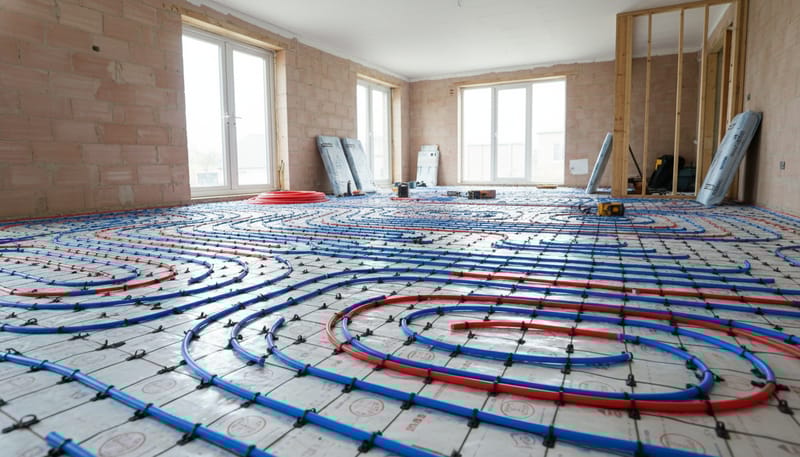
Why Underfloor Heating Suits New Build Homes
Underfloor heating (UFH) has long been considered a luxury feature in UK homes, but in new build construction it is rapidly becoming mainstream. The combination of modern building standards, well-insulated floor slabs, and the growing adoption of heat pumps makes underfloor heating a natural fit for newly constructed properties.
New builds are inherently better suited to UFH than older homes for several reasons. The floor construction is designed from scratch, meaning pipes or cables can be embedded during the build process rather than retrofitted at great expense. The high levels of insulation required by current Building Regulations mean the home retains heat exceptionally well, allowing UFH to operate at lower water temperatures and still maintain comfortable room temperatures. And the airtight construction standards of modern homes, as required by the Future Homes Standard, reduce draughts that would otherwise undermine the effectiveness of radiant floor heating.
For buyers considering whether to select underfloor heating as a developer upgrade, the decision involves weighing up installation costs against long-term running costs, comfort improvements, and design benefits. This guide covers everything you need to make an informed choice.
Wet vs Electric Underfloor Heating: How They Work
There are two fundamentally different types of underfloor heating, each with distinct characteristics, costs, and applications. Understanding the difference is essential for choosing the right system for your new build home.
Wet (Hydronic) Underfloor Heating
Wet UFH circulates warm water through a network of pipes embedded in or laid on top of the floor screed. The water is heated by the home’s central heating system — typically a boiler or heat pump — and pumped through the pipe circuits at temperatures between 35°C and 55°C. Each room or zone has its own pipe circuit, controlled by a manifold that distributes water to individual loops.
This is the preferred system for whole-house underfloor heating in new builds because:
- Lower running costs — water-based heating is significantly cheaper to operate than electric, particularly when powered by a heat pump
- Compatible with heat pumps — the low water temperatures required (35–45°C) match the optimal output range of air source and ground source heat pumps
- Even heat distribution — the extensive pipe network creates a large, uniform radiant surface
- Long lifespan — modern PEX or PERT pipes are rated for 50+ years with virtually no maintenance
Electric Underfloor Heating
Electric UFH uses thin heating cables or mats embedded in or placed beneath the floor covering. An electric current passes through the cable, generating heat directly. Electric systems are thinner than wet systems (typically 3–5mm compared to 50–75mm for wet UFH) and can be installed under virtually any floor covering.
Electric UFH is most commonly used in new builds for:
- Individual rooms such as bathrooms, en-suites, and kitchens where the luxury of a warm floor is most appreciated
- Upper floors where installing wet UFH pipework would add excessive floor build-up height
- Supplementary heating alongside a radiator system in the rest of the home
Wet vs Electric: Key Specifications
| Feature | Wet (Hydronic) UFH | Electric UFH |
|---|---|---|
| Heat source | Boiler or heat pump (hot water) | Electric cable or mat |
| Floor build-up height | 50–75mm (with screed) | 3–5mm (with mat systems) |
| Running cost (per m² per year) | £8–£14 | £16–£28 |
| Installation cost (new build) | £3,000–£6,000 (whole house) | £1,500–£3,000 (whole house) |
| Installation cost (single room) | £800–£1,500 | £150–£400 |
| Heat-up time | 2–4 hours (from cold) | 30–60 minutes |
| Heat pump compatibility | Excellent – ideal low-temperature emitter | N/A – uses electricity directly |
| Maintenance | Virtually none (annual system check) | None |
| Lifespan | 50+ years | 25–30 years |
| Best for | Whole-house heating, ground floors | Individual rooms, upper floors, retrofits |
Installation Costs in New Build Homes
One of the key advantages of choosing underfloor heating in a new build is that installation costs are significantly lower than retrofitting into an existing property. The floor structure is being built from scratch, so pipes can be laid before the screed is poured — a much simpler and cheaper process than lifting existing floors.
Typical Installation Costs
| System Type | Ground Floor Only | Whole House (3-bed) | Whole House (4-bed) | Retrofit Cost (comparison) |
|---|---|---|---|---|
| Wet UFH (with heat pump) | £2,500–£4,000 | £4,000–£6,000 | £5,500–£8,000 | £8,000–£15,000 |
| Wet UFH (with gas boiler) | £2,000–£3,500 | £3,000–£5,500 | £4,500–£7,000 | £7,000–£12,000 |
| Electric UFH (mats) | £800–£1,500 | £1,500–£3,000 | £2,000–£4,000 | £2,500–£5,000 |
| Electric UFH (cables) | £600–£1,200 | £1,200–£2,500 | £1,800–£3,500 | £2,000–£4,500 |
These costs include the UFH system, manifold, controls, and installation labour. In a new build, the developer may offer underfloor heating as a standard inclusion or as a priced upgrade option. Developer upgrade pricing is typically competitive with market rates because the installation is carried out during construction by the developer’s existing subcontractors.
When comparing costs, remember that a home with whole-house UFH does not need radiators, towel rails (in most rooms), or the associated pipework. This offsets some of the UFH installation cost. A typical radiator installation in a new build 3-bed home costs £2,000–£3,500, so the net additional cost of wet UFH is often only £1,000–£2,500.
Running Costs: UFH vs Radiators
The running cost comparison between underfloor heating and radiators depends heavily on the heat source (boiler or heat pump) and the home’s insulation levels. In a well-insulated new build, UFH has a clear efficiency advantage.
Why UFH Is More Efficient
Underfloor heating operates at lower water temperatures than radiators. A radiator system typically requires water at 55–75°C to heat a room effectively, while wet UFH achieves the same room temperature with water at just 35–45°C. This is because the floor provides a much larger surface area for heat emission — the entire floor acts as one giant radiator.
This lower operating temperature delivers two key benefits:
- Heat pump efficiency: Air source heat pumps are significantly more efficient when producing water at lower temperatures. At 35°C flow temperature (typical for UFH), a heat pump achieves a Coefficient of Performance (COP) of 3.5–4.5, meaning it produces 3.5–4.5 kWh of heat for every 1 kWh of electricity consumed. At the 55–65°C required by radiators, the COP drops to 2.5–3.0.
- Boiler efficiency: Even with a gas boiler, lower flow temperatures improve efficiency because the boiler operates in condensing mode more frequently, recovering heat that would otherwise be lost in the flue gases.
Annual Heating Cost Comparison
Based on a 3-bed semi-detached new build (90m²) at 2024/25 energy prices. Gas: 6.8p per kWh. Electricity: 24.5p per kWh.
The most efficient combination is wet underfloor heating with an air source heat pump, costing approximately £420 per year to heat a typical 3-bed new build. This represents a saving of £470 per year compared to a conventional radiator system with a gas boiler — enough to repay the additional UFH installation cost within 3–5 years.
Electric UFH as the sole heating system is the most expensive option due to the high unit cost of electricity. However, for individual rooms (such as a bathroom heated for 2–3 hours per day), electric UFH adds only £20–£40 per year to your bills — a worthwhile investment for the comfort of warm tiles underfoot.
UFH vs Radiators: Full Comparison
Choosing between underfloor heating and radiators involves more than just running costs. Here is a comprehensive side-by-side comparison covering all the factors that matter.
The comfort difference is one of the most frequently cited advantages of UFH. With radiators, warm air rises from the radiator and circulates around the room via convection, creating temperature stratification — it is warmest near the ceiling and coolest at floor level. With UFH, heat radiates evenly upward from the floor, creating the most comfortable temperature gradient: warm at foot level and slightly cooler at head height. For families with young children who play on the floor, this difference is particularly noticeable.
Heat Pump Compatibility: The Ideal Partnership
The combination of underfloor heating and an air source heat pump is widely regarded as the most efficient heating solution for new build homes. This pairing is increasingly specified by developers building to the Future Homes Standard, and for good reason.
Heat pumps work by extracting heat from the outside air (or ground) and transferring it into the home. The efficiency of this process is directly related to the temperature lift — the difference between the outdoor temperature and the required water temperature. The lower the output temperature needs to be, the more efficiently the heat pump operates.
Wet UFH requires water at just 35–45°C, compared to 55–75°C for radiators. This lower requirement allows the heat pump to operate with a COP (Coefficient of Performance) of 3.5–4.5, compared to 2.5–3.0 when feeding radiators. In practical terms, for every £1 of electricity consumed, the heat pump delivers £3.50–£4.50 worth of heat through UFH versus £2.50–£3.00 through radiators.
This efficiency gain is why many developers now offer UFH + heat pump packages as standard or as a strongly recommended upgrade. The EPC rating of a home with this combination is typically 5–10 SAP points higher than the same home with radiators and a gas boiler, potentially pushing the rating from B into A territory.
Zoned Control and Floor Covering Compatibility
Zoned Heating Control
One of the practical advantages of UFH is the ability to zone your heating by room. Each pipe circuit (in wet systems) or heating mat (in electric systems) is controlled independently via a room thermostat. This means you can maintain the living room at 21°C, bedrooms at 18°C, and the bathroom at 22°C simultaneously — only heating rooms to the temperature they need.
In a new build home, the UFH zone controls are typically integrated into a central controller or smart home system. Modern systems from brands like Heatmiser, Warmup, and Wunda offer smartphone app control, allowing you to adjust temperatures remotely and set schedules for each zone. This level of control is more granular than a typical radiator system, where individual room temperature control requires thermostatic radiator valves (TRVs) which are less precise.
Floor Covering Compatibility
Not all floor coverings work equally well with underfloor heating. The key factor is thermal conductivity — how easily heat passes through the floor covering from the warm pipes or cables below to the room above.
| Floor Covering | Thermal Conductivity | UFH Suitability | Notes |
|---|---|---|---|
| Stone / slate tiles | Excellent | Ideal | Best heat transfer, feels warmest underfoot |
| Ceramic / porcelain tiles | Excellent | Ideal | Most popular choice for UFH installations |
| Engineered wood | Good | Very suitable | Up to 18mm thickness, check manufacturer guidance |
| Luxury vinyl tile (LVT) | Good | Very suitable | Thin and heat-conductive, excellent for UFH |
| Laminate | Moderate | Suitable | Must be UFH-compatible grade, max 27°C surface temp |
| Solid hardwood | Moderate | Use with caution | Can expand and contract; max 27°C surface temperature |
| Carpet (thin, low tog) | Low–moderate | Acceptable | Max 1.5 tog with underlay; reduces UFH efficiency |
| Thick carpet (high tog) | Low | Not recommended | Insulates against heat transfer, system works harder |
For maximum UFH performance, tiles and stone are the optimal choice, particularly in kitchens and bathrooms. Engineered wood and LVT are excellent alternatives for living areas and bedrooms where a softer, warmer aesthetic is preferred. If you prefer carpet, choose a thin, low-tog option and pair it with a thin underlay — the combined tog value of carpet and underlay should not exceed 1.5 tog for effective UFH performance.
Frequently Asked Questions
Is underfloor heating worth the extra cost in a new build?
For most buyers, yes — particularly if the home has a heat pump. The net additional cost of whole-house wet UFH over radiators is typically £1,000–£2,500 in a new build, and the annual running cost savings of £200–£470 mean the investment pays back within 3–7 years. Beyond the financial case, the comfort improvements and freed wall space add genuine quality-of-life benefits. Check if your developer offers UFH as a standard inclusion or upgrade option.
Can underfloor heating work as the sole heating system?
Yes. In a well-insulated new build home, wet UFH is perfectly capable of being the sole heating source. The excellent insulation levels required by current Building Regulations mean that UFH can comfortably maintain room temperatures of 21°C even during the coldest winter weather. Some homeowners choose to add a heated towel rail in bathrooms for towel drying, but this is for convenience rather than supplementary heating.
How long does underfloor heating take to warm up?
Wet UFH takes 2–4 hours to bring a room up to temperature from a completely cold start. However, in practice, UFH is best operated on a low continuous setting rather than switched on and off like radiators. Maintaining a constant low background temperature and using the thermostat to boost as needed is more efficient and more comfortable. Most smart UFH controllers learn your usage patterns and pre-heat rooms accordingly.
Can I retrofit underfloor heating into a new build later?
Retrofitting UFH into an already-constructed home is significantly more expensive and disruptive. Low-profile electric systems can be added under new floor coverings with minimal disruption, but wet UFH typically requires lifting the existing floor. If you are considering UFH, it is far more cost-effective to select it as a developer upgrade during construction.
Does underfloor heating work with all floor types?
UFH works with most floor coverings, but performance varies. Tiles and stone offer the best heat transfer. Engineered wood and LVT are very suitable. Solid hardwood requires care (check manufacturer compatibility). Carpet should be thin (max 1.5 tog combined with underlay). Thick or high-tog carpets significantly reduce UFH effectiveness and are not recommended.
Is Underfloor Heating Right for Your New Build?
Underfloor heating is one of the most worthwhile upgrades available in a new build home. The combination of lower running costs (20–40% savings when paired with a heat pump), even heat distribution, freed wall space, and enhanced comfort makes it a compelling choice for any buyer who can include it in their budget.
The financial case is strongest when UFH is paired with an air source heat pump, where the low water temperatures create an ideal efficiency match. But even with a gas boiler, wet UFH delivers meaningful running cost savings and a noticeably more comfortable home environment.
When speaking to your developer, ask about UFH availability as a standard feature or priced upgrade. Many developers offer competitive UFH packages, especially on developments designed to meet the Future Homes Standard. Combined with excellent insulation, solar panels, and smart energy management, underfloor heating is a key component of a truly energy-efficient new build home.
For more guidance on new build specifications, explore our guides on ventilation systems, triple glazing, and running costs. Browse available new build homes to find developments offering the features that matter most to you.