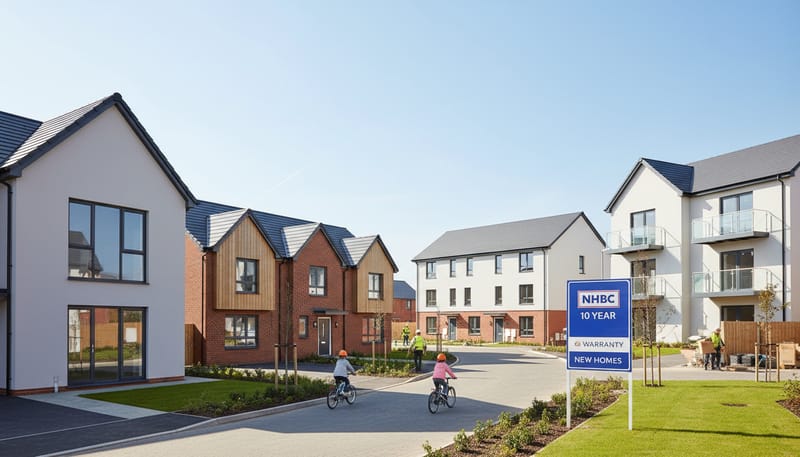
The Definition of a New Build Home
A new build home is a residential property that has never been occupied and is being sold for the first time. But that simple definition hides important nuance, because different organisations use different criteria.
The General Definition
In everyday use, a new build home means:
- Brand new construction — built from scratch on a new site or as part of a new development
- Never previously lived in — no prior owner or tenant has occupied the property
- Sold directly by the developer — or by an agent acting on the developer's behalf
- Covered by a structural warranty — typically 10 years from an approved provider
The NHBC Definition
The National House Building Council (NHBC), which provides the majority of new build warranties in the UK, defines a new build as a home that:
- Has been built by an NHBC-registered builder
- Is registered with NHBC before construction begins
- Has not been previously occupied at the point of the Buildmark warranty being issued
- Was completed within the last two years (for Buildmark cover to still be available)
The Mortgage Lender Definition
Most UK mortgage lenders classify a property as "new build" if it is:
- Being sold for the first time
- Less than two years old from the date of practical completion (some lenders use three years)
- Previously unoccupied or occupied only by the developer/builder
This matters because lenders apply different criteria to new build mortgages — including lower maximum loan-to-value ratios, specific valuation requirements, and restrictions on incentive levels. Once a property passes the two- or three-year threshold, it's treated as a resale property and standard mortgage criteria apply.
The HMRC Definition (for Stamp Duty)
HM Revenue and Customs treats a property as new build for stamp duty purposes if:
- It has been newly constructed
- It has not been previously occupied
- It is being purchased with a new build warranty or an architect's certificate
This distinction is relevant for stamp duty calculations, particularly when developer incentives include stamp duty contributions — HMRC looks at the actual price paid, not the list price minus incentives.
The Planning Definition
Local planning authorities classify new builds as properties built under a new planning permission, as distinct from conversions of existing buildings (which require a different type of permission and may have different section 106 obligations).
Who Defines "New Build" and Why the Definition Matters
The definition matters practically because it affects what you pay, what protection you get, and what mortgage products are available.
| Organisation | Their Definition | Why It Matters to You |
|---|---|---|
| NHBC / warranty providers | Never occupied, built by registered builder, within 2 years of completion | Determines whether you get a 10-year structural warranty |
| Mortgage lenders | First sale, under 2-3 years old, not previously occupied | Affects LTV limits (often 85-90% max), valuation requirements, and incentive caps |
| HMRC | Newly constructed, not previously occupied | Affects stamp duty treatment of developer incentives and contributions |
| Local planning authority | Built under new planning permission | Determines section 106 obligations, affordable housing requirements, CIL charges |
| Developers/agents | Marketing term — any unsold property on a new development | A show home that's been used for 2 years might be marketed as "new build" but won't meet the lender or NHBC definition |
| Help to Buy (historical) | Was new build at point of purchase from registered developer | Legacy equity loan holders — property is no longer "new build" for resale purposes |
When the Definitions Conflict
Problems arise when definitions don't align. Common scenarios include:
- Show homes sold after 18 months — the developer markets it as new build, but it's been occupied by staff. Some lenders won't treat it as new build; warranty cover may be reduced
- Properties completed but unsold for 2+ years — technically never occupied, but lenders may classify as second-hand. The warranty may have already started ticking
- Conversions of commercial buildings to flats — new to residential use but not newly constructed. May qualify for some purposes but not others
- Self-build completions — built by the owner, so it's new but wasn't sold by a developer. Different warranty and mortgage rules apply
Every Type of New Build Property in the UK
Not all new builds are the same. Understanding the types helps you know what to expect in terms of quality, price, specification, and the buying process.
1. Volume Housebuilder Developments
These are the developments most people think of when they hear "new build." Large-scale housing estates built by national developers like Barratt, Taylor Wimpey, Persimmon, and Bellway.
- Scale: Typically 50-500+ homes per development, sometimes thousands across multiple phases
- Property types: Mix of 2-5 bedroom houses, sometimes flats and apartments
- Specification: Standardised house types repeated across multiple sites nationally
- Price range: Typically £200,000-£600,000 depending on location and size
- Buying process: Sales centre with show homes, reservation fees, standard contracts
- Pros: Established warranty process, part-exchange schemes, developer incentives, established buying process
- Cons: Limited customisation, standardised finishes, potential for high density
2. Small and Medium Developer Builds
Regional and local developers building smaller developments of 5-50 homes.
- Scale: Infill sites, small estates, rural developments
- Specification: Often higher specification than volume builders, with more individual design
- Price range: Varies widely — can be below or above volume builder pricing
- Pros: More personal service, sometimes better finishes, unique designs
- Cons: Less standardised process, developer may lack track record, potentially harder to get mortgages
3. Luxury and Bespoke Developments
High-end developments aimed at the premium market.
- Scale: 1-30 homes, often in desirable locations
- Specification: Premium kitchens, bathrooms, flooring, smart home technology, landscaping
- Price range: £500,000-£5,000,000+
- Pros: Superior build quality, premium materials, exclusive locations, personalisation options
- Cons: Higher premium over local resale values, limited lender options at very high values
4. Apartment and Flat Developments
Purpose-built apartment blocks, from low-rise suburban to high-rise city centre towers.
- Scale: 10-500+ units
- Tenure: Almost always leasehold (though commonhold is slowly emerging)
- Key considerations: Service charges, ground rent (now capped at peppercorn for new leases under the Leasehold Reform Act 2022), building safety (especially for buildings over 11 metres), EWS1 form requirements for resale
- Pros: Often in prime locations, lower purchase price than houses, communal facilities
- Cons: Leasehold complexities, ongoing service charges, potential cladding/building safety concerns for taller buildings
5. Off-Plan Properties
Properties purchased before construction is completed — sometimes before it has even started.
- Timeline: 6-36 months from reservation to completion
- Key features: Often lower prices than completed units, choice of plots, ability to select finishes
- Key risks: Mortgage offer expiry, construction delays, market changes, specification differences from show home
- Full guide: Buying Off-Plan: The Complete Guide
6. Conversions
Existing buildings converted to residential use — barns, churches, warehouses, offices, pubs.
- Planning: Often under Permitted Development Rights (Class MA for commercial to residential)
- Specification: Varies enormously — from basic minimum-standard conversions to award-winning architectural projects
- Warranty: May use CRL, ICW, or architect's certificates rather than NHBC Buildmark
- Mortgage: Some lenders are cautious — non-standard construction, potential fire safety concerns, unusual layouts
- Note: Not always classified as "new build" by lenders despite being new to residential use
7. Custom Build Homes
The buyer works with a developer to customise the design of their home from a range of options. The developer manages the construction.
- How it works: Developer provides serviced plots and a design menu. Buyer chooses layout, finishes, and features
- Price range: Premium over standard volume builds, but less than full self-build
- Pros: Personalisation without the complexity of self-build
- Cons: Limited to developer's design options, longer build times
8. Self-Build Homes
The buyer designs and manages the construction of their own home on land they own.
- Mortgage: Specialist self-build mortgages released in stages
- Warranty: Structural warranty from providers like NHBC Solo, Premier Guarantee, or LABC
- Right to Build: Under the Self-build and Custom Housebuilding Act 2015, councils must maintain registers and grant enough planning permissions
- CIL exemption: Self-builders can claim exemption from the Community Infrastructure Levy
9. Modular and Modern Methods of Construction (MMC)
Homes manufactured in factories and assembled on site. An increasingly common approach driven by government housing targets and labour shortages.
- Types: Volumetric (entire rooms built in factory), panelised (wall/floor panels built in factory), hybrid
- Build time: Significantly faster than traditional construction — often 50-70% quicker on site
- Quality: Factory conditions reduce weather-related defects and allow tighter tolerances
- Mortgage: Growing lender acceptance, though some still restrict. NHBC now certifies many MMC systems
- Developers using MMC: Legal & General Modular Homes, ilke Homes, TopHat, and increasingly volume builders for some house types
10. Housing Association and Affordable New Builds
New homes built by registered providers (housing associations) for affordable rent, shared ownership, or discounted sale schemes like First Homes.
- Shared Ownership: Buy 25-75% share, pay rent on the remainder
- First Homes: Minimum 30% discount on market value, capped at £250,000 (£420,000 in London)
- Rent to Buy: Subsidised rent for an initial period to help save a deposit
- Full guide: Every New Build Buyer Scheme
How New Build Homes Are Actually Constructed
Understanding how new builds are constructed helps you know what to look for during inspections and what potential issues may arise.
The Development Process: From Land to Keys
| Stage | What Happens | Typical Duration |
|---|---|---|
| 1. Land acquisition | Developer purchases land, often through options agreements or at auction | Months to years |
| 2. Planning application | Full planning permission sought from local authority — includes design, density, affordable housing, infrastructure contributions | 3-12+ months |
| 3. Section 106 agreement | Legal agreement for developer contributions — affordable housing, schools, roads, open spaces | Negotiated alongside planning |
| 4. Site preparation | Demolition of existing structures, remediation of contaminated land, installing access roads, drainage, utilities | 2-6 months |
| 5. Foundation and substructure | Excavation, concrete foundations, below-ground drainage, damp-proof membrane | 2-4 weeks per plot |
| 6. Superstructure | Walls (brick/block, timber frame, or steel frame), floors, roof structure, roof covering | 6-12 weeks per plot |
| 7. First fix | Internal walls, plumbing pipes, electrical wiring, central heating pipes — all hidden within walls and floors | 2-4 weeks per plot |
| 8. Plastering and screeding | Internal walls plastered, floors screeded | 1-2 weeks per plot |
| 9. Second fix | Kitchen, bathroom, sockets, switches, light fittings, radiators, boiler, doors — everything visible | 3-6 weeks per plot |
| 10. Decoration and finishes | Painting, tiling, flooring, worktops, splashbacks | 1-3 weeks per plot |
| 11. External works | Driveways, fencing, turfing, landscaping, shared areas | Ongoing throughout development |
| 12. Snagging and inspection | Developer quality inspection, NHBC pre-completion inspection, buyer snagging | 1-2 weeks |
Traditional Construction Methods
The majority of UK new builds use masonry cavity wall construction:
- Outer leaf: Brick or stone facing
- Cavity: 50-150mm gap, partially or fully filled with insulation
- Inner leaf: Concrete blockwork or timber frame
- Roof: Timber trusses with concrete or clay tiles, or slate
- Floors: Ground floor — beam and block or concrete slab. Upper floors — timber joists or engineered timber
Timber Frame Construction
Increasingly popular in the UK (used in around 25-30% of new builds), timber frame uses a structural timber skeleton clad with an outer brick or render skin.
- Advantages: Faster erection, better thermal performance, lighter weight
- Mortgage implications: Most lenders now accept timber frame without restriction, but some specialist or commercial lenders may have conditions
- Warranty: Standard NHBC Buildmark covers timber frame construction
Steel Frame Construction
Used primarily for apartment buildings and larger structures. The steel frame carries the structural load, with external cladding (brick, render, rainscreen) providing the weatherproof envelope.
What "Build Quality" Actually Means
Build quality on new homes is assessed against several benchmarks:
- Building Regulations compliance — the legal minimum standard, checked by building control (local authority or approved inspector)
- NHBC Standards — more stringent than Building Regulations in many areas, covering over 40 chapters of technical requirements
- Developer's specification — what they promised in the sales brochure and purchase contract
- CQS (Consumer Quality Standards) — the Consumer Code for Home Builders sets standards for sales, marketing, and after-sales
For a detailed look at what to inspect, see our 200+ Item Snagging Checklist.
Who Builds New Homes in the UK
The UK housebuilding industry is dominated by a small number of large volume builders, supported by thousands of smaller developers.
The Major Volume Housebuilders
| Developer | Approximate Annual Completions | Typical Price Range | Known For |
|---|---|---|---|
| Barratt Developments (incl. David Wilson) | 14,000-17,000 | £200,000-£700,000+ | Largest UK housebuilder, wide geographic spread |
| Persimmon (incl. Charles Church) | 9,000-14,000 | £150,000-£500,000+ | Volume-focused, Charles Church is premium brand |
| Taylor Wimpey | 10,000-14,000 | £200,000-£600,000+ | Strong land bank, wide UK coverage |
| Bellway | 10,000-11,000 | £200,000-£600,000+ | North-east origins, strong regional presence |
| Vistry Group (incl. Bovis, Linden) | 12,000-16,000 | £200,000-£550,000+ | Partnerships model, affordable housing focus |
| Berkeley Group | 3,500-4,500 | £400,000-£2,000,000+ | London/South East focus, apartments, premium |
| Crest Nicholson | 2,000-3,000 | £250,000-£700,000+ | Design-led, sustainable communities |
| Redrow | 5,000-6,000 | £250,000-£700,000+ | Heritage-style designs, larger family homes |
Small and Medium Enterprise (SME) Builders
SME builders construct around 20-25% of UK new homes. They range from sole traders building one home at a time to regional developers completing 100+ per year. The government has various initiatives to support SME builders, including the Levelling Up Home Building Fund.
Housing Associations / Registered Providers
Organisations like L&Q, Peabody, Places for People, and Sanctuary build thousands of affordable homes annually — for shared ownership, affordable rent, and social housing. These homes are built to the same building regulations as private homes.
The HBF Star Rating System
The Home Builders Federation (HBF) runs an annual customer satisfaction survey. Builders are rated from 1-5 stars based on the percentage of buyers who would recommend them to a friend:
- 5 stars: 90%+ would recommend
- 4 stars: 80-89% would recommend
- 3 stars: 70-79% would recommend
Check a developer's current star rating before you buy — it's one of the most reliable indicators of build quality and customer service.
Building Regulations and Standards
Every new build home in England must comply with the Building Regulations 2010 (as amended). These are divided into "Approved Documents" covering specific aspects of construction.
Key Approved Documents for New Build Buyers
| Part | Subject | What It Means for You |
|---|---|---|
| Part A | Structure | The home won't collapse — foundations, walls, and roof are structurally sound |
| Part B | Fire safety | Fire detection, escape routes, fire resistance of materials. Significantly strengthened post-Grenfell for buildings 11m+ |
| Part C | Site preparation and resistance to contaminants/moisture | Protection against damp, radon, contaminated land |
| Part E | Resistance to sound | Sound insulation between homes (party walls/floors). Tested on completion |
| Part F | Ventilation | Adequate ventilation to prevent condensation and ensure air quality. Updated 2022 for improved airtightness |
| Part G | Sanitation, hot water, water efficiency | Water usage limited to 125 litres/person/day (110 in water-stressed areas) |
| Part L | Conservation of fuel and power | Energy efficiency — insulation, heating, glazing, airtightness. Significantly strengthened in June 2022 requiring 31% reduction in CO2 vs previous standard |
| Part M | Access | Category M4(1) minimum — visitable dwellings. Some planning authorities require M4(2) — accessible and adaptable |
| Part O | Overheating | New from June 2022 — homes must be designed to limit overheating risk without relying on air conditioning |
| Part S | Electric vehicle charging | New from June 2022 — every new home with associated parking must have an EV charge point |
Building Control
Building Regulations compliance is checked by a building control body — either the local authority building control (LABC) or an approved inspector (private sector). They inspect at key stages:
- Foundation excavation
- Foundation concrete pour
- Damp-proof course installation
- Drainage (before backfill)
- Structural frame (for timber or steel frame)
- Pre-plaster (first fix inspection)
- Final completion
A completion certificate is issued when all inspections pass — your solicitor should confirm this exists before you complete your purchase.
Scotland, Wales, and Northern Ireland
Building standards differ across the UK nations:
- Scotland: Building (Scotland) Regulations — generally more stringent than England on energy efficiency. Homes are assessed under the Scottish Building Standards system
- Wales: Uses England and Wales Building Regulations but can set different energy performance standards. Currently developing a Welsh-specific Future Homes pathway
- Northern Ireland: Building Regulations (Northern Ireland) — separate regime with different technical standards in some areas
The Future Homes Standard
The Future Homes Standard (FHS) is the most significant change to new build specifications in a generation. It will apply to all new homes in England from 2025 (with transitional arrangements).
What the Future Homes Standard Requires
- 75-80% reduction in CO2 emissions compared to homes built under the 2013 Part L standard
- No new gas boilers — heating will be provided by heat pumps (air source or ground source), heat networks, or other low-carbon systems
- Triple glazing likely to become standard to meet the insulation requirements
- Enhanced airtightness with mechanical ventilation and heat recovery (MVHR) systems
- Solar PV panels may be required in many cases to meet the carbon targets
- Wastewater heat recovery in some configurations
- EPC A rating expected as the norm
What This Means If You're Buying Now
Homes built under the current 2022 Part L standard (sometimes called the "interim uplift") are already significantly more energy efficient than older properties, achieving roughly a 31% CO2 reduction over the previous standard. They typically achieve EPC B ratings.
However, they will not be as efficient as homes built under the full Future Homes Standard. If you're buying off-plan with completion in 2026 or later, ask the developer which standard your home will be built to — it makes a material difference to your energy bills and the long-term running costs.
Impact on Running Costs
| Standard | Typical Heating Cost (3-bed semi) | EPC Rating |
|---|---|---|
| Pre-2013 Building Regs | £1,400-£1,800/year | C-D |
| 2013 Part L | £900-£1,200/year | B-C |
| 2022 Part L (current) | £600-£900/year | A-B |
| Future Homes Standard | £300-£500/year (estimated) | A |
New Build Warranties Explained
Every new build home in the UK should come with a structural warranty — a form of insurance that protects the buyer against major defects for typically 10 years from completion. Mortgage lenders require it as a condition of lending.
How New Build Warranties Work
Warranties typically have three phases:
| Phase | Period | Who Is Responsible | What's Covered |
|---|---|---|---|
| Defects liability period | Years 1-2 | The developer | All defects caused by the builder not meeting warranty standards — the developer must fix them at their own cost |
| Developer insolvency cover | Years 1-2 | Warranty provider | If the developer goes bust, the warranty provider steps in to fix defects or pay compensation |
| Structural insurance | Years 3-10 | Warranty provider | Major structural defects — foundations, load-bearing walls, roof structure, weatherproofing, drainage. Does NOT cover cosmetic issues, wear and tear, or internal fittings |
Major Warranty Providers
| Provider | Product Name | Market Share | Notes |
|---|---|---|---|
| NHBC | Buildmark | ~70-75% | The largest and most established. Accepted by all lenders. Also acts as building control on many sites |
| Premier Guarantee | Premier Guarantee | ~10-15% | Widely accepted. Strong presence with SME builders |
| LABC Warranty | LABC Warranty | ~5-8% | Linked to local authority building control. Growing market share |
| ICW (International Construction Warranties) | Buildzone / Global Home Warranties | ~3-5% | Specialist — often used for self-build and conversions. Check lender acceptance |
| Checkmate | Checkmate | ~2-3% | Newer entrant. Always confirm your lender will accept before proceeding |
For full details including how to claim, see our Complete Warranty Guide.
What Warranties Do NOT Cover
- Cosmetic defects after year 2 (hairline cracks, paint, minor shrinkage)
- Normal wear and tear
- Damage caused by the homeowner (alterations, neglect, failure to maintain)
- External areas (gardens, fencing, landscaping — unless they affect the structure)
- White goods and appliances
- Condensation, mould, and damp caused by lifestyle (not construction defects)
Leasehold vs Freehold on New Builds
Tenure — whether you own the land outright (freehold) or have a long lease on it (leasehold) — is one of the most important factors when buying a new build.
The Current Rules
- New build houses: Almost always sold as freehold. The practice of selling new build houses as leasehold (with escalating ground rents) was widespread until 2017 but is now effectively banned
- New build flats: Almost always leasehold because the building needs a freeholder to manage the structure and common parts
- Ground rent: Under the Leasehold Reform (Ground Rent) Act 2022, ground rent on new residential leases granted from 30 June 2022 is restricted to a peppercorn (zero financial value)
- Lease length: New leases are typically granted for 999 years, though some older developments used 125 or 250 years
Why It Matters
On leasehold new builds, your ongoing costs include:
- Service charges — for maintenance of communal areas, buildings insurance, management fees
- Reserve/sinking fund contributions — for major future repairs
- Permission fees — for alterations, subletting, or pet ownership in some leases
Always have your solicitor review the lease terms carefully before exchange.
Energy Performance on New Builds
New build homes are significantly more energy efficient than older properties. Every new build receives an Energy Performance Certificate (EPC) rated A to G.
Typical New Build EPC Ratings
- Homes built to 2022 Part L standard: EPC B (SAP score 81-91), sometimes EPC A
- Homes built to Future Homes Standard: EPC A (SAP score 92+) expected as standard
- Compared to UK average existing home: EPC D (SAP score 55-68)
What Makes New Builds More Efficient
- Insulation: Walls (0.21-0.26 W/m²K), roofs (0.11-0.15 W/m²K), floors (0.13-0.18 W/m²K) — far exceeding older building standards
- Glazing: Double-glazed as minimum, increasingly triple-glazed. Low-emissivity coatings standard
- Airtightness: Air permeability testing required — typically 3-5 m³/hr/m² (older homes: 10-15+)
- Heating: High-efficiency condensing boilers (current standard) or heat pumps (Future Homes Standard)
- Lighting: 100% low-energy lighting
- Renewable energy: Solar PV panels increasingly common
Mortgage Implications
Several lenders now offer green mortgage products with lower interest rates for properties with EPC A or B ratings. This effectively gives new build buyers access to cheaper borrowing. See our mortgage affordability guide for details on green mortgage uplift.
The UK New Build Market in Numbers
Understanding the scale of the new build market helps put your purchase in context.
Key Statistics
- Annual new build completions: Approximately 200,000-230,000 per year in England (government target: 300,000)
- Percentage of all home sales: New builds account for roughly 10-15% of all residential property transactions
- Average new build price (England): Approximately £365,000-£385,000 (varies significantly by region)
- Average resale price (England): Approximately £290,000-£310,000
- First-time buyers: Around 35-40% of new builds are purchased by first-time buyers
- Shared ownership/affordable: Roughly 25-30% of new builds are delivered as affordable housing (section 106 requirement)
- Flats vs houses: Approximately 35-40% of new builds are flats, 60-65% are houses
Regional Price Variation
| Region | Average New Build Price (Approximate) | Premium Over Resale |
|---|---|---|
| London | £525,000-£575,000 | 15-30% |
| South East | £400,000-£450,000 | 15-25% |
| South West | £340,000-£380,000 | 12-20% |
| East of England | £350,000-£400,000 | 12-22% |
| West Midlands | £280,000-£320,000 | 10-18% |
| East Midlands | £260,000-£300,000 | 10-18% |
| North West | £240,000-£280,000 | 10-15% |
| Yorkshire and Humber | £230,000-£270,000 | 10-15% |
| North East | £190,000-£230,000 | 8-15% |
| Wales | £230,000-£270,000 | 10-18% |
| Scotland | £240,000-£280,000 | 10-18% |
New Build vs Resale: Key Differences at a Glance
For a comprehensive analysis, see our full new build vs existing home comparison. Here is a summary of the key differences:
| Factor | New Build | Resale / Existing Property |
|---|---|---|
| Purchase price | 10-25% premium over comparable resale | Lower initial price |
| Energy bills | £600-£900/year (EPC A/B) | £1,200-£2,000/year (EPC C-E typical) |
| Maintenance (first 10 years) | Minimal — covered by warranty | Average £5,000-£15,000 over 10 years |
| Chain risk | No chain (buying from developer) | Chain of 3-5 parties common |
| Stamp duty | Usually on the full price (incentives may complicate) | On the purchase price |
| Customisation pre-purchase | Choice of finishes, upgrades (if bought early enough) | What you see is what you get |
| Character and space | Modern design, smaller rooms common | Often larger rooms, period features, mature gardens |
| Mortgage availability | Some lender restrictions (LTV caps, incentive limits) | Wider lender choice, standard criteria |
| Snagging risk | Common — professional inspection recommended | Known issues revealed by survey |
| Warranty | 10-year structural warranty included | None unless seller provides home buyer protection |
| Completion timeline | Can be 6-24+ months (off-plan) | Typically 8-12 weeks |
| Negotiation | Incentives rather than price cuts | Direct price negotiation normal |
What Is NOT a New Build
Several types of property are sometimes confused with or marketed as new builds, but strictly speaking are not:
Renovated or Refurbished Properties
A Victorian terrace that has been completely gutted and refurbished to modern standards is not a new build, even if it feels brand new inside. It was previously occupied, does not qualify for a new build warranty, and is treated as a resale property by lenders.
Show Homes Sold After Extended Use
A show home that has been used by the developer for 2-3 years of sales activity may be marketed as "brand new" because no one has lived in it as a residential occupant. However, many lenders will NOT classify it as new build, the warranty start date may have already passed, and you should negotiate a discount reflecting the property's age and usage.
Permitted Development Conversions (Office to Residential)
Commercial buildings converted to flats under Class MA Permitted Development Rights are new to residential use, but are not newly constructed buildings. They often have:
- Different (sometimes lower) space standards than purpose-built new homes
- No requirement for section 106 affordable housing contributions
- Potential issues with natural light, layout, and noise
- Non-standard warranty providers
Properties Over 2-3 Years Old (Never Occupied)
If a developer failed to sell a property for 3+ years, it may never have been lived in, but lenders will treat it as second-hand. The warranty period has been ticking. The property may have suffered from being unheated and unventilated during the unsold period.
Part-Exchange Properties Resold by Developers
When developers accept a buyer's existing home as part-exchange, they resell it — often through their own sales office. These are NOT new builds, even though they're being sold by a developer. They are second-hand properties with no new build warranty.
Frequently Asked Questions
What is classed as a new build home in the UK?
A property that has never been occupied and is being sold for the first time by the developer or builder. Most mortgage lenders add the criterion that it must be less than 2-3 years old from practical completion.
How long is a property considered a new build?
For warranty purposes, the defects liability period (developer responsibility) lasts 2 years. For mortgage purposes, most lenders treat a property as new build for 2-3 years from completion. After that, it's treated as a standard resale property.
Are new build homes good quality?
Quality varies significantly between developers and even between sites. Check the developer's HBF star rating, read reviews from previous buyers, and always arrange a professional snagging inspection. Building Regulations set a minimum standard, but that's exactly what it is — a minimum.
Do new build homes come with a guarantee?
Yes. All new builds should come with a 10-year structural warranty (NHBC Buildmark, Premier Guarantee, LABC, or equivalent). The first 2 years are the defects liability period where the developer must fix all issues. Years 3-10 cover major structural problems only. See our full warranty guide.
Can you negotiate on a new build home?
Developers rarely reduce the headline price because it would affect valuations on neighbouring plots. Instead, they offer incentives — stamp duty contributions, upgraded kitchens/bathrooms, flooring packages, legal fees paid, or cashback. The value of incentives is typically 3-7% of the purchase price but can reach 10%+ in a slow market. See our negotiation guide.
Are new build homes cheaper to run than older homes?
Significantly. A new build rated EPC A/B typically costs £600-£900 per year to heat, compared to £1,200-£2,000+ for an older EPC D/E property. Over 25 years of ownership, the energy savings alone can total £15,000-£30,000+. See our running costs guide.
What is the Future Homes Standard?
A new building standard for England requiring all new homes to produce 75-80% less CO2 than current standards. Key changes include heat pumps instead of gas boilers, enhanced insulation, and improved airtightness. Homes built to this standard will be among the most energy-efficient in Europe.
Do I need a special mortgage for a new build?
Not a special product, but lenders apply different criteria to new build purchases — typically lower maximum LTV (85-90% instead of 95%), specific valuation requirements, incentive caps, and offer validity concerns for off-plan purchases. A broker experienced with new builds is strongly recommended. See our mortgage guide.
What is snagging on a new build?
Snagging is the process of identifying defects in a newly built home — from cosmetic issues (poor paintwork, scratched glass) to functional problems (doors not closing, drainage issues) to potentially serious structural concerns. A professional snagging inspector typically finds 50-200+ items. See our 200+ item snagging checklist.
Is it safe to buy off-plan?
Off-plan purchases carry additional risks (construction delays, mortgage expiry, market changes, specification differences), but they also offer advantages (lower prices, plot choice, customisation). The key is understanding the contract terms, having proper legal advice, and being financially prepared for delays. See our off-plan buying guide.
Related Guides
- The Complete New Build Buying Process: Every Step
- Should You Buy a New Build? Pros, Cons, and Decision Guide
- New Build vs Existing Home: The Definitive Comparison
- Are New Build Homes More Expensive? The True Cost
- First-Time Buyer's Complete Guide to New Builds
- How Much Deposit Do You Need for a New Build?
- New Build Mortgages Explained
- New Build Conveyancing: The Complete Process
- New Build Incentives Explained
- Every New Build Buyer Scheme in the UK