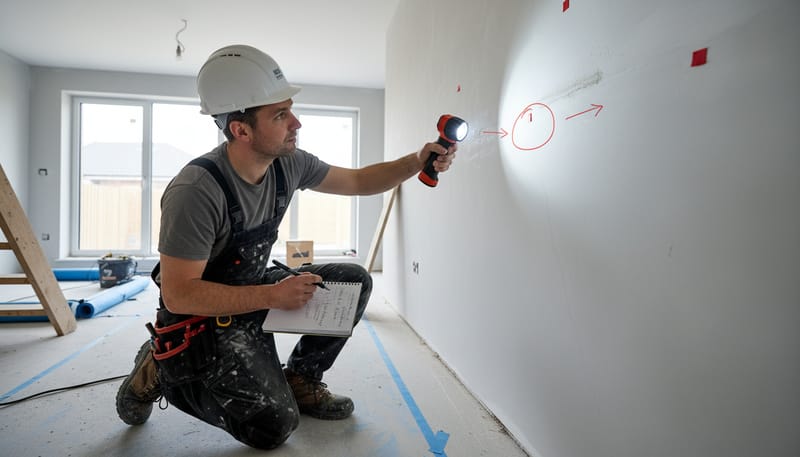
What Is Snagging?
Snagging is the inspection of a newly built property to identify defects, unfinished work, and items that don't meet the expected standard. The term comes from the construction industry where a 'snag list' is a document listing items that need attention before a project is considered complete.
| Term | Meaning |
|---|---|
| Snag | Any defect, fault, or piece of unfinished work in a new build property |
| Snagging inspection | A systematic survey of the property to identify all snags |
| Snag list / snagging report | A documented list of all defects found, with descriptions, locations, and photographs |
| Defects liability period | The contractual period (usually 2 years from completion) during which the developer must fix reported defects |
| NHBC warranty period | The 10-year structural warranty period — different from the defects liability period |
| Practical completion | The point at which the developer considers the property finished and ready for handover |
When Should You Snag?
Timing is important. There are three key points at which you should inspect your new build home:
| Inspection Point | When | Purpose | Access |
|---|---|---|---|
| Pre-completion inspection | After the developer issues the notice to complete but before you legally complete | Identify major defects before you own the property; gives you leverage to insist on fixes | Developer may allow access for 1-2 hours; some restrict this |
| Day-of-completion inspection | On completion day, when you collect the keys | Check the property before you move furniture in; document the condition at handover | You own the property — full access |
| End-of-defects-period inspection | Approximately 21-23 months after completion (before the 2-year defects period expires) | Catch any defects that have appeared since you moved in — settlement cracks, shrinkage, sticking doors | You own the property — full access |
Pre-Completion Snagging: Can You Do It?
The ideal time to snag is before completion, when the property is empty and every surface is visible. However, developers have different policies:
| Developer Policy | What It Means | Your Response |
|---|---|---|
| Pre-completion inspection allowed | Developer gives you 1-2 hours to inspect before completion day | Use this time efficiently — bring a professional snagger if possible |
| Pre-completion inspection not allowed | Developer claims it's a health and safety issue or 'not company policy' | You have limited leverage here, but the Consumer Code says buyers should have a reasonable opportunity to inspect before completion. Push back politely but firmly |
| Pre-completion inspection with restrictions | Developer allows you to look but not bring a professional snagging company | This is increasingly common. Some developers have relented under pressure, but you may need to accept the restriction and commission a professional snag after completion instead |
Important: Whether or not you can snag before completion, snagging does not affect your obligation to complete. If you've exchanged contracts and the developer serves the completion notice, you must complete — you cannot refuse to complete because of snags. Snagging is about documenting defects for the developer to fix, not about delaying completion.
The End-of-Defects Inspection
This is the inspection most buyers forget about, and it's arguably the most important. Many defects don't appear immediately — they emerge over the first 12-24 months as the building settles, materials shrink, and seasonal temperature changes take effect. Common issues that appear later include:
- Hairline cracks in plaster and around door frames (settlement)
- Doors that stick or no longer close properly (timber movement)
- Gaps appearing between skirting boards and walls
- Gaps around window frames
- Damp patches appearing in cold weather (condensation or construction moisture drying out)
- Drainage problems that only show in heavy rain
Commission a professional snagging inspection around month 21-22 of the defects period. This gives you time to submit the report and have the developer schedule repairs before the 2-year deadline.
DIY Snagging vs Professional Snagging
| Factor | DIY Snagging | Professional Snagging |
|---|---|---|
| Cost | Free (your time) | £300-£600 for a typical 3-4 bed house |
| Time required | 2-4 hours for a thorough inspection | 2-4 hours on site; report delivered within 24-72 hours |
| Expertise | You'll catch obvious defects; may miss technical issues | Trained inspectors with specialist equipment; know building regulations and standards |
| Equipment | Torch, phone camera, spirit level, ladder | Thermal imaging, moisture meters, spirit levels, laser measures, specialist lighting |
| Report quality | Your own notes and photos | Formal report with photos, descriptions, locations, and severity ratings — carries more weight with the developer |
| Developer response | Developer may dispute your findings or claim items are 'within tolerance' | Harder for the developer to dismiss a professional report — adds credibility and pressure |
| Items found | Typically 20-50 items | Typically 50-200+ items (many you wouldn't have spotted) |
What Does a Professional Snagging Company Do?
A professional snagging inspector will:
- Systematically inspect every room, surface, fixture, and fitting
- Check external areas including brickwork, render, roofline, guttering, and drainage
- Use a spirit level to check floors, walls, and worktops
- Test all doors and windows for smooth operation and sealing
- Check electrical sockets and switches for level alignment and function
- Inspect plumbing — run taps, flush toilets, check for leaks under sinks
- Use thermal imaging to identify cold spots, missing insulation, or air leaks
- Use a moisture meter to check for excessive damp in walls, floors, and around windows
- Check the loft for insulation depth, ventilation, and any visible defects
- Produce a detailed report with photographs, descriptions, locations, and recommended remedial actions
How to Choose a Snagging Company
| Criteria | What to Look For |
|---|---|
| Qualifications | RICS, RPSA (Residential Property Surveyors Association), or equivalent construction/surveying qualification |
| Insurance | Professional indemnity insurance — essential if they miss something significant |
| Experience | Specifically in new build snagging — not general property surveys |
| Reviews | Check reviews from other new build buyers; look for detail about report quality |
| Report format | Detailed report with photographs, room-by-room breakdown, and severity ratings |
| Turnaround | Report delivered within 24-72 hours of inspection |
| Follow-up | Will they do a re-inspection to check the developer's repairs? |
| Cost | £300-£600 for a standard inspection; beware of very cheap quotes (may lack thoroughness) |
Recommendation: If you can only afford one professional snagging inspection, have it done at the end-of-defects period (month 21-22) rather than at completion. This is when it has the most value — catching defects that have appeared over time before your contractual right to have them fixed expires.
How to Conduct a DIY Snagging Inspection
If you're doing the snagging yourself, follow this systematic approach:
What You Need
| Item | Purpose |
|---|---|
| Smartphone with camera | Photograph every defect with the location visible |
| Notepad or tablet | Record defects systematically by room |
| Torch / phone torch | Inspect dark areas — under sinks, inside cupboards, loft |
| Small spirit level | Check worktops, window sills, floors, and walls are level |
| Step ladder | Inspect high areas — top of doors, upper walls, ceilings, loft hatch |
| Sticky dots or masking tape | Mark the location of defects on walls/surfaces for easy identification |
| Toilet roll | Place a sheet over extractor fan vents — confirms the fan is pulling air (should hold the paper) |
| Tennis ball or marble | Check floors are level — roll the ball across the floor and see if it runs to one side |
| Printed checklist | Use our room-by-room snagging checklist to ensure you don't miss anything |
The Inspection Process
| Step | What to Do | Time |
|---|---|---|
| 1. Start outside | Inspect brickwork, render, roofline, guttering, downpipes, driveway, fencing, garden | 20-30 minutes |
| 2. Work room by room | Start at the front door and work systematically through every room | 15-20 minutes per room |
| 3. Check each surface | Walls (plaster, paint), ceilings, floors, skirting boards, architraves, window boards | Included in room time |
| 4. Test all moving parts | Every door, window, lock, handle, hinge, drawer, cupboard door | Included in room time |
| 5. Check fixtures and fittings | Sockets, switches, lights, taps, shower, toilet, extractor fans, towel rails | Included in room time |
| 6. Check the loft | Insulation depth (minimum 270mm), ventilation, water tank (if applicable), light | 10-15 minutes |
| 7. Check services | Boiler, hot water, central heating (run it even in summer), water pressure | 15-20 minutes |
| 8. Photograph everything | Take a wide shot showing the location and a close-up showing the defect | Throughout |
Key Things Most People Miss
| Commonly Missed Item | Where to Look | What to Check |
|---|---|---|
| Loft insulation gaps | Loft space — particularly around pipes, cables, and at the eaves | Insulation should be continuous and at least 270mm deep |
| Silicone sealant quality | Around baths, showers, sinks, worktops, and where walls meet different surfaces | Should be continuous, neatly applied, and fully adhered on both sides |
| External drainage | Run water through all taps and showers simultaneously; check gullies and downpipes outside | Water should drain quickly with no backing up or overflow |
| Window restrictor mechanisms | All upper-floor windows | Should have safety restrictors that prevent full opening; required by building regulations |
| Fire door closer mechanisms | Doors between garage and house; kitchen doors (if integral garage) | Fire doors should self-close fully into the frame |
| Underside of worktops | Kitchen — look underneath | Raw edges should be sealed; joints should be tight with no gaps |
| Behind appliances | Pull out the oven and check behind the fridge | Walls should be finished; no missing plaster, exposed cables, or debris |
| Manhole covers | Garden / driveway | Should sit flush and be accessible; check the drain runs clear |
How Many Snags Should You Expect?
| Property Type | Average Snags (Professional Inspection) | Range |
|---|---|---|
| 1-2 bed flat | 40-80 | 20-150 |
| 2-3 bed house | 60-120 | 30-200 |
| 4-5 bed house | 80-160 | 50-300+ |
| Premium / luxury property | 50-100 | 20-200 |
Don't be alarmed by high numbers. Most snags are minor — paint touches, small plaster cracks, adjustment issues. What matters is the severity breakdown:
| Severity | Examples | Typical Percentage |
|---|---|---|
| Cosmetic (minor) | Paint marks, small scratches, minor plaster imperfections, scuff marks | 50-60% of snags |
| Functional (moderate) | Sticking doors, dripping taps, poorly sealed sealant, gaps in skirting | 25-35% of snags |
| Significant (major) | Missing insulation, drainage issues, damp problems, structural cracks, non-functioning heating | 5-15% of snags |
| Critical (urgent) | Fire safety defects, electrical hazards, gas leaks, structural damage | Less than 1% (but the most important to catch) |
How to Report Snags to the Developer
How you report defects matters. A well-documented report gets taken seriously and makes it harder for the developer to dismiss or downplay issues.
What to Include in Your Snagging Report
| Element | Why It Matters | Example |
|---|---|---|
| Your name and plot/address | Identifies the property | 'Plot 42, 15 Meadow Lane, Development Name' |
| Date of inspection | Creates a formal record and establishes the timeline | 'Inspected: 15 February 2026' |
| Room-by-room organisation | Makes it easy for the developer to send the right trades | 'Kitchen — Item 1: ..., Item 2: ...' |
| Clear description of each defect | Removes ambiguity about what needs fixing | 'Kitchen — worktop joint has a visible gap of approximately 3mm where the two sections meet' |
| Photograph of each defect | Visual evidence the developer can't dispute | Wide shot showing location + close-up showing the defect |
| Severity rating (if possible) | Helps prioritise — cosmetic, functional, significant, critical | 'Severity: Functional — door does not close properly' |
| Reference to standards (if applicable) | Adds authority — 'does not meet NHBC standard 8.1.2' | A professional report will include these references |
How to Submit the Report
- Email: Send to the site manager and the developer's customer care / after-sales team. Email creates a date-stamped record
- Developer's portal: Some developers have online portals for reporting defects. Use these but also send a copy by email so you have your own record
- Keep a copy: Save a copy of the report, all photographs, and all correspondence. You may need this if the developer is slow to respond or you need to escalate
- Request acknowledgement: Ask the developer to confirm receipt and provide a timeline for addressing the items
The Developer's Response: What to Expect
| Developer Response | What It Means | Your Action |
|---|---|---|
| Acknowledges all items and schedules repairs | Best-case scenario — developer is being responsive | Confirm the repair dates; be available to provide access; inspect the quality of repairs afterwards |
| Acknowledges some items, rejects others | Developer may claim some items are 'within tolerance' or 'not defects' | Push back on rejected items with evidence; reference NHBC standards or building regulations; escalate if necessary |
| Acknowledges but gives no timeline | Developer is busy and not prioritising your repairs | Follow up in writing every 2 weeks; reference the Consumer Code requirement for timely after-sales service |
| Ignores the report entirely | Poor customer service — unfortunately not uncommon | Escalate to the developer's head office customer care team; reference Consumer Code; consider formal complaint |
| Claims the defects period has expired | Developer is trying to avoid obligations | Check your contract — you must have reported within the period, not the repairs must be completed within it. If you reported in time, the developer is still obligated to fix |
'Within Tolerance' — The Developer's Favourite Phrase
Developers often use 'within tolerance' to reject snags. While tolerances do exist in construction (a perfectly flat wall is physically impossible), many developers stretch this defence beyond what's reasonable.
| Item | Typical Acceptable Tolerance | What's Not Acceptable |
|---|---|---|
| Wall straightness | Up to 8mm deviation over 2 metres (NHBC) | Visible bowing or bulging; deviation greater than 8mm; misalignment at corners |
| Floor level | Up to 10mm over 2 metres (depending on finish) | Noticeable slope; furniture won't sit level; doors drag on the floor |
| Plaster finish | Minor surface imperfections not visible in normal lighting | Visible cracks, bulges, or unevenness in normal lighting conditions |
| Paint finish | Minor brush marks or roller stipple in consistent lighting | Visible drips, missed spots, colour variation, paint on fixtures |
| Tile alignment | Up to 1mm variation between adjacent tiles (NHBC) | Visible lippage; grout lines that aren't straight; cracked tiles |
| Door gaps | 2-3mm gap around the frame; consistent on all sides | Uneven gaps; door rubbing on carpet or frame; gap visible under external door |
| Window operation | Should open, close, and lock smoothly | Stiff operation; won't lock; catches on the frame; gaps when closed |
If the developer claims something is 'within tolerance,' ask them to specify which tolerance standard they're applying and the specific measurement. If they can't, it's not a valid defence.
The Defects Liability Period
The defects liability period is the contractual period during which the developer is obligated to fix defects in your property. This is separate from the NHBC or other structural warranty.
| Period | Duration | What It Covers | Who Is Responsible |
|---|---|---|---|
| Defects liability period | Usually 2 years from completion | All defects in workmanship, materials, and finish — including cosmetic issues | The developer directly |
| NHBC Buildmark Year 1-2 | First 2 years | If the developer doesn't fix defects, NHBC can step in (resolution service) | Developer first; NHBC as backstop |
| NHBC Buildmark Year 3-10 | Years 3 to 10 | Structural defects and damage caused by failure to meet NHBC standards — excludes cosmetic issues | NHBC directly (insurance policy) |
Critical point: The defects liability period and the NHBC warranty are different things covering different items at different times. Cosmetic defects (paint, plaster, minor finishes) are only covered during the 2-year defects period. After that, you're on your own for non-structural issues. This is why the end-of-defects inspection at month 21-22 is so important.
For a detailed breakdown of what the NHBC and other warranties cover, see our warranty guide.
Getting Repairs Done: The Practical Reality
Reporting snags is one thing; getting them fixed properly is another. Here's what typically happens:
| Stage | What Happens | Typical Timeline |
|---|---|---|
| Report submitted | You send the snagging report to the developer | Day 1 |
| Acknowledgement | Developer confirms receipt and reviews the list | 1-2 weeks |
| Initial assessment | Site manager or customer care team reviews items; may visit to inspect | 2-4 weeks |
| Repair scheduling | Developer schedules trades to attend — usually batch several repairs together | 4-8 weeks from report |
| First repair visit | Trades attend to fix items; may take 1-3 visits depending on scope | 6-12 weeks from report |
| Follow-up items | Some repairs create new issues (e.g., plaster repair needs repainting); developer schedules return visit | Additional 2-4 weeks |
| Sign-off | You confirm all items are resolved to your satisfaction | Total: 8-16+ weeks from initial report |
Tips for Getting Repairs Done Efficiently
- Be organised: Have a clear, numbered list so you and the developer can reference specific items
- Be available: Repairs need access. Be flexible with access times where possible — it speeds things up
- Be persistent but reasonable: Follow up every 2 weeks if you haven't heard back. Be polite but firm
- Document repairs: When trades attend, check their work before they leave. Take photos of repairs. Note any items that haven't been done or have been done poorly
- Don't accept poor repairs: If a repair is substandard (e.g., paint touch-up that doesn't match, sealant that's messy), reject it and ask for it to be redone properly
- Keep a running record: Maintain a master list showing which items are outstanding, which are completed, and which were done unsatisfactorily
- Escalate when needed: If the site manager is unresponsive, escalate to the developer's regional customer care team, then head office. For more on escalation, see our snagging disputes guide
What the Developer Must Fix vs What They Won't Fix
| Developer Must Fix (Within Defects Period) | Developer Probably Won't Fix |
|---|---|
| Cracked or poorly finished plaster | Normal settlement cracks (hairline cracks up to 0.5mm that appear as the building dries out) |
| Doors that don't close or lock properly | Minor adjustment needed due to seasonal timber movement (though significant issues still count) |
| Leaking taps, pipes, or radiators | Limescale build-up from normal water use |
| Missing or damaged sealant | Sealant shrinkage (some shrinkage is normal; significant gaps are defects) |
| Damaged or scratched windows | Condensation between panes (this IS a defect — the sealed unit has failed) |
| Electrical faults or non-working sockets | Blown light bulbs (consumable items) |
| Drainage problems | Blocked drains caused by your usage after moving in |
| Missing insulation or insulation gaps | Condensation on windows (usually ventilation-related, not a defect) |
| Unfinished external areas (fencing, landscaping) | Plant failure due to lack of watering (garden maintenance is your responsibility from completion) |
| Items not matching the specification | Items you've modified or damaged yourself |
Snagging and Your NHBC Warranty
The NHBC Buildmark warranty and the developer's defects liability period work in parallel but cover different things at different times.
| Period | Who Fixes It | What's Covered | How to Claim |
|---|---|---|---|
| Year 1-2 (defects liability) | Developer | All defects — cosmetic, functional, and structural | Report to developer; NHBC resolution service if developer doesn't respond |
| Year 3-10 (NHBC insurance) | NHBC directly | Structural defects and damage caused by non-compliance with NHBC standards only | Claim directly with NHBC; they send an inspector to assess |
For a comprehensive guide to NHBC, Premier Guarantee, LABC, and other warranty providers — including what they cover, what they exclude, and how to make a claim — see our warranty guide.
When Things Go Wrong: Escalation and Disputes
If the developer refuses to fix legitimate defects, is unresponsive, or does poor-quality repairs, you have several escalation routes:
| Escalation Step | When to Use It | What Happens |
|---|---|---|
| 1. Written complaint to developer | Developer not responding or refusing to fix items | Formal letter to customer care director; sets the clock running on their complaints process |
| 2. NHBC resolution service (years 1-2) | Developer fails to resolve defects within a reasonable time | NHBC mediates between you and the developer; can direct the developer to make repairs |
| 3. Consumer Code dispute resolution | Developer has breached the Consumer Code | Independent adjudicator reviews the complaint; can award compensation up to £15,000 |
| 4. NHBC claim (years 3-10) | Structural defect appears after year 2 | NHBC sends an inspector; if valid, NHBC pays for or arranges repairs |
| 5. Legal action | All other routes exhausted; significant financial loss | County court claim for breach of contract; need legal advice |
For a detailed guide to handling disputes and understanding your legal rights, see our snagging disputes and legal guide.
Snagging Timeline Summary
| When | What to Do | Key Points |
|---|---|---|
| Before completion | Pre-completion inspection (if developer allows) | Bring a professional if possible; document everything; this doesn't delay completion |
| Completion day | Collect keys; do a walkthrough inspection | Check against the specification; photograph the condition of every room before moving furniture in |
| Week 1-2 | Submit your initial snagging report | Detailed, photographed, room-by-room. Email to site manager and customer care |
| Month 1-3 | Chase developer for repair schedule; provide access for trades | Follow up every 2 weeks; document all communications |
| Month 3-6 | First round of repairs completed; check quality | Reject substandard repairs; submit follow-up items |
| Month 6-12 | Monitor for emerging defects (settlement cracks, sticking doors) | Keep a running list of new issues that appear |
| Month 12-18 | Report any new defects to the developer | Still within the defects liability period; report promptly |
| Month 21-22 | Commission professional end-of-defects snagging inspection | This is the most valuable single inspection — catches everything before the 2-year deadline |
| Month 22-23 | Submit end-of-defects report to developer | All items reported before month 24 must be fixed by the developer |
| Month 24 | Defects liability period expires | After this date, only structural issues are covered (under NHBC years 3-10) |
Snagging Checklist Overview
Here's a summary of the key areas to check. For a detailed room-by-room checklist you can print and take with you, see our snagging checklist.
| Area | Key Checks |
|---|---|
| External | Brickwork, render, roofline, guttering, downpipes, driveway, fencing, garden, drainage, manhole covers |
| Hallway/Landing | Front door seal, letterbox, flooring, skirting, walls, ceiling, stairs, banister, smoke alarms |
| Kitchen | Worktops, units, handles, drawers, taps, sink seal, splashback, appliances, extractor, sockets |
| Living Room | Walls, ceiling, skirting, windows, flooring, sockets, TV point, radiator |
| Bedrooms | Walls, ceiling, skirting, windows, built-in wardrobes (if any), sockets, radiator |
| Bathroom / En-Suite | Tiles, grouting, sealant, taps, shower, toilet, towel rail, extractor, window |
| Loft | Insulation depth and coverage, ventilation, water tank, light, truss clips, felt condition |
| Garage | Door operation, fire door to house, sockets, lighting, floor finish |
| Services | Boiler, heating, hot water, water pressure, electrics, consumer unit labelling |
Frequently Asked Questions
Can I refuse to complete because of snags?
No. If you've exchanged contracts and the developer serves the completion notice, you must complete within the notice period. Snagging does not give you the right to delay or refuse completion. If you don't complete, you'll face penalty interest charges and potentially forfeit your deposit. Snagging is about documenting defects for the developer to fix after completion.
Can I withhold part of the purchase price until snags are fixed?
In most new build contracts, no. The 'no set-off' clause means you must pay the full price and pursue remedies separately. This is one of the more frustrating aspects of new build contracts. For more on contract clauses, see our contracts guide.
How long does the developer have to fix snags?
There's no specific legal deadline for individual repairs. The developer must fix reported defects within a 'reasonable' time during the defects liability period. What's reasonable depends on the severity — a leaking pipe should be fixed urgently; a paint touch-up can wait. If the developer is unreasonably slow, escalate through the NHBC resolution service or Consumer Code.
What if I find a structural defect?
Report it immediately to the developer and to your NHBC (or equivalent warranty provider). Structural defects are covered for 10 years under the warranty. Don't attempt to fix structural issues yourself — this could void your warranty cover.
Should I snag if the property looks fine?
Yes. Most defects aren't visible at a casual glance — they're found by systematically checking every surface, fixture, and fitting. Even properties that look immaculate on first impression typically have 50-100+ snags when professionally inspected.