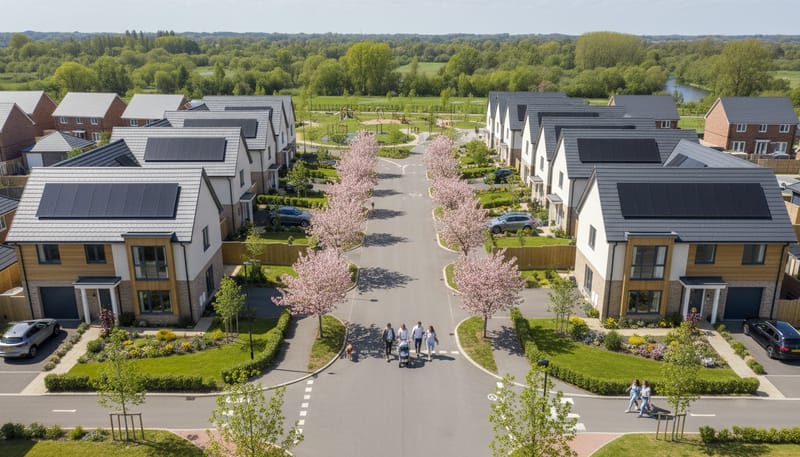
Why New Builds Work Well for First-Time Buyers
New builds aren't for everyone, but they have specific advantages that suit many first-time buyers:
- No chain: You're buying directly from a developer, so there's no chain of sellers above you that could collapse. This makes the process faster and more predictable.
- Known costs: Everything is new, so there are no surprise repairs or maintenance bills in the early years. The NHBC warranty covers defects for up to 10 years.
- Energy efficiency: New builds meet current building regulations, which means they're typically EPC A or B rated — significantly cheaper to heat than older properties.
- Scheme access: Government schemes like First Homes, Shared Ownership, and Own New Rate are specifically designed for (or most commonly used on) new build properties.
- Developer incentives: Free upgrades, paid legal fees, deposit contributions, and subsidised mortgage rates can reduce your upfront costs significantly.
- Move-in ready: No renovation, no redecorating, no waiting for builders. You get the keys and move straight in.
For an honest comparison of the trade-offs, see our new build vs older property comparison for first-time buyers.
Step 1: How Much Deposit Do You Need?
The minimum deposit for a new build mortgage is typically 5% of the purchase price. On a £300,000 property, that's £15,000. However, a larger deposit (10–15%) gives you access to better mortgage rates and lower monthly payments.
Ways to Build Your Deposit
- Lifetime ISA: Save up to £4,000/year and get a 25% government bonus (£1,000/year). The account must be open for 12 months before you can use the funds, and the property must be under £450,000. This is free money — every first-time buyer should have one.
- Regular savings: Set a monthly savings target and automate it. Even £300/month for 3 years gives you £10,800 plus interest.
- Gifted deposits: Family members can gift money toward your deposit. Your lender will need a signed letter confirming it's a gift, not a loan.
- Shared Ownership: If you can't afford a 5% deposit on the full property price, Shared Ownership lets you buy a share (25–75%) — so your deposit is 5–10% of your share, not the whole property. On a £300,000 home at 25% share, a 10% deposit is just £7,500.
For a detailed breakdown of every cost involved, see our full cost guide.
Step 2: Understanding the Schemes Available to You
As a first-time buyer purchasing a new build in 2026, you have access to several government-backed schemes. Here's a quick summary — each has its own detailed guide linked below.
First Homes
New build properties sold at a 30–50% discount to market value. The discount is locked in perpetuity (future buyers get the same percentage off). Available to first-time buyers in England with household income under £80,000 (£90,000 in London).
Shared Ownership
Buy a 25–75% share of a new build and pay subsidised rent on the rest. You can "staircase" (buy more shares) over time. Lower deposit requirements and lower monthly costs, but you don't own the whole property and rent increases annually.
Own New Rate
The developer subsidises your mortgage rate for the first 2–5 years, giving you significantly lower monthly payments in the early years. You buy at full price with full ownership — no shared equity or resale restrictions. No income cap, and open to home movers too.
Lifetime ISA
Not a scheme in the traditional sense, but a savings vehicle with a 25% government bonus. Can be used alongside any of the schemes above.
Deposit Unlock
The developer underwrites part of the mortgage risk, enabling lenders to offer 95% LTV mortgages on new builds that might otherwise need a larger deposit.
Detailed guides:
Step 3: Getting Mortgage-Ready
Before you start viewing, get a mortgage agreement in principle (AIP). This tells you how much a lender will offer, based on your income, deposit, and credit history. An AIP is free, takes 24–48 hours through a broker, and is valid for 60–90 days.
Choosing a Mortgage Broker
For new build purchases, use a broker who understands:
- Which lenders accept developer incentives (and their caps)
- Which lenders offer extended mortgage offer validity for off-plan purchases
- How schemes like Own New Rate and Shared Ownership affect mortgage applications
- New build valuation issues and how to handle down-valuations
Get quotes from both the developer's recommended broker and an independent whole-of-market broker. Use whichever offers genuinely better terms.
What Lenders Look At
- Income: Typically 4–4.5x your annual salary (sole or joint)
- Credit score: Check yours before applying. Fix any errors on your credit file and avoid opening new credit accounts in the months before applying.
- Outgoings: Existing debts, subscriptions, and regular commitments reduce how much you can borrow. Pay down credit cards and cancel unused subscriptions before applying.
- Deposit source: Lenders need to verify where your deposit comes from (savings, LISA, gift, etc.) for anti-money-laundering purposes.
Step 4: Finding and Choosing Your New Build
Use our new build search to find developments in your area. When shortlisting, consider:
The Development
- Location: Commute times, local schools, amenities, transport links
- Developer reputation: HBF star rating, online reviews, build quality on completed sites
- Schemes available: Not all schemes are offered on all developments. Check before visiting.
- Future phases: What will be built around you? A pleasant view today might be Phase 3 housing next year.
The Plot
- Orientation: South or west-facing rear gardens are more desirable (and valuable at resale)
- Position: Avoid plots next to main roads, bin stores, or substations. Corner plots often have larger gardens.
- House type: Consider your current needs and medium-term plans. A 2-bed flat is fine for a single buyer or couple, but if children are on the horizon, a 3-bed house may be worth stretching for.
- Parking: How many spaces? Where are they? Is there a garage?
The Show Home
Remember: the show home is staged to sell. Ask for the standard specification sheet — the show home kitchen, flooring, and garden landscaping are often upgrades, not what you'll get as standard.
Step 5: The Buying Process
The new build buying process is different from buying a resale property. Here's the summary — each stage has its own detailed guide.
Reservation (Day 1)
You pay a reservation fee (£500–£1,000) to secure your plot. This starts a 28-day clock to exchange contracts. Read the reservation agreement carefully — especially the refund conditions.
Guide: The critical 28 days after reservation
Mortgage Application + Solicitor (Days 1–3)
Submit your full mortgage application and instruct a solicitor immediately. Choose a solicitor with specific new build experience — the contract documents are more complex than standard conveyancing.
Exchange of Contracts (Days 14–28)
You pay your deposit (5–10%), sign the contract, and legally commit. Make sure your mortgage offer is in place, your solicitor has reviewed everything, and you understand the long-stop date and completion notice period.
Guide: Exchange of contracts explained
Completion Day
Funds transfer, ownership transfers, and you collect the keys. Do a thorough walkthrough before accepting — check walls, floors, windows, plumbing, electrics, and garden.
Guide: Your hour-by-hour completion day guide
For the full end-to-end process, see our complete 10-step buying guide.
Step 6: Developer Incentives and Negotiation
Developers offer incentives to attract buyers and move stock. As a first-time buyer, you can often get:
- Free upgrades: Kitchen, bathroom, flooring, garden — often worth £5,000–£15,000
- Legal fees paid: Saves £1,500–£2,500
- Deposit contribution: Typically 2–5% of the purchase price (subject to lender caps)
- Own New Rate subsidy: Reduced mortgage rate for the first 2–5 years
Don't accept the first offer — incentives are negotiable, especially at end-of-quarter or on remaining plots. And don't accept "stamp duty paid" if you don't owe stamp duty (first-time buyers pay nothing on properties under £425,000).
Guides:
Step 7: After You Move In
Snagging
A professional snagging inspection (£300–£500) checks the property for defects. The average new build has 50–100+ snags. Book this within the first week and submit the report to the developer. They must fix defects under the 2-year warranty.
Guide: Complete snagging guide
The Two-Year Defect Period
The developer must fix defects reported in the first two years. After that, you're only covered for structural issues (years 3–10). Report problems promptly via email, and do a thorough check before the 2-year mark.
Your First Year
New builds take time to settle. Expect: shrinkage cracks as the house dries out, the need to repaint after the first year, and ongoing construction noise if you're on an active development. None of this is unusual — but it helps to be prepared.
First-Time Buyer Stamp Duty in 2026
As a first-time buyer in England, you pay:
- £0 stamp duty on properties up to £425,000
- 5% on the portion between £425,001 and £625,000
- Standard rates on properties above £625,000 (you lose first-time buyer relief entirely)
Most new builds purchased by first-time buyers are under £425,000, meaning you pay no stamp duty at all. This is a significant saving — on the same £300,000 property, a non-first-time buyer would pay £2,500 in stamp duty.
For a detailed breakdown of every cost, see our full cost guide for first-time buyers.
The Mistakes to Avoid
First-time buyers consistently make the same errors on new builds. The most expensive include:
- Not getting an AIP before visiting show homes
- Choosing the cheapest solicitor instead of a new build specialist
- Skipping the snagging inspection
- Not understanding service charges before buying
- Accepting worthless stamp duty incentives
- Exchanging contracts without a mortgage offer in place
- Not using the two-year defect warranty properly
We've calculated the cost of each mistake — some can run to tens of thousands of pounds. Read the full breakdown: The 15 costliest first-time buyer mistakes on new builds.
Your First-Time Buyer Checklist
- Open a Lifetime ISA and start saving (12 months before you plan to buy)
- Check your credit score and fix any issues
- Get a mortgage agreement in principle through a new build specialist broker
- Research government schemes and decide which (if any) suits you
- Start viewing developments and comparing plots
- Reserve your chosen plot and instruct a new build solicitor immediately
- Submit your full mortgage application within days of reservation
- Review the contract with your solicitor — check the long-stop date, specification, and service charges
- Exchange contracts only when your mortgage offer is confirmed and everything is in order
- Arrange buildings insurance from exchange date
- Book a snagging inspection for completion day or the day after
- Complete, collect keys, and photograph everything before moving furniture in
- Submit your snagging list and keep reporting defects throughout the 2-year warranty
All Our First-Time Buyer Guides
- The 15 costliest FTB mistakes (with £ figures)
- New build vs older property: which is better for FTBs?
- Full cost breakdown for buying a new build
- Your first year in a new build: what to expect
- Government schemes for new build buyers (2026)
- The complete buying process step by step
- New build incentives explained
- Snagging your new build home