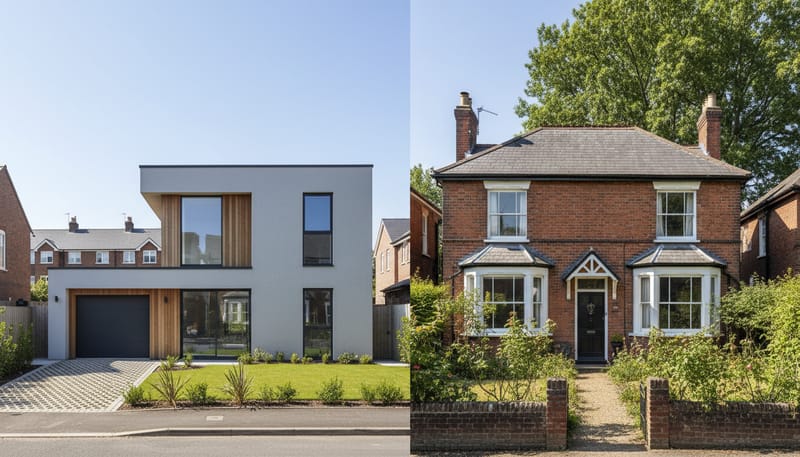
Quick Comparison Table
| Factor | New Build | Existing Home | Winner |
|---|---|---|---|
| Purchase price | 10-20% premium | Lower per sq ft | Existing |
| Energy bills | £800-£1,200/year typical | £1,500-£2,500/year typical | New build |
| Maintenance (first 10 years) | Very low | £1,000-£3,000/year average | New build |
| Space (sq ft per £) | Less space per £ | More space per £ | Existing |
| Garden size | Small or none | Usually larger | Existing |
| Build quality | Variable (warranty helps) | Variable (survey essential) | Draw |
| Energy efficiency (EPC) | A or B typical | D or E typical | New build |
| Character and charm | Limited | Often significant | Existing |
| Buying process | Chain-free, often faster | Chain-dependent, slower | New build |
| Warranty protection | 10-year NHBC or equivalent | None (unless recent build) | New build |
| Location choice | Limited to developments | Any street, any area | Existing |
| Customisation | Some pre-build choices | Full renovation freedom | Draw |
| Mortgage options | Some restrictions | Full market access | Existing (slightly) |
| Resale value (short-term) | Premium may deflate | Market-dependent | Existing |
| Resale value (long-term) | Generally tracks market | Generally tracks market | Draw |
Score: New build wins on 4, existing wins on 5, draw on 3, context-dependent on 3. Neither is objectively better — it depends on your priorities. Let's examine each factor in detail.
1. Purchase Price: The New Build Premium
New builds typically cost 10-20% more per square foot than comparable existing homes in the same area. On a £300,000 existing home, the equivalent new build might cost £330,000-£360,000.
This premium reflects:
- Higher specification — modern kitchens, bathrooms, and integrated appliances
- Energy efficiency — Part L building regulations compliance adds construction cost
- Warranty — the 10-year NHBC or equivalent is built into the price
- Developer profit margin — typically 15-20% of the sale price
- Marketing and sales costs — show homes, sales teams, incentive budgets
However, the premium isn't always what it seems. Developer incentives (stamp duty paid, legal fees covered, upgraded specification) can reduce the effective premium by 3-5%. And the lower running costs of a new build reduce the total cost of ownership — see our detailed cost analysis.
Verdict: existing homes win on headline price per square foot, but the gap narrows when you factor in running costs and incentives.
2. Energy Bills: The Biggest Ongoing Difference
This is where new builds have the clearest, most quantifiable advantage. A new build home built to current Part L regulations (2021 onwards) is dramatically more energy-efficient than a typical existing home:
| Property Type | Typical EPC | Annual Energy Cost (2026 prices) | Annual CO2 Emissions |
|---|---|---|---|
| New build (post-2021) | A or B | £800 - £1,200 | 1.0 - 1.5 tonnes |
| New build (2013-2021) | B or C | £1,000 - £1,500 | 1.5 - 2.5 tonnes |
| 1990s-2000s build | C or D | £1,300 - £1,800 | 2.5 - 3.5 tonnes |
| 1960s-1980s build | D or E | £1,600 - £2,300 | 3.5 - 5.0 tonnes |
| Victorian/Edwardian | D, E or F | £1,800 - £2,800 | 4.0 - 6.0 tonnes |
Over 10 years, the energy saving of a new build over a Victorian home is approximately £10,000-£16,000 at current prices — and significantly more if energy prices rise. This is the single largest financial argument for new builds and the one most often underestimated by buyers focused on purchase price.
New builds achieve this through triple glazing (or high-spec double), continuous insulation, airtight construction, heat recovery ventilation systems, heat pumps (increasingly standard), and solar PV panels (on some developments).
Verdict: clear new build win. The energy saving is real, substantial, and grows over time.
3. Maintenance Costs: The Early Years vs The Long Game
New builds require minimal maintenance in the first 5-10 years. Everything is new, under warranty, and built to current standards. The developer handles defects in the first 2 years; the NHBC or equivalent warranty covers structural issues for 10 years.
Existing homes, by contrast, need ongoing maintenance from day one — and often need immediate work that buyers underestimate:
| Item | Typical Cost | Frequency | New Build? |
|---|---|---|---|
| Boiler replacement | £2,500 - £4,500 | Every 12-15 years | Not for 12-15 years |
| Roof repairs | £3,000 - £10,000 | Every 20-30 years | Not for 20+ years |
| Window replacement | £5,000 - £10,000 | Every 20-25 years | Not for 20+ years |
| Rewiring | £3,500 - £6,000 | Every 25-30 years | Not needed |
| Replumbing | £2,000 - £5,000 | Every 30-40 years | Not needed |
| Damp treatment | £1,000 - £5,000 | As needed | Rare |
| External decoration | £2,000 - £4,000 | Every 5-8 years | Less frequent (modern materials) |
| Kitchen replacement | £5,000 - £15,000 | Every 15-20 years | Not for 15+ years |
| Bathroom replacement | £3,000 - £8,000 | Every 15-20 years | Not for 15+ years |
A typical existing home might need £15,000-£30,000 in maintenance and improvements over the first 10 years. A new build might need £2,000-£5,000 over the same period (mostly cosmetic — repainting, minor snagging repairs, drying-out related touch-ups).
However, after year 10-15, new builds start needing the same maintenance as any other home. The advantage is front-loaded — it defers costs, it doesn't eliminate them.
Verdict: new build wins clearly in years 1-10. By year 20+, the maintenance costs converge.
4. Space: More Room for Your Money in Existing Homes
This is one of the strongest arguments for existing homes. New build houses have been getting smaller for decades:
- Average new build 3-bed house: approximately 80-90 sq metres (860-970 sq ft)
- Average 1930s 3-bed semi: approximately 90-100 sq metres (970-1,075 sq ft)
- Average Victorian 3-bed terrace: approximately 95-110 sq metres (1,020-1,185 sq ft)
The difference is even more pronounced with gardens. A new build 3-bed detached might have a 30-50 sq metre garden; the equivalent 1930s semi often has 80-150 sq metres. And room sizes in new builds, particularly bedrooms, can be significantly smaller — a 'double bedroom' that technically meets building regulations may not comfortably fit a double bed plus furniture.
What new builds do better with space: modern layouts tend to be more efficient. Open-plan kitchen-living spaces, built-in storage, and en-suite bathrooms use the available space more effectively. An 85 sq metre new build can feel more spacious than a 95 sq metre Victorian terrace with separate small rooms and a narrow hallway.
Verdict: existing homes win on raw space per pound, especially gardens. New builds can feel more usable despite smaller measurements.
5. Build Quality: Neither Side Has a Clear Win
This is the most contentious comparison. Both new builds and existing homes have quality issues — they're just different issues:
New build quality concerns
- Speed of construction: pressure on build timescales means finishing quality can suffer — poor plastering, misaligned fixtures, incomplete snagging
- Skills shortage: the construction industry faces workforce challenges, affecting consistency
- Modern methods: timber frame, steel frame, and modular construction are faster but some buyers question long-term durability (though evidence suggests they perform well)
- Warranty protection: NHBC or equivalent covers structural defects for 10 years, developer covers finishing defects for 2 years. This provides a safety net that existing homes don't have
Existing home quality concerns
- Hidden defects: subsidence, asbestos, lead paint, Japanese knotweed, damp, woodworm — issues that may not be visible and require professional survey to identify
- Building regulations of the era: a 1970s home was built to 1970s standards (minimal insulation, single glazing, basic electrics). Bringing it to modern standards costs thousands
- Previous owner modifications: DIY alterations, unpermitted extensions, and bodged repairs are common in older properties
- No warranty: unless the home was built within the last 10 years, there's no structural warranty. You rely on a survey (which can miss issues) and seller disclosure
Verdict: draw. New builds have finishing quality issues but warranty protection. Existing homes may have hidden structural issues but have proven themselves over decades. A professional inspection is essential for either.
6. The Buying Process: Chain-Free vs Chain-Dependent
New builds are almost always chain-free — you're buying directly from a developer, so there's no chain of transactions that need to complete simultaneously. This eliminates the most common cause of transaction failure in the UK property market.
Existing homes typically involve chains — the seller is buying another property, whose seller is buying another, and so on. If any link breaks, everyone's purchase is at risk.
| Factor | New Build | Existing Home |
|---|---|---|
| Chain risk | None (chain-free) | High (average chain is 3-4 properties) |
| Fall-through rate | ~10-15% | ~30% (national average) |
| Typical timescale | 4-12 weeks (if built); 6-24 months (off-plan) | 12-16 weeks |
| Negotiation | Limited (incentives more common than price cuts) | Full negotiation (offers below asking common) |
| Gazumping risk | None after reservation | Possible until exchange |
Verdict: new build wins for certainty and simplicity. The chain-free advantage alone makes new builds significantly less stressful to buy. The exception is off-plan purchases where the long wait for completion introduces its own risks.
7. Warranties and Legal Protection
New builds come with layered protection:
- Developer defects period (years 1-2): the developer must fix any defects reported within the first 2 years. This covers everything from dripping taps to cracked plaster
- Builder warranty period (years 3-10): the NHBC, LABC, or equivalent warranty covers structural defects — foundations, load-bearing walls, roof structure, weatherproofing
- Consumer Rights Act 2015: your home must be of satisfactory quality, fit for purpose, and as described
- NHQB Code: most major developers are signed up to the New Homes Quality Board code, which sets standards for sales, build quality, and aftercare
Existing homes have no equivalent. A building survey might identify issues, but if the surveyor misses something (which happens), your main recourse is professional negligence claims — slow, expensive, and uncertain.
Verdict: clear new build win. The warranty protection alone is worth thousands in peace of mind and is unique to new builds. See our warranties guide for full details.
8. Location and Community
This is often overlooked but it's a significant practical difference:
- New builds are available only where developers are building — typically on brownfield sites, former industrial land, or greenfield edges. You get the development, not a specific street. Amenities (shops, pubs, parks, schools) may take years to materialise on new developments
- Existing homes are available on any street in any area. You can pick the exact location — near a school, next to a park, on a quiet cul-de-sac, close to a station. Established areas have mature amenities, communities, and character
On new developments, you're also living alongside construction for potentially years as later phases are built. The noise, dust, and disruption of an active building site is a real quality of life issue that marketing brochures don't mention.
Verdict: existing homes win for location choice. New builds offer what the developer builds, where the developer builds it. If the development happens to be perfectly located, great — but you have far less geographic choice.
9. Mortgages: Subtle Differences
Both new builds and existing homes are mortgageable, but there are differences:
- New build restrictions: some lenders don't lend on new builds, or restrict lending to certain construction types, or cap the percentage of developer incentives they'll accept
- Offer validity: new build mortgages need longer offer validity (especially for off-plan), which limits lender choice. See our application process guide
- Down-valuation risk: new builds are more susceptible to down-valuations because comparable evidence may be limited (the development is new, so there are few previous sales to reference)
- Green mortgage discounts: new builds with EPC A/B may qualify for green mortgage rates, offsetting some restrictions with lower interest rates
Existing homes have full market access with no construction-type restrictions, shorter timescales (standard 3-6 month offers are fine), and abundant comparable evidence for valuations.
Verdict: existing homes have a slight advantage on mortgage flexibility. New builds have a potential advantage through green mortgage discounts. For most buyers, the differences are manageable with broker guidance.
10. Customisation and Personal Style
- New builds (pre-completion): many developers offer upgrade packages before completion — kitchen worktops, bathroom tiles, flooring, socket positions. The range is limited to the developer's options, but you can tailor the home without post-purchase renovation
- New builds (post-completion): modifications are limited during the warranty period — structural changes may void or complicate your warranty. Cosmetic changes (painting, fixtures) are fine
- Existing homes: complete freedom to renovate, extend, reconfigure, and personalise (subject to planning permission and building regulations). You can create exactly the home you want — at your own pace and budget
Verdict: draw — depends on what you want. If you want a finished home with no renovation required, new builds deliver. If you want to create something uniquely yours over time, existing homes are the canvas.
11. Worked Example: 10-Year Total Cost Comparison
Let's compare the total cost of ownership over 10 years for a 3-bedroom property in the same area:
New Build: £320,000 purchase price
| Cost | Amount (10 years) |
|---|---|
| Mortgage payments (4.5%, 30yr, £288,000 loan) | £175,200 |
| Stamp duty (FTB) | £1,000 |
| Legal fees | £1,500 |
| Energy bills (£1,000/year avg) | £10,000 |
| Maintenance | £4,000 |
| Service/estate charges (£600/year) | £6,000 |
| Council tax (Band D, £2,000/year) | £20,000 |
| Insurance (£400/year) | £4,000 |
| Total 10-year cost | £221,700 |
Existing Home (1960s): £275,000 purchase price
| Cost | Amount (10 years) |
|---|---|
| Mortgage payments (4.5%, 30yr, £247,500 loan) | £150,480 |
| Stamp duty (FTB) | £0 |
| Legal fees | £1,500 |
| Energy bills (£1,900/year avg) | £19,000 |
| Maintenance + improvements | £25,000 |
| Service/estate charges | £0 |
| Council tax (Band D, £2,000/year) | £20,000 |
| Insurance (£500/year — older property) | £5,000 |
| Total 10-year cost | £220,980 |
The result: remarkably similar — within £720 over 10 years. The new build's higher mortgage is offset by lower energy bills and much lower maintenance. The existing home's lower purchase price is eroded by higher running costs.
This doesn't account for capital appreciation (which varies by location, not by age) or the intangible value of more space, a larger garden, or modern design. But it demonstrates that the 'new build premium' is largely recouped through lower running costs over a typical ownership period.
12. Resale Value: The Honest Assessment
New builds face a 'premium deflation' risk in the first 2-5 years — the 10-20% premium you paid may not be fully reflected in the resale price, because your buyer won't be paying developer prices (they're buying a 'used' home on the open market).
After 5-10 years, this effect largely washes out. The property trades as an existing home at existing home prices, and its value tracks the local market like any other property.
Existing homes don't face this premium deflation but are more exposed to condition-related depreciation — if the roof, windows, or heating system need replacement, the buyer deducts those costs from their offer.
For detailed analysis, see our guide on whether new builds hold their value.
Verdict: existing homes have a slight short-term advantage (no premium to deflate). Long-term, both track the local market similarly.
Who Should Buy New Build?
New builds work best for:
- First-time buyers who want a move-in ready home with no renovation costs, predictable monthly outgoings, and chain-free buying
- Busy professionals who don't have time or appetite for renovation and want minimal maintenance
- Energy-conscious buyers who prioritise low running costs and environmental impact
- Investors targeting new build-specific incentives, green mortgages, and warranty-backed rental properties
- Anyone who's been burned by chains — the chain-free certainty of new builds is genuinely transformative after multiple failed purchases
Who Should Buy Existing?
Existing homes work best for:
- Space-prioritising buyers who need larger rooms, bigger gardens, or more overall square footage for their budget
- Character lovers who want period features, high ceilings, original fireplaces, and established garden planting
- Location-specific buyers who want a particular street, school catchment, or neighbourhood that doesn't have new build development
- Renovators who enjoy (or are willing to undertake) improving a property to their own specification
- Budget buyers who need the lowest possible purchase price and are willing to accept higher running costs
Decision Framework
| Your Priority | Choose New Build If... | Choose Existing If... |
|---|---|---|
| Lowest monthly outgoings | You factor in energy + maintenance savings | You're confident in DIY maintenance |
| Biggest home for budget | You value layout efficiency over raw space | You need maximum square footage and garden |
| Least hassle | You want zero renovation and minimal maintenance | You enjoy hands-on home improvement |
| Best investment | You're holding 5+ years (premium washes out) | You're adding value through renovation |
| Specific location | A development exists where you want to live | You need a specific street or area |
| Certainty of purchase | You can't afford another failed chain | You're patient and prepared for chain risk |
Further Reading
- Are New Build Homes More Expensive? Total Cost of Ownership Analysis
- Do New Build Homes Hold Their Value?
- Buying Off-Plan: Complete Guide to the Process, Risks, and Rewards
- Should You Buy a New Build? Decision Guide by Buyer Type
- Snagging a New Build: Complete Guide
- Getting the Best Mortgage Deal on a New Build