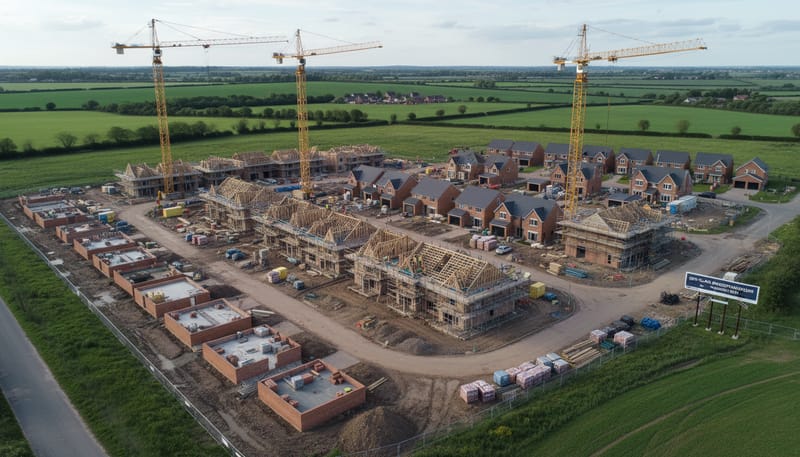
What Buying Off-Plan Actually Means
When you buy a completed property, you can see exactly what you're getting. You walk through the rooms, check the finishes, test the taps. Off-plan removes all of that. Instead, you're making a purchase based on:
- Architectural floor plans — showing room dimensions, layout, and plot position
- A specification document — listing materials, fixtures, finishes, kitchen units, bathroom fittings, and appliance brands
- CGI images or a show home — which may represent the general design but not your specific plot
- A site plan — showing where your plot sits relative to roads, green spaces, neighbouring properties, and future development phases
Off-plan purchases are standard practice in the UK new build market. Most large developments sell 30-60% of plots off-plan before any homes are completed. Some developments — particularly apartment blocks — sell entirely off-plan.
Off-Plan vs Built Stock: Key Differences
| Factor | Off-Plan Purchase | Completed Purchase |
|---|---|---|
| What you see before buying | Plans, CGIs, show home | The actual property |
| Price | Often 5-15% lower than later phases | Full current market price |
| Customisation | Some choice of finishes and upgrades | Usually limited to cosmetic changes |
| Timeframe to move in | 6 months to 3+ years | 6-12 weeks |
| Mortgage timing | Apply closer to completion | Apply immediately |
| Risk level | Higher (delays, spec changes, market shifts) | Lower (what you see is what you get) |
| Plot choice | Best selection available | Limited to remaining plots |
The Off-Plan Buying Process: Step by Step
Here's how an off-plan purchase typically works, from first visit to key collection. Each step is explained in detail in the sections that follow.
| Stage | What Happens | Typical Timeframe | Your Cost |
|---|---|---|---|
| 1. Research and viewing | Visit sales centre, review plans, choose plot | 1-4 weeks | None |
| 2. Reservation | Pay reservation fee, plot is held for you | Same day or within 1 week | £500 – £2,000 |
| 3. Instruct solicitor | Appoint conveyancer, receive contract pack | Within 1-2 weeks of reservation | £500 – £1,500 (on account) |
| 4. Contract review | Solicitor reviews contract, raises enquiries | 4-8 weeks | Included in solicitor fees |
| 5. Exchange of contracts | Sign contract, pay exchange deposit (5-10%) | Within 28 days of reservation (typically) | 5-10% of purchase price |
| 6. Build period | Construction continues, periodic updates | 6 months to 3+ years | None (unless stage payments) |
| 7. Notice of completion | Developer confirms build is finishing | 2-4 weeks before completion | None |
| 8. Mortgage application | Submit full application if not already done | 3-6 months before expected completion | Valuation fee (£300-£600) |
| 9. Pre-completion inspection | Walk through your home, create snagging list | 1-2 weeks before completion | £300-£500 (snagging inspector) |
| 10. Legal completion | Funds transferred, keys handed over | On agreed completion date | Remaining balance + stamp duty + fees |
Stage 1: Reservation — What You're Actually Signing
The reservation agreement is the first legal document you'll encounter. Most buyers sign it quickly in the excitement of choosing a plot. This is a mistake.
What the Reservation Agreement Contains
- The plot number and address (even if provisional)
- The purchase price — fixed at reservation, not subject to later increases
- The reservation fee — typically £500-£2,000, sometimes more for premium developments
- A deadline for exchange of contracts — usually 28 days, sometimes 56 days
- Conditions for refund — whether the reservation fee is refundable if you withdraw
- Any agreed incentives — deposit contributions, upgrade packages, stamp duty paid
- The specification — either included or referenced as a separate document
Critical Points to Check
| Item | What to Check | Why It Matters |
|---|---|---|
| Reservation fee refundability | Is the fee refundable if your mortgage is declined? | Under the Consumer Code, it should be refundable in most circumstances — but the wording matters |
| Exchange deadline | Is the timeframe realistic for your solicitor to complete due diligence? | 28 days is tight; request an extension if needed |
| Price lock | Is the price guaranteed, or can the developer increase it? | Reputable developers lock the price at reservation |
| Incentives in writing | Are all verbal promises documented in the reservation agreement? | Verbal promises are worth nothing; get everything in the signed document |
| Specification version | Which version of the specification is referenced? | Developers update specs; ensure yours is dated and attached |
The Consumer Code for Home Builders
Since 2010, all major warranty providers require developers to comply with the Consumer Code. Key protections at reservation stage:
- The developer must provide clear pre-purchase information including the reservation agreement terms
- You must be given adequate time to consider the reservation — high-pressure "sign today or lose the plot" tactics violate the Code
- The reservation fee must be reimbursed if you withdraw before exchange due to reasons beyond your control (e.g., mortgage decline)
- The developer must recommend you seek independent legal advice before exchange
Stage 2: Contract Exchange — The Point of No Return
Exchange of contracts is when you become legally committed to the purchase. Before this point, either party can walk away (though you may lose your reservation fee). After exchange, withdrawing means forfeiting your deposit and potentially facing a claim for damages.
What's in the Contract
Your solicitor will review the contract pack, which typically includes:
- The contract itself — setting out the purchase price, completion conditions, and both parties' obligations
- The specification — detailed list of what will be provided (kitchen units, bathroom fittings, flooring, garden landscaping, etc.)
- The site plan and plot plan — showing boundaries, parking allocations, and communal areas
- The lease (if leasehold) — the full lease terms including ground rent, service charge provisions, and restrictions
- Management company details — who will manage communal areas and at what cost
- Planning permissions and conditions — what the development is permitted to include
- The longstop date — the absolute deadline by which the developer must complete
- Warranty documentation — confirming NHBC, LABC, or equivalent cover
Key Contract Terms Your Solicitor Should Flag
| Term | What It Means | What to Negotiate |
|---|---|---|
| Longstop date | If the developer hasn't completed by this date, you can walk away and get your deposit back | Ensure this is a reasonable timeframe (12-18 months from expected completion, not 3-5 years) |
| Tolerance clause | Allows minor variations in room dimensions (typically 1-2%) | Check the percentage — some contracts allow up to 5%, which is a significant difference |
| Specification substitution | Allows the developer to swap specified materials for "equivalent" alternatives | Define what "equivalent" means — at minimum, same quality grade and price point |
| Completion notice period | How much notice the developer must give before completion | Minimum 14 days; 28 days is preferable to arrange finances and logistics |
| Sunset clause | Allows the developer to cancel the contract and refund your deposit if market conditions change | This is rare but devastating — your solicitor should flag and challenge it |
| Management company transfer | When the developer transfers control of the management company to residents | Get a commitment on timeline and terms for the transfer |
The Exchange Deposit
At exchange, you'll pay a deposit — typically 5-10% of the purchase price. This deposit structure varies:
- Standard deposit (10%): Held by the developer's solicitor until completion. Protected by the warranty provider if the developer becomes insolvent.
- Reduced deposit (5%): Some developers accept 5%, especially for first-time buyers. This reduces your upfront cost but the contract terms are otherwise identical.
- Stage payments: Occasionally, the deposit is split — for example, 5% at exchange and 5% at a later milestone (e.g., when the roof goes on). This is more common with smaller developers or self-build schemes.
Important: Your deposit should be held in a designated stakeholder account or protected by the warranty provider's deposit protection scheme. If the developer holds the deposit in their own account (as agent rather than stakeholder), your money is at risk if they become insolvent. Your solicitor should insist on stakeholder terms.
Stage 3: The Build Period — What to Expect
After exchange, you wait. This is the period many off-plan buyers find most stressful — you've committed a significant deposit and have limited control over what happens next.
Typical Build Timescales
| Property Type | Typical Build Time After Exchange | Common Range |
|---|---|---|
| House (early phase reservation) | 12-18 months | 6-24 months |
| Apartment (mid-rise block) | 18-24 months | 12-36 months |
| Apartment (high-rise tower) | 24-36 months | 18-48 months |
| House (later phase, partially built) | 3-9 months | 2-12 months |
Staying Informed During Construction
Good developers provide regular updates. What you should expect:
- Monthly or quarterly progress reports — photos, milestones reached, any timeline changes
- Site visit opportunities — most developers offer at least one guided site visit during construction so you can see progress. You won't be allowed to visit unaccompanied for health and safety reasons.
- Advance notice of specification changes — if a specified material becomes unavailable, you should be informed of the proposed substitution
- Updated completion estimate — as construction progresses, the expected completion date should become more precise
If you're not receiving updates, chase them. Silence from a developer during the build period is not a good sign.
What You Can and Can't Change During Construction
Depending on the build stage, you may be able to request changes:
- Before foundations: Some layout changes may be possible (e.g., moving internal walls, adding a downstairs WC). Expect to pay for any structural modifications.
- Before first fix: Electrical socket positions, additional sockets, TV point locations, and network cabling can often be customised.
- Before second fix: Kitchen unit layout, tile choices, worktop material, bathroom fixture choices. Most developers offer upgrade packages at this stage.
- After second fix: Very limited — usually only cosmetic options like paint colours are still changeable.
All change requests should be confirmed in writing with agreed costs. Verbal agreements during site visits are not binding.
Mortgages for Off-Plan Purchases
Mortgage timing is one of the trickiest aspects of buying off-plan. Standard mortgage offers last 6 months. If your property won't be ready for 18 months, you can't apply at exchange.
Mortgage Timing Strategy
| Expected Completion | When to Apply | Product Type |
|---|---|---|
| Within 6 months | At or shortly after exchange | Standard mortgage offer (6-month validity) |
| 6-9 months | Immediately after exchange | Extended offer (some lenders offer 9-month validity for new builds) |
| 9-12 months | 6 months before expected completion | Standard offer, timed to coincide with completion |
| 12+ months | 6 months before expected completion | May need to reapply if initial offer expires; rates may have changed |
The Extended Offer Problem
Some lenders extend mortgage offers for new build purchases, but this isn't guaranteed. If your offer expires before completion:
- You'll need to reapply, which means a new affordability assessment, new credit check, and new valuation
- Interest rates may have changed — if rates have risen, you may qualify for less or face higher monthly payments
- Your financial circumstances may have changed (job change, new debts, etc.) which could affect approval
To mitigate this risk, use a mortgage broker experienced with off-plan purchases. They can advise on lenders with the best extension policies and help manage reapplications if needed.
The Down-Valuation Risk
This is one of the biggest financial risks of buying off-plan. Here's how it works:
- You agree a purchase price of £300,000 at reservation
- 12-18 months later, when you apply for a mortgage, the lender sends a valuer
- The valuer assesses the property at £280,000 — a £20,000 "down-valuation"
- Your lender will only lend against the valuation figure, not the purchase price
- You need to find an additional £20,000 from your own funds, or renegotiate the price with the developer, or walk away (forfeiting your deposit)
Down-valuations happen for several reasons:
- Market decline: If property prices fall between reservation and completion, the valuation reflects current market conditions, not what you agreed to pay
- Conservative valuers: Some valuers are cautious about new build developments, particularly in areas without established comparable sales
- Incentive deductions: If the developer is offering large incentive packages, valuers may reduce the assessed value by the incentive amount
How to protect yourself:
- Don't buy off-plan with the absolute minimum deposit — have a financial buffer for a potential down-valuation of 5-10%
- Research the developer's pricing against comparable existing properties — if the premium seems excessive, down-valuation risk is higher
- Ask the developer whether they have a down-valuation clause — some will agree to renegotiate the price if the valuation comes in lower
- If you receive a down-valuation, request a re-valuation with a different surveyor before accepting the result
Construction Delays: Your Rights and Options
Delays are the most common problem with off-plan purchases. Understanding your legal position is essential.
How Common Are Delays?
Industry data suggests that around 40-50% of off-plan purchases experience some delay. The severity varies:
| Delay Length | Frequency | Typical Cause | Impact on Buyer |
|---|---|---|---|
| 1-4 weeks | Very common | Weather, minor supply issues | Minor inconvenience; easily managed |
| 1-3 months | Common | Material shortages, subcontractor delays | Mortgage offer may need extension; rental overlap costs |
| 3-6 months | Occasional | Significant supply chain issues, planning changes | Mortgage may expire; significant additional costs |
| 6-12+ months | Rare but serious | Developer financial difficulties, major construction problems | Mortgage expires; may need to reapply at different rates |
The Longstop Date
The longstop date is the most important clause in your contract for dealing with delays. It's the absolute deadline by which the developer must complete. If they miss it, you have the right to:
- Rescind (cancel) the contract
- Receive a full refund of your deposit
- Potentially claim compensation for losses (though this is harder to enforce)
Critical check: Some developers set the longstop date unreasonably far in the future — 3-5 years after exchange. This means you could be locked into a contract for years with no ability to walk away. Your solicitor should negotiate a reasonable longstop date, typically 12-18 months after the expected completion date.
Compensation for Delays
Some contracts include a delay compensation clause — for example, the developer pays you a fixed sum (often £20-£50 per day) for each day of delay beyond the estimated completion date. This isn't standard, but it's worth requesting. Even without a specific clause, you may have a claim under general contract law for losses caused by the delay (temporary accommodation, storage costs, mortgage reapplication fees).
What You Can Do During a Delay
- Contact your mortgage lender early to discuss extending your offer
- Keep records of all additional costs incurred due to the delay
- Communicate with the developer in writing (email, not phone) to create a paper trail
- Check whether your contract allows you to claim compensation
- If the delay approaches the longstop date, seek legal advice about exercising your right to rescind
Specification Changes and Substitutions
Your contract will include a specification — the detailed list of what your home will contain. However, most contracts also include a substitution clause allowing the developer to swap specified items for "equivalent" alternatives.
What Developers Can Change
- Kitchen unit brand/model: If the specified range is discontinued, the developer can substitute a similar product
- Bathroom fittings: Tap brand, shower enclosure model, toilet manufacturer
- Worktop material: Specific stone or composite colour/pattern
- Flooring: Tile range, carpet grade, or vinyl brand
- Appliances: Oven, hob, extractor, washer-dryer brand and model
- External materials: Brick colour, roof tile type, render colour
What Developers Can't Usually Change
- Room layout and dimensions (beyond the tolerance clause percentage)
- Number of bedrooms or bathrooms
- Plot position or garden size
- Fundamental structural elements
How to Protect Yourself
- Ensure the specification is a named, dated document attached to the contract — not a general brochure
- Request that any substitutions must be of "equal or higher quality" (not just "equivalent")
- Ask for advance written notice of any proposed substitutions, with your right to approve or reject
- Photograph the show home and keep a copy of all marketing materials — these can be evidence if the finished product differs significantly from what was advertised
What Happens If the Developer Goes Bust?
Developer insolvency during an off-plan build is rare but devastating. Here's what protection exists.
Before Exchange of Contracts
If you've paid a reservation fee but haven't exchanged, you're an unsecured creditor. Your reservation fee may be lost unless the developer's reservation agreement specifically states it's held in a client account (check this before paying).
After Exchange of Contracts
Your protection depends on how your deposit is held:
| Deposit Arrangement | Protection Level | What Happens |
|---|---|---|
| Held as stakeholder by solicitor | High | Deposit is ring-fenced and returned to you if the developer can't complete |
| Protected by NHBC/warranty provider | High | Warranty provider's deposit protection scheme covers your deposit (typically up to £100,000) |
| Held as agent by developer | Low | Deposit has been released to the developer and may be used in their business. If they become insolvent, you're an unsecured creditor |
| No formal protection | None | Your deposit is at risk. This should never happen with a reputable developer |
After the Developer Enters Administration
An administrator may:
- Complete the development — if the project is commercially viable, a new developer or the administrator may finish the build
- Sell the development — another developer buys the site and assumes (or renegotiates) existing contracts
- Abandon the development — in the worst case, the site is sold for land value and existing contracts are terminated
Your solicitor should ensure your contract and deposit arrangements provide maximum protection. Never accept "held as agent" terms.
Market Movements: What If Prices Rise or Fall?
Between reservation and completion, the property market can move in either direction. This is one of the defining risks — and potential rewards — of buying off-plan.
If Prices Rise
Your purchase price is locked at reservation. If the market rises 10% during an 18-month build period, you've made a paper profit before moving in. This is the scenario developers emphasise when selling off-plan, and it does happen — but it's not guaranteed.
Example: You reserve at £280,000. By completion 18 months later, equivalent properties are selling for £308,000. You've gained £28,000 in equity — minus stamp duty and transaction costs.
If Prices Fall
Your purchase price is still locked at reservation. If the market falls 10%, you're completing on a property worth less than you're paying. Combined with a potential down-valuation, this creates a serious problem:
- You may owe more than the property is worth from day one (negative equity)
- Your mortgage offer may be withdrawn if the valuation drops below the lender's requirements
- Walking away means forfeiting your deposit (5-10% of the purchase price)
This risk is why some buyers treat off-plan purchases as a form of speculation. If you're buying to live in the property long-term, short-term market movements matter less — you'll ride out any dip over 5-10 years. If you're investing for a quick return, off-plan carries meaningful market risk.
How to Assess the Risk
- Check the price against existing properties: If the off-plan price already includes a significant premium over comparable existing homes, there's more room for a down-valuation
- Consider the local market trend: Is the area growing (new employers, infrastructure, regeneration) or stagnant?
- Look at the developer's pricing history: Have they increased prices on later phases? This is a positive sign for early-phase buyers
- Don't overextend: If a 10% price drop would put you in financial difficulty, off-plan may not be suitable for your circumstances
Off-Plan for Different Buyer Types
First-Time Buyers
Off-plan can work well for FTBs who have time — for example, those currently saving a deposit and not in a rush to move. The build period gives you additional months to save, and early-phase pricing may be more affordable than completed homes. The risk is that you're committing to a significant financial obligation before you've ever owned property — make sure you fully understand the contract before exchanging.
Investors
Off-plan is popular with investors because of the potential for capital growth during the build period and the ability to secure a property with a relatively small deposit. However, investors face additional risks:
- You can't generate rental income during the build period — your deposit is tied up earning nothing
- Stamp duty surcharges apply from exchange, not completion
- If you're buying as part of a portfolio, the lending criteria are stricter
- Some developers restrict resale of off-plan contracts before completion
Families
Off-plan is more challenging for families with fixed timelines — school start dates, tenancy end dates, or a need to move by a specific month. Construction delays can disrupt these plans significantly. If timing is critical, buying a completed or near-complete home is safer. If you have flexibility, off-plan offers better plot choice and the opportunity to customise finishes.
Downsizers
Off-plan can suit downsizers who aren't in a hurry and can time the sale of their existing property to coincide with completion. The build period provides time to prepare your current home for sale. Part-exchange schemes are often available on off-plan purchases, removing the coordination challenge entirely. For a broader assessment of whether new builds suit downsizers, see our decision guide by buyer type.
The Pre-Completion Inspection
Before legal completion, you'll be invited to inspect your new home. This is your most important opportunity to identify defects.
Professional Snagging Inspection
A professional snagging inspector costs £300-£500 and is worth every penny. They typically identify 50-150 items in a new build, including:
- Cosmetic defects (paint, plaster, sealant)
- Fitting issues (doors, windows, kitchen units, handles)
- Plumbing problems (leaks, drainage, water pressure)
- Electrical issues (switches, sockets, lighting, extractor fans)
- External defects (pointing, guttering, fencing, landscaping)
- Specification mismatches (wrong fittings, missing items)
Should You Complete With Outstanding Snags?
This is a judgment call:
- Minor cosmetic issues: Usually acceptable to complete with a written commitment from the developer to fix within an agreed timeframe (typically 28-56 days)
- Functional issues (plumbing, electrics, heating): Should ideally be resolved before completion. If not, get a written commitment with a specific deadline and confirm the property is safe to occupy
- Major structural or safety issues: Do not complete. Inform your solicitor and insist these are resolved first
Your solicitor can hold a retention (a sum of money held back from the completion funds) to incentivise the developer to complete snagging works. Developers often resist retentions, but it's a legitimate negotiation tool.
Off-Plan Buying Checklist
Use this checklist to ensure you've covered every essential step.
| Stage | Action | Done? |
|---|---|---|
| Before reserving | Research the developer (HBF rating, reviews, completed developments) | |
| Before reserving | Compare off-plan price to existing properties in the area | |
| Before reserving | Visit a completed development by the same developer (not just the show home) | |
| Reservation | Check reservation fee refundability | |
| Reservation | Ensure all incentives are documented in writing | |
| Reservation | Obtain a dated, specific specification document | |
| Before exchange | Instruct an independent solicitor (not the developer's recommendation) | |
| Before exchange | Solicitor reviews longstop date, tolerance clause, substitution clause, sunset clause | |
| Before exchange | Confirm deposit will be held as stakeholder or protected by warranty provider | |
| Before exchange | Understand the lease terms if leasehold (ground rent, service charges, lease length) | |
| Build period | Request regular progress updates from the developer | |
| Build period | Attend at least one site visit during construction | |
| 6 months before completion | Begin mortgage application (or earlier if lender offers extensions) | |
| Pre-completion | Book a professional snagging inspection | |
| Pre-completion | Check the property against the specification document | |
| Completion | Ensure all critical snags are resolved or formally committed to | |
| Post-completion | Report remaining snags to the developer within the defect period (years 1-2) |
Related Guides
- Should You Buy a New Build? Decision Guide by Buyer Type — whether a new build is right for your specific circumstances
- New Build vs Existing Home: The Definitive UK Comparison — 15-factor head-to-head with worked cost examples
- Are New Build Homes More Expensive? The True Cost Over 10 and 25 Years — total cost of ownership analysis
- Do New Build Homes Hold Their Value? — what happens to your property's value after purchase
- New Build Snagging Inspection Checklist — what to check before and after completion