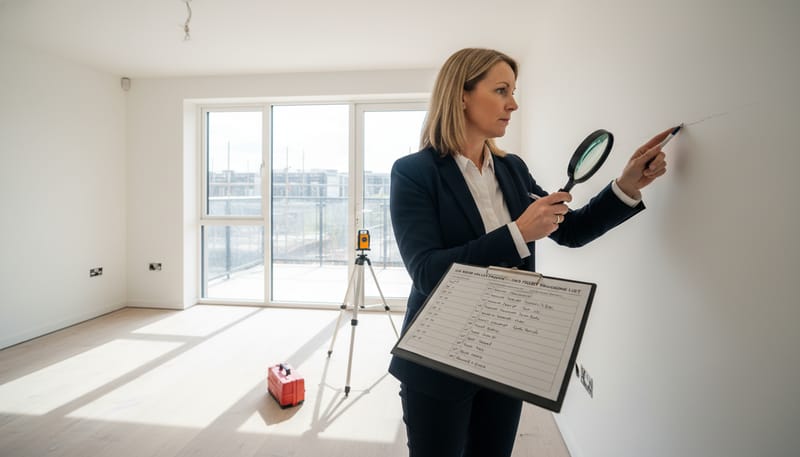
How to Use This Checklist
Severity Ratings Explained
| Rating | Meaning | Examples | Developer Must Fix? |
|---|
| Critical | Safety risk, building regulation breach, or structural issue | No fire stops, missing earth bonds, structural cracks | Yes — before completion if possible |
| Major | Significant defect affecting function, weather-tightness, or compliance | Leaking windows, faulty boiler, non-functioning extract fans | Yes — within defects liability period |
| Moderate | Noticeable quality issue that should be remedied | Poor paintwork, uneven tiling, stiff doors | Yes — most developers will fix |
| Minor | Cosmetic or small finishing issue | Small paint touch-ups, tiny chips, slight marks | Usually — but may argue within tolerance |
Equipment You'll Need
| Item | What It's For |
|---|
| Smartphone or tablet | Photos, videos, and notes |
| Spirit level (600mm minimum) | Checking walls, floors, worktops, tiles are level and plumb |
| Torch (bright LED) | Inspecting dark corners, under stairs, loft spaces, behind units |
| Socket tester (plug-in type, under £15) | Checking all sockets are correctly wired — identifies reversed polarity, missing earth |
| Tape measure (5m minimum) | Checking room dimensions match specification |
| Binoculars | Inspecting roof tiles, ridge tiles, flashings from ground level |
| Ladder or step stool | Checking loft hatch, high-level items, tops of wardrobes |
| Blue painter's tape or sticky dots | Marking snag locations physically on the property |
| Printed floor plan | Annotating locations of each snag for your report |
Before You Start
- Allow enough time — a thorough inspection takes 2-4 hours for a typical 3-bed house, longer for larger properties
- Go in daylight — natural light reveals paint imperfections, uneven surfaces, and colour mismatches that artificial light hides
- Ask the site manager to turn on all services — electricity, gas, water, and heating must be live for a proper inspection
- Bring your specification document — the list of finishes, fixtures, and fittings your contract specifies
- Check every item, even if it looks fine from a distance — get close to walls, open every door and drawer, run every tap
- Photograph everything — take a wide shot showing location, then a close-up of the defect, for every single snag
1. External: Front Elevation and Approach
Brickwork and External Walls
| Item | What to Check | Severity |
|---|
| Mortar joints | Consistent depth, colour, and profile throughout. No gaps, holes, or crumbling sections. Joints should be tooled (not just raked out) | Moderate-Major |
| Brick condition | No cracked, chipped, or spalled bricks. Colour consistency across panels (slight variation is normal for many brick types) | Moderate |
| Brick courses | Level and straight. Use a spirit level on window sill courses. Perpend joints should be reasonably aligned vertically | Moderate |
| Weep holes | Present above DPC, above windows, and above lintels. Must not be blocked with mortar droppings | Major |
| DPC (damp-proof course) | Visible at least 150mm above external ground level. Not bridged by render, soil, or paving | Critical |
| Cavity trays | Visible above windows, doors, and any penetration through the cavity wall. Should have stop ends and weep holes | Major |
| Wall ties | Not visible or protruding. If render is used, check for pattern cracking that might indicate tie failure | Major |
| Render or cladding | No cracks, blown sections, or discolouration. Bellcast beads present at base of render. Expansion joints where required | Moderate-Major |
| Air bricks | Present and unobstructed for sub-floor ventilation (suspended timber floors) and for combustion appliances | Major |
Roof (From Ground Level)
| Item | What to Check | Severity |
|---|
| Ridge tiles | Straight, evenly bedded, no gaps in mortar (or dry-fix system clips all present and aligned) | Major |
| Roof tiles/slates | All present, none slipped or cracked. Courses straight. Tile nibs correctly seated on battens | Major |
| Hip tiles | Secure and evenly spaced. Hip irons present at base if mortar-bedded | Major |
| Verge | Dry verge system clips present and straight, or mortar pointing intact with no gaps | Major |
| Flashings | Lead or lead-alternative flashings properly dressed into mortar joints at abutments. No lifting or gaps | Major |
| Valleys | Valley tiles or lead valleys properly lapped and sealed. No debris blocking water flow | Major |
| Soffits and fascias | Securely fixed, no gaps between boards, paint or finish consistent. Joints neat | Moderate |
| Gutters and downpipes | All joints connected. Gutters fall towards downpipes (no sagging or pooling). Downpipe clips secure. Shoes directing water into gullies | Major |
| Roof vents and terminals | SVP (soil vent pipe) terminal visible above ridge height. Mechanical extract vent tiles present and unobstructed | Major |
Windows and External Doors (Outside)
| Item | What to Check | Severity |
|---|
| Frame sealant | Continuous bead of sealant between frame and brickwork on all four sides. No gaps, cracks, or missing sections | Major |
| Glazing | No scratches, cracks, or blown units (condensation between panes means failed seal). Check every pane | Major |
| Trickle vents | Present on all habitable room windows (Building Regulations Part F requirement). Operable | Major |
| Drainage slots | Drainage holes at bottom of frames are clear and unblocked by sealant or paint | Moderate |
| Lintels | Steel or concrete lintels above all openings. DPC tray over lintels. No cracking above openings indicating lintel issues | Critical |
| Cills | Stone, tile, or precast cills with drip edge. Properly sealed at ends. Slight fall away from building | Moderate |
| Front door | Multipoint lock engages smoothly at all points. Door seal compresses evenly. Letter plate operates. Spy hole clear. Threshold seal intact | Major |
Driveway, Paths, and Landscaping
| Item | What to Check | Severity |
|---|
| Driveway surface | Block paving level and properly compacted (no rocking blocks). Tarmac smooth without roller marks. Concrete without significant cracking | Moderate |
| Drainage falls | All hard surfaces fall away from the building. No ponding areas. Drainage channels clear | Major |
| Paths | Slabs level, no trip hazards (more than 5mm difference is a defect). Jointing complete | Moderate-Major |
| Fencing | Posts vertical, panels secure, correct height as per specification. Gate operates and latches | Moderate |
| Turfing/seeding | Full coverage as per contract. Turves properly butted together. No large bare patches | Minor |
| Manhole covers | Sit flush with surrounding surface. Correct type (recessed tray type in paved areas). Lift easily for access | Moderate |
| Meter boxes | Doors close properly. Gas and electric meters accessible. Keys provided | Moderate |
| External taps | If specified, check flow and no leaks at connection | Minor |
2. Entrance Hall and Stairs
Hallway
| Item | What to Check | Severity |
|---|
| Front door (inside) | Opens and closes smoothly. Draught seal compresses fully. All locks operate. Key turns easily. Chain and spy hole fitted if specified | Major |
| Door frame | Plumb and square. No gaps between frame and wall (or filled/caulked neatly). Architrave mitres tight | Moderate |
| Flooring | Level throughout. No creaking boards (some minor settling noise can be normal). Skirting tight to floor. Threshold strips at doorways | Moderate |
| Walls | Smooth plaster finish. No cracks, dents, or nail pops. Run your hand across — feel for ridges and bumps. Check corners are straight | Moderate |
| Paintwork | Even coverage, no drips, runs, or brush marks. Consistent colour. No paint on carpet, flooring, or glass. Cut-in lines clean at ceiling and corners | Minor-Moderate |
| Ceiling | Level, no cracks (especially along joins in plasterboard). No sagging. Artex or smooth finish as specified | Moderate |
| Light fittings | Central pendant works. Switch operates correctly. Two-way switching if there are stairs (test from both ends) | Major |
| Sockets and switches | Straight (not tilted). Flush to wall. All work. Test with socket tester. Screws aligned horizontally | Moderate-Major |
| Radiator | Securely fixed to wall. No leaks at valves. Heats evenly when system is on (no cold spots indicating trapped air) | Major |
| Smoke/heat detector | Present in hallway (Building Regulations requirement). Test button produces alarm. Interconnected with other detectors | Critical |
| Understairs cupboard | Door opens fully. Light works. Consumer unit accessible. Shelving as specified. Floor finished | Minor-Moderate |
Staircase
| Item | What to Check | Severity |
|---|
| Treads and risers | No creaking (some is tolerable on timber stairs, but persistent loud creaking is a defect). Even tread depth. Risers consistent height | Moderate |
| Handrail | Secure at both ends and all brackets. Continuous run (no gaps). Height between 900mm-1000mm from pitch line | Critical |
| Balustrade | Spindles secure (grip and push each one). Gap between spindles must not allow a 100mm sphere through (Building Regulations). No climbable horizontal rails for children | Critical |
| Landing | Adequate size. Balustrade at top of stairs secure. No gaps a child could fall through | Critical |
| Carpet/covering | Properly fitted and secured. Gripper rods not exposed. No wrinkles or loose sections on treads | Moderate |
| Newel posts | Absolutely solid — no movement at all when pushed firmly. These are structural | Major |
| Stair string | No gaps between string and wall. Properly decorated | Minor |
3. Living Room / Lounge
| Item | What to Check | Severity |
|---|
| Walls (all four) | Stand in each corner and look along each wall at an angle in natural light. Feel for bumps. Check plaster is smooth and even. No cracks at ceiling junction or around window reveals | Moderate |
| Paintwork | Consistent coverage on all walls. No missed patches, drips, or roller marks. Satin/gloss on woodwork without runs. Cutting-in clean at all edges | Minor-Moderate |
| Ceiling | Level and smooth. Check for cracks along plasterboard joints (common where boards meet). No staining. Light fitting centred | Moderate |
| Windows | All open, close, and lock. Restrictors work on upper-floor windows. Trickle vents present and operable. Handles tighten fully. No draught when closed. Beading secure on glazing | Major |
| Window reveals | Plaster returns smooth and straight. External sealant visible through window. Window board (cill) level and properly sealed at edges | Moderate |
| Internal doors | Open and close without catching. Latch engages. No rubbing on carpet. 2-3mm gap around frame. Handles secure. Hinges don't squeak | Moderate |
| Skirting boards | Tight to wall and floor. Mitres at corners tight. No gaps. Consistent colour/finish. Nails punched and filled | Minor |
| Floor | Level (check with spirit level). Carpet laid without wrinkles. Laminate/engineered boards without gaps or raised edges. No squeaking underfoot | Moderate |
| Sockets | Test every one with socket tester. All straight and flush. TV point connected. Phone/data points if specified. USB sockets charge a device | Major |
| Radiator | Level, secure, correct size for room. No leaks. Heats evenly. TRV (thermostatic radiator valve) operates smoothly. Pipework neatly routed and clipped | Major |
| Patio doors (if fitted) | Slide/open smoothly. Multi-point lock engages at all points. Threshold sealed. Drainage channel clear. Key operates from both sides if required | Major |
| Fireplace (if fitted) | Surround secure. Hearth level. If gas fire: gas connection capped or fire installed and working. If electric: operates on all settings. Flue/chimney correct for fuel type | Major-Critical |
4. Kitchen
The kitchen is typically the most snag-heavy room in a new build. Expect to spend significant time here.
Units and Worktops
| Item | What to Check | Severity |
|---|
| Base unit doors | All aligned — open and close smoothly. No warping. Handles straight and secure. Soft-close mechanisms work on every door | Moderate |
| Drawers | Slide smoothly on runners. Soft-close operates. Faces aligned with adjacent doors. Can support reasonable weight without sagging | Moderate |
| Wall unit doors | Aligned with each other. Secure fixings (pull gently — unit should not move). Soft-close operates | Moderate |
| Worktops | Level (check with spirit level). Joints properly filled and flush (no lips). No scratches, chips, or burn marks. Edging strips secure on laminate. Upstands sealed at wall | Moderate-Major |
| Worktop joints | Colour-matched filler. No gaps. Moisture barrier applied underneath at joints (critical for laminate — moisture destroys the chipboard substrate) | Major |
| Plinths/kickboards | Secure, no gaps at floor. Spring clips holding properly. Cut neatly around obstacles | Minor |
| Cornice/pelmet | If specified, properly fitted and aligned. Mitres tight at corners | Minor |
| End panels | Secure, correct colour match. Screw holes filled if visible | Minor |
Sink, Taps, and Plumbing
| Item | What to Check | Severity |
|---|
| Sink | No scratches or chips. Securely mounted (press down on undermount sinks). Overflow works — fill sink, unplug, check overflow drains before main water level reaches rim | Moderate |
| Taps | Hot on left, cold on right. Mixer operates smoothly. No drips when off. Good pressure from both supplies. No knocking or hammering in pipes | Major |
| Waste and trap | Open under-sink cupboard. Run taps for 2 minutes. Check every joint for drips. Push-fit waste connections properly engaged. No smell from waste pipe | Major |
| Dishwasher connection | Waste spigot on trap, hot and cold supplies (or cold only depending on model), electrical spur present. Space dimensions correct for standard 600mm appliance | Moderate |
| Washing machine connection | Hot and cold supply valves present (even if cold-fill only). Standpipe waste. Electrical socket accessible. Space dimensions correct | Moderate |
Appliances
| Item | What to Check | Severity |
|---|
| Oven/hob | All rings/burners light and heat. Oven reaches temperature. Door seals properly. Fan operates. If gas: flame blue and stable, no smell. Timer works | Major |
| Extractor hood | Fan operates on all speeds. Light works. Ducted to outside (check external vent operates) or recirculating with carbon filter present. Filters clean and removable | Major |
| Integrated fridge/freezer | Cooling to correct temperature. Door closes properly with furniture door attached. Seal intact. Interior light works | Major |
| Integrated dishwasher | If included: completes a cycle. No leaks. Door closes with furniture panel. Salt and rinse-aid compartments accessible | Major |
| Washer/dryer | If included: completes a wash and dry cycle. No leaks. Drum rotates smoothly. Drainage works | Major |
Kitchen General
| Item | What to Check | Severity |
|---|
| Splashback/tiles | Grouting complete, no gaps. Tiles level and evenly spaced. No cracked or chipped tiles. Sealant at worktop junction | Moderate |
| Floor tiles | All solid when tapped (hollow sound means loose/debonded). Level. Grout complete. No cracked tiles. Threshold strip at doorway | Moderate-Major |
| Sockets | Sufficient number (check specification). All working. RCD-protected (mandatory for kitchen sockets — test with socket tester) | Critical |
| Lighting | All fittings work. Under-cabinet lighting if specified. Sufficient light on worktops | Moderate |
| Ventilation | Mechanical extract fan present (Building Regulations Part F). Operates when light switched on or via separate switch/humidistat. Adequate extraction rate (30 l/s intermittent for kitchen) | Major |
| Boiler (if in kitchen) | Operates. No error codes. Pressure gauge in green zone. Condensate pipe routed to drain. Flue terminal visible outside and correctly positioned (away from windows/vents) | Critical |
| Window | Opens and closes fully. Trickle vent present. Handles lock. Not obscured by wall units | Major |
5. Bedrooms
Check every bedroom individually — don't assume they're all the same. Different tradespeople may have worked on different rooms.
Master Bedroom
| Item | What to Check | Severity |
|---|
| Walls | All four walls smooth. Check at an angle in natural light. No cracks, especially at corners and ceiling junction. Window reveals straight | Moderate |
| Ceiling | Level and smooth. No cracks along plasterboard joints. If downlights: all working, evenly spaced | Moderate |
| Paintwork | Even coverage. No drips or roller marks. Clean cutting-in. Woodwork (door frame, skirting, window board) satin/gloss without runs | Minor-Moderate |
| Windows | Open, close, and lock. Child-safety restrictors on first floor and above (Part K Building Regulations). Trickle vents present. Good seal — no draught. Handles secure | Major |
| Door | Opens and closes smoothly. Latch clicks positively. No rubbing on floor. Handle secure. Hinges silent. Lock works if privacy lock specified | Moderate |
| Built-in wardrobe | If specified: doors slide/open smoothly. Hanging rail secure (pull down firmly). Shelf supports adequate. Light inside works. Interior finished (not bare chipboard) | Moderate |
| Floor | Level. Carpet fitted properly — no wrinkles, edges tucked under skirting. If engineered wood: expansion gap around edges covered by skirting. No squeaking | Moderate |
| Sockets | All working (socket tester). Double sockets on bedside walls. USB sockets if specified. TV point if specified | Major |
| Radiator | Correct size. Level. Heats evenly. TRV operates. No leaks at valves. Pipework clipped and neat | Major |
| Light switches | Two-way switching (door and bed side) if specified. Dimmer operates smoothly if fitted | Moderate |
Additional Bedrooms (Check Each One)
| Item | What to Check | Severity |
|---|
| Same items as master | Every wall, ceiling, floor, window, door, socket, radiator — check them all individually in each room | Various |
| Room dimensions | Measure and compare to specification or sales brochure. Significant shortfalls (more than 50mm) should be raised | Major |
| Airing cupboard | If located off bedroom: door opens fully, shelving as specified, hot water cylinder accessible, thermostat visible. Immersion heater works | Moderate |
| Loft hatch | If in bedroom ceiling: opens smoothly, loft ladder (if specified) operates safely, loft light works, insulation visible and correctly laid (not blocking eaves ventilation) | Moderate-Major |
6. Main Bathroom
Bathrooms need careful inspection — water damage from poor installation is one of the costliest defects to fix later.
Sanitaryware
| Item | What to Check | Severity |
|---|
| Bath | No chips or scratches. Level (check with spirit level). Stable — no movement when you stand in it. Overflow works. Plug holds water. Waste drains quickly (fill completely and release — should empty within 90 seconds) | Moderate-Major |
| Bath panel | Secure but removable for maintenance access. No gaps at floor or wall. Clips holding properly | Minor |
| Toilet | Flush operates (test dual flush both buttons). Fills quietly and stops filling completely. No rocking on floor (indicates poor fixing). Seat secure. No leaks at base or cistern connection | Major |
| Basin | No chips or scratches. Securely mounted (push down and forward on pedestal; push down on wall-hung). Overflow works. Waste drains quickly. Plug holds water | Moderate |
| Taps (all) | Hot on left. Good pressure. No drips. No water hammer. Temperature reaches comfortable hot within 30 seconds. Mixer smooth operation | Major |
| Shower | Thermostat controls temperature accurately. Adequate pressure (should feel strong, not dribbling). Mixer valve operates smoothly. Shower head and hose secure. No leaks at riser bar fixings | Major |
| Shower screen/enclosure | Door opens and closes smoothly. Seals at wall and base intact. No leaks when shower running at full — test by running shower for 5 minutes and checking floor outside for water | Major |
Tiling and Waterproofing
| Item | What to Check | Severity |
|---|
| Wall tiles | All grouted. No cracked or chipped tiles. Level and evenly spaced. Tap each tile — hollow sound means poor adhesion (potential for tiles falling off) | Moderate-Major |
| Tile cuts | Neat and straight around pipes, fixtures, and edges. No rough or sharp edges. Corners either mitred or with trim strip | Moderate |
| Silicone sealant | Continuous bead around bath/shower tray to wall junction. Around basin to wall. Around shower screen. No gaps. Neat finish. Mould-resistant type in wet areas | Major |
| Floor tiles | Level. All solid (tap for hollow sound). Grout complete. Non-slip rating appropriate for bathroom. Sealed at walls with sealant, not grout | Moderate-Major |
| Shower tray | Level (water should drain to waste, not pool). No cracks. Stable — no flex when stood on. Waste drains quickly. Seal to wall intact | Major |
| Tanking/waterproofing | You can't see this after tiling, but check for any signs of water damage on the ceiling below the bathroom — staining or damp indicates failed or missing tanking | Critical |
Bathroom General
| Item | What to Check | Severity |
|---|
| Extractor fan | Operates (usually linked to light switch with overrun timer — should continue running for 15+ minutes after light off). Adequate extraction rate (15 l/s for bathroom). Actually ducted to outside (not just into loft) | Critical |
| Heated towel rail | Heats up. Secure to wall. No leaks at valves. Operates independently or with central heating as specified | Moderate |
| Mirror/cabinet | If specified: securely fixed. Shaver socket works (and has correct isolation transformer — not a standard socket). Cabinet doors/shelves intact | Moderate |
| Lighting | Correct IP rating for bathroom zones. Pull cord or externally switched — no standard switches inside bathroom. All fittings work | Critical |
| Ventilation | Window opens or mechanical extract operates. Building Regulations Part F requires either openable window or mechanical ventilation | Major |
| Door | Privacy lock fitted and works from inside. Emergency release on outside (coin slot). Opens outward or sliding (ideally not into bathroom for safety reasons) | Moderate |
| Accessories | Toilet roll holder, towel hooks/rails, robe hooks — as specified. Securely fixed to wall (not just plasterboard — should have proper fixings) | Minor |
7. En-Suite Shower Room
Check all items from the main bathroom section that apply, plus these en-suite-specific items:
| Item | What to Check | Severity |
|---|
| Sound transfer | Flush toilet, run shower — listen from master bedroom. Excessive noise indicates poor sound insulation between stud walls | Moderate |
| Shower tray drainage | En-suite showers on upper floors are common leak sources. After running shower for 5 minutes, check ceiling below for any dampness | Critical |
| Ventilation duct route | Extract fan must duct to outside — in many new builds the duct runs through the loft. Check in loft that ducting is properly connected and insulated (to prevent condensation) | Major |
| Hot water pressure | Run shower while someone flushes the toilet or runs a tap elsewhere. Pressure and temperature should remain stable (combi boiler systems are more susceptible to pressure drops) | Major |
| Door clearance | Door should clear shower tray/enclosure. Common snag: shower door hits bathroom door or towel rail | Moderate |
| Waterproof flooring threshold | Where en-suite floor meets bedroom carpet — threshold strip present, waterproof seal intact, no path for water to reach carpet | Major |
8. Utility Room (If Applicable)
| Item | What to Check | Severity |
|---|
| Plumbing connections | Hot and cold supply valves for washing machine. Standpipe waste. Check all connections for leaks | Major |
| Tumble dryer provision | Vent to outside or condenser drain point. Electrical socket in correct position | Moderate |
| Sink (if fitted) | Same checks as kitchen sink — taps, waste, overflow, seal | Moderate |
| Worktop and units | Same checks as kitchen — alignment, soft close, worktop level and sealed | Moderate |
| Floor | Waterproof finish (tile, vinyl). Sealed at walls. Falls to drain if floor drain fitted | Moderate |
| Boiler (if here) | Full checks: operates, no errors, pressure correct, condensate drains, flue properly positioned outside | Critical |
| Ventilation | Openable window or extract fan. Essential in room with boiler or drying appliances | Major |
9. Garage (If Applicable)
| Item | What to Check | Severity |
|---|
| Garage door | Opens smoothly (manual or electric). Locks securely. Auto-reverse on electric doors works (safety requirement). Remote controls provided if electric | Major |
| Fire door to house | If integral garage: door must be FD30 fire door with self-closing device. Intumescent strip and smoke seal. Step up into house (not level — building regulation requirement to prevent fuel fumes entering house) | Critical |
| Floor | Concrete finished smoothly. Falls to front (away from house). No significant cracking. Power-floated or as specified | Moderate |
| Electrics | Light works. Sockets present (at least one double). Consumer unit or sub-board if separate supply. RCD protected | Major |
| Walls and ceiling | Plasterboard fire barrier on house side (30 minutes fire resistance). Boarded and sealed at ceiling if room above | Critical |
| Roof | No daylight visible. Felt underlay intact. If flat roof: no ponding | Major |
| Drainage | Gully or channel drain at entrance if driveway slopes towards garage | Moderate |
| Eaves/ventilation | Ventilation provided as required. No bird/pest ingress points | Minor |
10. Loft Space
| Item | What to Check | Severity |
|---|
| Loft hatch | Opens easily. Insulated on top side. Draft-sealed around frame. Loft ladder (if specified) operates safely and locks | Moderate |
| Insulation | Minimum 270mm mineral wool between and over joists (current Building Regulations Part L). Evenly laid. Not compressed. Not blocking eaves ventilation | Major |
| Roof structure | Truss clips present at wall plate. No broken or damaged trusses. Bracing installed as per truss designer's layout. No obvious deflection | Critical |
| Felt/membrane | Breathable roofing membrane intact. No tears or gaps. Properly lapped at joints. Dressed into gutters at eaves | Major |
| Ventilation | Clear air path at eaves (insulation not blocking). Ridge vent or tile vents present if specified. Cross-ventilation achieved | Major |
| Water tanks | If present (vented hot water system): properly supported on platform over joists. Insulated. Lid fitted. Overflow pipe runs to outside. Ball valve operates | Major |
| Pipework | All pipes in loft insulated against freezing. No leaks at joints. Properly clipped | Major |
| Electrics | Light fitted and works. Junction boxes accessible (not buried under insulation). Cables properly clipped and not lying on insulation without support | Major |
| Extract fan ducting | Bathroom and kitchen extract ducts run to external terminals (not just venting into loft). Ducts insulated to prevent condensation. Properly connected at both ends — no gaps | Critical |
| Party wall (if terraced/semi) | Fire stopping present at party wall junction with roof — full height barrier of mineral wool or fire-rated board. Gaps around pipes and cables sealed with intumescent material | Critical |
| Debris | Builder's debris removed — offcuts of timber, insulation, packaging, food wrappers (yes, this happens). Mortar droppings cleaned up | Minor |
11. Building Services and Systems
Heating System
| Item | What to Check | Severity |
|---|
| Boiler | Fires and heats water. No error codes on display. Pressure gauge reads 1-1.5 bar (when cold). Gas certificate provided (CP12/benchmark). Condensate pipe insulated if external run. Flue terminal correctly positioned | Critical |
| Thermostat | Controls heating. Programmable timer works. Located in hallway or living area (not near heat source or in direct sunlight). Smart thermostat connected if specified | Major |
| All radiators | Every radiator in every room heats fully and evenly. No cold spots (top = air, bottom = sludge, one side = valve). TRVs turn. Bleed valves present. No leaks at any valve or joint | Major |
| Underfloor heating | If fitted: heats evenly across floor. Individual room thermostats work. No cold zones (indicating damaged pipe loops). Check all manifold connections for leaks | Major |
| Hot water | Reaches all taps within reasonable time. Temperature adequate. If unvented cylinder: tundish present, discharge pipe visible outside, expansion vessel correct pressure | Major |
Electrical System
| Item | What to Check | Severity |
|---|
| Consumer unit | Clearly labelled with all circuits. RCDs present and trip when tested (press test button). MCBs for each circuit. RCBO units if specified. Accessible location | Critical |
| All sockets (every one) | Test with plug-in socket tester in every single socket in the house. Checks for correct wiring, earth, and polarity. Takes 5 seconds per socket — don't skip any | Critical |
| All light switches | Every switch operates its corresponding light. Two-way switches work from both positions. Dimmer switches dim smoothly without flickering | Moderate |
| Smoke detectors | One on each floor minimum (Building Regulations). Interconnected (pressing test on one triggers all). Mains-powered with battery backup. Heat detector in kitchen | Critical |
| Carbon monoxide detector | Present in rooms with combustion appliances (gas boiler, gas fire). Tests positive. Mains-powered with battery backup preferred | Critical |
| EV charger | If specified or new builds post-June 2022 (Building Regulations Part S): present and functional. Correct type. App connects if smart charger | Major |
| External lighting | PIR security lights work. Front door light works. Any garden or path lighting operational | Moderate |
| Doorbell | Works (wired or wireless as specified). Audible throughout house. Smart doorbell connected if specified | Minor |
Plumbing and Drainage
| Item | What to Check | Severity |
|---|
| Stopcock | Located (usually under kitchen sink or in utility). Turns off and on. Actually stops water flow when closed | Critical |
| All taps | Run every tap in the house simultaneously for 2 minutes. Check flow and pressure doesn't drop unacceptably. No water hammer. No discoloured water | Major |
| All wastes | Fill every sink, basin, and bath. Release simultaneously. All should drain without gurgling (gurgling indicates venting issue). Check all traps for leaks | Major |
| External drainage | Lift manhole covers. Check inside is clean (no builder's debris). Rodding access points present. Gullies not blocked | Major |
| Soil vent pipe | Extends above roof line. No leaks at joints. Anti-bird cage on terminal | Major |
| Outside tap | If fitted: isolating valve inside. No leaks. Backflow prevention device (double-check valve) | Minor |
12. Rear Garden and External Rear
| Item | What to Check | Severity |
|---|
| Patio/paving | Level. Falls away from house. No ponding. Joints properly filled. Slabs stable (no rocking) | Moderate |
| Rear elevation | Same brickwork, render, and cladding checks as front elevation | Moderate-Major |
| Rear windows and doors | Same checks as front. Bi-fold doors: all panels slide, multi-point locks engage, threshold sealed, drainage clear | Major |
| Fencing and boundaries | Correct specification. Posts secure. Panels level. Gates latch. Check which boundaries are yours (check deed plan) | Moderate |
| Retaining walls | If garden has level changes: retaining walls properly built with drainage behind. No bulging or cracking | Major |
| Drainage and gullies | All downpipes discharge into gullies. Surface water drains clear. Soakaway area identified if used | Major |
| Ground levels | Soil or paving at least 150mm below DPC. Flower beds not piled against house walls. Air bricks unblocked | Major |
| Garden finish | Turf or seed as specified. Topsoil depth adequate (not just builder's rubble with a skim of soil). Basic landscaping complete per contract | Moderate |
13. Communal Areas (Apartments and Flats)
If you're buying a flat or apartment, these additional areas affect your property even though they're shared.
| Item | What to Check | Severity |
|---|
| Communal entrance | Door entry system works. Fob/key provided. Door closer operates. Lock secure | Major |
| Corridors and lobbies | Decoration complete. Fire doors self-closing with intumescent strips and smoke seals. Emergency lighting works. Smoke detectors present | Critical |
| Stairwells | Handrails secure. Fire signage present. Emergency lighting. Smoke ventilation (AOVs) — ask site manager to demonstrate | Critical |
| Lift (if applicable) | Operates to all floors. Emergency phone works. Displays correct floor. Doors open smoothly. Certificate displayed | Major |
| Bin stores | Accessible. Correct bins provided. Door/gate locks. Lighting | Moderate |
| Car park | Allocated space correct size and location per contract. Line markings present. Lighting adequate. EV charging point if specified | Moderate |
| Post boxes | Correct number assigned. Key works. Secure | Minor |
| Cycle storage | If specified: secure, accessible, rack or space provided | Minor |
| Sound insulation | While at the property, listen for noise from adjacent flats above, below, and either side. Excessive sound transfer through party walls or floors is a defect (Building Regulations Part E sets minimum standards) | Major |
14. Documentation and Handover Checks
These aren't physical snags, but missing documentation is one of the most common issues at handover — and missing documents can cause serious problems later.
| Document | Why You Need It | When You Should Receive It |
|---|
| Gas safety certificate (CP12) | Legal requirement. Proves boiler installation is safe and compliant | At completion |
| Electrical installation certificate (EIC) | Confirms electrical system meets BS 7671. Essential for insurance and resale | At completion |
| Energy Performance Certificate (EPC) | Legal requirement for all property sales. Shows energy rating | Before marketing (should already exist) |
| NHBC/warranty certificate | Confirms warranty cover. Needed for mortgage lender | Within weeks of completion — chase if not received within 28 days |
| Building control completion certificate | Confirms building passed all regulatory inspections. Essential for resale | At or shortly after completion — may take weeks from local authority |
| Boiler benchmark certificate | Completed commissioning record in the boiler manual. Required for manufacturer's warranty | At completion (in boiler manual) |
| Appliance manuals and warranties | Instructions and warranty registration for all fitted appliances | At completion |
| Window FENSA certificate | Confirms windows comply with Building Regulations. Needed for resale | Usually arrives by post within 6-8 weeks |
| Home user guide | Consumer Code requirement. Instructions for operating and maintaining your home | At completion |
| Keys | All keys for all doors, windows, meter boxes, garage. Minimum 2 sets | At completion |
| Alarm code and fobs | Burglar alarm instructions, master code, and any fobs or sensors | At completion |
| Management company details | Contact details for managing agent if leasehold or estate management company | At or before completion |
How Many Snags Should You Expect?
| Property Type | Typical Snag Count | Range |
|---|
| 1-2 bed apartment | 30-60 | 15-100+ |
| 3-bed semi-detached | 50-100 | 25-150+ |
| 4-bed detached | 80-150 | 40-200+ |
| 5+ bed executive home | 100-200+ | 60-300+ |
These numbers are from professional snagging companies based on thousands of inspections. A low snag count doesn't necessarily mean a better-built home — it might mean a less thorough inspection. Professional inspectors typically find 2-3 times more snags than homeowners doing their own check.
For typical snag counts and what constitutes each severity level, see our common defects encyclopaedia.
Recording and Reporting Your Snags
How to Document Each Snag
For each defect you find, record the following:
| Detail | Example |
|---|
| Location | Master bedroom, rear wall, left of window |
| Description | Plaster crack running diagonally from window corner towards ceiling, approximately 300mm long, 1mm wide |
| Severity | Moderate — cosmetic but indicates possible lintel movement |
| Photo reference | IMG_0234 (wide) and IMG_0235 (close-up) |
| Floor plan mark | Point 47 on annotated floor plan |
Submitting Your Snag List
- Email is best — creates a dated, written record. Send to the site manager and customer care team
- Include all photos as attachments or in a shared folder linked in the email
- Number every snag — makes it easier to track which have been completed during follow-up inspections
- Request written acknowledgment within 7 days and a proposed schedule for repairs
- Keep copies of everything — your snag list, their responses, and all correspondence
For detailed guidance on the reporting process, developer response times, and what to do if snags aren't fixed, see our complete snagging process guide.
Quick-Reference Printable Summary
Before your inspection, ensure you can tick off every area:
| Area | Key Focus | Checked? |
|---|
| Front exterior | Brickwork, roof, windows, driveway, drainage | ☐ |
| Entrance hall and stairs | Front door, staircase safety, smoke detectors | ☐ |
| Living room | Walls, windows, doors, sockets, radiator | ☐ |
| Kitchen | Units, worktops, appliances, plumbing, ventilation | ☐ |
| Master bedroom | Walls, windows, wardrobes, sockets | ☐ |
| Bedroom 2 | Same as master | ☐ |
| Bedroom 3+ | Same as master (check each individually) | ☐ |
| Main bathroom | Sanitaryware, tiling, waterproofing, extractor | ☐ |
| En-suite | Same as bathroom plus sound transfer, drainage | ☐ |
| Utility room | Plumbing connections, boiler, ventilation | ☐ |
| Garage | Door, fire door, electrics, floor | ☐ |
| Loft | Insulation, structure, extract ducts, fire stopping | ☐ |
| Heating system | Boiler, all radiators, thermostat, hot water | ☐ |
| Electrical system | Consumer unit, all sockets, smoke/CO detectors | ☐ |
| Plumbing | Stopcock, all taps, all wastes, external drainage | ☐ |
| Rear garden | Patio, boundaries, ground levels, rear elevation | ☐ |
| Communal areas (flats) | Fire doors, entry system, lift, sound insulation | ☐ |
| Documentation | All certificates, manuals, keys, codes | ☐ |
Frequently Asked Questions
Can I snag my home before completion?
Many developers allow a pre-completion inspection (PCI), typically 1-2 weeks before your completion date. Some restrict access or limit time. If your developer offers a PCI, take it — it's your best opportunity to get defects fixed before you move in. If they refuse, you can still snag immediately after completion and during the defects liability period. See our snagging process guide for how to arrange access.
Do I need a professional snagging company?
You don't have to — this checklist covers everything a professional would check. However, professionals have experience identifying defects that are easy to miss (particularly structural and building regulation issues), carry specialist equipment (thermal imaging cameras, damp meters, drain cameras), and produce a formal report that developers take seriously. A typical professional snagging inspection costs £300-£500 for a standard house. If your budget allows, it's a worthwhile investment — especially as a first-time buyer.
How long do I have to report snags?
There's no legal deadline, but practically: report snags as soon as possible. The developer's defects liability period (typically 2 years under NHBC warranty) covers most issues. After 2 years, only structural defects are covered under the warranty's insurance period (years 3-10). Reporting defects promptly also strengthens your position — it's harder for a developer to argue a defect was caused by wear and tear if you reported it in the first week.
What if the developer says something is within tolerance?
Developers often claim issues are "within tolerance" or "within specification." NHBC Standards Chapter 1 includes guidance on tolerances — for example, a 3mm deviation in a plaster finish is generally considered within tolerance, while 5mm is not. If you disagree, ask them to show you the specific standard they're referring to. For more on tolerance standards and dispute resolution, see our snagging disputes and legal guide.
Should I hold back retention money?
On a new build purchase, you typically can't hold back part of the purchase price as retention (unlike a building contract). However, your solicitor can raise significant snags with the developer's solicitor before completion, and serious safety defects could justify delaying completion. Discuss this with your solicitor — see our conveyancing guide for how snagging fits into the legal process.
What about snags I find months after moving in?
Many defects only become apparent with use — a roof leak during heavy rain, condensation problems in winter, or cracks that appear as the building settles. You can and should report these at any time within the defects liability period. Keep an ongoing snag list and report new items in batches rather than individual emails. Seasonal defects (heating issues, drainage problems) may only manifest at certain times of year — this is entirely normal and the developer should still fix them.