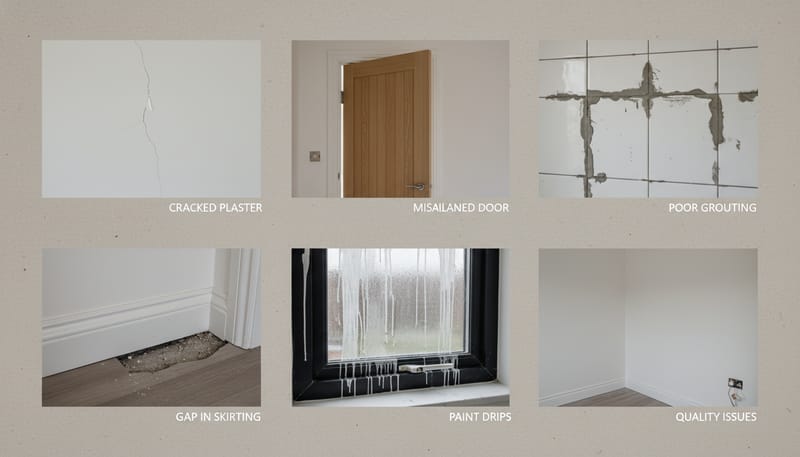
How Defects Are Categorised
Severity Levels
| Severity | Definition | Typical Response Time | Examples |
|---|---|---|---|
| Critical | Safety hazard, building regulation breach, or structural failure. Must be addressed urgently | 24-48 hours (emergency) to 14 days | Gas leak, no fire stopping, missing earth bond, structural movement |
| Major | Significant defect affecting function, weatherproofing, or compliance. Property not performing as it should | 14-28 days | Leaking roof, failed boiler, inoperable windows, blocked drainage |
| Moderate | Noticeable quality issue that affects appearance or minor function. Should be remedied | 28-56 days | Poor paintwork, misaligned doors, uneven tiling, stiff windows |
| Minor | Small cosmetic issue. Desirable to fix but doesn't affect function | Next scheduled visit or end of defects period | Small paint touch-ups, minor scratches, tiny grout gaps |
Who's Responsible?
| Period | Responsible Party | What They Cover |
|---|---|---|
| Year 1-2 (Defects Liability) | Developer (directly) | All defects — cosmetic, functional, and structural. Developer must fix anything that doesn't meet the specification or building regulations |
| Year 3-10 (Insurance Period) | NHBC / warranty provider | Structural defects only — foundations, load-bearing walls, roof structure, external weatherproofing. Cosmetic issues no longer covered |
| After Year 10 | Homeowner | All repairs become the homeowner's responsibility unless covered by a separate insurance or legal claim |
For full warranty details and how to make claims, see our NHBC and warranties guide.
1. Plastering and Internal Walls
Plastering defects are the single most common category of snag in new build homes. They account for approximately 20-30% of all reported defects.
| Defect | What It Looks Like | Cause | Severity | Developer Must Fix? |
|---|---|---|---|---|
| Cracking at ceiling/wall junction | Hairline cracks running along the join between wall and ceiling, often in straight lines | Normal shrinkage as plasterboard dries and building settles. Plasterboard tape joints separating | Minor-Moderate | Yes in Year 1-2. Hairline cracks under 1mm are often considered within tolerance — wider cracks or recurring cracks should be repaired |
| Nail or screw pops | Small circular bumps appearing through the paint surface, sometimes with a visible nail head | Plasterboard fixings working loose as timber dries and shrinks. Common in the first heating season | Minor | Yes — developer should re-fix and re-skim the affected area |
| Uneven plaster finish | Ridges, bumps, or hollows visible when looking along the wall at an angle in natural light | Poor workmanship — rushed application, insufficient trowelling, or incorrect plaster mix | Moderate | Yes — NHBC tolerance is 3mm deviation over a 2m straightedge. Greater deviation is a defect |
| Hollow-sounding plaster | A drum-like hollow sound when you tap the wall with your knuckles | Plaster has debonded from the substrate (plasterboard or blockwork). Could be due to damp backing coat, contaminated surface, or incorrect mix | Major | Yes — debonded plaster will eventually crack and fall. Must be hacked off and re-plastered |
| Damp patches on new plaster | Dark or discoloured areas on walls, particularly on external walls or around windows | Could be construction moisture still drying out (normal in first 12 months), or could indicate a leak, missing cavity tray, or bridged DPC | Moderate-Critical | Yes — must be investigated. Construction moisture should dry within 12 months. Persistent damp indicates a water ingress problem that needs urgent attention |
| Cracks around windows and doors | Diagonal cracks radiating from the corners of window and door openings | Stress cracks from structural settlement or inadequate lintels. Can also be shrinkage cracks in new plaster | Moderate-Major | Yes — diagonal cracks suggest structural movement and should be investigated. Simple shrinkage cracks can be filled and decorated |
| Rough or pitted finish | Surface feels gritty or has tiny holes and imperfections rather than being smooth | Plaster applied too thin, over-trowelled, or contaminated. Sand in multi-finish plaster | Moderate | Yes — the specified finish should be smooth, suitable for decoration |
| Plaster crumbling at corners | External corners of walls chipping, crumbling, or soft | Missing or damaged corner beads. Plaster not properly keyed around the bead | Moderate | Yes — corner beads should be secure with plaster fully bonded |
What Happens If Not Fixed
Most plastering defects are cosmetic and won't cause structural problems. However, hollow plaster will eventually fail (sections can fall off walls), and damp-related plaster issues can indicate water ingress that leads to mould, timber decay, and compromised insulation if the underlying cause isn't resolved.
2. Paintwork and Decoration
Paint defects are the second most common category, often accounting for 15-25% of snags.
| Defect | What It Looks Like | Cause | Severity | Developer Must Fix? |
|---|---|---|---|---|
| Missed patches | Areas where paint coverage is thin or the undercoat/plaster shows through | Insufficient coats applied. Rushed application. Poor lighting during decoration | Minor-Moderate | Yes — specification typically requires 2-3 coats for even coverage |
| Drips and runs | Visible drip marks or runs in the paint, especially on woodwork (gloss/satin) and around window frames | Over-application. Paint too thick. Not catching drips during application | Minor | Yes — should be sanded and recoated |
| Poor cutting in | Ragged or uneven lines where different colours or finishes meet — typically ceiling to wall, wall to woodwork, or around sockets and switches | Unskilled application. No masking used. Rushed work | Minor | Yes — clean, straight lines are expected at all junctions |
| Roller marks and stipple | Visible texture pattern from the roller nap, or stippled effect instead of smooth finish | Wrong roller type for the paint. Not laid off properly. Too much pressure | Minor | Developer may argue within tolerance for emulsion on walls — but gloss and satin finishes on woodwork should be smooth |
| Paint on glass, carpet, or fittings | Splashes or smears of paint on window glass, light switches, carpet edges, or other surfaces | Careless workmanship. No masking or dust sheets used | Minor | Yes — developer should clean or replace affected items |
| Colour inconsistency | Visible colour difference between walls in the same room, or between patches where touch-ups have been done | Different paint batches. Touch-ups with slightly different mix. Applying over damp plaster | Minor-Moderate | Yes if noticeable — may require repainting an entire wall rather than just touching up |
3. Joinery: Doors, Skirting, and Architrave
| Defect | What It Looks Like | Cause | Severity | Developer Must Fix? |
|---|---|---|---|---|
| Doors sticking or catching | Door rubs on frame or floor when opening/closing. May need force to open or won't latch properly | Frame not square. Door swollen from moisture (common in first winter). Hinges misaligned. Floor covering too thick | Moderate | Yes — doors should open and close freely. If caused by seasonal swelling, developer may ask to wait one full heating cycle before adjusting |
| Gaps around door frames | Visible gaps between the door frame (lining) and the wall. Sometimes stuffed with filler or left open | Frame not fitted tightly to wall opening. Plaster not taken up to frame. Missing or poorly fitted architrave | Moderate | Yes — gaps should be filled and architrave should cover the junction |
| Skirting board gaps | Gaps between skirting board and floor, or between skirting and wall. Mitres at corners opening up | Building settlement. Timber shrinkage as moisture content reduces in first heating season. Poor fixing | Minor | Yes — developer should re-fix and fill. Some minor shrinkage is expected in Year 1 but should be remedied |
| Architrave mitres open | Gaps at the 45-degree mitre joints where architrave meets at door frame corners | Timber shrinkage. Poor cutting. Frames not perfectly square | Minor | Yes — should be re-glued and filled. Very common snag |
| Handles loose or misaligned | Door handles wobble, don't return to horizontal, or latch doesn't engage the strike plate | Screws not tightened. Strike plate misaligned. Cheap hardware | Moderate | Yes — all hardware should function correctly |
| Fire door defects | Fire doors without self-closing devices, missing intumescent strips, or gaps exceeding 3mm around frame | Incomplete installation. Wrong hinges (fire doors need three hinges). Strips not fitted or painted over | Critical | Yes — fire door defects are building regulation breaches and safety hazards. Must be rectified immediately |
| Kitchen unit misalignment | Cabinet doors not level with each other. Gaps between units. Drawers catching | Poor installation. Uneven walls or floors not compensated for. Hinge adjustment needed | Moderate | Yes — kitchen units should be level, aligned, and fully operational |
4. Windows and Glazing
| Defect | What It Looks Like | Cause | Severity | Developer Must Fix? |
|---|---|---|---|---|
| Blown sealed units | Condensation or misting between the two panes of a double-glazed unit that cannot be wiped away | Failed perimeter seal on the sealed unit. Manufacturing defect. Damage during installation | Major | Yes — sealed unit must be replaced. Covered under window manufacturer's warranty (typically 10 years) and NHBC |
| Scratched glass | Visible scratches on glass surface, often from site debris, mortar splash removal, or label scraping | Site damage during construction. Cleaning with abrasive materials. Mortar left to harden on glass | Moderate | Yes — developer should replace scratched panes. Deep scratches that can be felt with a fingernail are always a defect |
| Draughts | Cold air felt around closed windows, sometimes with visible movement of a tissue held near the frame edges | Seals not compressing properly. Window not adjusted correctly. Missing or incomplete external sealant between frame and brickwork | Major | Yes — windows must be weathertight when closed. Adjustment, seal replacement, or re-sealing required |
| Handles stiff or not locking | Window handle hard to turn, or doesn't engage the multi-point locking mechanism at all positions | Frame alignment issue. Locking points not engaging with keeps. Hardware fault | Major | Yes — windows must lock fully for security and weather sealing |
| Trickle vents missing | No small ventilators visible in the window frame head | Not fitted during manufacture or installation. Background ventilation is required by Building Regulations Part F | Major | Yes — this is a building regulation breach. Trickle vents must be retrofitted |
| External sealant gaps | Missing or cracked sealant between window frame and external wall. Daylight visible | Incomplete or poor quality sealant application. Sealant not tooled. Wrong sealant type | Major | Yes — gaps allow water and air penetration. Must be fully sealed |
| Condensation on inside of windows | Water droplets forming on the room-side surface of windows, particularly overnight in bedrooms and kitchens | Usually caused by inadequate ventilation rather than a window defect. New builds are airtight — moisture from occupants, cooking, and showering must be ventilated out | Moderate | Not always a defect — developer should check extract fans are working and trickle vents are fitted. Persistent condensation leading to mould around frames needs investigation |
What Happens If Not Fixed
Blown sealed units get progressively worse and reduce thermal performance. Draught and sealant issues lead to water ingress, which causes internal damp, mould, and timber decay around reveals. Persistent condensation from poor ventilation causes black mould on window frames and surrounding walls — a health hazard, particularly for children and those with respiratory conditions.
5. Plumbing and Heating
Plumbing defects are among the most serious because water damage from even a small leak can be extensive and costly to repair.
| Defect | What It Looks Like | Cause | Severity | Developer Must Fix? |
|---|---|---|---|---|
| Leaking pipe joints | Drips or damp patches at pipe connections — under sinks, behind baths, at radiator valves, in the loft | Push-fit connections not fully engaged. Compression joints not tightened. Solder joints with pinholes. Pipes stressed during installation | Major-Critical | Yes — all leaks must be repaired immediately. Water damage to structure and finishes is the developer's liability during Year 1-2 |
| Cold radiators or cold spots | Radiator doesn't heat up, or has cold areas (typically top = trapped air, bottom = sludge, one side = valve closed) | Air in system (needs bleeding). Debris in system. Faulty TRV. Incorrectly balanced system. Pump failure | Major | Yes — heating system must function correctly. Developer should bleed, balance, and flush system as needed |
| Low water pressure | Taps and showers deliver a weak flow. Multiple outlets running simultaneously causes significant drop | Undersized pipework. Too many fittings in sequence. Faulty pressure reducing valve. Supply issue from water main | Major | Yes — water supply must be adequate for the property. Developer should investigate and remedy. Minimum pressure is 1 bar at the kitchen tap |
| Noisy pipes (water hammer) | Banging, knocking, or hammering sounds when taps or valves close | High water pressure. Pipes not properly clipped. No hammer arrestors fitted. Quick-closing valves (washing machines, dishwashers) | Moderate | Yes — water hammer can damage pipe joints over time. Developer should fit arrestors and clip loose pipework |
| Slow-draining wastes | Sinks, baths, or showers drain slowly. Water pools rather than flowing away quickly | Insufficient fall on waste pipes. Partially blocked trap. Venting issue (no AAV or SVP causing air lock). Construction debris in pipes | Moderate-Major | Yes — waste pipes must drain efficiently. Developer should check falls, clear debris, and ensure venting is correct |
| Boiler faults | Error codes on display. Boiler locks out. No hot water. Heating doesn't respond to thermostat | Commissioning fault. Incorrect gas pressure. Faulty components. Condensate pipe frozen (winter) or blocked | Major-Critical | Yes — boiler must function correctly. If under manufacturer's warranty, developer should coordinate repair. Gas safety certificate should confirm correct installation |
| Toilet runs continuously | Cistern doesn't stop filling. Water constantly trickles into the bowl | Faulty fill valve or flush valve. Float arm misadjusted. Washer worn (less likely on new installation — usually faulty component) | Moderate | Yes — wastes water and indicates faulty component that needs replacement |
| Silicone sealant failure around baths and showers | Sealant peeling away from surfaces. Gaps appearing. Water getting behind the bath or shower tray | Sealant applied to damp or dusty surfaces. Wrong type of sealant. Bath filled with water weight not present during sealing (sealant stretches when bath subsequently loaded) | Major | Yes — failed sealant allows water behind sanitaryware, causing damp, mould, and potentially ceiling damage below. Developer should strip and re-seal |
What Happens If Not Fixed
Water damage is cumulative and often hidden. A small leak behind a bath panel can go unnoticed for months, rotting the timber floor, causing mould in the ceiling below, and damaging insulation. By the time it becomes visible, repair costs can run into thousands of pounds. This is why plumbing defects should always be treated as urgent, regardless of their apparent size.
6. Electrical Installation
| Defect | What It Looks Like | Cause | Severity | Developer Must Fix? |
|---|---|---|---|---|
| Reversed polarity on sockets | Socket tester shows live and neutral wires swapped. Socket appears to work but wiring is incorrect | Wiring error during installation. Face plate removed and replaced incorrectly | Critical | Yes — this is a safety hazard and building regulation breach. Must be corrected by a qualified electrician immediately |
| Missing earth connection | Socket tester shows no earth. Metal appliances plugged in would not be safely earthed | Earth wire not connected at socket or distribution board. Broken conductor | Critical | Yes — extremely dangerous. Electric shock risk. Must be rectified immediately |
| Dead sockets | Socket doesn't work — nothing happens when an appliance is plugged in | Not connected at consumer unit. Loose wire at socket. Tripped MCB (circuit breaker) | Major | Yes — all sockets must be operational |
| Flickering or failing lights | Lights flicker, buzz, or cut out intermittently | Loose connection at fitting or switch. Incompatible dimmer switch with LED bulbs. Faulty transformer on low-voltage fittings | Moderate-Major | Yes — loose connections are fire risks. Developer should investigate and rectify |
| Smoke detectors not interconnected | Testing one smoke detector doesn't trigger the others | Wiring fault. Wireless interconnection not paired. Incorrect installation | Critical | Yes — Building Regulations require interconnected detection on every floor. Must be rectified immediately |
| Consumer unit not labelled | Circuit breakers have no labels identifying which circuit they protect | Electrician didn't complete labelling. Labels fell off or were never applied | Major | Yes — BS 7671 requires clear circuit identification. Essential for safe isolation |
| Sockets and switches not level | Face plates visibly tilted or not flush with the wall surface | Back boxes not fitted straight. Plaster not built up around boxes correctly | Minor | Yes — cosmetic defect but indicates poor workmanship. Should be straightened |
7. Brickwork and External Walls
| Defect | What It Looks Like | Cause | Severity | Developer Must Fix? |
|---|---|---|---|---|
| Cracked bricks | Individual bricks with visible cracks — hairline or through the full thickness | Frost damage during construction. Impact damage on site. Structural movement causing stress. Defective bricks from supplier | Moderate-Major | Yes — cracked bricks should be cut out and replaced (not just filled). If widespread, may indicate structural issue |
| Poor mortar joints | Inconsistent joint widths, colour differences between sections, holes or gaps in mortar, joints not properly tooled | Different bricklayers working on the same wall. Mortar mix variations. Poor workmanship | Moderate | Yes — joints should be consistent and fully filled. Raking out and repointing may be required for poorly filled joints |
| Efflorescence | White powdery deposits on brick surface | Salts in bricks or mortar dissolving in moisture and crystallising on the surface as water evaporates. Very common in first 1-2 years of a new building | Minor | Rarely — efflorescence is considered normal in new brickwork and typically clears naturally within 1-2 years. Persistent or severe cases should be investigated for damp source |
| Blocked weep holes | Mortar droppings visible in or completely blocking weep holes above DPC, windows, or lintels | Mortar dropped into cavity during construction. No cavity trays or weep hole protection fitted during build | Major | Yes — blocked weep holes prevent moisture draining from the cavity, leading to damp penetration. Must be cleared |
| DPC bridging | External ground level (soil, paving, render) raised above the damp-proof course level (less than 150mm clearance) | Landscaping or paving installed too high. Soil piled against walls. Render taken below DPC | Critical | Yes — bridged DPC allows ground moisture to penetrate the wall above the DPC, causing rising damp. Ground levels must be reduced or other remediation undertaken |
| Render cracking | Cracks in external render — hairline map cracking, or larger defined cracks following a pattern | Shrinkage cracking (fine crazing is normal). Structural movement (larger cracks). Insufficient movement joints. Render applied too thick in one coat | Moderate-Major | Yes — fine crazing may be cosmetic, but cracks wider than 0.5mm allow water penetration and must be repaired. Structural cracks need investigation |
| Staining from flashings or ironwork | Rust-coloured staining running down brickwork from metal fixings, wall ties, or flashings | Ferrous (non-stainless) wall ties or fixings corroding. Lead flashings not patinated. Iron-rich mortar | Moderate | Yes — staining from corroding fixings indicates the fixings themselves may be failing. Should be investigated and cleaned |
8. Roofing
| Defect | What It Looks Like | Cause | Severity | Developer Must Fix? |
|---|---|---|---|---|
| Slipped or missing tiles | Tiles visibly displaced, exposing the felt or membrane underneath. Gaps in tile courses | Tiles not properly hung on battens (nibs not engaged). Missing tile clips. High wind damage on unsecured tiles | Major | Yes — exposes roof to water penetration. Must be replaced and secured |
| Ridge tile defects | Ridge tiles loose, mortar bed crumbling, or dry-fix clips missing/broken | Mortar not correctly bedded (too wet, too dry). Dry-fix system not properly installed. Wind damage | Major | Yes — loose ridge tiles in high winds are dangerous (falling risk) and allow water into the roof space |
| Flashing defects | Lead or lead-alternative flashings lifting, not properly dressed into mortar joints, or gaps visible | Flashings not wedged and pointed into chase. Incorrect overlap. Thermal movement in lead not accommodated | Major | Yes — flashings are the primary defence against water penetration at roof-wall junctions. Must be properly fixed |
| Gutter and downpipe leaks | Water overflowing from joints, dripping at connections, or running down walls instead of into downpipes | Joints not properly connected or sealed. Incorrect fall (gutters should slope towards downpipes). Blockage from construction debris | Major | Yes — water running down external walls causes damp, staining, and can undermine foundations over time |
| Condensation in loft | Water droplets on roof felt/membrane underside. Damp insulation. Black mould on timbers | Inadequate loft ventilation (eaves blocked by insulation). Extract fans venting into loft instead of outside. Loft hatch not sealed | Major | Yes — condensation can rot roof timbers and reduce insulation effectiveness. Ventilation paths must be cleared and extract ducting corrected |
| Felt/membrane damage | Tears, gaps, or sagging sections in the breathable membrane visible from inside the loft | Damage during construction (tradespeople walking on battens). Tears around services penetrating the roof. Insufficient lapping at joints | Major | Yes — membrane is the secondary defence against water penetration. Damaged sections must be repaired or replaced |
9. Tiling (Floor and Wall)
| Defect | What It Looks Like | Cause | Severity | Developer Must Fix? |
|---|---|---|---|---|
| Hollow or debonded tiles | A hollow, drum-like sound when you tap a tile with your knuckles (compared to the solid thud of properly bonded tiles) | Insufficient adhesive coverage (should be minimum 80% coverage, 95% in wet areas). Incorrect adhesive type. Tiles laid on damp or contaminated substrate | Major | Yes — debonded tiles will eventually crack or lift, especially floor tiles under foot traffic. Must be relaid |
| Cracked tiles | Visible crack running across the tile surface. May be hairline or wide enough to feel | Impact damage. Substrate movement (particularly on timber floors without sufficient flexible adhesive). Point load on unsupported tile | Moderate | Yes — cracked tiles should be replaced. If cracking is widespread, the substrate preparation should be investigated |
| Uneven tile surfaces (lippage) | Edges of adjacent tiles not flush — one tile sits higher than its neighbour, creating a step | Uneven substrate. Incorrect use of levelling spacers. Large-format tiles on uneven floor. Adhesive bed inconsistent | Moderate | Yes — NHBC tolerance for tiling lippage is 1mm for wall tiles, 2mm for floor tiles. Greater deviation is a defect |
| Grout defects | Missing grout, crumbling grout, colour inconsistency, or grout cracking | Grout not fully applied. Wrong mix (too wet or too dry). Grout applied before adhesive fully cured. Structural movement cracking grout | Minor-Moderate | Yes — grouting should be complete, consistent, and intact. Missing grout in wet areas (showers, splashbacks) allows water penetration behind tiles |
| Poor tile cuts | Rough, uneven, or chipped edges where tiles have been cut to fit around pipes, fittings, or room edges | Incorrect cutting technique. No diamond blade used. Cuts not filed smooth | Moderate | Yes — tile cuts should be neat, straight, and covered by trim or grout. Jagged cuts are a workmanship defect |
10. Flooring
| Defect | What It Looks Like | Cause | Severity | Developer Must Fix? |
|---|---|---|---|---|
| Squeaky floors | Creaking, squeaking, or popping sounds when walking across the floor, particularly on upper storeys | Timber floor joists or chipboard flooring sheets not properly fixed. Nails working loose. Pipes rubbing against floor structure. Insufficient adhesive on tongue-and-groove joints | Moderate | Yes — persistent, loud squeaking is a defect. Developer should re-fix boards and ensure all tongue-and-groove joints are properly glued and screwed. Some minor noise from timber floors is considered normal |
| Uneven floors | Visible dip or slope. Spirit level shows clear deviation. Furniture rocks | Screed not level (concrete floors). Joist deflection (timber floors). Settlement. Screed shrinkage | Moderate-Major | Yes — NHBC tolerance is 5mm over 2m for screeded floors, 10mm over 2m for structural timber floors. Greater deviation requires levelling |
| Carpet wrinkles and loose edges | Carpet not lying flat. Visible humps or wrinkles. Edges pulling away from grippers under skirting | Poor fitting — not stretched properly. Gripper rods not holding. Underlay wrinkled beneath | Moderate | Yes — carpet should be professionally refitted. Trip hazard if severe |
| Laminate/LVT gaps | Visible gaps between boards. Boards lifting at edges. Click-lock joints separating | Not properly clicked together during installation. Expansion gap insufficient or excessive. Subfloor not level (boards can't sit flat) | Moderate | Yes — boards should fit tightly. Developer should relay affected sections |
| Screed cracking | Cracks in concrete screed visible before floor covering installed, or causing cracks to telegraph through vinyl or tile above | Screed dried too quickly (not cured properly). Screed too thin. No expansion joints at doorways. Underfloor heating brought up to temperature too quickly | Moderate-Major | Yes — cracked screed can affect the floor covering above. May need grinding, filling, or partial replacement depending on severity |
11. External Drainage and Groundworks
| Defect | What It Looks Like | Cause | Severity | Developer Must Fix? |
|---|---|---|---|---|
| Ponding on driveway or patio | Standing water that doesn't drain away within a reasonable time after rain | Insufficient falls in hard surfaces. Drainage not installed. Levels set incorrectly | Major | Yes — hard surfaces must drain away from the building. Ponding causes slip hazards, freeze-thaw damage, and potential water ingress |
| Blocked drains | Manholes overflowing. Water backing up in gullies. Slow drainage from external wastes | Construction debris left in drainage system (mortar, plaster, packaging, food waste). Very common on new sites | Major | Yes — developer should jet-clean and CCTV-survey drainage if blockages occur. Construction debris is entirely the developer's responsibility |
| Settlement of paths and drives | Paving or tarmac sinking or cracking, particularly adjacent to the building or over trenches | Backfilled trenches (for services) not properly compacted. Subgrade inadequate. Fill material settling | Moderate-Major | Yes — settlement indicates poor compaction. Developer should excavate, compact, and resurface. May recur if root cause not addressed |
| Garden drainage issues | Waterlogged garden. Standing water that doesn't drain. Water flowing towards the house | Clay soil compacted by construction traffic. No land drainage installed. Garden falls towards rather than away from building | Major | Yes if levels fall towards the house or if waterlogging makes the garden unusable. Developer should re-grade or install land drainage. Some clay-soil waterlogging in winter may be considered within the range of normal — but the garden should be usable |
| Subsidence or heave cracking | Cracks appearing in walls, particularly stepped cracks following mortar joints. Doors and windows becoming difficult to open. Floor levels changing | Foundation movement — could be settlement (downward), heave (upward, often from clay soils rehydrating after tree removal), or subsidence (downward from soil shrinkage). Very rare on new builds but serious when it occurs | Critical | Yes — structural issue covered by NHBC/warranty for full 10 years. Developer must investigate and remedy. May require underpinning |
12. Insulation and Energy Performance
| Defect | What It Looks Like | Cause | Severity | Developer Must Fix? |
|---|---|---|---|---|
| Cold spots on walls | Areas of internal wall that feel noticeably cold to the touch. Condensation forming on wall surface in specific spots | Missing or displaced cavity wall insulation. Thermal bridge at structural elements. Insulation compressed or slumped | Major | Yes — thermal imaging can identify missing insulation. Developer must remedy to meet Part L requirements and the thermal performance specified in the EPC |
| Insufficient loft insulation | Insulation depth less than 270mm. Gaps or areas not covered. Insulation blocking eaves ventilation | Installation not completed. Insulation disturbed by other trades working in loft after installation. Rolls not properly butted together | Major | Yes — Building Regulations Part L sets minimum standards. Insulation must be correctly installed to the specified depth throughout |
| Draughts from around sockets on external walls | Air movement felt from socket openings on external walls, particularly on windy days | No draught-proofing gaskets on socket face plates. Gaps around back boxes not sealed. Air path through cavity wall insulation | Moderate | Yes — airtightness is part of Part L compliance. Socket gaskets and back-box sealing should be installed |
| Condensation and mould | Black mould growth on walls, window reveals, and in corners. Musty smell. Damp feeling in rooms | Combination of factors: thermal bridging (cold spots where insulation is poor), high internal moisture levels, and inadequate ventilation. New builds generate more moisture as construction materials dry out | Major | Yes — developer should investigate and address root cause. If caused by thermal bridge or defective insulation, this is a construction defect. If caused by occupant behaviour (not using ventilation), developer should still ensure extract fans are working and trickle vents are fitted |
13. Fire Safety
Fire safety defects are among the most serious issues found in new build homes. They may not be visible during a standard snagging inspection but should be checked where accessible.
| Defect | What It Looks Like | Cause | Severity | Developer Must Fix? |
|---|---|---|---|---|
| Missing fire stopping | Gaps around pipes, cables, and ducts where they pass through fire-rated walls, floors, and ceilings. Visible from loft space at party wall junctions | Fire stopping not installed by subcontractors. Subsequent trades (plumbers, electricians) penetrating fire barriers without re-sealing | Critical | Yes — fire stopping is a building regulation requirement. Missing fire stopping can allow fire and smoke to spread between properties (terraced/semi-detached) or between floors. Must be rectified immediately |
| Fire door defects | Self-closer not fitted or not working. Intumescent strips missing. Smoke seals absent. Gaps around frame exceeding 3mm. Wrong hinges (need 3 x CE-marked fire-rated hinges) | Incomplete installation. Components not fitted. Door adjusted after installation breaking the fire seal | Critical | Yes — fire doors are life-safety elements. Every component must be correct |
| Smoke/heat detector issues | Detectors not fitted on every floor. Not interconnected. Battery-only instead of mains-powered with battery backup. Heat detector missing from kitchen | Incomplete installation. Not commissioned properly. Wrong detector type in wrong location | Critical | Yes — Building Regulations mandate the type, location, and interconnection of detection systems |
| Garage fire separation | Integral garage without FD30 fire door. No step up from garage to house. Ceiling/wall plasterboard fire lining missing or incomplete | Door not fire-rated. Builder fitted standard door instead. Fire-resistant lining not completed to all surfaces | Critical | Yes — integral garages must have 30-minute fire separation from the house. This is non-negotiable under building regulations |
14. Sound Insulation (Flats and Terraced/Semi-Detached Houses)
| Defect | What It Looks Like | Cause | Severity | Developer Must Fix? |
|---|---|---|---|---|
| Airborne sound transfer through party walls | Voices, music, and TV clearly audible from the neighbouring property through the party wall | Inadequate party wall construction. Missing insulation in cavity. Sockets back-to-back through party wall creating a sound bridge. Services penetrating the wall without acoustic sealing | Major | Yes — Building Regulations Part E sets minimum standards (tested by pre-completion testing on a sample of properties). If sound insulation fails to meet standards, remedial work is required |
| Impact sound through floors (flats) | Footsteps, dropped objects, and impact noise from the flat above clearly audible | Inadequate floor construction. Floating floor not properly isolated. Rigid connections bridging the resilient layer. Floor covering removed or changed | Major | Yes — the developer is responsible for the floor construction meeting Part E standards as built. However, if the upstairs occupant has removed the original floor covering, that changes the performance |
| Flanking sound | Sound apparently coming through the floor, ceiling, or adjacent walls rather than directly through the party wall | Sound travelling around the party wall via connected structural elements. Floor or ceiling structures not properly isolated at the party wall junction | Major | Yes — flanking transmission is a construction defect that needs investigation. Often requires opening up and adding acoustic isolation |
Defect Frequency: What Snagging Companies Find Most Often
Based on data from professional snagging inspections across thousands of UK new build homes, the most frequently reported defects are:
| Rank | Defect Category | % of All Snags | Average Count per House |
|---|---|---|---|
| 1 | Plastering and internal walls | 20-25% | 15-30 |
| 2 | Paintwork and decoration | 15-20% | 10-25 |
| 3 | Joinery (doors, skirting, architrave) | 12-15% | 8-15 |
| 4 | External works (brickwork, drainage, landscaping) | 10-12% | 6-12 |
| 5 | Plumbing and heating | 8-10% | 5-10 |
| 6 | Kitchen and bathroom fittings | 8-10% | 5-10 |
| 7 | Windows and glazing | 5-8% | 3-8 |
| 8 | Electrical | 5-7% | 3-7 |
| 9 | Flooring | 3-5% | 2-5 |
| 10 | Roofing and loft | 2-4% | 1-4 |
Use our comprehensive snagging checklist to systematically check every area listed above.
When a Defect Becomes a Warranty Claim
Not every defect is handled the same way. Understanding which route to take saves time and frustration.
| Situation | Who to Contact | What They'll Do |
|---|---|---|
| Cosmetic snag in Year 1-2 | Developer's customer care team | Schedule repair visit. Most developers batch repairs monthly |
| Functional defect in Year 1-2 | Developer's customer care team (urgent: site manager) | Should attend within 14-28 days. Emergency items within 24-48 hours |
| Developer not responding in Year 1-2 | NHBC (or warranty provider) Resolution Service | Mediate between you and developer. Can direct developer to fix |
| Structural defect in Year 3-10 | NHBC (or warranty provider) directly | Claim under insurance period. Surveyor inspection. Covered repairs |
| Appliance fault | Appliance manufacturer (using warranty registration) | Repair or replace under manufacturer's warranty |
| Boiler fault | Developer in Year 1, then boiler manufacturer | Gas Safe engineer visit. Repair under manufacturer's warranty (typically 5-10 years) |
| Window/door hardware fault | Developer in Year 1-2, then window manufacturer | Adjustment or replacement. Window warranties typically 10 years |
For the full claims process and escalation steps, see our NHBC and warranties guide and snagging disputes guide.
What 'Within Tolerance' Actually Means
Developers frequently respond to snag reports by saying an item is "within tolerance" or "meets acceptable standards." Here are the actual tolerances from NHBC Standards and industry guidelines:
| Element | Acceptable Tolerance | Defect Threshold |
|---|---|---|
| Plaster flatness | 3mm over 2 metres | More than 5mm deviation is always a defect |
| Wall tile lippage | 1mm between adjacent tiles | More than 2mm is always a defect |
| Floor tile lippage | 2mm between adjacent tiles | More than 3mm is always a defect |
| Floor level (screeded) | 5mm over 2 metres | More than 10mm is always a defect |
| Floor level (timber) | 10mm over 2 metres | More than 15mm is always a defect |
| Door gap to frame | 2-3mm around three sides | Less than 2mm (catching) or more than 4mm |
| Brick course level | 10mm over 5 metres | Visibly out of level or more than 15mm |
| Worktop level | 3mm over full length | More than 5mm or visible to eye |
| External ground to DPC | Minimum 150mm clearance | Less than 150mm is a building regulation breach |
| Staircase baluster gap | Maximum 99mm (100mm sphere must not pass through) | 100mm or more is a safety hazard and building regulation breach |
| Sealant bead width | Consistent throughout | Gaps, breaks, or sections thinner than 3mm |
| Paint finish | Even coverage, no visible defects at normal viewing distance (1.5m) | Drips, runs, missed patches, or colour inconsistency visible at 1.5m |
If a developer claims something is within tolerance, ask them to specify which standard they're referring to. You're entitled to see the measurement. If you disagree, escalate through the warranty provider's resolution service — see our disputes guide.
Seasonal Defects: Issues That Only Appear at Certain Times
Some defects only manifest under specific weather conditions. This doesn't make them less valid — report them whenever they appear.
| Season | Defects That Appear | Why |
|---|---|---|
| First winter | Condensation on windows and walls. Mould growth. Draughts become noticeable. Cold spots on walls. Frozen condensate pipes. Heating system problems | First time the heating system runs continuously. Building moisture at peak. Cold weather reveals thermal bridging. Wind-driven rain tests weatherproofing |
| First spring | Cracking in plaster, render, and screeds. Skirting and architrave joints opening. Doors sticking or gaps appearing | Timber drying out after first heating season. Materials reaching equilibrium moisture content. Differential movement between materials |
| First summer | Subsidence cracks (clay soils). Drainage issues from dry ground. Expansion cracks in brickwork or render | Clay soil shrinks in hot, dry weather causing foundation movement. Thermal expansion of building materials |
| First heavy rain | Roof leaks. Window leaks. Gutter overflow. Drainage flooding. Damp patches on walls | First real test of weatherproofing. Construction debris blocking gutters and drains. Sealant gaps only leak under significant rainfall or wind-driven rain |
Tip: keep a running snag list and report new issues as they arise throughout the defects liability period. You don't need to report everything at once — batch your reports every 2-3 months.
Defects vs Normal New Build Behaviour
Some things that seem like defects are actually normal characteristics of a new building settling in.
| Observation | Defect or Normal? | Explanation |
|---|---|---|
| Hairline cracks in plaster (under 1mm) | Normal (but report anyway) | Plaster and structural drying causes minor cracking in the first year. Developer should fill and redecorate at end of Year 1 |
| White deposits on brickwork (efflorescence) | Normal | Salts in brick and mortar crystallising on surface. Usually disappears within 1-2 years. Brush off with dry brush |
| Condensation on window interiors | Often normal | New builds are airtight. Occupant moisture (cooking, showering, breathing) must be ventilated out. Use trickle vents and extract fans |
| Slight timber creaking | Normal | Timber frame and floor joists adjusting to ambient moisture levels. Seasonal — more noticeable when heating switches on/off |
| Skirting/architrave mitre gaps in first winter | Normal (but developer should fix) | Timber shrinks as it dries in the heated home. Gaps up to 1mm at mitres are typical. Developer should fill at Year 1 visit |
| Damp smell in first few months | Usually normal | Construction moisture evaporating from plaster, screed, and timber. Should clear within 6-12 months. Ensure adequate ventilation |
| Doors sticking in humid weather | Normal (if mild) | Timber doors absorb moisture and swell. Should free up as moisture levels stabilise. Persistent sticking should be adjusted |
What Defects Cost If Left Unrepaired
While defects are the developer's responsibility to fix during the defects liability period, understanding the potential cost of unresolved issues helps you prioritise what to chase hardest.
| Defect Left Unresolved | Potential Consequence | Estimated Repair Cost (If You Pay Later) |
|---|---|---|
| Leaking pipe behind bath | Rotted floor joists, ceiling damage below, mould | £2,000-£8,000+ |
| Missing fire stopping at party wall | Fire spread between properties | £1,000-£3,000 to remediate (if accessible) |
| Blocked weep holes | Internal damp, mould, damaged insulation | £500-£2,000 |
| DPC bridged by paving | Rising damp in ground floor walls | £2,000-£10,000+ (re-landscaping plus damp treatment) |
| Condensation in loft (extract fan venting into loft) | Rotted roof timbers, wet insulation, mould | £3,000-£15,000+ (timber replacement, re-insulation) |
| Roof flashing failure | Water ingress causing internal damage | £500-£3,000 |
| Poor drainage causing waterlogged garden | Foundation heave, subsidence risk, unusable garden | £3,000-£10,000+ (land drainage installation) |
| Blown sealed glazing units | Reduced thermal performance, condensation, mould | £100-£300 per unit |
| Subsidence crack left uninvestigated | Progressive structural damage | £10,000-£50,000+ (underpinning) |
Frequently Asked Questions
How many defects is normal in a new build?
Professional snagging inspectors typically find 50-150 defects in a standard 3-4 bedroom house. This doesn't mean the house is badly built — most snags are minor or moderate. Even well-built homes by reputable developers will have 30-50 snags because of the number of individual trades and tasks involved in building a house (over 30 different trades, thousands of individual operations). What matters is the severity of the defects and whether the developer fixes them promptly.
Can the developer refuse to fix defects?
During the defects liability period (Year 1-2), the developer must fix defects that don't meet the specification, building regulations, or NHBC Standards. They can legitimately decline items genuinely within tolerance or caused by normal wear and tear. They cannot refuse to fix genuine defects. If they do, escalate through the warranty provider's resolution service. See our snagging disputes guide for the full escalation process.
Should I fix defects myself to avoid waiting?
Generally no — at least not during the defects liability period. If you fix a defect yourself, you lose the right to have the developer fix it and may void warranty cover for that element. The exception is genuine emergencies (burst pipe, gas leak) where you must act immediately for safety — keep all receipts and documentation, and claim the cost back from the developer. For non-emergency items, document them, report them formally, and allow the developer reasonable time to respond.
Do defects affect the value of my property?
Minor snags don't affect value if fixed during the defects liability period. However, unresolved structural defects, damp issues, or fire safety defects can significantly affect both value and saleability. Mortgage lenders may refuse to lend against properties with known structural defects. This is another reason to pursue defect resolution diligently — it protects your investment.
What if I find defects after the 2-year defects liability period?
After Year 2, the developer's direct obligation ends. However, structural defects are covered by the NHBC/warranty insurance for years 3-10. You can also pursue the developer through consumer protection legislation (Consumer Rights Act 2015 — goods and services must be of satisfactory quality) or common law (the Defective Premises Act 1972 — duty to build dwellings properly, with a limitation period recently extended to 30 years by the Building Safety Act 2022 for certain defects). For guidance, see our snagging disputes guide.
Related Guides
- Snagging Checklist: 200+ Items Room by Room — the practical inspection checklist
- Snagging Your New Build Home: Complete Process Guide — when to snag, how to report, getting everything fixed
- NHBC and Warranties Guide — what's covered, how to claim, all providers compared
- Snagging Disputes and Legal Rights — escalation, Consumer Code, tribunal, remedies
- New Build Conveyancing Guide — how snagging fits into the legal process