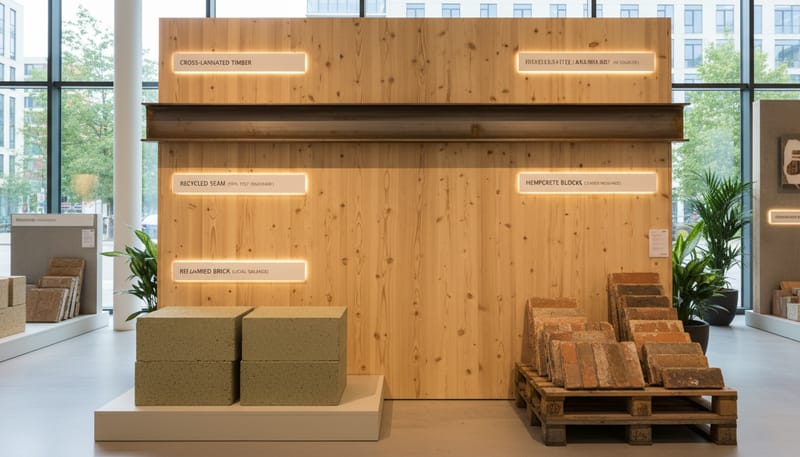
Why Sustainable Building Materials Matter for New Build Homes
The construction industry accounts for approximately 40% of the UK’s total carbon emissions, with a significant proportion of that figure coming from the materials used to build our homes. As the UK races towards its legally binding target of net zero emissions by 2050, the choice of building materials has become one of the most important — and often overlooked — factors in determining how truly green a new build home really is.
When we talk about the carbon footprint of a new build home, we must consider two distinct elements: operational carbon (the energy used to heat, light, and run the home once occupied) and embodied carbon (the emissions generated by extracting, manufacturing, transporting, and assembling the building materials). While operational carbon has received the most attention through EPC ratings and the Future Homes Standard, embodied carbon can account for 50–80% of a new home’s total lifecycle emissions.
This guide examines the sustainable building materials increasingly used in modern UK new build developments. We will cover everything from structural systems like timber frame and low-carbon concrete through to insulation, roofing, and landscaping materials, providing a comprehensive overview for buyers who want to understand what their home is built from and why it matters.
The Scale of the Challenge
A typical 3-bedroom semi-detached new build home in the UK generates between 50 and 80 tonnes of CO2 during construction, before a single light switch is flicked. By comparison, the same home might produce 1.5–2.5 tonnes of CO2 per year in operational emissions. This means the embodied carbon from construction can equal 20–50 years of operational emissions — a staggering figure that underscores why material choices are so critical.
Leading UK developers are increasingly recognising this challenge. Housebuilders such as Barratt Developments, Berkeley Group, and Countryside Partnerships have all published sustainability strategies that include targets for reducing embodied carbon through material innovation and responsible sourcing.
Structural Systems Compared: Timber, Steel, and Concrete
The structural system of a home — its walls, floors, and roof structure — accounts for the largest proportion of embodied carbon. The three main structural systems used in UK new build homes are traditional masonry (brick and block), timber frame, and steel frame, with various hybrid systems combining elements of each.
Embodied Carbon by Structural Material
| Material | Embodied Carbon (kgCO2e per kg) | Typical Use in New Builds | Recyclability | Sustainability Rating |
|---|---|---|---|---|
| Softwood timber (UK-grown) | 0.31 (net negative with carbon storage) | Frame walls, roof trusses, floor joists | Highly recyclable & biodegradable | Excellent |
| Cross-laminated timber (CLT) | 0.42 | Structural walls and floors (mid-rise) | Recyclable | Excellent |
| Concrete blocks | 0.073–0.12 | Inner leaf of cavity walls, foundations | Crushable for aggregate | Moderate |
| Standard Portland cement | 0.91 | Foundations, floors, mortar | Limited | Poor |
| Low-carbon concrete (GGBS blend) | 0.50–0.65 | Foundations, ground floors | Crushable for aggregate | Good |
| Structural steel | 1.55 | Beams, columns (commercial and apartments) | Highly recyclable (90%+ rate) | Moderate |
| Recycled steel | 0.47 | Beams, columns, reinforcement | Infinitely recyclable | Good |
| Clay bricks (UK-manufactured) | 0.21–0.24 | External leaf of cavity walls | Reusable or crushable | Good |
| Aluminium (virgin) | 6.67 | Window frames, cladding | Highly recyclable | Poor (virgin) / Good (recycled) |
| Recycled aluminium | 0.42 | Window frames, cladding | Infinitely recyclable | Good |
As the table demonstrates, timber has by far the lowest embodied carbon of any structural material, and uniquely among building materials, trees absorb CO2 as they grow, effectively locking carbon into the structure of the building. A timber-frame home can store between 15 and 30 tonnes of CO2 within its structure — carbon that would otherwise be in the atmosphere.
Timber Frame Construction
Timber frame construction has been the dominant method in Scotland for decades, accounting for over 80% of new homes north of the border. In England and Wales, its market share has been growing steadily and now accounts for approximately 25–30% of new build homes. Major developers including Taylor Wimpey, Stewart Milne, and Springfield Properties use timber frame extensively.
The advantages of timber frame extend beyond carbon. Timber-frame homes can be erected faster than traditional masonry (reducing on-site construction time by 30–40%), offer excellent thermal insulation when combined with appropriate insulation materials, and are highly adaptable for off-site manufacturing — a growing trend in modern construction that reduces waste and improves quality control.
Low-Carbon Concrete Alternatives
Concrete remains essential for foundations and ground floors, but significant progress has been made in reducing its carbon footprint. Standard Portland cement is one of the most carbon-intensive building materials, but several alternatives are now widely available:
- GGBS (Ground Granulated Blast-furnace Slag): A by-product of steel manufacturing that can replace 50–70% of Portland cement in concrete mixes, reducing embodied carbon by 40–50%.
- PFA (Pulverised Fuel Ash): A by-product of coal power generation that can replace 25–40% of cement. Supply is declining as coal plants close.
- Limestone calcined clay cement (LC3): A newer technology that can reduce cement emissions by up to 40% using widely available raw materials.
- Geopolymer concrete: An emerging alternative that eliminates Portland cement entirely, potentially reducing embodied carbon by 80%. Not yet widely used in UK housing but being trialled by several research institutions.
Sustainable Insulation Materials
Insulation is critical for achieving the high EPC ratings expected of modern new builds, and the choice of insulation material has a significant impact on both environmental credentials and indoor air quality. While synthetic insulation materials like mineral wool and PIR (polyisocyanurate) boards dominate the UK market, a growing range of natural and recycled alternatives offer comparable thermal performance with substantially lower environmental impact.
Insulation Materials Comparison
| Insulation Material | Thermal Conductivity (W/mK) | Embodied Carbon (kgCO2e per kg) | Recycled Content | Natural or Synthetic | Sustainability Rating |
|---|---|---|---|---|---|
| Sheep’s wool | 0.035–0.040 | 0.08 | N/A (natural) | Natural | Excellent |
| Hemp fibre | 0.038–0.042 | -0.16 (carbon negative) | N/A (natural) | Natural | Excellent |
| Wood fibre board | 0.038–0.043 | -0.39 (carbon negative) | N/A (natural) | Natural | Excellent |
| Cellulose (recycled newspaper) | 0.035–0.040 | 0.06 | 80–85% | Recycled | Excellent |
| Recycled plastic (PET) batts | 0.035–0.038 | 0.18 | 80–100% | Recycled | Good |
| Mineral wool (glass and rock) | 0.032–0.040 | 1.20 | 20–80% | Synthetic | Moderate |
| PIR board (rigid foam) | 0.022–0.025 | 4.02 | 0–5% | Synthetic | Poor |
| Expanded polystyrene (EPS) | 0.030–0.038 | 3.29 | 0–10% | Synthetic | Poor |
Natural Insulation: Sheep’s Wool
Sheep’s wool is one of the most appealing natural insulation materials for environmentally conscious homeowners. It offers thermal conductivity values comparable to mineral wool (0.035–0.040 W/mK), naturally regulates moisture by absorbing and releasing water vapour without losing its insulating properties, and can even absorb indoor pollutants such as formaldehyde. UK manufacturers such as Thermafleece and Black Mountain produce wool insulation from British sheep, supporting local farming communities.
The primary limitation is cost — sheep’s wool insulation typically costs 2–3 times more than mineral wool per square metre. However, for buyers who prioritise sustainability and are willing to invest in developer upgrades, it represents an excellent choice for loft and internal wall insulation.
Hemp Insulation
Hemp is a rapidly renewable crop that grows in the UK climate and requires minimal pesticides or fertiliser. Hemp fibre insulation is carbon negative — the plant absorbs more CO2 during growth than is emitted during manufacturing. Products like Tradical Hemcrete combine hemp shiv with lime binder to create a breathable, insulating wall material.
Choosing the Right Insulation
When evaluating insulation in a new build home, consider these factors alongside thermal performance:
- Breathability: Natural materials like wool and hemp allow moisture to pass through, reducing condensation risk and supporting healthy indoor air quality. This is particularly important in airtight new build homes with mechanical ventilation systems.
- Fire resistance: All insulation in new builds must meet fire safety standards. Sheep’s wool is naturally fire-resistant (it requires temperatures above 560°C to ignite), while synthetic materials may require additional fire retardant treatments.
- Durability: Natural insulation materials generally last the lifetime of the building without significant degradation, similar to synthetic alternatives.
- End of life: Natural and recycled insulation materials can be composted, reused, or recycled at end of life, whereas synthetic materials like PIR board typically go to landfill.
Responsibly Sourced Materials and Certification
Beyond the choice of material itself, how that material is sourced plays a crucial role in determining its overall sustainability. Responsible sourcing considers the environmental and social impacts of extraction, manufacturing, and transportation, ensuring that the materials used in your new build home have not contributed to deforestation, habitat destruction, or poor labour practices.
Key Certification Schemes
Several certification schemes help buyers and developers identify responsibly sourced building materials:
| Certification | What It Covers | Key Requirements | Relevance to New Builds |
|---|---|---|---|
| FSC (Forest Stewardship Council) | Timber and wood products | Sustainable forest management, biodiversity protection, community rights | Structural timber, joinery, fencing |
| PEFC | Timber and wood products | Sustainable forest management across 50+ national schemes | Structural timber, cladding, decking |
| BES 6001 (Responsible Sourcing) | All construction products | Supply chain management, environmental assessment, social responsibility | Concrete, aggregates, bricks, steel |
| BRE Green Guide | All building elements | Environmental impact ratings (A+ to E) for building specifications | Used in BREEAM assessments |
| Cradle to Cradle | Any manufactured product | Material health, circularity, renewable energy, water stewardship, social fairness | Flooring, paints, finishes |
| EU Ecolabel | Various consumer and construction products | Reduced environmental impact across product lifecycle | Paints, adhesives, floor coverings |
When buying a new build home, you can ask your developer about their material sourcing policies. Major UK housebuilders are increasingly transparent about their supply chains — for example, Barratt Developments requires all timber to be FSC or PEFC certified, and Berkeley Group publishes an annual sustainability report detailing their responsible sourcing commitments.
BREEAM Ratings for New Build Developments
BREEAM (Building Research Establishment Environmental Assessment Method) is the world’s leading sustainability assessment method for buildings. While it is more commonly applied to commercial buildings, an increasing number of new build housing developments are seeking BREEAM certification, particularly in the affordable housing sector and for larger mixed-use developments.
BREEAM assesses developments across nine categories including energy, materials, waste, and ecology. The materials category specifically examines responsible sourcing and lifecycle impact. Ratings range from Pass through Good, Very Good, and Excellent to Outstanding. Developments achieving Excellent or Outstanding demonstrate genuine commitment to sustainable construction.
Recycled and Reclaimed Materials in New Builds
The use of recycled and reclaimed materials in new build construction is growing as developers seek to reduce both embodied carbon and construction waste. The UK construction industry generates approximately 60 million tonnes of waste per year, making it the country’s largest waste-producing sector. By incorporating recycled content into new homes, developers can help close the loop on this waste stream.
Recycled Content in Common Building Materials
| Material | Typical Recycled Content (%) | Source of Recycled Content | Carbon Saving vs Virgin |
|---|---|---|---|
| Recycled aggregate concrete | 20–30% | Crushed demolition concrete | 15–25% |
| Recycled steel reinforcement | 95–100% | Scrap steel from vehicles, machinery | 60–70% |
| Glass wool insulation | 80% | Recycled glass bottles and jars | 40–50% |
| Cellulose insulation | 80–85% | Recycled newspaper | 70–80% |
| Recycled plastic damp-proof course | 100% | Post-consumer plastic waste | 50–60% |
| Reclaimed bricks | 100% (reuse) | Demolition of older buildings | 85–95% |
| Recycled copper pipework | 30–40% | Scrap copper from various sources | 40–50% |
| Recycled PET carpet fibre | 50–100% | Recycled plastic bottles | 30–40% |
Recycled Aggregate
One of the most significant opportunities for recycled material use in new builds is recycled aggregate. When buildings are demolished, the concrete and masonry can be crushed and processed into aggregate suitable for use in new concrete, sub-base material for roads and paths, and drainage systems. Using recycled aggregate reduces the need for quarrying virgin materials, which saves both carbon emissions and natural landscapes.
UK regulations now encourage recycled aggregate, and many concrete suppliers offer products with 20–30% recycled content as standard. On brownfield sites, developers often incorporate material from previous structures into the new construction.
Reclaimed Bricks
Reclaimed bricks are popular for developers seeking to create homes with character. Using bricks from demolished local buildings gives new developments a mature appearance while reducing embodied carbon by 85–95% compared to new bricks. They are most commonly used for external elevations and feature walls rather than structural purposes.
Green Roofs, Permeable Paving, and External Materials
Sustainable materials are not limited to the structure of the home itself. The external elements of a new build development — roofing, paving, landscaping, and drainage — offer significant opportunities for environmental improvement through thoughtful material choices.
Green Roofs
Green roofs (also called living roofs) consist of a waterproof membrane topped with a growing medium and vegetation, typically sedums and wildflowers. They are increasingly incorporated into new build developments, particularly on flat-roofed apartment buildings and garage structures. Benefits include:
- Stormwater management: Green roofs can absorb and retain 50–90% of rainfall, reducing the burden on drainage systems and helping to comply with sustainable drainage (SuDS) requirements.
- Biodiversity: They create habitat for insects, birds, and other wildlife, contributing to the Biodiversity Net Gain requirements that became mandatory in 2024.
- Thermal insulation: A green roof provides additional insulation, reducing heating demand in winter and cooling demand in summer by 2–5°C.
- Air quality: Plants on green roofs filter particulate matter and absorb CO2, improving local air quality.
- Longevity: Green roofs can extend the life of the underlying waterproof membrane by protecting it from UV radiation and temperature extremes, potentially doubling its lifespan from 20 to 40+ years.
Permeable Paving
Permeable paving allows rainwater to drain through the surface into the ground below, rather than running off into drains and potentially causing flooding. For new build developments, permeable paving is increasingly required under planning conditions, particularly for driveways, parking areas, and shared surfaces.
Common permeable paving options for new builds include:
- Permeable block paving: Standard-looking block paving with wider joints filled with permeable material (gravel or coarse sand). The most common choice for new build driveways.
- Porous concrete: Concrete manufactured with a reduced fine aggregate content, creating an open structure that allows water to pass through.
- Grass-reinforced grids: Plastic or concrete grids filled with soil and grass, suitable for overflow parking areas and access routes.
- Gravel with cellular confinement: Loose gravel retained in a honeycomb grid system, providing both permeability and a stable surface for walking and driving.
- Resin-bound gravel: Natural gravel bound with UV-stable resin, creating a smooth, permeable surface popular for footpaths and driveways.
PVC Alternatives
PVC (polyvinyl chloride) is widely used in new builds for windows, doors, guttering, and drainage pipes. While PVC is durable and low-maintenance, its manufacture involves chlorine chemistry and the material is difficult to recycle effectively. Several alternatives are gaining traction:
- Aluminium-clad timber windows: Timber frames with aluminium external cladding combine the sustainability of wood with the weather resistance and low maintenance of metal. Companies like Rationel and Velfac offer these systems.
- Modified timber windows: Accoya and other modified timber products offer durability rivalling PVC while being fully sustainable and recyclable. Accoya wood comes from FSC-certified fast-growing softwood and is guaranteed for 50+ years.
- Aluminium guttering and downpipes: Recyclable aluminium systems from manufacturers like Marley Alutec offer a long-lasting alternative to PVC with a much higher recycling rate.
- Cast iron or zinc guttering: Premium alternatives with very long lifespans (50–100+ years) and full recyclability, though at significantly higher cost.
Lifecycle Assessment and Whole-Life Carbon
To truly understand the sustainability of building materials, we need to look beyond the point of construction. Lifecycle Assessment (LCA) considers the environmental impact of a material across its entire life — from raw material extraction through manufacturing, transportation, installation, use, maintenance, and eventual disposal or recycling.
The Lifecycle Stages
Building materials are assessed across defined lifecycle stages, categorised in the UK using the EN 15978 framework:
| Stage | Description | What It Includes | % of Total Lifecycle Carbon (Typical) |
|---|---|---|---|
| A1–A3 (Product) | Raw materials to factory gate | Extraction, transport to factory, manufacturing | 35–50% |
| A4–A5 (Construction) | Factory gate to completed building | Transport to site, installation, construction waste | 5–10% |
| B1–B7 (Use) | Operational phase | Maintenance, replacement, operational energy and water | 30–50% |
| C1–C4 (End of Life) | Demolition to disposal | Demolition, transport, waste processing, disposal | 3–5% |
| D (Beyond Life) | Reuse, recovery, recycling | Benefits from material recovery, energy generation from waste | Can offset 5–15% |
Understanding these stages explains why a material with low manufacturing emissions (stages A1–A3) is not necessarily the most sustainable overall. For example, PVC windows have moderate manufacturing emissions but minimal maintenance over decades, while timber windows have lower manufacturing emissions but may need periodic repainting.
Whole-Life Carbon and the Future Homes Standard
The Future Homes Standard, expected to take full effect by 2025, primarily addresses operational carbon through stringent energy efficiency requirements. However, the UK Green Building Council and industry bodies are pushing for whole-life carbon regulation to be included in future iterations. This would require developers to assess and limit the total carbon footprint of a building across its entire lifecycle, not just its operational emissions.
Some forward-thinking developers already conduct whole-life carbon assessments voluntarily. Berkeley Group targets a 40% reduction in embodied carbon by 2030, while Barratt Developments has committed to measuring and reducing whole-life carbon across its developments.
For buyers, this means the materials in your new build home will become an increasingly important factor in valuations and green mortgage eligibility as the industry moves towards comprehensive carbon accounting.
Developer Sustainability Commitments
UK housebuilders are making significant strides in adopting sustainable materials and construction practices. Understanding these commitments can help you choose a developer whose values align with your own when buying a new build home.
Major Developer Sustainability Pledges
| Developer | Key Material Commitments | Targets |
|---|---|---|
| Barratt Developments | 100% FSC or PEFC certified timber; GGBS concrete where feasible; waste reduction targets | Net zero by 2040; 50% waste reduction by 2025 |
| Berkeley Group | Whole-life carbon assessment; responsible sourcing (BES 6001); modern methods of construction | Net zero by 2040; 40% embodied carbon reduction by 2030 |
| Taylor Wimpey | FSC and PEFC timber; recycled aggregate targets; timber frame adoption | Science-based carbon targets; zero waste to landfill |
| Persimmon Homes | Certified timber; energy-efficient specifications; waste segregation | Carbon reduction roadmap aligned to net zero |
| Countryside Partnerships | Timber frame standard; factory-built homes; low-carbon heating | Net zero operational carbon; significant embodied carbon reduction |
| Bellway | Responsible sourcing policy; FSC timber; site waste management plans | Carbon intensity reduction targets; improved BREEAM ratings |
When viewing show homes, consider asking about insulation type, timber certification, concrete specifications, and waste management. These questions reveal how seriously a developer takes sustainability in practice.
Modern Methods of Construction (MMC)
One of the most significant trends in sustainable housebuilding is the shift towards Modern Methods of Construction (MMC), which encompasses factory-built and modular housing techniques. MMC offers substantial sustainability benefits through material optimisation:
- Waste reduction: Factory construction generates 50–70% less waste than traditional site-built methods, as materials are cut precisely by computer-controlled machinery.
- Material efficiency: Off-site manufacturing allows for tighter tolerances and more efficient use of materials, reducing the overall volume of material required.
- Quality control: Factory conditions enable better quality control, resulting in fewer defects, less rework, and therefore less material waste.
- Reduced transport: While panels and modules must be transported from factory to site, the reduction in material waste and delivery of multiple trade materials often results in fewer overall transport movements.
- Speed of construction: Faster build times mean less energy consumed on site for temporary heating, lighting, and welfare facilities, reducing the construction phase carbon footprint.
Developers like Ilke Homes and Legal & General Modular Homes are pioneering fully factory-built homes in the UK. These approaches deliver homes that are more sustainable and achieve better airtightness and insulation performance thanks to precision manufacturing.
Frequently Asked Questions
Can I find out what materials my new build home is made from?
Yes. Your developer should be able to provide information about the key materials used in your home, including the structural system, insulation type, and heating system. The technical specification document provided during the buying process will list many of these details. For more specific information about material sourcing and certification, contact the developer’s sustainability team or sales office. NHBC build standards also require certain material specifications to be met.
Is timber frame construction as durable as brick and block?
Yes. Properly constructed timber-frame homes have a design life equivalent to traditional masonry construction — typically 60+ years, with many lasting centuries. The key is correct detailing to prevent moisture ingress and adequate treatment to resist decay and insect attack. Timber frame is the dominant construction method in Scotland, Scandinavia, North America, and Japan, with countless examples of timber buildings lasting hundreds of years. Modern timber-frame construction uses engineered timber and factory-controlled manufacturing to ensure consistent quality and durability.
What is the most sustainable building material for a new build home?
Responsibly sourced timber is generally considered the most sustainable mainstream building material. It has the lowest embodied carbon of any structural material (and can be carbon negative when carbon storage is accounted for), it is fully renewable, recyclable, and biodegradable, and modern engineered timber products like CLT offer strength and versatility comparable to steel and concrete. However, sustainability is not determined by a single material — the most sustainable home uses a combination of low-carbon materials across its structure, insulation, finishes, and external works.
Do sustainable building materials cost more?
Some do and some do not. Natural insulation materials like sheep’s wool and hemp typically cost 2–3 times more than synthetic alternatives, but timber frame construction can actually be cheaper than traditional masonry when the faster build time and reduced labour costs are factored in. Low-carbon concrete blends using GGBS are often cost-neutral compared to standard Portland cement concrete. As demand grows and supply chains mature, the price premium for sustainable materials is expected to decrease. Importantly, sustainable materials can also contribute to lower running costs through better thermal performance.
How do I know if the timber in my home is sustainably sourced?
Look for FSC (Forest Stewardship Council) or PEFC (Programme for the Endorsement of Forest Certification) certification. All major UK housebuilders now require their timber to carry one of these certifications, which guarantee that the wood comes from sustainably managed forests. You can ask your developer for their timber sourcing policy, and the FSC and PEFC websites allow you to check chain-of-custody certification for specific suppliers.
Building a Greener Future, One Material at a Time
The materials used to build your new home matter far more than most buyers realise. From the carbon-storing timber frame to the recycled aggregate in the foundations, every material choice has environmental consequences that extend far beyond the construction site. As the UK moves towards its net zero targets and regulations like the Future Homes Standard tighten requirements for both operational and embodied carbon, the sustainability credentials of building materials will become an increasingly important factor in home valuations and buyer decisions.
When choosing a new build home, take the time to understand what it is built from. Ask about timber certification, insulation materials, concrete specifications, and the developer’s broader sustainability commitments. The most sustainable new build is one that combines low-carbon materials with excellent energy efficiency, renewable energy systems, and thoughtful landscaping and biodiversity features.
For more information on the environmental performance of new build homes, explore our guides to carbon footprints, net zero homes, and solar panel installations. Together, these resources provide a comprehensive picture of what it means to live in a truly sustainable new build home in the UK.