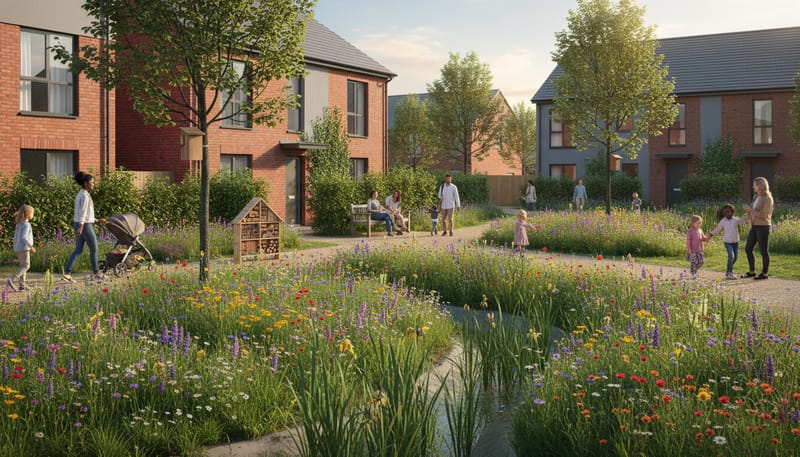
Why Biodiversity Matters in New Build Developments
Biodiversity — the variety of plant and animal life in a given area — has become one of the most important considerations in UK new build development. Since February 2024, all major developments in England are legally required to deliver a minimum 10% Biodiversity Net Gain (BNG) under the Environment Act 2021. This means that every new housing development must leave the natural environment in a measurably better state than before construction began.
For new build homeowners, this legislation has a direct and positive impact. It means the development you buy into will feature more green spaces, more wildlife-friendly landscaping, and better-designed outdoor areas than developments built even five years ago. From wildflower meadows and native hedgerows to hedgehog highways and bird boxes, the biodiversity features integrated into modern new build estates enhance both the natural environment and your quality of life.
This guide explains how biodiversity requirements affect new build developments, what features to look for when choosing a home, and how you can enhance biodiversity in your own garden after moving in. Whether you are buying your first new build home or upgrading to a larger property, understanding the landscaping and ecological credentials of a development is increasingly important for both environmental and resale value reasons.
Biodiversity Net Gain: The 10% Requirement
Biodiversity Net Gain (BNG) is a planning condition that requires developers to demonstrate that their development will result in a net increase in biodiversity value compared to the pre-development baseline. The minimum requirement is a 10% net gain, measured using the statutory biodiversity metric (currently Metric 4.0, developed by Natural England).
How BNG Works in Practice
The BNG process follows a structured approach:
- Baseline assessment: Before development begins, an ecologist surveys the site and calculates its existing biodiversity value using the metric. This considers the type, quality, and extent of habitats present (grassland, hedgerows, woodland, water features, etc.).
- Impact assessment: The ecologist calculates the biodiversity value that will be lost during construction — the habitat that will be removed or degraded.
- Mitigation and enhancement plan: The developer produces a plan showing how they will deliver a 10% or greater net gain, through a combination of on-site habitat creation, on-site habitat enhancement, and (if necessary) off-site habitat creation or purchase of biodiversity credits.
- 30-year management plan: Crucially, the developer must demonstrate that the biodiversity gains will be maintained for at least 30 years. This typically involves a habitat management and monitoring plan secured through a planning condition or legal agreement.
What This Means for Homebuyers
For buyers of new build homes, BNG means your development should feature:
- More native planting and less ornamental landscaping
- Retained and enhanced existing trees and hedgerows where possible
- New habitat features such as ponds, wildflower areas, and wildlife corridors
- Long-term management of communal green spaces (typically through a management company funded by a service charge)
- Better integration with the surrounding natural environment
It is worth noting that BNG applies to the development as a whole, not to individual plots. The communal areas, landscaping buffers, and open spaces are where most of the biodiversity gains are delivered. Your private garden is not typically included in the BNG calculation, but it represents an excellent opportunity to add further biodiversity value.
Developer Landscaping Schemes and Green Infrastructure
Modern new build developments are incorporating increasingly sophisticated landscaping schemes that go well beyond the basic turf-and-fence approach of previous decades. Leading developers are working with landscape architects and ecologists to create green infrastructure that delivers multiple benefits: biodiversity, visual amenity, stormwater management, and community wellbeing.
Common Green Infrastructure Features
| Feature | Biodiversity Benefit | Additional Benefits | Typical Cost to Developer |
|---|---|---|---|
| Native hedgerow planting | Habitat for birds, mammals, and insects; wildlife corridors | Screening, boundary definition, wind protection | £15–£25 per linear metre |
| Wildflower meadow areas | Pollinator habitat (bees, butterflies); diverse plant community | Low maintenance, visual interest, SuDS function | £3–£8 per m² |
| Wetland or attenuation ponds | Aquatic habitat for amphibians, dragonflies, waterfowl | Flood risk management, SuDS, amenity value | £5,000–£50,000+ per feature |
| Native tree planting | Habitat for birds, insects; carbon sequestration | Shade, air quality, visual amenity, property value | £30–£100 per tree (planted and staked) |
| Green roofs (on garages or communal buildings) | Habitat for insects and birds; connecting corridors | Stormwater retention, thermal insulation, aesthetics | £60–£150 per m² |
| Hedgehog highways (fence gaps) | Essential connectivity for hedgehog populations | No cost barrier to residents; community engagement | £0–£5 per gap (13 x 13 cm) |
| Bird and bat boxes | Nesting habitat for declining species | Pest control (bats eat mosquitoes; birds eat slugs) | £20–£50 per box (integral types: £50–£100) |
| Swales and rain gardens | Wetland plant communities; amphibian habitat | Sustainable drainage (SuDS), flood prevention | £50–£150 per linear metre |
| Permeable paving | Reduces runoff; supports soil biodiversity | Flood prevention, groundwater recharge | £40–£80 per m² |
When visiting a show home or reviewing development plans, ask the sales team about the landscaping scheme and ecological features. Better developers will have detailed landscape masterplans and can explain how the green infrastructure has been designed to deliver biodiversity alongside amenity value.
Wildlife Corridors and Sustainable Drainage Systems (SuDS)
Two of the most significant ecological features in modern new build developments are wildlife corridors and Sustainable Drainage Systems (SuDS). Both serve dual purposes — ecological and practical — and are increasingly required by local planning authorities.
Wildlife Corridors
Wildlife corridors are connected strips of habitat that allow animals, insects, and plants to move between larger habitat areas. In a new build development, corridors typically take the form of:
- Linked hedgerow networks: Continuous hedgerows connecting the development to surrounding countryside, allowing mammals and birds to move safely between habitats.
- Green buffer strips: Landscape strips along development boundaries that maintain connectivity with existing woodland, hedgerows, or watercourses.
- Hedgehog highways: Small gaps (13 x 13 cm) cut into garden fences at ground level, allowing hedgehogs and other small mammals to move freely between gardens and communal spaces. This simple measure is now included as standard by many developers, including Barratt Homes and Taylor Wimpey.
- Street tree avenues: Lines of native trees along streets and paths that provide aerial corridors for birds and foraging routes for pollinators.
Sustainable Drainage Systems (SuDS)
Sustainable Drainage Systems manage rainwater runoff from roofs, roads, and hard surfaces in a way that mimics natural drainage. They are required in most new build developments and serve as some of the richest biodiversity features on site. SuDS elements include:
- Attenuation ponds: Permanent or seasonal water bodies that collect and slowly release stormwater. They develop into valuable wetland habitats for amphibians (frogs, newts), dragonflies, aquatic plants, and visiting water birds.
- Swales: Shallow, gently sloping channels planted with grasses and wildflowers that collect and convey runoff. They function as linear meadow habitats.
- Rain gardens: Planted depressions that collect runoff from roofs and paths, filtering it through soil before it enters the drainage system. They support diverse plant and insect communities.
- Permeable paving: Hard surfaces that allow water to infiltrate, supporting soil biology and reducing surface runoff. Used for driveways, parking areas, and pedestrian paths.
SuDS features are typically maintained by a management company, with costs shared among homeowners through a service charge. When buying a new build, it is important to understand what the service charge covers and how communal green spaces will be maintained long-term.
Planning Your New Build Garden for Biodiversity
While the communal areas of your development will deliver the formal BNG requirements, your private garden offers a wonderful opportunity to further enhance biodiversity. New build gardens are typically delivered as blank canvases — turfed and fenced but otherwise unplanted — giving you the freedom to create a wildlife-friendly space from scratch.
Native Planting Suggestions by Garden Size
| Garden Size | Recommended Trees | Hedge and Shrub Planting | Ground Cover and Flowers | Wildlife Features |
|---|---|---|---|---|
| Small (up to 30 m²) | 1 small native tree (crab apple, rowan, or field maple) | Mixed native hedge along one boundary (hawthorn, blackthorn, dog rose) | Wildflower border; herbs (lavender, thyme, rosemary) for pollinators | Bird feeder; insect hotel; hedgehog gap in fence; small water dish |
| Medium (30–80 m²) | 1–2 native trees (birch, hazel, wild cherry) | Mixed native hedge along 2 boundaries; evergreen screening (holly, yew) | Wildflower meadow patch (2–4 m²); pollinator border; native climber (honeysuckle, clematis) | Bird box; bat box; log pile; small wildlife pond (preformed or liner) |
| Large (80–200 m²) | 2–4 native trees (oak, birch, hazel, rowan) | Mixed native hedge along 2–3 boundaries; fruit trees (apple, pear, plum) | Wildflower meadow (10–20 m²); herbaceous perennial border; ground cover (ivy, wild strawberry) | Multiple bird boxes; bat box; hedgehog house; wildlife pond; log pile; compost area |
| Very Large (200+ m²) | 4–8 native trees including larger species (oak, beech, lime) | Extensive native hedging; woodland edge planting; fruit orchard area | Large wildflower meadow; native woodland understorey; pond margin planting | Owl box; multiple nesting boxes; dedicated wildlife area with minimal human disturbance; bee hives (with training) |
Wildlife-Friendly Garden Elements and Costs
| Element | Typical Cost | Difficulty to Install | Key Wildlife Benefit |
|---|---|---|---|
| Native mixed hedge (per 3m) | £20–£40 (bare root plants) | Easy (plant in winter) | Nesting birds, shelter for hedgehogs, berries for thrushes |
| Bird nesting box (wooden) | £10–£25 | Very easy | Nesting habitat for tits, robins, sparrows, starlings |
| Bat box | £15–£35 | Easy (mount on tree or wall) | Roosting habitat for pipistrelle and brown long-eared bats |
| Hedgehog house | £20–£50 | Very easy | Hibernation and nesting habitat for declining hedgehog population |
| Insect hotel | £10–£30 (or free if DIY) | Very easy | Nesting habitat for solitary bees, lacewings, ladybirds |
| Wildlife pond (preformed, 1m²) | £50–£150 | Moderate | Habitat for frogs, newts, dragonflies, water insects |
| Log pile (stacked logs and branches) | Free (use garden waste or donated logs) | Very easy | Habitat for beetles, fungi, amphibians, small mammals |
| Wildflower seed mix (per 10 m²) | £5–£15 | Easy (sow on bare soil) | Food source for pollinators; habitat for butterflies and moths |
| Compost bin | £20–£50 | Very easy | Habitat for invertebrates; attracts slow worms; enriches soil biology |
| Native climbing plant (honeysuckle or clematis) | £8–£15 per plant | Easy | Nectar for moths and butterflies; nesting cover for birds |
Top Tips for Wildlife-Friendly Gardening in a New Build
- Avoid paving over your entire garden: New build gardens are often small, but resist the temptation to pave or artificial-turf the whole space. Even a small border of native planting makes a significant difference for pollinators and insects.
- Choose native species: Native plants support far more wildlife than non-native ornamentals. Hawthorn, blackthorn, and dog rose hedges support over 200 insect species each, while exotic alternatives support far fewer.
- Create layers: The most biodiverse gardens have multiple layers of vegetation: trees, shrubs, herbaceous plants, and ground cover. Each layer provides different habitat niches.
- Leave some areas wild: A patch of uncut grass, a pile of leaves, or a stack of logs may look untidy but provides essential habitat for hedgehogs, beetles, amphibians, and fungi.
- Avoid pesticides: Chemical pesticides kill beneficial insects alongside pests. Encourage natural pest control by attracting birds (slug eaters), ladybirds (aphid eaters), and hedgehogs (slug and snail eaters).
- Provide water: A wildlife pond is the single most effective thing you can add to your garden for biodiversity. Even a shallow dish of water helps birds, hedgehogs, and insects during dry periods.
- Plant for all seasons: Choose plants that flower at different times of year to provide a continuous food source for pollinators from early spring (snowdrops, crocuses) through to late autumn (ivy, sedum).
Community Green Spaces and Maintenance
Most modern new build developments include communal green spaces — parks, play areas, wildlife areas, and landscaped buffers — that are shared by all residents. These spaces are a significant part of what makes a new build development attractive, and their quality and maintenance directly affect property values and resident satisfaction.
Types of Communal Green Space
- Public open space: Parks, play areas, and amenity grassland that are typically adopted by the local authority and maintained using council tax revenue. These are free for all to use and maintained to a standard set by the council.
- Private communal space: Landscaped areas, wildlife habitats, and SuDS features maintained by a private management company, funded by a service charge paid by residents. Quality depends on the management company and the terms of the management plan.
- Allotment or community growing areas: Some developments include shared growing spaces where residents can cultivate vegetables, herbs, and flowers. These build community connections and provide additional biodiversity.
Understanding Your Service Charge
If your development has private communal green spaces (as most modern developments do), you will pay a service charge towards their maintenance. Typical annual service charges for landscape and ecology maintenance range from £150 to £500 per household, depending on the extent and complexity of the green infrastructure.
When buying your new build, review the management company details, the service charge breakdown, and the landscape management plan. Key questions to ask include:
- Who is the management company and what is their track record?
- What does the service charge cover (landscaping, SuDS maintenance, ecology management)?
- Is there a sinking fund for major works (tree replacement, pond restoration)?
- How often will communal areas be maintained (mowing, pruning, litter picking)?
- Is the 30-year habitat management plan (required under BNG) available for review?
How to Enhance Biodiversity in Your Development
Beyond your own garden, there are several ways to promote biodiversity across your wider new build development, working with neighbours and the management company to create a genuinely wildlife-rich community.
Community-Level Actions
- Hedgehog highway campaign: Coordinate with neighbours to ensure hedgehog gaps are maintained in all connecting fences. The British Hedgehog Preservation Society provides free signs and guidance. Hedgehog populations have declined by 50% since 2000, and connected gardens can provide vital habitat.
- Community wildflower planting: Work with your management company to convert areas of amenity grassland (regularly mown grass) to wildflower meadow. This reduces maintenance costs and dramatically increases biodiversity.
- Swift nest box installation: Swifts are a declining species that nest in buildings. Installing swift boxes on the gable ends of houses provides nesting habitat and can be coordinated as a community project.
- No-mow May and beyond: Encourage the management company to adopt reduced mowing regimes in appropriate areas, allowing wildflowers to establish and pollinators to thrive.
- Tree planting initiatives: Work with the management company or local authority to plant additional native trees in communal areas. Organisations like the Woodland Trust provide free trees for community planting projects.
- Resident wildlife recording: Start a community wildlife recording scheme using apps like iNaturalist or iRecord. Documenting the wildlife on your development raises awareness and can provide valuable data for the site’s biodiversity monitoring plan.
What to Ask Your Developer About Biodiversity
When choosing a new build home, consider asking these questions about the development’s ecological credentials:
- What is the Biodiversity Net Gain percentage for this development? (Minimum 10%, but some achieve 20%+ voluntarily.)
- What native species have been planted in the communal landscaping?
- Are hedgehog highways included in all garden fences?
- Are integral bird and bat boxes built into the homes?
- What SuDS features are included, and how are they maintained?
- Is there a 30-year habitat management plan, and who is responsible for delivering it?
- Are any existing trees, hedgerows, or habitats being retained?
Frequently Asked Questions
What is Biodiversity Net Gain and does it apply to all new builds?
Biodiversity Net Gain (BNG) is a legal requirement under the Environment Act 2021 that requires all major developments in England (10+ homes) to deliver a minimum 10% increase in biodiversity compared to the pre-development baseline. The requirement came into force in February 2024 for major developments and April 2024 for smaller developments. It means your new build estate must feature more and better quality habitat than existed on the site before construction.
Will my garden be included in the biodiversity requirements?
No. Private gardens are not typically included in the BNG calculation for a development. The biodiversity gains are delivered through communal landscaping, green infrastructure, and (where needed) off-site habitat creation. However, your garden represents an excellent opportunity to add further biodiversity value beyond the development’s formal requirements.
How can I attract hedgehogs to my new build garden?
Hedgehogs need three things: access, food, and shelter. Ensure there are 13 x 13 cm gaps in your garden fences (hedgehog highways) connecting to neighbouring gardens and communal areas. Provide a hedgehog house in a quiet corner, leave areas of leaf litter and log piles for foraging, and put out fresh water (never milk). Avoid using slug pellets, which can poison hedgehogs. If your new build has connected hedgehog highways, hedgehogs may colonise within the first year of occupation.
Do I have to pay for communal green space maintenance?
In most modern new build developments, communal green spaces are maintained by a private management company funded by a service charge paid by homeowners. This charge typically covers grass cutting, hedge trimming, tree maintenance, SuDS management, and ecological monitoring. Charges vary but typically range from £150 to £500 per household per year. Some public open spaces may be adopted by the local authority and maintained through council tax instead.
What are the best plants for wildlife in a new build garden?
Focus on native species that provide food and habitat for UK wildlife. Top choices include: hawthorn and blackthorn for hedging (berries for birds, flowers for pollinators); lavender, buddleia, and sedum for pollinators; honeysuckle and clematis for climbing cover; native wildflower mixes for meadow areas; and ivy as a late-season nectar source for bees and butterflies. A mix of species flowering at different times ensures year-round food availability.
Creating a Wildlife-Rich Home and Community
Biodiversity is no longer an afterthought in UK new build development — it is a legal requirement and, increasingly, a selling point. The mandatory 10% Biodiversity Net Gain ensures that every new development contributes positively to the natural environment, while thoughtful landscaping and green infrastructure create attractive, healthy places to live.
When choosing a new build home, look beyond the kitchen fittings and bathroom tiles to the landscaping scheme, wildlife features, and ecological credentials of the development. Ask about hedgehog highways, native planting, SuDS features, and the long-term management plan for communal green spaces. These features enhance your quality of life, support declining wildlife species, and can positively affect your property’s resale value.
Once you have moved in, your garden — however small — is an opportunity to make a real difference. A wildlife pond, some native hedge planting, a few bird boxes, and a commitment to pesticide-free gardening can transform even a modest new build plot into a haven for birds, bees, butterflies, and hedgehogs.
For more on the sustainability credentials of new build homes, explore our guides to sustainable building materials, carbon footprints, water efficiency, and rainwater harvesting. Together with strong biodiversity and landscaping, these features define what it means to live in a truly sustainable new build community.