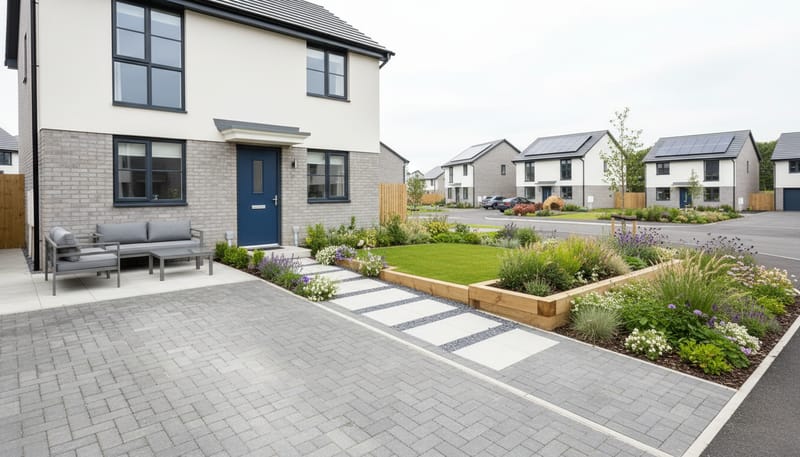
Why Parking and Outdoor Space Matter in New Build Homes
After the home itself, the parking and outdoor space that come with a new build property are among the most important factors influencing your daily quality of life. Whether you need to park two cars, charge an electric vehicle, or simply want a garden where your children can play, understanding what is provided — and what is not — is essential before you reserve a plot.
New build developments in the UK have come under scrutiny in recent years for reduced garden sizes and limited parking provision. Higher housing densities, driven by planning policy and land costs, mean that outdoor space and parking allocations on modern developments are often smaller than buyers expect, particularly when compared to properties built in the 1960s, 70s, or 80s.
This guide covers everything you need to know about parking provision, garage sizes, EV charging, garden dimensions, balconies, shared green spaces, and the legal frameworks that govern them. By understanding these factors before you buy, you can make an informed decision about whether a development meets your needs — and avoid unpleasant surprises after moving in.
Allocated Parking: What to Expect
Parking provision on new build developments varies significantly depending on the location, property type, and local planning authority requirements. Understanding how parking is allocated and what your options are is crucial for day-to-day convenience.
Types of Parking on New Build Developments
- On-plot parking (driveway): A dedicated driveway in front of or beside your home. This is the most convenient type and is common for houses. Driveways typically accommodate one or two cars depending on width.
- Integral garage: A garage built into the structure of the house, usually at ground level. This provides secure, covered parking and additional storage space.
- Detached garage: A separate garage building on your plot. Less common on modern high-density developments but still found on larger detached and executive homes.
- Allocated parking bay: A marked bay in a communal parking area assigned to your property. Common for apartments and terraced houses. Usually identified by plot number.
- Underground or undercroft parking: Covered parking beneath apartment buildings. Offers security and weather protection but spaces can be tight for larger vehicles.
- On-street parking: Some developments rely on on-street parking within the estate roads. This is less convenient and can lead to disputes between neighbours.
Parking Allocation by Property Type
| Property Type | Typical Allocation | Common Setup | Visitor Parking |
|---|---|---|---|
| 1-bed apartment | 1 space | Allocated bay or underground | Shared communal spaces |
| 2-bed apartment | 1 space | Allocated bay or underground | Shared communal spaces |
| 2-bed terraced house | 1–2 spaces | Single driveway or allocated bay + on-street | Limited on-street |
| 3-bed semi-detached | 2 spaces | Driveway for 2 cars or driveway + garage | On-street or shared bays |
| 3-bed detached | 2 spaces | Double driveway or driveway + single garage | On-street |
| 4-bed detached | 2–3 spaces | Double driveway + garage or triple driveway | On-street or own driveway |
| 5-bed executive | 3+ spaces | Double garage + driveway for 2+ | Own driveway capacity |
Visitor Parking
Visitor parking is one of the most common sources of frustration on new build developments. Many developments provide insufficient visitor spaces for the number of homes, leading to congestion, blocked driveways, and neighbour disputes. Before reserving, check:
- How many visitor spaces are provided across the development?
- What is the ratio of visitor spaces to homes? (A ratio of at least 0.2 spaces per home is considered reasonable)
- Are there parking restrictions or permit schemes on the estate roads?
- Can visitors park on your driveway or allocated space if you have room?
Garage Sizes and Dimensions
If your new build comes with a garage, it is essential to check the internal dimensions. Many modern garages are designed to minimum standards that may not comfortably accommodate larger vehicles, especially SUVs and family cars, while also leaving room for storage.
UK Garage Dimension Standards
| Garage Type | Minimum Internal Width | Minimum Internal Length | Usable for Parking? |
|---|---|---|---|
| Single garage (minimum) | 2.4m (7’10”) | 4.8m (15’9”) | Very tight — compact cars only, no storage room |
| Single garage (recommended) | 3.0m (9’10”) | 6.0m (19’8”) | Yes — fits most cars with some storage space |
| Double garage (minimum) | 5.0m (16’5”) | 5.0m (16’5”) | Tight for 2 cars — limited door-opening room |
| Double garage (recommended) | 6.0m (19’8”) | 6.0m (19’8”) | Yes — comfortable for 2 cars with storage |
The key issue with garages on new build developments is that many are built to the minimum standard of 2.4m × 4.8m. While this technically qualifies as a garage for planning purposes, it is too small to comfortably park a modern family car (which averages 1.8m wide and 4.5m long) while still being able to open the doors. As a result, many homeowners end up using their garage for storage rather than parking.
Garage Considerations
- Measure your car: Before relying on a garage for parking, compare your car’s dimensions against the garage’s internal measurements. Allow at least 30cm on each side for door opening.
- Garage door type: Up-and-over, roller, or sectional doors affect how much headroom and depth you lose. Sectional doors take up the least internal space.
- Power supply: Check whether the garage has a power supply for lighting, tools, and EV charging. Many new builds include this as standard.
- Insulation: Integral garages are typically insulated to prevent heat loss from the house above. Detached garages may not be insulated.
- Conversion potential: Some buyers plan to convert their garage into a home office or utility room. Check the restrictive covenants in your deeds — many new build developments prohibit garage conversions to maintain parking provision.
EV Charging Provision in New Builds
Since June 2022, all new homes in England with associated parking must have an electric vehicle (EV) charge point installed. This is a requirement of the Building Regulations (Part S), and it applies to both houses with driveways and apartments with allocated parking spaces.
What the Regulations Require
Part S of the Building Regulations requires:
- A minimum 7kW charge point for each new home with an associated parking space
- The charge point must be a Mode 3 (smart charger) capable of being remotely controlled and of receiving and reacting to signals
- For apartments, each space that is not fitted with a charge point must have cable routing (ducting and cabling) to allow easy future installation
- The charge point must be located within easy reach of the associated parking space
What to Check About Your EV Charge Point
- Charger brand and type: Ask the developer which charger brand and model is being installed. Premium brands such as Pod Point, Andersen, or Ohme offer better smart features and reliability.
- Power output: The minimum is 7kW (single-phase), which adds approximately 30 miles of range per hour of charging. Some developments offer 22kW (three-phase) charging for faster top-ups.
- Location: Check where the charge point is positioned relative to your parking space. Ideally, it should be on the wall closest to where you park, with a cable long enough to reach your car’s charging port.
- Smart features: Modern smart chargers can schedule charging for off-peak electricity rates, integrate with home energy management systems, and track usage for business mileage claims.
- Solar integration: If your home has solar panels, check whether the EV charger can be configured to use excess solar generation, reducing charging costs to near zero during daylight hours.
EV Charging Costs: Home vs Public
As the comparison shows, charging at home on an off-peak tariff is approximately nine times cheaper than using public rapid chargers. Having a dedicated EV charge point at your new build home is therefore a significant financial advantage and one of the strongest arguments for choosing a property with on-plot parking.
Garden Sizes on Modern New Build Developments
Garden sizes on new build developments are a frequent topic of discussion among buyers and homeowners alike. While some buyers are pleasantly surprised by the outdoor space provided, others find that new build gardens are smaller than expected, particularly compared to properties built in previous decades.
What Determines Garden Size
The size of your garden is determined by several factors:
- Plot density: Planning policies and land economics push developers towards higher densities, which typically results in smaller individual gardens.
- Property type: Detached houses generally have the largest gardens, while terraced houses and apartments have the smallest (or no) private outdoor space.
- Development location: Urban and suburban developments tend to have smaller gardens than rural ones, reflecting higher land values and planning constraints.
- Local planning requirements: Some councils specify minimum garden sizes in their planning policies, while others leave it to the developer’s discretion.
- Site layout: The position of your plot on the development affects garden size and shape. Corner plots often have larger or more irregularly shaped gardens.
Typical Garden Sizes by Property Type
| Property Type | Typical Rear Garden Size | Front Garden | Total Outdoor Space |
|---|---|---|---|
| 1-bed apartment | None (may have balcony) | None | Balcony: 3–8m² |
| 2-bed apartment | None or small patio (ground floor) | None | Balcony: 5–10m² or patio: 10–20m² |
| 2-bed terraced house | 25–40m² | Small or none | 25–45m² |
| 3-bed semi-detached | 40–70m² | Small front garden | 50–85m² |
| 3-bed detached | 50–90m² | Front garden with driveway | 65–110m² |
| 4-bed detached | 70–120m² | Front garden with driveway | 90–150m² |
| 5-bed executive | 100–200m²+ | Landscaped front garden | 130–250m²+ |
For context, the average garden size of homes built in the 1970s is approximately 168m², compared to around 48m² for homes built in the 2020s. While this represents a significant reduction, modern new build gardens are typically more usable — level, turfed, and fenced — and the trade-off often includes better communal green spaces, play areas, and landscaping across the development.
What Developers Typically Provide
Most new build developers provide the garden in a basic but functional state. Standard provision usually includes:
- Turf to the rear garden (some developers provide topsoil and seed instead — check the specification)
- Close-board fencing (1.8m height to sides and rear is typical, though some provide 1.5m)
- Patio area: Many developers include a small paved patio adjacent to the rear of the house, but not all
- External tap: Useful for garden watering and car washing
- External power socket: Increasingly common, especially where EV charging is provided
For more guidance on setting up your new build garden, see our garden setup guide.
Planning Requirements, Adoptable Roads, and Parking Covenants
The legal and planning framework around parking and outdoor space on new build developments is more complex than many buyers realise. Understanding these aspects before you buy will help you avoid restrictions and costs that come as a surprise.
Planning Requirements for Parking
Local planning authorities set parking standards that developers must meet. These standards vary significantly across the country:
- Maximum parking standards: Some urban councils (particularly in London) set maximum rather than minimum parking standards, limiting the number of spaces a developer can provide. This is intended to reduce car dependency and encourage public transport use.
- Minimum parking standards: Many suburban and rural councils set minimum parking requirements based on property size and bedroom count. A typical standard might be 1.5 spaces per 1–2 bed home and 2 spaces per 3+ bed home.
- Cycle storage: Planning policy increasingly requires secure cycle storage for new homes. For apartments, this may be communal storage rooms. For houses, a shed or garage may satisfy the requirement.
Adoptable Roads vs Private Roads
The roads within a new build development may be either adopted (maintained by the council at public expense) or private (maintained by the management company at residents’ expense). This has significant implications:
| Feature | Adopted Road | Private Road |
|---|---|---|
| Maintenance responsibility | Local council (public funds) | Management company (residents’ service charges) |
| Parking enforcement | Council or police | Management company (limited powers) |
| Street lighting | Council maintained | Residents fund through service charges |
| Gritting and snow clearance | Council responsibility | Residents’ responsibility |
| Pothole repairs | Council responsibility | Funded through service charges |
| Annual cost to residents | Included in council tax | Additional service charge (£100–£400/year) |
Ask the developer whether the estate roads will be adopted by the council upon completion or remain private. Adoption typically happens through a Section 38 agreement (Highways Act 1980), but the process can take several years after the development is finished.
Parking Covenants and Restrictions
New build properties often come with restrictive covenants relating to parking and vehicles. Common restrictions include:
- No commercial vehicles: Vans, lorries, or vehicles with commercial signage may not be permitted to park on the development
- No caravans or motorhomes: Parking of caravans, motorhomes, or trailers on driveways or within the development may be prohibited
- No garage conversions: Converting a garage to a habitable room may be restricted to maintain parking provision
- No front garden parking: Some developments prohibit creating additional hardstanding by paving over front gardens
- Vehicle height restrictions: Underground car parks may have height limits that exclude larger SUVs or vans
These covenants are contained in the title deeds and are legally enforceable. Your conveyancing solicitor should draw them to your attention during the purchase process, but it is worth asking about them when you visit the sales office.
Frequently Asked Questions
Do all new build homes come with an EV charge point?
Since June 2022, all new homes in England with an associated parking space must have an EV charge point installed as a requirement of Building Regulations Part S. This applies to houses with driveways and apartments with allocated bays. If your home does not have an associated parking space (for example, a city-centre apartment with no parking allocation), an EV charge point is not required, but cable routing should be provided for future installation.
Can I extend my new build garden?
Generally, no. The boundaries of your plot are fixed in the title deeds, and you cannot extend into communal land or neighbouring plots. However, you can maximise the usable space within your garden through landscaping, raised beds, and clever design. Check the restrictive covenants before building any structures such as sheds, greenhouses, or pergolas, as some developments have restrictions on outbuildings.
What size garage do I need to actually park a car in?
For comfortable parking with room to open doors and store some items, a garage should be at least 3.0m wide and 6.0m long internally. The minimum garage dimensions of 2.4m × 4.8m are too tight for most modern cars, especially SUVs and family vehicles. If the garage on your chosen plot is at the minimum size, plan to use it primarily for storage and park on the driveway instead.
Are new build garden sizes regulated?
There is no national minimum garden size for new build homes in England. However, the Nationally Described Space Standard (NDSS) sets minimum internal floor areas, and many local authorities have their own policies on minimum garden sizes or require private amenity space proportionate to the size of the home. The National Design Guide also recommends adequate private outdoor space. Check your local council’s planning policies for specific requirements.
What happens if visitor parking is insufficient on my development?
Insufficient visitor parking is a common complaint on new build developments. If parking becomes a serious issue, residents can petition the management company to introduce a parking management scheme, or the local council may implement parking restrictions on adopted roads. Before buying, check the visitor parking ratio and speak to residents on completed phases (if available) about their parking experience. Reviewing the site plan carefully can also help you understand the overall parking layout.
Make an Informed Decision on Parking and Outdoor Space
Parking and outdoor space are among the most practical everyday considerations when buying a new build home. By understanding what is provided, measuring garage dimensions, checking EV charging provision, and reviewing garden sizes against your needs, you can make a confident decision that supports your lifestyle.
Key takeaways to remember: always verify the exact parking allocation for your specific plot, not the general marketing material; check garage dimensions against your car’s size before relying on it for parking; confirm that your EV charge point is the right specification for your vehicle; and review the restrictive covenants for any restrictions on how you can use your parking and outdoor spaces.
For more guidance on choosing the right new build property, explore our guides to choosing the right plot, understanding specifications, and the step-by-step buying process. And for a complete overview of what to check before committing, see our pre-reservation checklist.