Understanding the Critical Difference Between Leasehold and Freehold
If you are buying a new build home in the UK, understanding the difference between leasehold and freehold tenure is absolutely essential. This single factor affects your rights as a homeowner, the ongoing costs you will pay, and your ability to sell the property in the future. Getting it wrong can cost thousands of pounds over the lifetime of your ownership.
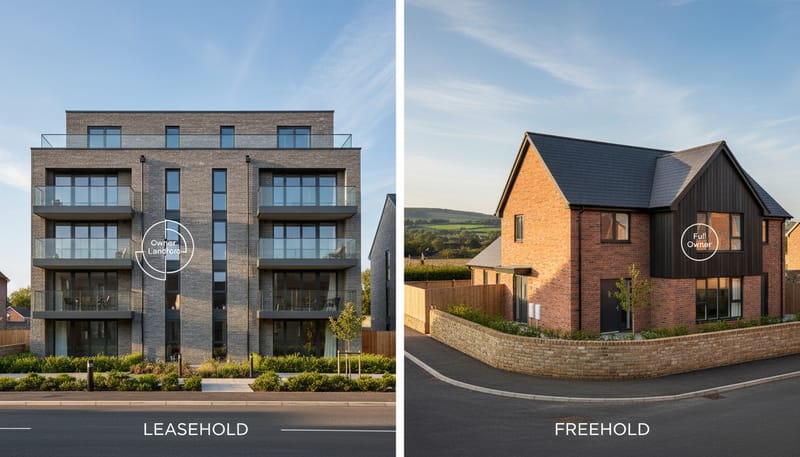
In simple terms, freehold means you own the property and the land it sits on outright, with no time limit. Leasehold means you own the right to live in the property for a fixed period (the “lease term”), but the land belongs to someone else — the “freeholder” or “landlord.” In most cases, the freeholder is a separate company, often retained by or associated with the developer.
This guide explains the full implications of each tenure type, the history of the leasehold ground rent scandal, the protections introduced by the Leasehold Reform Act, and the practical steps you should take when buying a new build to ensure you understand exactly what you are purchasing.
Leasehold vs Freehold: A Detailed Comparison
The differences between leasehold and freehold ownership go far beyond the initial concept of owning land versus renting it. The practical implications affect your day-to-day life, your finances, and your long-term property investment. Below is a comprehensive comparison:
| Factor | Freehold | Leasehold |
|---|---|---|
| Ownership | You own the property and land permanently | You own the right to occupy for a fixed period (e.g., 125–999 years) |
| Ground rent | None | Annual charge payable to the freeholder (banned on new leases from 2022) |
| Service charges | None (unless on a managed estate) | Annual charge for maintenance of communal areas, buildings insurance, and management |
| Estate charges | May apply on managed estates (separate from service charges) | May also apply if the development has shared amenities |
| Permission for alterations | Generally free to alter your property (subject to planning and building regulations) | Often need written consent from the freeholder, which may come with a fee |
| Permission for pets | No restrictions from a freeholder | Some leases restrict pet ownership; permission may be required |
| Subletting | Free to let your property | May require freeholder consent; some leases prohibit subletting |
| Selling | Straightforward process | Freeholder must be notified; may require compliance certificate; longer leases sell more easily |
| Lease length impact | N/A — no lease | Below 80 years, mortgage availability decreases and enfranchisement costs increase significantly |
| Typical property types | Houses, bungalows, some townhouses | Flats, apartments, some new build houses (historically) |
The table clearly illustrates why freehold is generally considered the superior form of ownership. For houses, bungalows, and other ground-level properties, freehold should always be the expectation. For flats and apartments, leasehold is the standard tenure because the structure of the building is shared between multiple owners, making freehold ownership of individual units impractical in most cases.
The Ground Rent Scandal: What Happened and Why It Matters
Between approximately 2005 and 2019, a practice emerged among some developers and freehold investment companies of selling new build houses on leasehold terms rather than freehold — a practice that was virtually unprecedented in England and Wales. These leases often included ground rent clauses that would double every 10 or 15 years, potentially making the homes unmortgageable and unsellable in the long term.
How the Scandal Unfolded
The typical pattern involved a developer selling a new build house on a 150-year or 250-year lease with an initial ground rent of £250–£400 per year. The lease would include a clause allowing the ground rent to double every 10 years. Under this structure, a £300 annual ground rent would increase as follows:
- Year 1: £300 per year
- Year 10: £600 per year
- Year 20: £1,200 per year
- Year 30: £2,400 per year
- Year 50: £9,600 per year
At these levels, the ground rent would exceed the cost of renting the entire property, and many mortgage lenders refused to lend on properties with such escalating clauses. Thousands of homeowners found their properties effectively unsellable.
Industry Response
The scandal prompted significant industry and legislative action. Major developers, including Taylor Wimpey and Countryside, voluntarily agreed to convert doubling ground rent clauses to RPI-linked increases for affected homeowners. Taylor Wimpey set aside £130 million to fund this process for their customers. Other developers followed with similar remediation programmes.
It is important to note that many responsible developers never engaged in these practices and have always sold houses as freehold. The scandal primarily involved a minority of companies operating during a specific period, and the industry has since reformed to prevent any recurrence.
The Leasehold Reform Act and Your Protections
The Leasehold Reform (Ground Rent) Act 2022 was a landmark piece of legislation that fundamentally changed the leasehold landscape in England and Wales. The Act, which came into force on 30 June 2022, provides the following key protections for buyers of new leasehold properties:
Key Provisions of the 2022 Act
- Ground rent capped at a peppercorn: All new residential leases granted after 30 June 2022 must have a ground rent of zero (described legally as a “peppercorn” rent). This applies to new build flats and any new leases created on existing properties.
- No premium for zero ground rent: Freeholders cannot charge a premium or increase the purchase price to compensate for the loss of ground rent income.
- Trading Standards enforcement: Freeholders who breach the Act by charging prohibited ground rent face enforcement action by Trading Standards and potential financial penalties.
- Applies to all new residential leases: Whether you are buying a new build flat, extending an existing lease, or purchasing a shared ownership property, the ground rent must be zero on any new lease.
Further Reforms
The UK Government has signalled further leasehold reforms through the Leasehold and Freehold Reform Act 2024, which aims to:
- Make lease extensions easier and cheaper: By standardising the process and removing the “marriage value” calculation that inflated costs for leases with fewer than 80 years remaining.
- Give leaseholders more control: By making it simpler and cheaper for leaseholders to take over management of their building or purchase the freehold collectively.
- Increase transparency: By requiring more detailed service charge breakdowns, regulated property management qualifications, and improved access to information about the terms of leases.
- Ban leasehold for new houses: Subject to certain limited exceptions, new houses in England and Wales will be required to be sold on a freehold basis.
These reforms represent a significant shift towards protecting leaseholders and are particularly relevant for anyone buying a new build flat or apartment where leasehold tenure is standard.
What to Check in Your New Build Contract
Whether you are buying a leasehold flat or confirming that your new build house is freehold, your purchase contract and lease (if applicable) require careful scrutiny. Below are the key items your solicitor should review and explain to you.
Critical Contract Checks for New Build Purchases
| Item to Check | Freehold | Leasehold |
|---|---|---|
| Tenure type confirmation | Title register should show “Freehold” | Title register shows “Leasehold” with lease details |
| Ground rent | N/A | Must be zero for new leases after 30 June 2022; check for any hidden charges |
| Service charges | Check for estate management charges | Review current charges and how they are calculated; ask for 3 years of accounts |
| Lease length | N/A | Should be 125 years minimum; ideally 250+ years for new builds |
| Restrictions on use | Check restrictive covenants in transfer deed | Review lease clauses on alterations, pets, subletting, business use |
| Estate charges | May apply if communal areas are maintained by a management company | May be in addition to service charges; understand what each covers |
| Insurance arrangements | You arrange your own buildings insurance | Usually arranged by freeholder; check the policy is adequate and competitively priced |
| Sinking fund | Rarely applicable | A reserve fund for major works; check the current balance and contribution levels |
| Management company details | If applicable, check who manages communal areas | Confirm the managing agent, their fees, and whether leaseholders can change them |
Your conveyancing solicitor should provide a detailed report on all these items before you exchange contracts. If anything is unclear or concerning, ask your solicitor to explain it in plain language and, if necessary, negotiate changes with the developer before proceeding.
Estate Charges vs Service Charges: Understanding Ongoing Costs
One area that catches many new build buyers off guard is the difference between estate charges and service charges, and the fact that both can apply regardless of whether your property is freehold or leasehold.
Service Charges (Leasehold Properties)
Service charges are payments made by leaseholders to the freeholder or managing agent for the maintenance and management of the building and any communal areas within it. For new build flats, this typically covers:
- Building insurance: The freeholder arranges insurance for the whole building; the cost is shared among leaseholders.
- Communal area maintenance: Cleaning, lighting, and repair of hallways, stairwells, lifts, and corridors.
- Grounds maintenance: Upkeep of shared gardens, lawns, and landscaping around the building.
- Management fees: The cost of the managing agent who administers the building.
- Sinking fund contribution: A reserve fund for major future works such as roof replacement, external decoration, or lift replacement.
Typical service charges for a new build flat in England range from £1,200 to £3,500 per year, though this can be higher for developments with extensive communal facilities such as concierge services, gyms, or underground parking.
Estate Charges (Freehold and Leasehold Properties)
Estate charges are a separate cost that applies to properties on managed estates — and this includes many freehold new build houses. When a developer creates a new housing estate, they often establish a management company to maintain the communal roads, footpaths, green spaces, play areas, and drainage infrastructure that are not adopted by the local authority.
As a homeowner on such an estate, you are required to contribute to the upkeep of these communal areas through an annual estate charge, regardless of whether your property is freehold or leasehold. Typical estate charges range from £150 to £800 per year for houses, depending on the extent of communal facilities and the quality of maintenance provided.
The Key Difference
Service charges relate to the building itself (relevant for flats), while estate charges relate to the wider development infrastructure (relevant for houses and flats on managed estates). It is possible for a new build apartment buyer to pay both service charges and estate charges, so always ask the developer to confirm the full breakdown of ongoing costs before reserving. Your solicitor should verify these charges as part of the buying process.
How to Check If a New Build Is Freehold
Given the historical issues with leasehold houses, it is essential to confirm the tenure of any new build property you are considering. Here are the steps to verify what you are buying:
Before Reserving
- Ask the sales advisor directly: “Is this property freehold or leasehold?” The answer should be clear and unambiguous. If the sales advisor is uncertain or evasive, treat this as a warning sign.
- Check the price list: Many developers include the tenure type on their price list or property particulars. Look for “Freehold” or “Leasehold” next to each house type.
- Review the reservation form: The tenure should be stated on the reservation agreement. Read it carefully before signing.
- Ask about estate charges: Even if the property is freehold, ask whether there are any estate management charges for communal areas. Get a written estimate of the annual cost.
During the Legal Process
- Your solicitor’s title check: Your conveyancing solicitor will review the title documents and confirm the tenure. For freehold properties, the Land Registry title will clearly state “Freehold.”
- Transfer deed review: Even for freehold purchases, the transfer deed may contain restrictive covenants — rules about what you can and cannot do with the property. Your solicitor should explain every covenant.
- Management company details: If the freehold comes with estate charges, your solicitor should review the management company articles and confirm your obligations.
For additional pre-reservation checks, consult our comprehensive checklist that covers tenure and many other essential items to verify before committing.
Frequently Asked Questions
Should I avoid buying a leasehold new build flat?
Not necessarily. For flats and apartments, leasehold is the standard and accepted form of tenure because the building is shared between multiple owners. The key is to ensure the lease terms are fair: ground rent must be zero for new leases, the lease should be at least 125 years (ideally 250+), service charges should be reasonable and transparent, and the management company should be competent and accountable. Your solicitor can advise on whether the specific lease terms are acceptable.
Can I convert a leasehold property to freehold?
For houses, you have a statutory right to purchase the freehold from the freeholder under the Leasehold Reform Act 1967 (as amended). The process is called “enfranchisement.” For flats, groups of leaseholders can collectively purchase the freehold of the building under the Leasehold Reform, Housing and Urban Development Act 1993. The cost depends on the remaining lease length, the ground rent, and the value of the property. The Leasehold and Freehold Reform Act 2024 aims to simplify and reduce the cost of both processes.
Are ground rents still charged on new build properties?
No. Since 30 June 2022, all new residential leases in England and Wales must have a ground rent of zero (peppercorn). If you are buying a new build flat, you should not be paying any ground rent. If a developer or sales advisor suggests otherwise, seek legal advice immediately. For properties sold before this date with existing ground rent clauses, the rent continues to apply under the original lease terms, though the government has signalled further reforms to address historic ground rents.
What is the difference between a restrictive covenant and a lease clause?
A restrictive covenant is a condition attached to freehold land (recorded on the title deed) that limits what you can do with the property, such as prohibiting business use or requiring approval for extensions. A lease clause is a term within a leasehold agreement that imposes obligations or restrictions on the leaseholder. Both can affect your rights, but restrictive covenants on freehold properties are generally less onerous than the comprehensive restrictions found in leasehold agreements. Your solicitor should explain all covenants and clauses before exchange.
Do I need to budget for service charges on a freehold new build house?
Not for service charges specifically, but you may need to budget for estate management charges if your freehold property is on a managed estate. These charges cover the maintenance of communal roads, footpaths, green spaces, and drainage features that are not adopted by the local authority. Ask the developer for an estimate of annual estate charges before you reserve, and factor this into your overall budget calculations.
Making an Informed Tenure Decision
Understanding the difference between leasehold and freehold is not just a legal technicality — it is a fundamental aspect of homeownership that affects your finances, your rights, and your long-term security. For new build houses, freehold should be the default and expected tenure. For new build flats and apartments, leasehold is standard, but the terms of the lease must be fair and comply with the latest legislation.
The Leasehold Reform (Ground Rent) Act 2022 has significantly improved the position of new leaseholders by eliminating ground rent, and further reforms through the Leasehold and Freehold Reform Act 2024 are set to make the system even fairer. However, the responsibility ultimately lies with you as a buyer to check the tenure, understand the ongoing costs, and ensure your solicitor reviews every aspect of the contract and lease before you commit.
For more guidance on the buying process, explore our buyer’s paperwork checklist, understand the conveyancing process for new builds, or browse available new build homes across the UK. Whether you are buying a freehold family house or a leasehold apartment, being informed about tenure is the first step to a confident purchase.