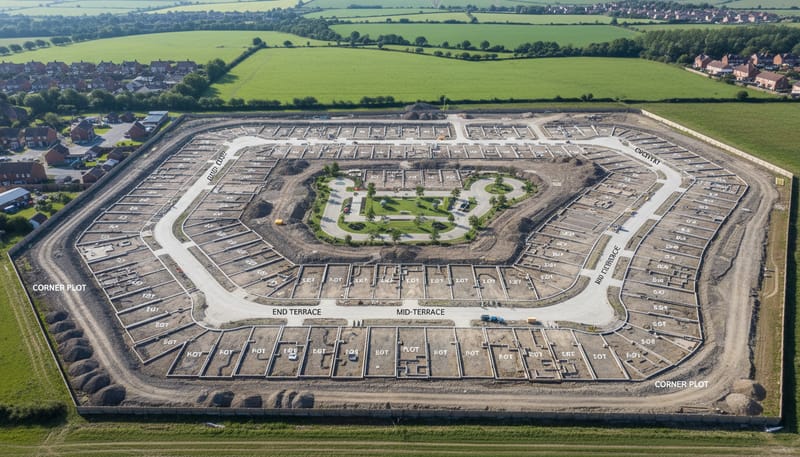
Why Your Plot Choice Matters as Much as the House
When buying a new build home, most buyers focus primarily on the house type, the number of bedrooms, and the price. While these are all crucial factors, the specific plot you choose on a development can have an equally significant impact on your quality of life, your enjoyment of the property, and its long-term resale value. Two identical house types on the same development can feel remarkably different depending on their position, orientation, and surroundings.
The plot determines your garden orientation (and how much sunshine you receive), your proximity to roads and potential noise sources, your level of privacy from neighbouring properties, your views, and even the amount of natural light your rooms receive. A south-facing garden can transform your outdoor living experience, while a plot overlooking open countryside may command a significant premium over one backing onto other properties.
This guide will equip you with the knowledge to read site plans effectively, evaluate different plot positions, understand the pricing dynamics of plot premiums, and make a decision that you will be delighted with for years to come. Whether you are choosing between two plots on a small development or navigating a complex site plan with hundreds of homes, these principles will help you identify the best plot for your needs and budget.
Garden Orientation: The South-Facing Premium
Garden orientation is one of the single most important factors in plot selection, and it is often underestimated by first-time buyers. The direction your rear garden faces determines how much direct sunlight it receives throughout the day, which profoundly affects your enjoyment of outdoor space, the temperature of your rear living rooms, and even the growth of plants in your garden.
Understanding Compass Orientation
| Garden Facing | Sunlight Pattern | Advantages | Considerations | Typical Premium |
|---|---|---|---|---|
| South-Facing | Direct sun from mid-morning to evening | Maximum garden sunshine, warm rear rooms, ideal for outdoor living and growing | Rear rooms can overheat in summer, may need blinds/shading | 5–15% above average |
| South-West Facing | Afternoon and evening sun | Excellent evening sunshine, great for after-work relaxation, balances light well | Less morning sun in garden, front rooms may be cooler | 3–10% above average |
| West-Facing | Afternoon and sunset sun | Beautiful evening light, good for summer barbecues and entertaining | Less sun early in the day, can be dazzling at sunset through rear windows | 2–5% above average |
| East-Facing | Morning sun until early afternoon | Bright mornings, pleasant breakfast spaces, cooler afternoons | Garden in shade from mid-afternoon, less useful for evening outdoor living | Average pricing |
| North-Facing | Limited direct sun, mainly in summer months | Cooler in summer, consistent soft light, no overheating issues | Less garden sunshine year-round, slower plant growth, cooler rear rooms | Often below average |
It is important to note that orientation affects your entire home, not just the garden. A south-facing garden means your rear rooms (typically the kitchen and living areas) receive abundant natural light, while the front bedrooms face north and receive softer, more consistent light — which many people actually prefer for sleeping. Conversely, a north-facing garden means your rear rooms may feel darker and cooler, while your front bedrooms enjoy southern sunshine.
When reviewing the site plan, look for a compass rose or north arrow to determine orientation. If one is not shown, ask the sales advisor or use your phone’s compass during a site visit. Understanding orientation before you reserve can save you from disappointment after moving in.
Plot Position: Location Within the Development
Beyond orientation, the physical position of your plot within the development affects your daily experience in numerous ways. Here are the key positional factors to evaluate.
Proximity to Roads
Plots adjacent to the main development access road or near busy junctions within the estate will experience more traffic noise and activity. This is particularly noticeable during the construction phase if the development is still being built. Plots on cul-de-sacs or at the quieter end of the development tend to be calmer and more private, though they may involve a longer walk to amenities and public transport.
If the development borders a public road, be aware that plots along this boundary may experience noise from passing traffic. Check whether acoustic fencing or landscaping buffers are planned. This information should be available in the planning documents and site plans.
Corner Plots
Corner plots are positioned at the junction of two roads within the development. They often command a premium because they typically offer larger gardens (wrapping around two sides of the house), greater separation from neighbours, and a more open feel. However, corner plots can also mean that your garden is more visible from the road on two sides, potentially reducing privacy unless adequate fencing or hedging is provided.
Overlooking and Privacy
One of the most common buyer complaints after moving into a new build is feeling overlooked by neighbouring properties. On higher-density developments, properties can be positioned relatively close together, and upper-floor windows may look directly into your garden or home. When evaluating a plot, study the site plan carefully to identify:
- Which properties will have windows facing your garden or rear windows
- The distance between your home and the nearest neighbouring properties
- Whether any higher buildings (apartments, townhouses) are positioned to overlook your plot
- The position and height of boundary fencing (standard close-board fencing is typically 1.8m, which does not prevent overlooking from upper floors)
- Whether mature trees or landscaping will provide natural screening over time
Proximity to Amenities and Green Space
Many new build developments include communal amenities such as play areas, green spaces, allotments, community buildings, and sometimes local shops or cafes. Plots adjacent to green spaces or parks often command premiums for the pleasant outlook, while plots next to play areas or community buildings may experience more noise and activity. Consider what matters most to your household when evaluating proximity to on-site amenities.
Development Phases: Early vs Late Buyers
Large developments are built in phases, sometimes over five to ten years. The phase you buy in has significant implications for your living experience and potentially your finances.
Buying in Early Phases
- Lower prices: Developers typically offer the most competitive pricing and best incentives in the earliest phases to generate momentum and sales velocity.
- Best plot selection: Early buyers have the widest choice of plots, including the most desirable positions and orientations.
- Living on a building site: The significant downside is that you may live alongside active construction for years, with associated noise, dust, construction traffic, and visual disruption.
- Incomplete amenities: Roads, landscaping, play areas, and community facilities may not be completed for several years after you move in.
- Capital growth potential: If the development is successful and house prices rise, early buyers may see their property value increase as the development matures and fills up.
Buying in Later Phases
- Established community: You move into a partially or fully established neighbourhood with existing residents, completed landscaping, and operational amenities.
- Higher prices: Later phases typically cost more, reflecting both general house price inflation and the premium of a more mature development.
- Reduced plot choice: The most desirable plots are often sold in earlier phases, so your options may be more limited.
- Known quantity: You can see the completed earlier phases, assess build quality, speak to existing residents, and evaluate the reality of the development before committing.
- Less disruption: If you buy in the final phase, you avoid most of the construction disruption, though some finishing works may continue.
There is no universally correct answer about whether to buy early or late. Your decision should reflect your tolerance for construction disruption, your budget flexibility, and how important plot selection is to you. For a detailed look at the buying process across different development stages, see our step-by-step guide.
Noise and Environmental Considerations
Noise is one of the factors that buyers most often overlook when choosing a plot, and one of the hardest to change after moving in. While modern new builds offer significantly better sound insulation than older properties, external noise still matters enormously.
Noise Sources to Investigate
- Main roads: If the development borders a busy road, A-road, or motorway, plots along that boundary will experience traffic noise. Visit at rush hour to assess the reality.
- Railway lines: Nearby train lines create periodic noise. While some people find this manageable, others find it disruptive, particularly for light sleepers. Check the frequency of services, including early morning and late evening trains, and whether freight trains run overnight.
- Schools: Plots adjacent to schools will experience noise during break times and congestion at pick-up and drop-off times. If you have school-age children, proximity can be an advantage; if not, it may be a nuisance.
- Commercial premises: Nearby pubs, restaurants, supermarkets, and industrial estates can generate noise at various times. Check the location thoroughly before committing.
- Substations and pumping stations: Many new developments include electrical substations and water pumping stations. These generate a low-level hum that can be noticeable from adjacent plots. Check the site plan for their locations.
- Future development: Check the local plan for any allocated development land nearby. A peaceful field today could become a construction site next year.
Environmental and Flooding Considerations
While new build developments undergo rigorous environmental assessments before receiving planning permission, individual plot positions can still vary in their exposure to environmental factors. Check flood risk maps (available at gov.uk) for your specific plot, not just the development as a whole. Plots at lower elevations within a development may have different flood risk profiles to those on higher ground.
Also consider prevailing wind direction (south-westerly in most of the UK), which affects how sheltered your garden will feel, and the position of any watercourses, sustainable drainage systems (SuDS), or attenuation ponds. These features can be attractive but may also attract insects in summer and create damp conditions in adjacent areas.
Plot Scoring and Evaluation Framework
Use this scoring framework to systematically compare plots on a development. Score each factor from 1 (poor) to 5 (excellent) and multiply by the weighting to get a weighted score. Compare totals across your shortlisted plots to identify the strongest option.
| Factor | Weighting | Score 1–5 | What to Evaluate |
|---|---|---|---|
| Garden orientation | ×3 (High) | ___ | South/SW = 5, West = 4, East = 3, NW/NE = 2, North = 1 |
| Privacy level | ×3 (High) | ___ | Not overlooked = 5, minimal overlooking = 3, significantly overlooked = 1 |
| Noise exposure | ×3 (High) | ___ | Very quiet = 5, some noise = 3, adjacent to noise source = 1 |
| Garden size | ×2 (Medium) | ___ | Larger than average = 5, average = 3, smaller than average = 1 |
| Views/outlook | ×2 (Medium) | ___ | Open views/green space = 5, mixed = 3, backs onto properties = 1 |
| Parking convenience | ×2 (Medium) | ___ | Driveway/integral garage = 5, allocated nearby = 3, on-street = 1 |
| Distance to amenities | ×1 (Lower) | ___ | Walking distance = 5, moderate = 3, remote within development = 1 |
| Construction disruption | ×1 (Lower) | ___ | All phases complete = 5, some building nearby = 3, major works adjacent = 1 |
| Flood risk | ×2 (Medium) | ___ | Zone 1 (low) = 5, Zone 2 = 3, Zone 3 = 1 |
| Price vs comparable plots | ×2 (Medium) | ___ | Below average = 5, average = 3, premium pricing = 1 |
Maximum possible score: 105. Plots scoring above 80 are excellent. Scores of 60–80 indicate good value with acceptable compromises. Below 60, carefully consider whether the plot meets your needs or if a different option would serve you better.
Plot Factor Impact on Resale Value
Estimated impact on resale value compared to average plot pricing on same development.
Tips for Reading Site Plans Effectively
The site plan is your most valuable tool when choosing a plot. It shows the layout of the entire development, including all plot positions, road layouts, amenities, and landscaping. However, site plans can be complex and require careful interpretation. Here are the key elements to focus on.
Essential Site Plan Elements
- North arrow: This tells you the compass orientation, which is critical for understanding garden orientation and sunlight patterns. If there is no north arrow, ask the sales advisor to confirm orientation.
- Plot boundaries: Check the extent of your plot boundary carefully. The red line around your plot shows exactly what land you are purchasing. Some plots have irregular shapes that are not immediately obvious from the house footprint alone.
- Neighbouring plot types: Identify what property types surround your plot. Having a three-storey townhouse directly behind your two-storey semi can create significant overlooking issues.
- Access and parking: Confirm your parking arrangements. Is your parking on your plot (driveway or garage) or in a communal parking area? How far is the nearest visitor parking?
- Landscaping and open space: Green areas shown on the site plan are usually communal and maintained by a management company. Check whether your plot backs onto green space or another property.
- Utilities and infrastructure: Look for the positions of substations, pumping stations, bin collection points, and attenuation ponds. You do not want these immediately adjacent to your plot.
- Future phases: If the development has future phases, understand what will be built adjacent to your plot in coming years. An empty field shown on the current plan may become a construction site in the near future.
Questions to Ask About Your Specific Plot
When you have narrowed your choice to one or two plots, ask the sales advisor these specific questions:
- What are the exact garden dimensions for this plot?
- What boundary treatment is provided (fence type, height, and who is responsible for maintenance)?
- Are there any easements or rights of way affecting this plot?
- What is the finished floor level relative to neighbouring properties and the road?
- When will the adjacent plots be completed, and what disruption should I expect?
- Are there any restrictive covenants specific to this plot position?
Frequently Asked Questions
Can I negotiate the price of a specific plot?
Yes, plot prices are not always fixed. Developers have flexibility, particularly on plots that have been available for a while, plots in less desirable positions, or during quieter market periods. If you have identified that a plot carries a premium for a feature you do not particularly value (such as a larger garden when you prefer low maintenance), you may be able to negotiate the price down or secure additional incentives. Having a mortgage agreement in principle and being chain-free strengthens your position significantly.
Is a south-facing garden really worth paying more for?
For most buyers, yes. A south-facing garden receives direct sunlight for the majority of the day, making it significantly more usable for outdoor dining, children’s play, gardening, and general relaxation. It also means your rear living areas (typically kitchen and living room) benefit from abundant natural light. The premium typically represents 5–15% of the property price, but south-facing homes consistently achieve higher resale values and sell more quickly. If you enjoy spending time outdoors, the premium \— often \£10,000\–\£30,000 on a typical family home \— is almost always justified. If you rarely use your garden, you could save money by choosing a different orientation.
What should I avoid when choosing a plot?
The main things to avoid depend on your priorities, but common concerns include: plots directly adjacent to the main development access road (noise and traffic), plots overlooked by taller neighbouring properties (privacy), plots next to substations or pumping stations (noise and visual impact), plots with north-facing gardens (limited sunshine), and plots in the earliest phase of a large development (years of construction disruption). However, each of these “negatives” typically comes with a lower price, so if the discount is sufficient and the issue genuinely does not concern you, they can represent excellent value.
Should I buy an early-phase plot or wait for later phases?
Early-phase buying offers the widest plot selection, typically the best prices, and the potential for capital growth as the development matures. Later-phase buying offers a more established community, completed amenities, and the ability to see the finished product before committing. If budget and plot choice are your priorities, buy early. If living in a completed environment matters more, wait for later phases. There is no universally right answer — it depends entirely on your personal priorities and tolerance for construction disruption.
How do I check the orientation of a plot?
The simplest method is to look for a north arrow or compass rose on the site plan, which every developer should provide. You can also use a compass app on your smartphone during a site visit. Stand at the rear of the plot (where your garden will be) and determine which direction you are facing. If you face south, the garden is south-facing and will receive maximum sunshine. Online mapping tools such as Google Maps also show compass orientation and can be used to verify the site plan. If you are in any doubt, ask the sales advisor to confirm the orientation of your specific plot in writing.
Securing the Best Plot for Your New Build Home
Choosing the right plot is a decision that will affect your enjoyment of your home every single day. A few hours spent carefully studying the site plan, visiting the development at different times, and systematically scoring your options against the criteria in this guide will pay dividends for years to come.
Remember that the “best” plot is subjective — it depends entirely on your priorities. A family with young children may prioritise proximity to the play area and a safe cul-de-sac position, while a retired couple may value peace, privacy, and a south-facing garden above all else. The key is to be honest about what matters most to you and to evaluate plots against those criteria rather than being swayed by the sales advisor’s recommendations alone.
Before committing, make sure you have also considered the property type that best suits your needs, the developer’s reputation, and the wider location factors that will affect your quality of life. With thorough research and a systematic approach, you will find a plot that feels like home from the very first day.
For more guidance on the buying process, explore our guides on what to check before reserving, the conveyancing process, and snagging your new home.