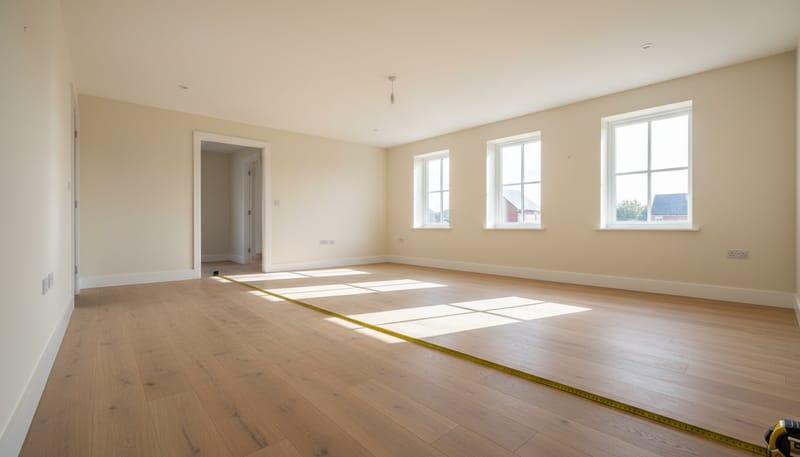
Why Home Size Matters When Buying a New Build
The size of a new build home – measured in total internal floor area and individual room dimensions – is one of the most fundamental factors affecting your comfort, lifestyle, and long-term satisfaction with your property. Yet home size is also one of the most commonly misunderstood and overlooked aspects of the buying decision. Many buyers focus on the number of bedrooms, the kitchen layout, or the garden size, without fully considering the actual dimensions of the spaces they’ll be living in day to day.
The UK has a complex relationship with home sizes. Studies consistently show that new build homes in Britain are among the smallest in Europe, and the trend over recent decades has generally been towards smaller properties. However, the introduction of space standards, increasing buyer awareness, and competitive pressure between developers have all contributed to improvements in recent years. Understanding the standards that exist, how to read and compare floor plans effectively, and what constitutes a well-proportioned home will equip you to make a truly informed purchase.
In this comprehensive guide, we’ll explain the Nationally Described Space Standard (NDSS), walk you through minimum room sizes, show you how to compare developer floor plans and measure usable space, examine storage requirements, and provide practical tools for comparing home sizes across different developers and property types.
The Nationally Described Space Standard (NDSS) Explained
The Nationally Described Space Standard (NDSS) is a government-defined standard that sets minimum internal floor areas for new dwellings in England. Introduced in March 2015 by the Department for Communities and Local Government (now the Department for Levelling Up, Housing and Communities), the NDSS replaced a patchwork of local space standards that had been adopted by individual local planning authorities.
How the NDSS Works
The NDSS specifies minimum gross internal floor areas (GIA) based on the number of bedrooms, the number of expected occupants, and the number of storeys. It also sets minimum areas for individual bedrooms, minimum floor-to-ceiling heights, and requirements for built-in storage. The standard applies to all types of new dwellings, including houses, flats, and bungalows, whether they are market sale, affordable housing, or social rent.
Crucially, the NDSS is not mandatory nationally. Local planning authorities must adopt it through their Local Plan if they wish to apply it, and they can only do so where they can demonstrate a local need and that the standard would not make development unviable. As of 2025, a significant number of local authorities have adopted the NDSS – particularly in London, the South East, and other areas with high housing costs – but many have not. This means that the space standard that applies to your new home depends on where it is being built.
Where the NDSS has been adopted, developers must ensure their homes meet or exceed the minimum areas. Where it has not been adopted, there is no mandatory minimum size standard (beyond basic Building Regulations requirements for habitable rooms), and developers have greater flexibility in the sizes of homes they build.
Key NDSS Requirements
- Minimum gross internal floor areas based on bedroom count, occupancy, and storeys
- Single bedrooms must be at least 7.5m² (approximately 80.7 sq ft)
- Double bedrooms must be at least 11.5m² (approximately 123.8 sq ft)
- Minimum floor-to-ceiling height of 2.3m for at least 75% of the GIA
- Built-in storage requirements based on the number of bedrooms (ranging from 1.5m² for a one-bedroom dwelling to 3.5m² for a six-bedroom dwelling)
- Minimum dwelling width provisions to ensure habitable room proportions
NDSS Minimum Sizes by Bedroom Count
The following table sets out the NDSS minimum gross internal floor areas for the most common dwelling types. These represent the absolute minimum sizes where the standard applies – many developers build homes that exceed these minimums, particularly at the mid-range and premium end of the market.
| Bedrooms | Occupancy (persons) | 1 Storey (m²) | 2 Storey (m²) | 3 Storey (m²) |
|---|---|---|---|---|
| 1 bedroom | 1 person | 39 | N/A | N/A |
| 1 bedroom | 2 persons | 50 | 58 | N/A |
| 2 bedrooms | 3 persons | 61 | 70 | N/A |
| 2 bedrooms | 4 persons | 70 | 79 | N/A |
| 3 bedrooms | 4 persons | 74 | 84 | 90 |
| 3 bedrooms | 5 persons | 86 | 93 | 99 |
| 3 bedrooms | 6 persons | 95 | 102 | 108 |
| 4 bedrooms | 5 persons | 90 | 97 | 103 |
| 4 bedrooms | 6 persons | 99 | 106 | 112 |
| 4 bedrooms | 7 persons | 108 | 115 | 121 |
| 4 bedrooms | 8 persons | 117 | 124 | 130 |
| 5 bedrooms | 7 persons | 112 | 119 | 125 |
| 5 bedrooms | 8 persons | 121 | 128 | 134 |
| 6 bedrooms | 8 persons | 125 | 132 | 138 |
Important notes: The “occupancy” column indicates the number of persons the dwelling is designed to accommodate, which determines the minimum size. A single bedroom counts as one person, and a double (or twin) bedroom counts as two. An additional 10m² is added for each storey above one. These figures represent gross internal area (GIA), which includes all internal space measured to the internal face of external walls but excludes external walls, balconies, and shared circulation space in flats.
When comparing new build homes, always check whether the development is in an area where the NDSS has been adopted. If it has, the developer must meet these minimums. If it hasn’t, homes may be smaller – though many reputable developers choose to build to NDSS standards regardless, recognising that adequate space is essential for buyer satisfaction and long-term property values.
How to Read and Compare Developer Floor Plans
Floor plans are the primary tool for assessing the size and layout of a new build home before it’s built. Learning to read them effectively is an essential skill for any new build buyer. Here’s how to get the most from the floor plans you’ll encounter during your property search.
Understanding Floor Plan Measurements
Developer floor plans typically show room dimensions in metres or feet and inches, along with an overall gross internal area (GIA) for the property. Some developers provide dimensions on the plan itself, while others list them in a separate schedule. Key measurements to focus on include the total GIA (gross internal floor area), individual room dimensions (length and width), hallway and landing widths, staircase dimensions, and built-in storage areas.
Be aware that room dimensions on floor plans may be measured at the widest points, which can be misleading for irregularly shaped rooms. An L-shaped living room, for example, might show dimensions of 5.5m x 4.0m, but the actual usable rectangular portion might only be 4.0m x 3.5m. Always look at the shape of the room as well as the headline dimensions.
What to Look For on a Floor Plan
- Room proportions: Long, narrow rooms can feel significantly smaller than square rooms of the same area. A room that is 3m x 5m (15m²) feels very different from one that is 3.8m x 3.9m (14.8m²), even though the areas are similar
- Door and window positions: Doors and windows reduce usable wall space for furniture placement. Count the doors in each room and consider where furniture will go
- Circulation space: Hallways, landings, and the space around doors all consume floor area. Generously proportioned circulation spaces make a home feel larger but reduce the area available for rooms
- Storage: Look for built-in wardrobes, cupboards under stairs, and utility areas. Adequate storage eliminates the need for freestanding furniture that reduces room space
- Kitchen layout: The arrangement of units, appliances, and counters determines how functional the kitchen will be, regardless of its overall area
- Staircase position: Central staircases can eat into the usable floor area on both levels, while staircases against external walls tend to be more space-efficient
Comparing Floor Plans Between Developers
When comparing properties from different developers, ensure you’re making like-for-like comparisons. Some developers quote gross internal area (including internal walls, stairs, and circulation), while others may quote room areas only (which will always be lower). Always compare GIA to GIA, and be aware that a three-bedroom home from one developer may have a GIA of 85m² while a three-bedroom from another is 100m² – a 17% difference that will significantly affect how the home feels to live in.
It’s also valuable to visit show homes for properties you’re considering, as the experience of being in the actual space is far more informative than studying a floor plan on paper. Bring a tape measure and check key dimensions yourself – and pay attention to how furniture is arranged, as show homes are often dressed with smaller-scale furniture to make rooms appear larger.
Measuring Usable Space and Storage Requirements
The total floor area of a home tells only part of the story. What really matters for daily living is usable space – the area that’s genuinely available for furniture, activities, and circulation once you account for doors, windows, radiators, and the practical layout of each room.
Usable vs Total Floor Area
As a general rule, approximately 75–85% of a room’s total floor area is genuinely usable for furniture and activities. The remaining 15–25% is consumed by door swings, radiator zones (where you can’t place furniture close to heat sources), window sill depths, and circulation paths through the room. In smaller rooms, this percentage can be even lower, as the fixed elements (doors, windows, radiators) take up a proportionally larger share of the space.
When assessing a floor plan, mentally place your existing furniture in each room. Can you fit a standard UK double bed (135cm x 190cm) with adequate clearance on at least two sides in the master bedroom? Will your sofa and TV unit fit comfortably in the living room? Does the dining area accommodate your table with room to pull back chairs? These practical checks are far more useful than simply comparing square metre figures.
Bedroom Size Guidelines
| Bedroom Type | NDSS Minimum | Comfortable Size | Generous Size | Can Accommodate |
|---|---|---|---|---|
| Principal double | 11.5m² | 13–15m² | 16–20m² | King bed, 2 bedside tables, wardrobe, dressing table |
| Second double | 11.5m² | 12–14m² | 14–17m² | Double bed, 2 bedside tables, wardrobe |
| Third double | 11.5m² | 11.5–13m² | 13–15m² | Double bed, 1–2 bedside tables, wardrobe |
| Single bedroom | 7.5m² | 8–9m² | 9–11m² | Single bed, desk, small wardrobe |
| Box room / nursery | 7.5m² | 7.5–8m² | 8–10m² | Single bed or cot, small storage |
Storage Requirements
Adequate storage is one of the most overlooked aspects of home size assessment, yet it has an enormous impact on how spacious and organised a home feels in practice. The NDSS specifies minimum built-in storage areas based on bedroom count:
- 1-bedroom dwelling: 1.5m² of built-in storage
- 2-bedroom dwelling: 2.0m² of built-in storage
- 3-bedroom dwelling: 2.5m² of built-in storage
- 4-bedroom dwelling: 3.0m² of built-in storage
- 5-bedroom dwelling: 3.5m² of built-in storage
These minimums are measured in floor area – a cupboard that is 0.6m deep and 1.0m wide provides 0.6m² of storage. In practice, the NDSS minimums are modest, and most families will benefit from significantly more storage than the minimum standard. Under-stairs cupboards, built-in wardrobes, airing cupboards, and utility rooms all contribute to the total storage provision.
When comparing properties, count the total number and size of all storage areas. A home with generous built-in storage will feel significantly more spacious than one without, even if the total floor area is similar, because you won’t need freestanding wardrobes, chests of drawers, and storage units that consume valuable room space.
Comparing Home Sizes Across Developers
One of the most valuable exercises you can undertake when buying a new build is to compare the sizes of similar properties from different developers. The variation can be surprising – two three-bedroom semi-detached homes at similar price points may differ in gross internal area by 15% or more, which has a meaningful impact on daily comfort. When you consider that the average UK new build three-bedroom house is priced between £280,000 and £450,000 depending on location, even a 10% difference in floor area represents a significant variation in value per square metre. Calculating the cost per square metre (total price divided by GIA) is one of the most objective ways to compare value across developers and developments.
Based on analysis of house types from major UK developers, 2024–2025. NDSS minimum shown for 3-bed, 5-person, 2-storey dwelling.
Factors That Affect Home Size
Several factors influence the sizes of homes that developers build on a given site, and understanding these helps explain why sizes vary:
- Land cost and density: In areas with high land values, developers may build smaller homes at higher density to make the economics work. This is particularly evident in London and the South East, where residential land can cost £5,000,000 or more per hectare in prime locations
- Local planning requirements: Where the NDSS has been adopted locally, developers must meet the minimum standards. Other local policies may specify minimum garden sizes, parking provision, or density limits, all of which affect home sizes
- Developer positioning: Premium developers typically build larger homes as part of their brand proposition, while volume builders may offer a broader range of sizes to serve different price points
- House type design: Developers design standard house types that are used across multiple developments. Some developers invest more in spacious, well-proportioned designs, while others prioritise efficiency and cost management
- Market segment: Homes designed for first-time buyers tend to be smaller, while family homes and executive properties are typically more generous in size
How to Compare Effectively
When comparing similar properties from different developers, use the following approach:
- Compare total GIA: Request the gross internal floor area for each property and compare directly. Remember that even a 5m² difference is noticeable in daily use
- Compare individual room sizes: A property with a slightly lower total GIA but larger living areas and bedrooms may feel more spacious than a larger property with excessive circulation space
- Assess the layout efficiency: Some floor plans use space more efficiently than others. A well-designed 85m² home can feel more spacious than a poorly laid out 95m² home
- Count and measure storage: Storage areas can significantly affect perceived spaciousness
- Visit show homes or completed properties: Nothing replaces the experience of standing in the actual space. Visit show homes where possible, and if the exact house type you’re considering has been built elsewhere, ask if you can view a completed example
- Consider the plot: The same house type on different plots can feel very different. A corner plot with more natural light will feel more spacious than a mid-terrace position. Our guide to choosing the right plot can help with this assessment
Frequently Asked Questions
Is the Nationally Described Space Standard mandatory for all new build homes in England?
No, the NDSS is not automatically mandatory. It must be adopted by each local planning authority through their Local Plan. Many authorities have adopted it – particularly in London and the South East – but significant areas of England have not. Where it has been adopted, developers must meet the minimum standards for all new dwellings. You can check whether the NDSS applies in your area by reviewing the relevant local authority’s adopted Local Plan or by asking the developer directly. Even where the NDSS is not mandatory, many reputable developers choose to build to its standards or exceed them, recognising that adequate space is essential for buyer satisfaction.
How does the size of new build homes in the UK compare to other European countries?
UK new build homes have historically been among the smallest in Western Europe. Average new build house sizes in the UK are approximately 76m², compared to around 109m² in Denmark, 115m² in the Netherlands, and 137m² in Ireland. However, this average includes the full range of property types, and larger family homes from mid-range and premium developers in the UK can be comparable in size to European equivalents. The introduction of the NDSS and growing consumer awareness are driving improvements, and many developers now actively promote the spaciousness of their homes as a competitive advantage. When choosing a developer, comparing gross internal floor areas is one of the most objective measures of value.
What is the minimum size for a double bedroom in a new build home?
Under the NDSS, a double bedroom (designed for two people) must be at least 11.5m², while a single bedroom (one person) must be at least 7.5m². These are the minimum floor areas, and comfortable use typically requires somewhat more space. A double bedroom of 11.5m² will accommodate a standard double bed with basic furniture, but you may find it tight for a king-size bed with bedside tables and a wardrobe. The principal bedroom in most new build homes is typically 12–18m² depending on the developer and house type, with premium properties often exceeding 15m².
How can I tell if a new build home will feel spacious enough for my family?
The best approach combines several strategies. First, measure your current rooms and compare them to the dimensions on the new build floor plan – this gives you a concrete reference point for how the new rooms will feel. Second, visit the show home or, if possible, a completed example of the same house type. Third, consider your furniture and check that it will fit comfortably in each room. Fourth, assess storage provision – adequate built-in storage eliminates the need for freestanding units that consume room space. Finally, think about how you actually use your home: if you spend most of your time in the kitchen and living area, prioritise these spaces over bedroom size. Our guide to apartments vs houses also explores how different property types offer different approaches to space.
Do all developers publish the gross internal floor area of their homes?
Most major UK developers now publish gross internal floor areas for their house types, typically on their website, in marketing brochures, and on floor plan documents. However, the prominence and detail of this information varies. Some developers prominently display the GIA alongside room dimensions, while others may only provide it on request. If the GIA is not readily available, ask the sales adviser directly – they should be able to provide this information. For leasehold properties such as apartments, the internal area may also be specified in the lease documentation. When comparing properties, always ensure you’re comparing like-for-like measurements.
Making Space Work for You
Understanding home sizes and space standards is not just an academic exercise – it’s a practical tool that will directly affect your comfort and satisfaction in your new home for years to come. The NDSS provides a valuable baseline, but your personal needs, furniture, lifestyle, and family circumstances all determine what size of home is right for you.
When searching for your new build home, make space a priority alongside location, price, and specification. Request floor plans and GIA figures from every developer you’re considering, compare like-for-like, and always visit properties in person to experience the space first-hand. Pay attention to room proportions as well as raw numbers, assess storage provision carefully, and don’t be swayed by clever show home furniture that makes rooms appear larger than they are.
Remember that a slightly larger home doesn’t always mean a significantly higher price – comparing across developers can reveal genuinely better value. A home that’s 10% larger for 5% more in price represents excellent value, particularly when you consider that you cannot easily add space to a property after purchase. For example, choosing a 95m² three-bedroom home at £340,000 over an 85m² alternative at £320,000 gives you an extra 10m² of living space for just £20,000 – that’s £2,000 per square metre, which is well below the average cost per square metre for the property as a whole. For more guidance on evaluating new build homes, explore our comprehensive guide to buying a new build home in the UK, and use our buyer’s paperwork checklist to ensure you have all the documentation you need to compare properties effectively.