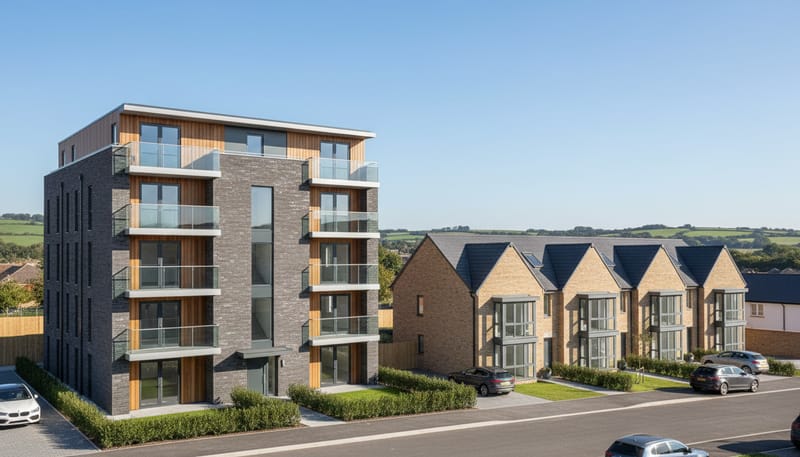
The Big Decision: Apartment or House?
Choosing between a new build apartment and a new build house is one of the most fundamental decisions in the home buying process. Both options offer the advantages of modern construction, warranty protection, and energy efficiency, but they deliver very different lifestyles, ownership structures, and long-term financial outcomes. Making the right choice depends on your budget, lifestyle priorities, family circumstances, and future plans.
In the UK new build market, apartments and houses each account for a significant share of sales. According to NHBC data for 2024, approximately 35% of new build completions were flats and apartments, with the remaining 65% being houses (including detached, semi-detached, terraced, and bungalows). In London and other major cities, apartments dominate, accounting for over 70% of new build completions. In suburban and rural areas, houses make up the vast majority.
This guide provides a thorough, objective comparison across every factor that matters — from upfront costs and ongoing expenses to space, lifestyle, legal considerations, and resale value. Whether you are a first-time buyer weighing up affordability, a professional seeking city-centre convenience, or someone downsizing for a simpler lifestyle, this comparison will help you make an informed decision.
Cost Comparison: Apartments vs Houses
Cost is typically the first consideration for any buyer. New build apartments are generally cheaper to purchase than houses in the same area, but the total cost of ownership involves more than just the purchase price. Service charges, ground rent (where applicable), and maintenance contributions can significantly affect the long-term financial picture.
Purchase Price Comparison
The purchase price gap between apartments and houses varies dramatically by region. In London, a new build apartment might cost £400,000 while a comparable new build house (if available) would be £700,000+. In the Midlands, a new build apartment might cost £170,000 compared to £280,000 for a 3-bedroom house on the same development.
| Cost Factor | New Build Apartment | New Build House (3-bed semi) |
|---|---|---|
| Average UK purchase price | £230,000 | £340,000 |
| Deposit (10%) | £23,000 | £34,000 |
| Stamp duty (first-time buyer) | £0 (under £425,000) | £0 (under £425,000) |
| Stamp duty (non-FTB) | £2,000 | £4,500 |
| Annual energy bills (EPC B) | £520–£700 | £780–£1,100 |
| Annual council tax | £1,200–£1,600 (Band B/C) | £1,600–£2,400 (Band C/D) |
| Annual service charge | £1,200–£3,500 | £0 (or £100–£300 estate charge) |
| Annual ground rent | £0 (leases post-June 2022) | £0 (freehold) |
| Annual maintenance budget | £100–£300 (personal space only) | £500–£1,500 |
| Buildings insurance | Included in service charge | £200–£400 per year |
| Total annual running costs | £3,020–£6,100 | £3,080–£5,700 |
As the table shows, the annual running costs can be surprisingly similar once service charges are factored in for apartments. The lower purchase price of an apartment is its biggest financial advantage, requiring a smaller deposit and lower mortgage repayments. However, the stamp duty savings and lower council tax may be partially offset by service charges.
Understanding Service Charges
Service charges are the ongoing fees that apartment owners pay to the management company responsible for maintaining the building and communal areas. These charges typically cover:
- Buildings insurance for the entire block
- Communal area maintenance (hallways, stairwells, lobbies)
- Lift maintenance and servicing
- External grounds and landscaping
- Communal lighting and heating
- Management company fees
- Sinking fund contributions (reserve fund for major works such as roof replacement or cladding)
- Concierge or security (in premium developments)
Service charges for new build apartments in the UK typically range from £1,200 to £3,500 per year, depending on the development, location, and facilities provided. Luxury developments with gyms, pools, and concierge services can charge £5,000–£8,000 or more annually. It is essential to understand the service charge budget before purchasing — ask the developer or management company for a detailed breakdown and a projection of how charges may increase over time.
Space, Layout, and Lifestyle Factors
Beyond cost, the space you live in and the lifestyle each option enables are critical factors in the apartment vs house decision. Modern new builds of both types are designed to make efficient use of space, but the differences in living experience are significant.
Space Comparison
The Nationally Described Space Standard (NDSS) sets minimum floor areas for new homes in England, though adoption by local authorities varies. Here is how typical new build apartments and houses compare on space:
| Metric | 1-Bed Apartment | 2-Bed Apartment | 2-Bed House | 3-Bed House |
|---|---|---|---|---|
| Minimum floor area (NDSS) | 50 m² | 61–70 m² | 70–79 m² | 84–93 m² |
| Typical new build actual | 45–55 m² | 55–75 m² | 65–85 m² | 80–100 m² |
| Bedrooms | 1 | 2 | 2 | 3 |
| Bathrooms | 1 | 1–2 | 1 | 1–2 |
| Private outdoor space | Balcony (3–8 m²) | Balcony (5–12 m²) | Garden (30–60 m²) | Garden (40–80 m²) |
| Storage | Limited | Moderate | Good | Good to generous |
| Parking | 0–1 allocated space | 0–1 allocated space | 1–2 spaces (driveway) | 1–2 spaces (driveway/garage) |
The most obvious difference is outdoor space. A house provides a private garden, however modest, where children can play, pets can roam, and you can garden, entertain, or simply enjoy outdoor living. An apartment offers a balcony or terrace — useful for plants, morning coffee, and fresh air, but fundamentally different from a garden. If outdoor space is a priority, explore our guide to new build outdoor spaces and parking.
Lifestyle Comparison
The lifestyle that comes with apartment living versus house living is markedly different. Neither is inherently better — the right choice depends entirely on your personal preferences and circumstances.
Maintenance, Service Charges, and Responsibilities
The division of maintenance responsibilities is one of the starkest differences between apartment and house ownership. Understanding who is responsible for what — and what it costs — is essential for making a well-informed decision.
Apartment Maintenance
As an apartment owner, your maintenance responsibilities are limited to the interior of your flat. The building structure, roof, exterior walls, communal hallways, lifts, and shared grounds are all maintained by the management company, funded through your service charge. This arrangement has clear advantages: you never need to worry about roof repairs, exterior decorating, or drain unblocking. However, you also have less control — you pay for communal maintenance regardless of whether you feel it is necessary or well-managed.
Key maintenance considerations for apartment owners:
- Sinking fund: A well-managed development will build up a reserve fund (sinking fund) for major future works. Ask the developer what percentage of the service charge goes into the sinking fund. A healthy reserve prevents large one-off special assessments.
- Major works: Significant repairs — such as lift replacement, roof works, or cladding remediation — can result in special levies if the sinking fund is insufficient. Ensure the management company has a long-term maintenance plan.
- Right to manage: Under the Commonhold and Leasehold Reform Act 2002, leaseholders have the right to collectively take over the management of their building. This can be a powerful tool if the appointed management company is underperforming.
House Maintenance
As a house owner (typically freehold), you are responsible for all maintenance — internal and external. This gives you complete control over what gets done, when, and by whom. For the first two years, your developer’s aftercare team will handle defects, and the 10-year NHBC warranty covers structural issues. After that, maintenance is entirely your responsibility.
Typical maintenance tasks for house owners include:
- Boiler servicing (annual, £80–£120)
- External decorating (every 5–8 years, £1,500–£3,000)
- Gutter cleaning (annual, £80–£150)
- Garden maintenance (ongoing, £0–£2,000+ per year depending on effort)
- Roof and chimney checks (periodic, £200–£500)
- Driveway and path maintenance (as needed)
- Fencing repairs (as needed, £200–£800)
On a new build house, significant maintenance expenditure is unlikely in the first 5–10 years. The advantage of houses is that you spread these costs over time and only pay for what is actually needed, whereas apartment service charges are paid regardless of whether major works are required in any given year.
Leasehold Considerations for Apartments
One of the most important legal differences between buying an apartment and buying a house is the tenure. The vast majority of new build apartments in England and Wales are sold on a leasehold basis, whereas most new build houses are sold as freehold.
What Leasehold Means in Practice
When you buy a leasehold apartment, you are purchasing the right to live in the property for a specified number of years (the “term” of the lease). New build apartment leases are typically granted for 125 to 999 years. You do not own the building or the land it sits on — that is owned by the freeholder. The lease is a legal contract between you and the freeholder that sets out your rights and obligations.
Key leasehold terms to understand:
- Lease length: New build leases are typically 125+ years. A lease under 80 years becomes progressively harder and more expensive to extend. Always check the remaining lease length before purchasing.
- Ground rent: Since the Leasehold Reform (Ground Rent) Act 2022, new residential leases in England and Wales must have ground rent set at a “peppercorn” (effectively £0). This is a significant improvement for buyers of new build apartments.
- Service charge: As discussed above, this covers communal maintenance, insurance, and management. It is set by the management company and reviewed annually.
- Alterations and permissions: Your lease will specify what alterations you can and cannot make to your flat. Major works such as removing walls, changing flooring type, or installing new bathrooms may require written permission from the freeholder.
- Subletting: Some leases restrict or prohibit subletting. If you plan to let the property in the future, check the lease terms carefully.
- Pet restrictions: Many leases contain clauses about keeping pets. Some prohibit them entirely, while others require permission from the management company.
Recent Leasehold Reforms
The UK government has introduced significant leasehold reforms in recent years that benefit apartment buyers:
- Ground rent capped at zero: Since June 2022, new residential leases cannot charge ground rent above a peppercorn. This saves apartment owners hundreds of pounds per year compared to older leases.
- Leasehold reform proposals: The Leasehold and Freehold Reform Act 2024 introduced measures to make lease extensions easier and cheaper, reduce the cost of enfranchisement, and improve transparency around service charges.
- Building Safety Act 2022: This act established new protections for leaseholders in buildings over 11 metres, including limitations on remediation costs for building safety defects such as cladding issues.
- Right to manage: Leaseholders can collectively take over building management without proving fault by the current manager. This gives apartment owners more control over their service charges and maintenance.
Resale Value and Investment Potential
For many buyers, the property is both a home and an investment. Understanding how apartments and houses perform in terms of resale value and capital growth is an important factor in the decision.
Historical Price Growth
Over the past decade, UK houses have generally appreciated faster than apartments in most regions. Land Registry data shows that between 2014 and 2024, average house prices in England increased by approximately 50–55%, while apartment prices increased by approximately 35–40%. The gap is largely driven by land value — houses come with land that appreciates, while apartments share land among multiple units.
However, this national picture masks significant regional variation:
Based on Land Registry data 2014–2024. Past performance does not guarantee future returns. Individual property performance varies.
Rental Yield Comparison
If you are considering the property as a potential rental investment in the future, apartments often offer higher rental yields than houses. This is because the lower purchase price of apartments combined with strong rental demand in urban areas creates a favourable rent-to-price ratio.
Typical gross rental yields for new build properties:
- Apartments in city centres: 5–7% gross yield
- Apartments in suburban areas: 4–5.5% gross yield
- Houses in suburban areas: 3.5–5% gross yield
- Houses in rural areas: 3–4.5% gross yield
However, higher yields come with higher ongoing costs (service charges) and potentially lower capital growth. The best investment strategy depends on whether you prioritise income (yield) or growth (capital appreciation). For a family home that you plan to live in for 10+ years, capital growth is usually more important, which tends to favour houses. For a shorter-term or dual-purpose property, the higher yield of an apartment may be more attractive.
Shared Areas and Communal Living
Apartment living inherently involves sharing spaces and facilities with other residents. For some people, this is a positive feature that creates community and convenience. For others, it represents a loss of privacy and independence. Understanding the communal aspects of apartment living is essential before committing.
Common Communal Facilities
Modern new build apartment developments, particularly those built by developers such as Berkeley Group, Barratt London, and Crest Nicholson, often include impressive communal facilities:
- Residents’ lounge or co-working space: A shared area for socialising or working from home
- Gymnasium or fitness suite: On-site exercise facilities included in the service charge
- Concierge or reception: A staffed entrance for security and package management
- Landscaped courtyard or roof terrace: Shared outdoor space that compensates for the lack of a private garden
- Bicycle storage: Secure, covered cycle parking — increasingly important in urban areas
- Post room: A secure area for package deliveries when you are not at home
Considerations for Communal Living
Living in close proximity to others requires a degree of compromise and consideration. Here are the key factors to weigh up:
- Noise: Modern new builds have significantly better sound insulation than older conversions, but you will still be closer to neighbours than in a house. Check the developer’s sound insulation specifications before purchasing.
- Shared decision-making: Major decisions about the building — from decorating communal areas to approving major works — are made collectively by leaseholders or the management company. You may not always agree with the outcome.
- Communal rules: Most developments have rules about noise levels, waste disposal, use of communal areas, and alterations to your flat. These are legally enforceable under the lease.
- Neighbour issues: In any communal building, there is a possibility of disputes with neighbours over noise, parking, or communal area use. The management company typically mediates these issues.
Frequently Asked Questions
Are new build apartments a good first home?
Yes, new build apartments are an excellent first home for many buyers. They are typically more affordable than houses, require less maintenance, and are often located in convenient urban locations. For first-time buyers who prioritise location and affordability over space, an apartment is a practical entry point onto the property ladder. Many first-time buyers purchase an apartment, build equity, and then move to a house when their circumstances change.
Can I have pets in a new build apartment?
This depends on the lease terms. Many new build apartment leases include a “no pets” clause or require written consent from the management company or freeholder. The Renters’ Reform Bill proposes making it easier for tenants to keep pets, but this specifically applies to renters rather than leaseholders. If owning a pet is important to you, check the lease terms carefully before committing to an apartment purchase. Houses (especially freehold) have no such restrictions.
Do new build apartments hold their value?
New build apartments do appreciate in value over time, but historically at a slower rate than houses in most UK regions. The key factors that determine an apartment’s resale value are location, lease length, service charge levels, building condition, and local demand. Apartments in prime city-centre locations with good transport links tend to hold their value well. Apartments in oversupplied areas or with high service charges may appreciate more slowly. Always research the local market before purchasing.
What happens if the management company is not doing a good job?
Leaseholders have several legal remedies if the management company is underperforming. You can formally challenge unreasonable service charges through a First-tier Tribunal (Property Chamber). You can also exercise the Right to Manage, which allows leaseholders to collectively take over the management of their building without needing to prove fault by the existing manager. Additionally, the Right to Appoint a Manager allows leaseholders to apply to a tribunal for the appointment of a new manager if the current one is failing in their duties.
Is it harder to get a mortgage on a new build apartment?
Mortgage availability for new build apartments is generally good, though some lenders have additional criteria. These may include minimum floor area requirements (typically 30 m²), restrictions on ex-local authority blocks, or limits on the percentage of units in a development that can be buy-to-let. Most new build mortgage products are available for both apartments and houses. Speak to a mortgage advisor who specialises in new builds for personalised guidance.
Making Your Choice with Confidence
The apartment vs house decision ultimately comes down to your personal priorities. If you value low maintenance, urban convenience, security, and affordability, a new build apartment may be the perfect fit. If you prioritise space, a private garden, freehold ownership, and maximum capital growth potential, a new build house is likely the better choice.
There is no universally “right” answer — only the right answer for your circumstances, budget, and lifestyle. Take the time to visit show homes for both apartments and houses, compare the total costs of ownership (not just the purchase price), and consider how your needs may change over the next 5–10 years.
For further guidance on the buying process, explore our comprehensive new build buying guide. Our guides on leasehold vs freehold and property types explained provide additional detail on the legal and practical considerations discussed in this article. If you are buying your first home, our first-time buyer guide covers everything from deposits to government schemes.