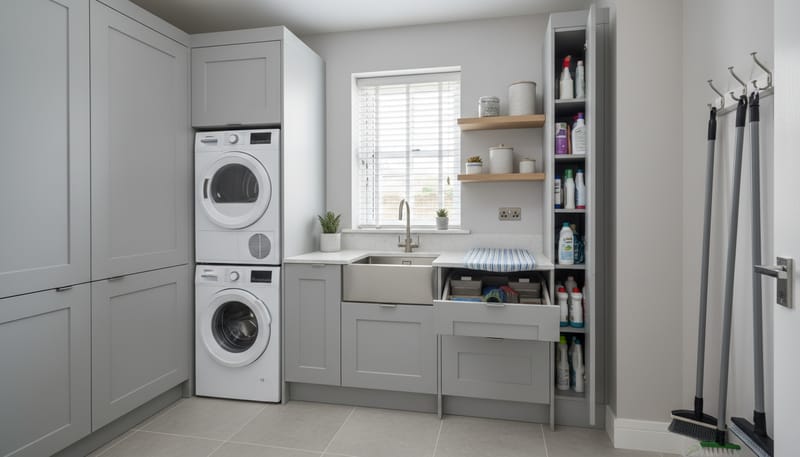
What Your Developer Provides as Standard
Before you spend a penny, it is worth understanding exactly what your housebuilder has already put in place. UK developers such as Barratt, Taylor Wimpey, Persimmon, Bellway, and David Wilson design utility rooms with the essential services pre-installed, giving you a solid foundation to build upon. The standard specification varies by developer and house type, but most new builds include the following provisions.
- Cold water supply and waste standpipe: Plumbed and ready for a standard 600mm freestanding washing machine, usually positioned against an external or shared wall for efficient drainage.
- Electrical sockets: Typically two to four double sockets at worktop height, plus a dedicated socket behind the washing machine position.
- Condensate or vent provision: Either a pre-formed vent hole through the external wall (for vented dryers) or a waste connection for condenser dryer drainage.
- Mechanical ventilation: A trickle vent in the window frame or a passive vent in the wall; some developers fit a basic intermittent extract fan.
- Flooring: The subfloor is finished and ready for your chosen covering. Some developers include vinyl or basic tiling as standard.
- Lighting: A single ceiling light point, sometimes with a basic pendant fitting.
- Door to kitchen: An internal door separating the utility room from the main kitchen area, which helps contain noise and moisture.
On mid-range and premium developments, you may also receive a fitted base cabinet run with laminate worktop, a utility sink with mixer tap, and an external door to the garden or side passage. Check your specification carefully and speak with your sales adviser about any optional upgrades available during the build stage, as developer-installed upgrades often represent better value than retrofitting. For more on which upgrades are worth selecting, read our guide to developer upgrades worth choosing.
Utility Room Layout Types
The size and shape of your utility room dictates which layout works best. New build utility rooms generally fall into one of five configurations. Understanding which type you have helps you plan appliance positions, storage runs, and workflow before you start buying anything.
| Layout Type | Typical Size | Configuration | Best For | Common In |
|---|---|---|---|---|
| Utility cupboard | 1.0 – 2.0 m² | Stacked appliances behind bi-fold or sliding doors | Apartments and 2-bed houses | Starter homes, apartments |
| Single-wall galley | 2.0 – 3.5 m² | Appliances and cabinets along one wall only | Narrow rooms off the kitchen | 3-bed semi-detached |
| Double-wall galley | 3.5 – 5.0 m² | Parallel runs on opposite walls with a central walkway | Separating laundry from storage | 3 – 4 bed detached |
| L-shaped | 4.0 – 6.0 m² | Cabinets and appliances on two adjoining walls | Combining laundry with boot room | 4-bed detached |
| Full room / U-shaped | 5.0 – 8.0 m² | Cabinets on three walls with central floor space | Comprehensive utility with pet zone and boot area | 5-bed executive homes |
Whatever your layout, aim for a minimum 900mm clear walkway between opposing runs of cabinets or appliances. This allows you to open appliance doors fully and move laundry baskets through the space without difficulty. In a single-wall layout, the walkway is naturally generous; in a double-wall galley, measure carefully before committing to deep cabinets on both sides.
If your utility room has an external door, position the boot and coat zone nearest to that door and the laundry zone nearest to the kitchen entrance. This creates a logical flow: muddy boots come off at the garden door, clean laundry moves towards the kitchen and the rest of the house.
Washing Machine and Dryer Placement
The laundry appliances are the centrepiece of any utility room. Choosing the right combination and positioning them correctly has a direct impact on noise, workflow, and how much usable space remains for everything else. There are three main approaches, each with distinct advantages.
| Appliance Option | Typical Cost (2026) | Space Required | Pros | Cons |
|---|---|---|---|---|
| Washer-dryer combo | £400 – £800 | 600mm width (single unit) | One appliance, minimal space, lower upfront cost | Smaller drying capacity, longer cycle times, higher long-term energy use |
| Separate washing machine + vented/condenser dryer | £500 – £1,000 (pair) | 1,200mm side-by-side or 600mm stacked | Full-size loads in both, can wash and dry simultaneously | Higher upfront cost, vented dryers need external wall access |
| Separate washing machine + heat pump dryer | £800 – £1,600 (pair) | 1,200mm side-by-side or 600mm stacked | Lowest energy running cost, no external vent needed, gentler on fabrics | Higher purchase price, slightly longer drying cycles |
| Washing machine only (air dry) | £300 – £700 | 600mm width | Lowest cost, maximum remaining space, zero drying energy cost | Requires dedicated drying space and good ventilation |
For most UK families, a separate washing machine paired with a heat pump dryer offers the best long-term balance. Heat pump dryers from Bosch, Samsung, and AEG typically cost £3 to £5 per month to run compared with £8 to £15 per month for a traditional condenser model. They also produce less ambient heat, which is important in a compact utility room where excess warmth contributes to condensation.
- Check your plumbing position: The developer's cold water feed and waste standpipe fix the washing machine location. Work outward from there.
- Decide stacked or side-by-side: Side-by-side gives you a worktop above both machines. Stacking saves 600mm of floor width but requires a manufacturer-specific stacking kit (£30 – £60).
- Allow vibration clearance: Leave at least 10 – 15mm between appliances and adjacent walls or cabinets to prevent transmitted vibration during spin cycles.
- Position near the external wall: This simplifies vent routing for vented dryers and condensate drainage for condenser and heat pump models.
- Install anti-vibration pads: Rubber anti-vibration mats (£10 – £25) placed beneath each machine significantly reduce noise and floor vibration, particularly on hard flooring.
Drying Solutions: Rack, Pulley, and Dehumidifier
Even households with a tumble dryer need air-drying options for delicates, woollens, and items that cannot tolerate heat. The right drying setup keeps your utility room functional without spreading damp laundry across radiators throughout the house.
- Ceiling-mounted pulley airer (Sheila Maid): A wooden or metal rack that raises and lowers on pulleys, keeping drying clothes at ceiling height and completely out of the way. Costs £40 – £120 and provides up to 10 metres of drying rail. Ideal for standard and larger utility rooms.
- Wall-mounted retractable airer: Folds flat when not in use. The Brabantia WallFix provides 24 metres of line from a compact wall-mounted unit. Budget £50 – £100.
- Heated electric airer: Aluminium frame with heated bars that cost approximately 6p per hour to run. Dries clothes faster than ambient air without the energy cost of a tumble dryer. Expect to pay £40 – £130.
- Over-bath style concertina airer: Wall-mounted and extends outward on a concertina mechanism. Suits narrow single-wall utility rooms. Costs £20 – £50.
- Freestanding folding airer: The simplest option. A large three-tier airer (£15 – £40) provides generous drying capacity but occupies floor space when in use.
- Dehumidifier for drying: A desiccant dehumidifier (£120 – £280) pulls moisture from the air, accelerating drying times by up to 50%. Produces gentle warmth as a byproduct. Essential if you air-dry laundry regularly in a sealed new build.
For most new build utility rooms, the combination of a ceiling-mounted pulley airer for everyday items and a desiccant dehumidifier running during drying cycles delivers the best results. The pulley airer keeps clothes overhead while the dehumidifier prevents condensation build-up on windows and cold surfaces. For more on managing moisture in new builds, see our guide to maximising your new build's energy efficiency.
Worktop and Folding Space
A clear worktop is one of the most underrated features in a utility room. Without a dedicated surface, you end up folding laundry on top of vibrating appliances, on the bed, or on the sofa. Even 600mm of clear worktop transforms the laundry workflow. Ideally, aim for 1,200mm or more positioned directly above or adjacent to your appliances.
| Worktop Material | Cost per Linear Metre | Water Resistance | Durability | Best For |
|---|---|---|---|---|
| Laminate (post-formed) | £30 – £80 | Good (sealed edges essential) | High | Budget-friendly, easy replacement |
| Solid wood (oiled oak or beech) | £80 – £160 | Moderate (needs regular oiling) | High with maintenance | Warm aesthetic, matching kitchen |
| Solid surface (Corian-type) | £150 – £300 | Excellent | Very high | Seamless sink integration |
| Compact laminate (Duropal) | £60 – £120 | Excellent | Very high | Slim profile, modern look |
| Quartz composite | £200 – £400 | Excellent | Extremely high | Premium finish, coordinating with kitchen |
For most utility rooms, a laminate worktop from Howdens, Wickes, or IKEA is the smart choice. It costs a fraction of stone or composite alternatives, withstands daily use, and can be replaced in a few years if it suffers damage. The IKEA EKBACKEN range offers laminate worktops from around £45 for a 186cm length, which is enough to span two side-by-side appliances. If you want to match your kitchen exactly, order the same worktop material from the same supplier and have them cut to size.
For compact utility rooms where permanent worktop space is not feasible, a wall-mounted fold-down table (£40 – £100) provides a folding surface that tucks flat against the wall when not in use. Alternatively, a pull-out worktop integrated into a cabinet run serves the same purpose and disappears completely when pushed back in.
Sink Options: Belfast vs Standard
A dedicated utility sink handles tasks you would rather keep out of the kitchen: soaking stained school uniforms, rinsing muddy wellies, handwashing delicates, filling mop buckets, and cleaning pet bowls. If your developer has not included one as standard, adding a sink is one of the most worthwhile utility room investments you can make.
| Sink Type | Typical Cost | Weight | Bowl Depth | Best For |
|---|---|---|---|---|
| Belfast (butler) fireclay | £120 – £350 | 25 – 35 kg | 200 – 220 mm | Deep soaking, character, durability |
| Composite granite | £100 – £300 | 12 – 20 kg | 180 – 210 mm | Colour choice, modern look, quiet |
| Stainless steel (single deep bowl) | £40 – £150 | 3 – 6 kg | 180 – 250 mm | Budget-friendly, hygienic, lightweight |
| Ceramic inset | £80 – £200 | 15 – 25 kg | 170 – 200 mm | Traditional style, easy cleaning |
The Belfast sink remains the most popular utility room choice in the UK, prized for its generous depth and classic appearance. A deep single bowl accommodates large items like dog beds, bulky coats, and tall vases. If you choose a Belfast sink, ensure your cabinet or wall bracket can support the weight, as fireclay sinks are substantially heavier than composite or steel alternatives.
For the tap, choose a lever-operated mixer with a tall, curved spout that gives clearance for buckets and large items. A pull-out spray head adds versatility for rinsing. Budget options from Screwfix and Toolstation start at £30 – £60, while premium taps from Bristan, Grohe, or Hansgrohe range from £80 – £200. If your new build does not have utility room plumbing for a sink, budget £300 – £600 for a plumber to install hot and cold feeds and a waste connection, assuming the utility room shares a wall with the kitchen.
Ironing Station Setup
The utility room is the logical home for ironing, keeping the board, iron, and spray bottles out of living areas. A well-planned ironing station makes the chore less tedious and keeps equipment safely stored when not in use.
- Wall-mounted fold-down ironing board: Folds flat into a slim wall cabinet when not in use. Saves significant floor space. Costs £80 – £200 from brands like Ironfix and Hafele. Ideal for compact utility rooms.
- Over-door ironing board hook: The simplest storage solution. Hangs a standard board on the back of the door for £5 – £15.
- Built-in ironing drawer: A pull-out drawer with a padded, heat-resistant surface that slides out from a cabinet run. Premium solution at £150 – £350 but delivers a perfectly integrated look.
- Dedicated power socket at ironing height: If your ironing area is away from existing sockets, have an electrician install a double socket at 1,000 – 1,100mm from the floor. Budget £80 – £150 for installation.
- Steam generator iron storage: Steam generator irons are bulkier than standard irons. Allocate a shelf or cabinet section at least 400mm deep and 350mm wide for the base unit plus iron.
Position your ironing area near a hanging rail or hooks where you can immediately hang freshly ironed shirts and trousers. A short section of wardrobe rail (£5 – £15 from any hardware shop) mounted on the wall or inside a cabinet is perfect for this purpose and prevents re-creasing.
Shelving, Cabinetry, and Storage Solutions
Storage is what elevates a utility room from a laundry cupboard to a genuinely functional household hub. The principle is simple: everything needs a home. When every item has a designated place, the room stays organised even during the busiest weeks.
| Storage Solution | Cost Range | Space Required | Capacity | Best For |
|---|---|---|---|---|
| IKEA METOD base + wall cabinets (2m run) | £400 – £900 | 2,000 × 600mm floor + wall | High (closed storage) | Clean, fitted look; hiding clutter |
| Howdens or Wren fitted utility cabinets | £600 – £1,800 | Custom to room dimensions | Very high | Matching kitchen; bespoke configuration |
| IKEA BOAXEL adjustable shelving system | £60 – £180 per section | 600 – 800mm wall width | Medium – high | Flexible, reconfigurable, visible items |
| Floating timber or MDF shelves (set of 3) | £30 – £90 | Wall space only | Medium | Quick-grab items; small rooms |
| Tall freestanding cupboard (1,800mm) | £80 – £250 | 600 × 400mm floor | High | Brooms, vacuum, ironing board |
| Pull-out wire baskets in base cabinet | £30 – £80 each | Within existing cabinet | Medium | Laundry supplies, cleaning products |
| Over-door pocket organiser | £10 – £25 | Door back only | Low – medium | Small items, cloths, sprays |
- Prioritise vertical storage: Use every centimetre from floor to ceiling. Wall cabinets above the worktop, shelving above the door frame, and hooks on the back of the door all exploit otherwise wasted space.
- Use uniform containers: Matching storage boxes and baskets create visual order and stack efficiently. Label them clearly so every family member can find and return items.
- Install pull-out internal fittings: Pull-out baskets, drawer dividers, and carousel units inside base cabinets make contents far more accessible than fixed shelves where items get lost at the back.
- Add a pegboard for tools: A painted pegboard (£15 – £30) with hooks and baskets provides infinitely reconfigurable wall storage for scissors, tape, string, and small tools.
- Keep a clear countertop: Store daily-use items just behind cabinet doors rather than on the worktop. A clear surface is always more useful than a cluttered one.
If budget is a concern, start with freestanding shelving and over-door organisers in the first few months, then upgrade to fitted cabinets once you understand exactly how you use the space. Living in the house for a few weeks before committing to a permanent layout ensures the design reflects your actual habits rather than assumptions. For ideas on organising other areas of your new build, see our guide to new build storage solutions.
The Cleaning Cupboard
A dedicated section of your utility room for cleaning supplies eliminates the frustrating search through under-sink cupboards and hallway corners. The key is a caddy-based system that groups products by room or task, allowing you to grab a ready-stocked caddy and head to whichever room needs attention.
- Room-specific caddies: Prepare separate caddies for the kitchen, bathroom, and general use. Each caddy (£3 – £10) holds sprays, cloths, and sponges for that specific area.
- Wall-mounted broom holder: A spring-grip rail (£10 – £20) mounted on the wall holds mops, brooms, and dustpans off the floor and neatly organised.
- Vacuum charging dock: Dedicate a power socket at the correct height (800 – 1,200mm) for your cordless vacuum's wall-mounted dock. Dyson, Shark, and Samsung models all include mounting brackets.
- Under-sink pull-out tray: A two-tier pull-out (£20 – £50) maximises the space beneath the utility sink for bottles and cleaning cloths.
- Bulk refill shelf: Keep large economy refill bottles on a high shelf, decanting into smaller spray bottles stored in the caddies. This saves money and reduces plastic waste.
- Microfibre cloth rack: A small towel rail or set of hooks (£5 – £15) near the sink for drying and storing reusable microfibre cloths after washing.
Store hazardous chemicals such as bleach, drain unblocker, and oven cleaner in a high cabinet with a child-safety latch if you have young children. Magnetic child locks (£10 – £20 for a pack of four) retrofit easily to any standard cabinet door.
Laundry Sorting Systems
An effective sorting system turns laundry from a chaotic pile into an orderly process. The goal is to sort dirty clothes at the point they enter the utility room so that when it is time to run a wash, you simply grab an already-sorted load.
- Three-compartment laundry sorter: A freestanding sorter with removable bags for whites, colours, and darks. Costs £30 – £80. The removable bags carry directly to the machine.
- Pull-out hamper in base cabinet: Hidden behind a cabinet door, a pull-out hamper (£40 – £120) keeps dirty laundry concealed and the room looking tidy.
- Labelled baskets on open shelving: Stack three or four labelled baskets on a shelf unit. Each basket serves a category: lights, darks, delicates, towels and bedding.
- Family member baskets: Assign each family member a personal basket for clean, folded clothes. They collect their own basket and put clothes away in their rooms. This distributes the workload and teaches children responsibility.
- Dirty clothes enter the utility room and go directly into the appropriate sorting basket.
- When a basket is full, its contents go straight into the washing machine as a pre-sorted load.
- Clean clothes come out of the dryer or off the airer and are folded on the worktop.
- Folded clothes are placed into each family member's personal basket.
- Each person collects their basket and puts clothes away in their own room.
This five-step laundry flow keeps the utility room clear, prevents laundry pile-ups on sofas and beds, and ensures the washing machine always receives a properly sorted load, which protects your clothes and improves wash results.
Pet Washing Station and Pet Zone
The UK is a nation of pet lovers, and the utility room is the perfect space to centralise pet care. A well-designed pet zone keeps feeding bowls, leads, towels, and grooming equipment in one place, and provides a washing station that saves your bathroom from muddy paw prints.
- Low-level dog shower: A shallow shower tray (£60 – £120) with a flexible hose and pull-out spray head, installed at floor level. Tiled or panelled splash-back. Total installation cost including plumbing: £300 – £800.
- Deep utility sink with spray tap: If a separate shower tray is not feasible, a Belfast or deep stainless sink with a pull-out spray tap (£80 – £150 for the tap) handles small to medium dogs comfortably.
- Built-in feeding station: A plinth-level cut-out in the base cabinet run with a pull-out tray for bowls. Keeps food and water contained and easy to clean. DIY cost: £20 – £50.
- Raised feeding stand: A purpose-built stand (£20 – £60) brings bowls to a comfortable height for larger dogs, reducing neck strain and making spills easier to wipe.
- Pet food storage: Airtight containers (£10 – £30) inside a base cabinet keep dry food fresh and prevent pests. Decant from large bags on delivery day.
- Towel hooks and drying space: Dedicate two or three hooks near the wash station for dog towels. A small heated towel rail (£40 – £80) dries towels between walks.
- Lead and harness hooks: A row of sturdy hooks near the external door (£10 – £25) keeps walking equipment accessible and organised.
- Grooming tool caddy: A wall-mounted basket or shelf section for brushes, nail clippers, shampoo, and flea treatment. Keep everything in one place to make grooming sessions efficient.
Position the pet zone nearest to the external door so muddy dogs travel the shortest possible distance through the room. A waterproof mat or tray on the floor beneath the wash station catches drips and protects your flooring. For households with cats, the utility room also works well as a location for a litter tray, positioned away from the feeding area and fitted with a small extract fan or air freshener nearby.
Boot and Coat Storage
If your utility room has an external door, the area beside it naturally becomes a boot room zone. This transition space between the outdoors and the rest of the house is your first line of defence against mud, rain, and clutter. Equipping it properly keeps the hallway and kitchen clear of shoes, coats, and outdoor gear.
- Boot rack with drainage tray: A slatted boot rack (£20 – £60) holds wellies and walking boots upright, allowing air to circulate and mud to dry. A removable tray underneath catches drips.
- Three-tier shoe rack: Accommodates six to nine pairs of everyday shoes in a compact footprint. Budget £15 – £40.
- Bench with under-seat storage: A hallway bench (£60 – £200) provides seating for putting shoes on and off, with baskets or drawers beneath for shoe storage.
- Sturdy coat hooks (two rows): Adult height at 1,500 – 1,600mm, child height at 900 – 1,000mm. Allocate two hooks per family member for current-season coats only.
- Shelf with individual baskets: A shelf above the coat hooks with one labelled basket per family member for hats, gloves, scarves, and keys. Cost: £30 – £60 for shelf and baskets combined.
- Large absorbent entrance mat: A washable mat like Hug Rug (£25 – £50) traps dirt and moisture at the door. Machine-washable so it stays fresh.
Keep the boot room zone focused on current-season items only. Winter coats go to bedroom wardrobes in summer; flip-flops and sun hats go to storage in winter. Rotating seasonal items prevents overcrowding and keeps the space manageable year-round.
Lighting Your Utility Room
The standard developer provision of a single ceiling light point with a basic pendant is functional but uninspiring. Upgrading the lighting turns the utility room from a dim afterthought into a bright, pleasant workspace where you can actually see what you are doing.
Recessed LED downlights are the best ceiling option for utility rooms. Flush-mounted, they do not interfere with ceiling-mounted airers and provide even, shadow-free illumination. Install two to four downlights depending on room size, spaced evenly. Choose warm white (2,700 – 3,000K) for a welcoming atmosphere or cool white (4,000K) for maximum visibility. Budget £20 – £35 per light for the LED fitting, plus £60 – £100 per light for electrician installation.
- Under-cabinet LED strips: Illuminate the worktop directly, eliminating shadows from wall cabinets above. Plug-in strips cost £15 – £40; hardwired installation runs £100 – £250.
- Motion-sensor activation: A motion sensor on the main lights (£10 – £25 for a PIR module) means the lights come on automatically when you walk in with arms full of laundry.
- IP-rated fittings near water: Any light near the sink, dog wash, or shower tray must be rated IP44 or above for splash protection.
- Natural light: If you have a window, keep it unobstructed. A simple roller blind (£15 – £40) provides privacy without blocking daylight. Frosted glass eliminates the need for a blind entirely.
The total cost of upgrading from a single pendant to a proper lighting scheme with four downlights and under-cabinet LEDs is typically £250 – £500 including electrician labour. It is one of the highest-impact, lowest-cost improvements you can make.
Ventilation and Moisture Control
Modern new builds are designed to be airtight for energy efficiency, which is excellent for heating bills but creates a challenge in moisture-generating rooms like the utility. Without adequate ventilation, a single wash cycle and a load of air-drying laundry can raise the room's relative humidity to levels that encourage condensation, musty odours, and eventually mould growth. Getting ventilation right is not optional; it is essential.
- Humidity-sensing extract fan: Activates automatically when moisture levels rise and switches off when humidity normalises. The best option for set-and-forget moisture control. Budget £40 – £80 for the fan plus £100 – £200 for electrician installation.
- Trickle vents: Small openable vents in the window frame that provide continuous background ventilation. Most new build windows include these as standard. Keep them open in the utility room at all times.
- Tumble dryer venting: Vented dryers must exhaust through the external wall via a proper vent kit. Never vent into the room. Condenser and heat pump dryers do not require external venting but do release some ambient moisture.
- Desiccant dehumidifier: Works effectively at lower temperatures than compressor models, making it suited to utility rooms that are not continuously heated. Running cost approximately 4 – 8p per hour.
- Door undercut: Ensure the utility room door has a minimum 10mm undercut to allow replacement air to flow in when the extract fan is running. Without this, the fan works against a near-sealed room and loses effectiveness.
- Window ventilation: If you have an opening window, crack it when air-drying laundry. Even a few centimetres of opening dramatically improves air circulation.
- Avoid blocking vents: Do not place furniture or storage in front of wall vents, trickle vents, or the extract fan. Blocked vents are as useless as no vents at all.
The combination of a humidity-sensing extract fan running during and after wash cycles, trickle vents kept open, and a desiccant dehumidifier for air-drying days provides comprehensive moisture management. Monitor the room for any early signs of condensation on windows or cold surfaces and respond by increasing ventilation immediately.
Flooring: Waterproof Options That Last
Utility room flooring faces a unique combination of challenges: water splashes from the sink and washing machine, muddy footprints from the garden, heavy appliance weight and vibration, dropped cleaning products, and frequent mopping. The floor you choose must be waterproof, durable, easy to clean, and slip-resistant when wet.
| Flooring Type | Cost per m² (Supplied & Fitted) | Waterproof | Durability | Slip Resistance | Comfort Underfoot |
|---|---|---|---|---|---|
| Luxury vinyl tile (LVT) | £30 – £65 | Yes (100%) | High | Good (textured surface) | Warm, cushioned |
| Porcelain tile | £45 – £100 | Yes (100%) | Very high | Excellent (R10/R11 rated) | Cold, hard (UFH recommended) |
| Sheet vinyl | £10 – £25 | Yes (100%) | Medium | Good | Warm, cushioned |
| Ceramic tile | £20 – £45 | Yes (100%) | Medium – high | Good (floor-rated only) | Cold, hard |
| Polished concrete | £80 – £150 | Yes (sealed) | Extremely high | Moderate | Cold, hard (UFH essential) |
- LVT (Karndean, Amtico, Quick-Step): The most popular choice for new build utility rooms. Completely waterproof, warm underfoot, and available in convincing wood and stone effects. Choose a wear layer of 0.5mm or thicker for appliance areas.
- Porcelain tile: The ultimate hardwearing option. Impervious to water, stains, and heavy use. Select a tile with an R10 or R11 slip rating for wet areas.
- Sheet vinyl: The most affordable waterproof option. Modern designs from Rhinofloor and Leoline look far better than budget vinyl of old. Excellent for utility rooms on a tight budget.
- Ceramic tile: A cost-effective tiled option. Ensure you choose floor-rated tiles (not wall tiles) and apply a quality grout sealant to prevent moisture ingress.
- Engineered wood and laminate: Not recommended. Even water-resistant laminate can swell and warp with repeated utility room splashes. Standard engineered wood will deteriorate around the sink and washing machine.
For most new build utility rooms, LVT offers the best all-round performance. If you are installing the same LVT in your kitchen, extend it into the utility room for a seamless, coordinated finish. Many new build buyers choose this approach and find it makes both rooms feel larger and more connected.
Connecting to the Garden
A utility room with a door to the garden or side passage is a genuine lifestyle upgrade. It creates a buffer zone between the outdoors and the house, containing mud, wet shoes, and garden debris in one manageable space before they spread through your living areas.
If your new build utility room has an external door, make the most of the connection by positioning your boot rack, coat hooks, and pet wash station nearest to that door. Consider adding an outdoor tap just outside the utility door (£100 – £250 installed by a plumber) for hosing down wellies, garden tools, and muddy bikes before they come inside. An outdoor shoe rack or a simple covered bench outside the door provides a place to remove the dirtiest footwear before entering the house at all.
For keen gardeners, the utility room doubles as a potting and preparation space. A deep sink for washing vegetables, a section of worktop for potting, and a shelf for seeds and small tools keep garden activities contained. If your utility room does not have an external door but you wish it did, adding one is possible but involves structural work to create the opening. Budget £1,500 – £3,500 for a new external door including lintel, frame, door, and builder and carpenter labour. This is a significant investment but one that transforms the room's usefulness. For more on garden-connected living, see our guide to new build garden design.
Multi-Purpose Utility: The Home Office Nook
In larger utility rooms, there is often space for a secondary function beyond laundry and storage. The most popular dual-use is incorporating a small home office nook, a household admin station, or additional food storage. The key is ensuring the secondary function does not compromise the room's primary utility purpose.
- Home office nook: A 600 – 900mm section of worktop at desk height with a power socket, a small shelf for files, and a stool or chair. Ideal for paying bills, managing household admin, and online shopping without taking over the kitchen table.
- Second fridge or freezer: An under-counter fridge (£150 – £350) or tall freezer (£250 – £550) provides overflow storage for large families, batch cookers, and those who buy in bulk. Ensure adequate ventilation clearance around the appliance.
- Pantry extension: Shelving or a tall larder cabinet stocked with tins, dry goods, and bulky items that overflow from the kitchen. Keeps the kitchen cupboards focused on everyday essentials.
- Craft and hobby corner: A section of worktop with storage for sewing supplies, wrapping paper, gift bags, and craft materials. Keeps creative mess out of shared living spaces.
- Charging station: A designated shelf or drawer with a multi-port USB charger (£15 – £30) for phones, tablets, and devices. Keeps charging cables off kitchen worktops and dining tables.
When combining functions, ensure that moisture-generating activities (laundry, drying) are adequately ventilated so they do not affect electronics, paperwork, or food storage. A dehumidifier running during drying cycles protects everything in the room, not just the laundry. For broader ideas on making every room in your new build work harder, read our guide to new build home improvements that add value.
Full Cost Guide for 2026
Planning your utility room budget starts with knowing the realistic costs for each element. The table below breaks down three tiers of investment, from a minimal functional setup to a comprehensive premium fit-out. All figures assume you already own a washing machine and dryer.
| Item / Category | Budget Tier | Mid-Range Tier | Premium Tier |
|---|---|---|---|
| Cabinetry and worktop | £0 (freestanding shelves £30 – £80) | £500 – £1,200 (IKEA/Howdens run) | £1,500 – £4,000 (fitted with premium doors) |
| Sink and tap (inc. plumbing) | £0 (use kitchen sink) | £250 – £600 (stainless or composite) | £400 – £900 (Belfast with designer tap) |
| Flooring | £50 – £120 (sheet vinyl) | £200 – £500 (LVT) | £400 – £1,000 (porcelain tile) |
| Lighting upgrade | £0 (use developer fitting) | £150 – £350 (downlights) | £300 – £600 (downlights + under-cabinet + feature) |
| Ventilation | £0 (use developer vent) | £120 – £280 (humidity-sensing fan) | £250 – £450 (fan + desiccant dehumidifier) |
| Drying solutions | £15 – £40 (folding airer) | £60 – £150 (pulley airer + heated rack) | £150 – £350 (pulley + heated rack + dehumidifier) |
| Boot room area | £30 – £80 (hooks + shoe rack) | £100 – £300 (bench + hooks + baskets) | £300 – £800 (built-in bench + fitted storage) |
| Pet station | £0 – £50 (bowls + hooks) | £100 – £250 (feeding station + storage) | £400 – £900 (dog shower + full station) |
| Storage and organisation | £40 – £100 (baskets + door hooks) | £100 – £300 (shelving system + containers) | £200 – £500 (pull-out fittings + custom internals) |
| Second fridge or freezer | £0 | £150 – £350 (under-counter) | £300 – £600 (tall freestanding) |
| Total estimated cost | £150 – £500 | £1,800 – £4,500 | £4,500 – £12,000 |
The budget tier is achievable within the first month of moving in and makes the room immediately functional. The mid-range tier delivers a well-equipped, attractive utility room that handles all core household tasks. The premium tier creates a fully fitted, beautifully finished space with dedicated zones for laundry, cleaning, pet care, and boot room storage.
There is no need to complete everything at once. Many homeowners start with the budget tier and add elements incrementally over the first year, upgrading as they learn how they actually use the space. This phased approach often produces a better result than committing to a full fit-out before you have lived in the house.
Must-Have Features Checklist
Before you begin purchasing, work through this checklist to ensure you cover the essentials. Tick off each item as you plan or install it.
- Adequate ventilation: Humidity-sensing extract fan or upgraded vent, plus dehumidifier if air-drying regularly.
- Sufficient power sockets: Count every appliance that needs a socket and add two spare doubles for future needs.
- Waterproof flooring: LVT, vinyl, porcelain, or ceramic. Never carpet, laminate, or unsealed wood.
- Clear worktop surface: At least 600mm for folding, ideally 1,200mm or more.
- Bright, even lighting: Recessed LED downlights plus under-cabinet task lighting above the worktop.
- A sorting system: Whether baskets, hampers, or pull-out bins, pre-sort laundry to save time and protect clothes.
- Utility sink: Deep enough for soaking, with a lever-operated tap for hands-busy operation.
- Vertical storage: Use wall height with shelves, cabinets, hooks, and door-mounted organisers.
- Boot and coat zone: Hooks, shoe rack, and an absorbent mat near the external door.
- Anti-vibration pads: Under washing machine and dryer to reduce noise and protect the floor.
Organisation Tips for Keeping It Tidy
Even the best-designed utility room descends into chaos without simple maintenance habits. These organisation principles keep the room working efficiently week after week.
- One-in-one-out rule: When you buy a new cleaning product, finish or discard the old one. This prevents shelf clutter and expired bottles accumulating.
- Label everything: Baskets, shelves, and containers labelled clearly ensure that every family member returns items to the correct place.
- Daily five-minute reset: At the end of each day, spend five minutes returning items to their places, wiping the worktop, and checking baskets. This prevents small messes from becoming overwhelming.
- Seasonal rotation: Swap out-of-season items (summer sun cream, winter de-icer) to a less accessible shelf or another storage area. Keep only current-season items at grabbing height.
- Decant into uniform containers: Matching bottles, jars, and boxes not only look tidier but stack more efficiently than products in their original packaging.
- Use door backs and cabinet interiors: These hidden surfaces are prime storage real estate. Hooks, pocket organisers, and magnetic strips hold items without taking up shelf or floor space.
- Schedule a quarterly declutter: Every three months, review the room's contents. Discard expired products, donate unused items, and reassess whether your storage layout still works for your household.
Final Thoughts
The utility room will never win a design award or feature on the cover of a homes magazine, but it is the room that keeps every other space in your new build functioning at its best. When the laundry is sorted, the cleaning supplies are organised, the dog comes in from a walk and goes straight to the wash station, and the muddy wellies dry on a rack beside the garden door, the rest of the house stays calmer, cleaner, and more enjoyable to live in.
Your developer has provided the essential infrastructure: plumbing, drainage, electrics, and a dedicated room. The task now is to equip it intelligently, starting with the basics and building out as you learn how your household uses the space. Whether you invest £200 or £10,000, the return on that investment is measured in smoother mornings, tidier evenings, and a kitchen that finally gets to be just a kitchen. For more ideas on making the most of every room in your new build, explore our guides to new build kitchen design, smart home technology, and sustainable living in new builds.