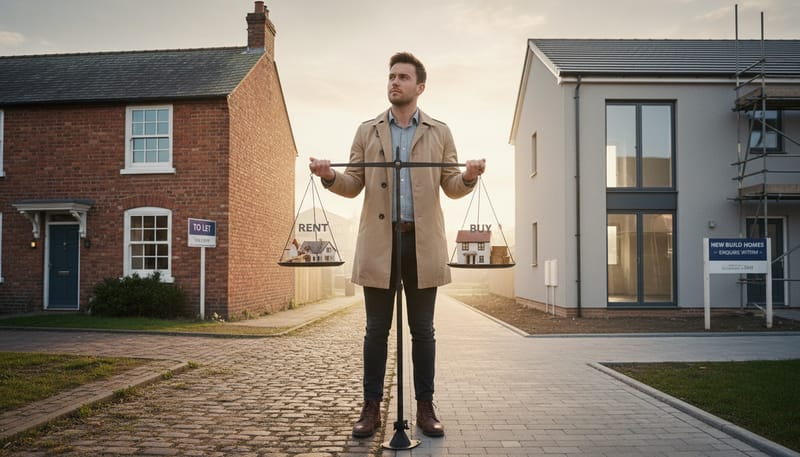
The Big Question: Rent or Buy?
“Why are you throwing money away on rent?” It is a question every renter hears, and while it is well-intentioned, the reality is far more nuanced. Renting is not always a waste of money, and buying is not always the better financial move — it depends on your circumstances, your timeline, and where you live.
This guide gives you the honest numbers so you can decide for yourself when — and whether — making the switch from renting to buying a new build home makes financial and lifestyle sense. We compare monthly costs at different price points, explain how long it takes for buying to become cheaper than renting, and break down the regional picture across the UK.
If you have already decided you want to buy and need help with the deposit, our guide on saving for a new build deposit is the next logical step. And if you are on the fence, read on — the data might surprise you.
Financial Comparison: Renting vs Buying
Let us start with the raw numbers. The financial comparison between renting and buying involves far more than just comparing monthly rent to a mortgage payment. You need to account for the deposit (opportunity cost), transaction costs, maintenance, insurance, and the equity you build as a homeowner.
Monthly Cost Comparison at Different Price Points
The table below compares the monthly cost of renting with the monthly mortgage payment for buying a new build at various price points. Mortgage figures assume a 90% LTV, 4.5% fixed rate, 30-year term. Rent figures are based on typical market rents for equivalent new build properties in 2025.
| Property Price | Deposit (10%) | Monthly Mortgage | Equivalent Monthly Rent | Monthly Saving by Buying |
|---|---|---|---|---|
| £180,000 | £18,000 | £821 | £850–£950 | £29–£129 |
| £225,000 | £22,500 | £1,026 | £1,000–£1,150 | −£26 to £124 |
| £275,000 | £27,500 | £1,254 | £1,150–£1,350 | −£104 to £96 |
| £325,000 | £32,500 | £1,482 | £1,300–£1,500 | −£182 to £18 |
| £400,000 | £40,000 | £1,823 | £1,600–£1,850 | −£223 to £27 |
At first glance, the monthly mortgage payment and rent are often remarkably similar — and in many cases, the mortgage is lower than the rent. But this comparison misses the crucial point: when you pay a mortgage, a portion of each payment goes towards reducing your loan balance (building equity), while rent payments build nothing for you.
The Hidden Costs of Buying
To make a fair comparison, you need to add the costs that renters do not pay:
- Deposit: Typically 5–15% of the property price (£12,500–£60,000 for the examples above). This money could otherwise be invested.
- Solicitor/conveyancing fees: £1,200–£2,500
- Mortgage product fees: £0–£2,000
- Survey/valuation: £0–£600 (often free on new builds)
- Stamp duty: £0 for most FTBs purchasing under £300,000; 5% on the portion between £300,001–£500,000
- Maintenance & repairs: Budget 1–2% of the property value per year (lower for new builds thanks to warranties)
- Buildings insurance: £150–£400 per year
- Service charges: £0–£4,000+ per year (mainly apartments)
The Hidden Costs of Renting
Renting has its own ongoing costs that are easy to overlook:
- Annual rent increases: Rents typically rise 3–7% per year, meaning your costs grow steadily while a fixed-rate mortgage stays the same
- No equity: Every pound of rent disappears — you never build ownership
- Moving costs: Renters move more frequently, incurring repeated moving fees, deposits, and agency charges
- Limited control: You cannot renovate or personalise freely, and the landlord may sell or not renew your tenancy
- Deposit tied up: Your tenancy deposit (typically 5 weeks’ rent) sits in a scheme earning minimal interest
For a full picture of what to budget for as a buyer, see our budgeting beyond the deposit guide.
When Does Buying Become Cheaper Than Renting?
This is the question everyone wants answered, and the concept is known as the break-even point — the moment when the total cost of buying (including the deposit, fees, mortgage payments, maintenance, and lost investment returns on your deposit) falls below the total cost of renting over the same period.
The Break-Even Calculation Explained
The break-even point depends on several variables:
- The gap between rent and mortgage payments: If rent is significantly higher than your mortgage, buying becomes cheaper faster.
- Rate of rent increases: Faster rent growth tips the balance towards buying sooner.
- Property price growth: If your home increases in value, you build equity faster.
- Mortgage interest rate: A lower rate means more of your payment goes towards equity from day one.
- Deposit opportunity cost: The return you would have earned by investing your deposit instead (typically 4–6% in stocks, 3–5% in savings accounts).
- Transaction costs: The upfront costs of buying (solicitor, fees) need to be “paid back” through savings on housing costs.
Typical Break-Even Timelines
For most UK first-time buyers purchasing a new build in 2025:
Estimated Break-Even by Scenario
Assumes 3% annual rent growth, 3% annual house price growth, 4.5% mortgage rate. Individual results vary.
The key takeaway: if you plan to stay in your home for 5 years or more, buying is almost always cheaper in the long run. If you might move within 2–3 years, renting may be more cost-effective once you factor in transaction costs.
The Lifetime ISA can accelerate your break-even point by effectively giving you a 25% bonus on your deposit savings — worth exploring if you are under 40.
Deposit Requirements: How Much Do You Actually Need?
The deposit is the biggest barrier to switching from renting to buying. Here is a realistic breakdown of what you need to save and the options available.
Minimum Deposit Levels
| Deposit % | £180,000 Home | £225,000 Home | £275,000 Home | £325,000 Home |
|---|---|---|---|---|
| 5% (minimum) | £9,000 | £11,250 | £13,750 | £16,250 |
| 10% (typical FTB) | £18,000 | £22,500 | £27,500 | £32,500 |
| 15% (better rates) | £27,000 | £33,750 | £41,250 | £48,750 |
| 20% (optimal rates) | £36,000 | £45,000 | £55,000 | £65,000 |
A 5% deposit is the absolute minimum for most lenders, and products at this level are available through the government-backed mortgage guarantee scheme. However, a 10% deposit opens up significantly more products at better rates and is the target we recommend for most first-time buyers.
Help With Your Deposit
If saving a deposit feels impossible while paying rent, there are several mechanisms that can help:
- Lifetime ISA: Save up to £4,000 per year and receive a 25% government bonus (up to £1,000 per year). Available to 18–39 year olds.
- Shared Ownership: Buy a 25–75% share and pay reduced rent on the remainder. Deposits are based on the share you buy, not the full price.
- Family support: Gift deposits, guarantor mortgages, or family offset mortgages can bridge the gap.
- Developer incentives: Some developers contribute towards your deposit or cover stamp duty and legal fees.
- Help to Buy alternatives: Explore current schemes that have replaced Help to Buy.
Lifestyle Factors: It Is Not Just About Money
The rent-vs-buy decision is not purely financial. Your lifestyle, career, and personal circumstances play an equally important role.
When Renting Makes More Sense
- You are not sure where you want to live long-term. If your career might take you to a different city within the next 2–3 years, renting keeps you mobile.
- You are in a volatile industry. If redundancy is a real possibility, the flexibility of renting is valuable. Selling a home in a hurry can be costly.
- You value zero maintenance responsibility. As a renter, the boiler and the roof are the landlord’s problem.
- You are saving towards a larger deposit. Sometimes it makes sense to rent cheaply for another year or two to save a bigger deposit, which secures a better mortgage rate and lower monthly payments.
- You want to live in a location where buying is not yet affordable. In parts of London and the South East, the deposit required can be £50,000+, and continuing to rent while saving is a pragmatic choice.
When Buying Makes More Sense
- You plan to stay put for 5+ years. The longer you stay, the more buying saves you compared to renting.
- You want stability and security. Homeownership means no landlord can ask you to leave. You can paint the walls, have pets, and put down roots.
- You want to build wealth. Every mortgage payment builds equity. Over 10 years, a typical homeowner builds £50,000–£100,000+ in equity through payments and price growth.
- Your rent is already close to (or higher than) a mortgage payment. If you are paying £1,200 in rent and a mortgage would cost £1,100, the financial case is strong.
- You want to personalise your home. New builds offer a blank canvas — see our guide on furnishing your first new build on a budget.
- You have access to deposit help. Family gifts, Lifetime ISA bonuses, or Shared Ownership can make buying affordable sooner.
Think about where you want to be in 5–10 years. If the answer involves settling in one area, starting a family, or building long-term financial security, buying a new build is likely the stronger option.
Regional Rent vs Mortgage Comparison
The rent-vs-buy equation varies enormously across the UK. In some regions, buying is dramatically cheaper than renting from month one. In others — particularly London — the gap is narrower or even reversed in the short term.
Monthly Rent vs Mortgage by Region (3-Bed New Build, 2025)
| Region | Avg. New Build Price | Monthly Mortgage (90% LTV) | Avg. Monthly Rent | Monthly Difference |
|---|---|---|---|---|
| North East | £195,000 | £889 | £750 | Rent cheaper by £139 |
| North West | £235,000 | £1,071 | £950 | Rent cheaper by £121 |
| Yorkshire | £225,000 | £1,026 | £900 | Rent cheaper by £126 |
| East Midlands | £260,000 | £1,185 | £1,050 | Rent cheaper by £135 |
| West Midlands | £275,000 | £1,254 | £1,100 | Rent cheaper by £154 |
| East of England | £340,000 | £1,550 | £1,350 | Rent cheaper by £200 |
| South West | £310,000 | £1,413 | £1,200 | Rent cheaper by £213 |
| South East | £385,000 | £1,755 | £1,500 | Rent cheaper by £255 |
| London | £520,000 | £2,370 | £2,100 | Rent cheaper by £270 |
| Wales | £215,000 | £980 | £800 | Rent cheaper by £180 |
| Scotland | £210,000 | £957 | £850 | Rent cheaper by £107 |
Important: While rent appears cheaper on a monthly basis in every region, this comparison ignores the critical fact that mortgage payments build equity. Of a £1,100 monthly mortgage payment, roughly £400–£550 goes towards reducing your loan balance (the exact split depends on your rate and how far into your term you are). That £400–£550 is effectively savings, not a cost. When you factor in equity building, buying is cheaper in most regions within 3–7 years.
Rent Growth Over Time
Another factor the table does not capture is rent inflation. UK rents have risen by an average of 5–7% per year in recent years. If you are paying £1,000 per month today and rents increase by 5% annually, you will be paying £1,276 in 5 years and £1,629 in 10 years. Meanwhile, a fixed-rate mortgage payment stays exactly the same (until you remortgage, at which point your balance will be lower).
This rent escalation is one of the strongest arguments for buying as soon as you can afford to. Our first-time buyer timeline can help you plan the optimal point to make the switch.
Frequently Asked Questions
Is renting really “throwing money away”?
Not exactly. Renting provides a roof over your head, flexibility to move, and freedom from maintenance costs. However, it does not build any equity or long-term financial asset. Over 10 years, a renter paying £1,200/month will have spent £144,000+ (accounting for rent increases) with nothing to show for it. A homeowner spending a similar amount on their mortgage will have built £50,000–£80,000+ in equity. Renting is a valid choice in many circumstances, but the long-term financial advantage of buying is significant for those who can afford to do so.
How much deposit do I need to switch from renting to buying?
The minimum is 5% of the property price, though 10% opens up much better mortgage products. For a £250,000 new build, that is £12,500–£25,000. You will also need £2,000–£5,000 for solicitor fees, moving costs, and other expenses. A Lifetime ISA with its 25% government bonus is one of the most effective ways to grow your deposit while renting. Our deposit saving guide has a full breakdown.
Can I get a mortgage if I am currently renting?
Absolutely. Being a renter does not affect your mortgage eligibility. In fact, a consistent history of paying rent on time demonstrates financial responsibility. Lenders assess your income, outgoings, credit history, and deposit — not your current housing status. If you are renting and your credit score is healthy, you are in a good position to apply.
What about Shared Ownership as a stepping stone?
Shared Ownership is an excellent middle ground between renting and full ownership. You buy a 25–75% share of a new build home and pay a reduced rent on the remaining share. Your deposit is based only on the share you buy, making it significantly more affordable. For example, a 40% share of a £250,000 home means a purchase price of £100,000 and a 5% deposit of just £5,000. You can “staircase” (buy more shares) over time as your finances improve.
Will my monthly costs increase if I buy?
Not necessarily. In many areas, a mortgage payment is similar to or lower than rent for an equivalent property. However, as a homeowner you will also pay for buildings insurance, maintenance, and potentially service charges. The total monthly outgoing may be 5–15% higher than rent in the short term, but remember that a significant portion of your mortgage payment is building equity — money that comes back to you when you sell. And while rent will increase every year, your fixed-rate mortgage payment stays level for the deal period.
Making the Switch at the Right Time
The decision to switch from renting to buying a new build is one of the most impactful financial moves you will ever make. The numbers show that for anyone planning to stay in one place for 5 years or more, buying is almost always the better long-term choice — you build equity, your costs are more predictable, and you benefit from any growth in property values.
But timing matters. Rushing into a purchase before you are financially ready can cause stress and strain. Make sure you have a solid deposit (ideally 10%), a healthy credit score, and a clear understanding of the total costs involved. If you need another 6–12 months of saving, that is time well spent.
When you are ready, the new build buying process is more straightforward than many people expect — chain-free, warranty-backed, and increasingly supported by schemes like Shared Ownership and developer incentives that make that first step onto the ladder more achievable than ever.
Your future self will thank you for every pound you put towards a home instead of a landlord’s mortgage. Start planning today, and let our full range of first-time buyer guides support you every step of the way.