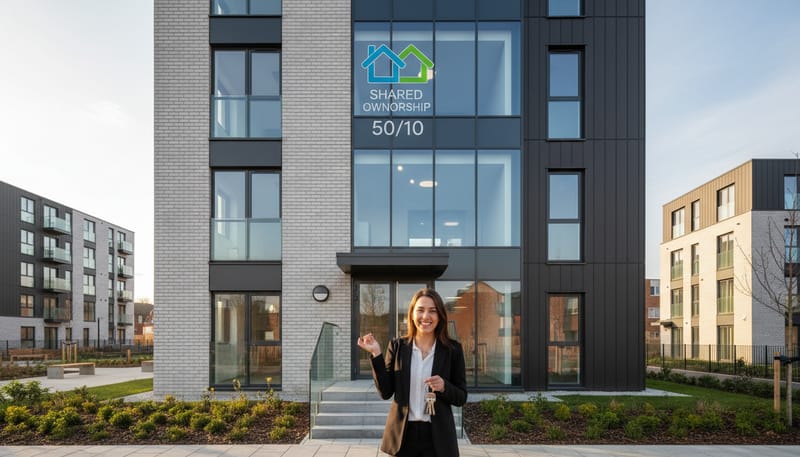
Understanding Your Two Main Routes to Homeownership
As a first-time buyer looking at new build homes, you have two primary routes onto the property ladder: buying outright (with a standard mortgage covering the full property value) or shared ownership (where you buy a share of the property and pay rent on the remainder). Both have their merits, and the right choice depends entirely on your financial situation, location, and long-term goals.
Shared ownership was specifically designed to help people who can’t afford to buy a home outright on the open market. It’s delivered through housing associations and is widely available on new build developments across England. If you’ve been looking at new build homes and feeling priced out, shared ownership could be the key that unlocks the door to homeownership. For a broader overview of the buying journey, see our complete guide to buying a new build home in the UK.
Buying outright with a standard mortgage is the traditional route and gives you full ownership from day one. You’ll need a larger deposit and higher income, but you won’t pay rent on any portion of the property and you’ll have complete freedom over your home. Understanding the new build buying process step by step will help you navigate either route.
At a Glance: Key Differences
Shared Ownership
- Buy 25%–75% of the home
- Smaller deposit needed
- Pay rent on the unsold share
- Can “staircase” to full ownership
- Income cap applies
Buying Outright
- Own 100% from day one
- Larger deposit required
- No rent to pay
- Full control over property
- No income cap
Comparison based on current shared ownership model (England, 2024/25)
Monthly Cost Comparison at Different Share Levels
One of the most important factors in your decision is the monthly cost. The table below compares the typical monthly outgoings for shared ownership at different share levels against buying outright, based on a £250,000 new build property. These figures use a mortgage rate of 5% over 25 years and a shared ownership rent rate of 2.75% on the unsold share.
| Cost Component | 25% Share | 50% Share | 75% Share | 100% (Buying Outright) |
|---|---|---|---|---|
| Property value owned | £62,500 | £125,000 | £187,500 | £250,000 |
| Deposit needed (10%) | £6,250 | £12,500 | £18,750 | £25,000 |
| Mortgage amount | £56,250 | £112,500 | £168,750 | £225,000 |
| Monthly mortgage payment | £329 | £658 | £987 | £1,316 |
| Monthly rent on unsold share | £430 | £286 | £143 | £0 |
| Estimated service charge | £125 | £125 | £125 | £125 |
| Total monthly cost | £884 | £1,069 | £1,255 | £1,441 |
| Monthly saving vs outright | £557 | £372 | £186 | – |
Important notes: These figures are illustrative and based on a £250,000 property with a 5% mortgage rate. Your actual costs will depend on the specific property price, mortgage rate, rent rate set by the housing association, and service charge. Always get a personalised affordability assessment before committing.
The Deposit Advantage
Perhaps the most striking difference is the deposit requirement. At a 25% share, you only need a £6,250 deposit compared to £25,000 for buying outright – that’s £18,750 less to save. This can cut years off your savings timeline, especially if you’re combining it with a Lifetime ISA. For more strategies on building your deposit, read our guide to saving for a new build deposit.
What About a £350,000 Property?
For those looking at higher-priced new builds, the numbers scale accordingly. Here’s how a £350,000 property compares:
| Cost Component | 25% Share | 50% Share | 75% Share | 100% (Buying Outright) |
|---|---|---|---|---|
| Property value owned | £87,500 | £175,000 | £262,500 | £350,000 |
| Deposit needed (10%) | £8,750 | £17,500 | £26,250 | £35,000 |
| Monthly mortgage payment | £460 | £921 | £1,381 | £1,842 |
| Monthly rent on unsold share | £602 | £401 | £201 | £0 |
| Estimated service charge | £150 | £150 | £150 | £150 |
| Total monthly cost | £1,212 | £1,472 | £1,732 | £1,992 |
Staircasing: Building Towards Full Ownership
One of the key advantages of shared ownership is the ability to staircase – gradually buying additional shares of your property over time until you eventually own it outright. Understanding how staircasing works is essential for making an informed decision.
How Staircasing Works
When you want to increase your ownership share, you apply to the housing association and have the property independently valued at current market rates. You then purchase additional shares at the current market value (which may be higher or lower than the original purchase price, depending on how the market has moved).
Under the New Model shared ownership (from 2021), you can staircase in 1% increments for the first 15 years (up to a total of 15% additional ownership through 1% steps). After that, or if you want to buy larger chunks, the minimum purchase is typically 5% or 10% depending on the housing association. You can staircase up to 100% ownership, at which point you own the property outright and no longer pay rent.
Costs of Staircasing
Each staircasing transaction involves costs including:
- Valuation fee: £200–£500 for an independent property valuation
- Solicitor fees: £500–£1,500 for the legal work
- Mortgage arrangement fees: If you need to remortgage to fund the additional share
- Stamp duty: May apply if you’re staircasing to 80% or above and the property value exceeds the relevant threshold. Our guide to stamp duty on new build homes explains the details
These costs mean that very small staircasing steps (1%) may not be cost-effective once you factor in fees. Many shared owners wait until they can afford to staircase by 10% or more to make the transaction costs worthwhile.
The Strategic Approach to Staircasing
The optimal staircasing strategy depends on property values and mortgage rates at the time. Here are the key considerations:
- Property value appreciation: If your property has increased significantly in value, buying additional shares costs more. Some owners choose to staircase early while prices are lower
- Mortgage rate environment: When mortgage rates are low, it may be cheaper to borrow more and staircase up. When rates are high, the combined cost of mortgage plus rent may be acceptable
- Rent reduction: Each time you staircase, your rent decreases because the unsold share is smaller. This can free up money for further staircasing
- Reaching 100%: Once you own 100%, you no longer pay rent to the housing association, your monthly costs may decrease significantly, and you have full ownership rights
Pros and Cons: A Direct Comparison
To help you weigh up both options, here’s a comprehensive comparison of the advantages and disadvantages of each route. Consider which factors matter most to your personal situation.
| Factor | Shared Ownership | Buying Outright |
|---|---|---|
| Deposit required | 5–10% of your share only (e.g., £3,125–£6,250 for 25% of a £250k property) | 5–20% of the full property price (e.g., £12,500–£50,000 for a £250k property) |
| Income needed | Lower – mortgage is only on your share | Higher – mortgage is on the full price |
| Monthly costs | Mortgage + rent + service charge (can be lower overall but rent is not building equity) | Mortgage + service charge only (all payments build equity) |
| Equity building | Only build equity on your owned share; rent payments build no equity | All mortgage payments build equity in the full property |
| Property choice | Limited to specific shared ownership developments and housing association stock | Any property on the open market |
| Making changes | May need housing association permission for significant alterations | Full freedom to modify your home (within planning rules) |
| Selling | Housing association has first refusal and manages the sale process initially | Full control over sale timing, price, and process |
| Stamp duty | Can be deferred on shared ownership (pay on initial share or elect to pay on full value upfront) | First-time buyer relief on properties up to £625,000 |
| Speed to market | Faster – lower deposit means less saving time | Slower – larger deposit takes longer to save |
| Long-term cost | Can be higher due to rent payments over time, but staircasing reduces this | Lower overall as all payments go towards ownership |
| Mortgage options | Fewer lenders offer shared ownership mortgages, but options are growing | Widest choice of lenders and mortgage products |
Which Option Is Better for Your Circumstances?
There’s no universally “better” option – the right choice depends on your individual circumstances. Here’s a guide to help you decide.
Shared Ownership May Be Better If:
- You have a smaller deposit saved (under £15,000) and want to get on the ladder sooner
- Your income is below £80,000 (£90,000 in London) and you’re priced out of the open market in your area
- You want to stop renting and start building some equity, even if it’s not on the full property value
- You’re happy to live in a specific development rather than having unlimited choice
- You see it as a stepping stone and plan to staircase to full ownership over time
- You’re currently paying rent that’s comparable to or higher than shared ownership costs
- You’re looking at an area where even with a Lifetime ISA and maximum savings, outright purchase is years away
Buying Outright May Be Better If:
- You have a sufficient deposit (ideally 10%+) for the properties you’re considering
- Your income comfortably supports a mortgage on the full property price
- You want maximum choice over location, development, and property type
- You prefer to build equity on the full value of the property from day one
- You want complete control over your home without housing association involvement
- You’re thinking long-term and want to avoid the ongoing cost of rent on an unsold share
- You may want to make significant modifications or improvements to your home
The “Wait and Save” vs “Get on the Ladder Now” Debate
One of the biggest dilemmas first-time buyers face is whether to use shared ownership to get on the ladder now, or wait longer to save a bigger deposit for outright purchase. Consider these factors:
- Property price growth: If prices are rising in your area, waiting could mean the goal posts move further away. Getting on the ladder via shared ownership means you benefit from any future price increases on your share
- Rent vs mortgage: Every month you spend renting privately is money going to your landlord with no return. Even with shared ownership, you’re building equity on your owned share. For a detailed comparison, see our renting vs buying analysis
- Life stage: If you need stability now (starting a family, settling in an area), shared ownership can provide that sooner. If you’re flexible and happy renting for a few more years, outright purchase may be worth the wait
- Career trajectory: If your income is likely to increase significantly in the next few years, waiting to buy outright might make sense. If it’s stable, shared ownership gets you started now
No matter which route you choose, improving your credit score beforehand will help you secure the best possible mortgage deal.
Frequently Asked Questions
Can I use a Lifetime ISA with shared ownership?
Yes, absolutely. You can use your Lifetime ISA funds (including the 25% government bonus) towards the deposit on a shared ownership property, provided the full market value of the property is £450,000 or less. Since the deposit required for shared ownership is much smaller, your LISA savings may cover the entire deposit. For example, a 10% deposit on a 25% share of a £250,000 property is just £6,250 – achievable with around 18 months of LISA savings and bonus.
What happens to my shared ownership home if I want to move?
When you want to sell a shared ownership property, the housing association typically has the right of first refusal for a set period (usually 8–12 weeks). During this time, they may find a nominated buyer (another shared ownership applicant). If they don’t find a buyer within this period, you can sell on the open market. If you’ve staircased to 100% ownership, you can sell freely without housing association involvement. The sales process is slightly longer than a standard sale, so factor this into your plans.
Is shared ownership only available on new build homes?
No, shared ownership is available on both new build properties and resale shared ownership homes (where a previous shared owner is selling their share). However, the majority of shared ownership stock in the UK is new build, as housing associations partner with developers to include shared ownership units in new developments. Resale shared ownership properties can offer good value and are worth considering alongside new builds.
Can I rent out a shared ownership property?
Generally, no. Shared ownership properties are intended to be your main residence, and most housing associations do not allow sub-letting without prior written consent. In exceptional circumstances (such as temporary work relocation), some housing associations may grant permission for a limited period. If you think you might need to move temporarily in the future, discuss this with the housing association before purchasing.
What are the income limits for shared ownership in 2025?
The current household income cap for shared ownership in England is £80,000 per year, or £90,000 per year in London. This applies to the combined income of all people who will be named on the mortgage. These limits are reviewed periodically by the government. If your income is above these thresholds, you would need to explore other routes onto the property ladder such as buying outright with available developer incentives.
Making Your Decision: Next Steps
Both shared ownership and buying outright are valid, well-trodden paths to homeownership for first-time buyers. Shared ownership offers an accessible entry point with a smaller deposit and lower income requirement, making it ideal for those who want to stop renting and start building equity sooner. Buying outright gives you full ownership, maximum flexibility, and no ongoing rent – but requires more savings and a higher income.
Whichever route you choose, the key steps are the same: start saving your deposit as early as possible, work on building a strong credit score, and research the developments and areas that interest you. If shared ownership appeals, contact local housing associations to register your interest and attend open days at shared ownership developments. If you’re aiming to buy outright, maximise your Lifetime ISA and explore mortgage options well in advance.
Remember, there’s no wrong answer here – both routes lead to the same destination: your very own new build home. The best choice is the one that gets you there in a way that works for your finances and your life.