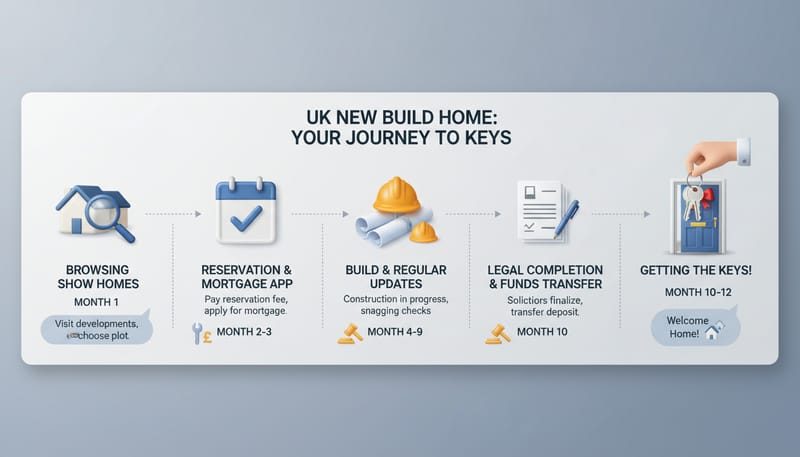
Your Complete First-Time Buyer Timeline
Buying your first home is one of the biggest financial decisions you will ever make, and understanding the timeline from initial research to collecting your keys can transform an overwhelming process into a manageable, step-by-step journey. Knowing what happens when — and how long each stage typically takes — helps you plan your finances, coordinate with solicitors and mortgage brokers, and avoid the anxiety that comes from the unknown.
For new build homes specifically, the timeline has some important differences compared to buying an older property. There is no property chain to worry about (a major advantage), but the completion date may depend on the build stage when you reserve. Buying a completed new build can take as little as 8 to 12 weeks from reservation to moving in, while purchasing off-plan can involve a wait of 12 to 24 months or more before the home is ready.
This guide breaks down the entire process into clear phases, with realistic timeframes for each stage. Whether you are still saving for a deposit or ready to start viewing developments, this is your roadmap from first thought to first night in your new home.
Phase 1: Research and Financial Preparation (6–24 Months Before)
The journey to homeownership begins long before you set foot in a show home. This preparation phase is about getting your finances in order, understanding what you can afford, and building the foundation for a successful purchase.
Step-by-Step: Getting Ready
- Assess your finances (Month 1): Calculate your total income, regular outgoings, existing debts, and how much you can realistically save each month. Use online mortgage calculators to get a rough idea of what you could borrow
- Check your credit score (Month 1): Obtain your free credit report from all three agencies (Experian, Equifax, TransUnion). Address any errors or issues immediately. If your score needs improvement, start building positive credit history
- Start saving aggressively (Months 1–24): Open a Lifetime ISA to benefit from the 25% government bonus. Set up standing orders to a dedicated savings account. Reduce non-essential spending and consider increasing your income through overtime, side work, or career progression
- Research the market (Ongoing): Start browsing new build developments in areas you are interested in. Sign up for developer mailing lists. Attend show home viewings to understand what is available at different price points
- Understand your options (Months 3–6): Research shared ownership, first-time buyer schemes, and any government incentives that could help you buy sooner
- Budget for all costs (Months 6–12): Remember that the deposit is just one part of the cost. Factor in legal fees, stamp duty, survey costs, moving expenses, and furnishing costs that many first-time buyers underestimate
Preparation Phase Milestones
| Milestone | When | What to Do | Cost / Impact |
|---|---|---|---|
| Credit check | Month 1 | Check all three credit reports, dispute errors | Free (statutory reports) |
| Open Lifetime ISA | Month 1–2 | Open LISA, set up monthly contributions up to £333/month | 25% government bonus on savings |
| Create savings plan | Month 1–2 | Set monthly savings target, automate transfers | Target: 5–15% of property price |
| Research areas | Months 2–6 | Visit developments, check commute times, local amenities | Time investment only |
| Get mortgage AIP | 3–6 months before buying | Approach a mortgage broker for Agreement in Principle | Free (most brokers) |
| Instruct a solicitor | Before reservation | Get quotes from 2–3 conveyancing solicitors experienced with new builds | £1,000–£2,500 (payable later) |
Phase 2: House Hunting and Reservation (Weeks 1–8)
With your finances prepared and a mortgage agreement in principle (AIP) in hand, you are ready to start seriously looking for your new build home. This phase typically takes 4 to 8 weeks, though some buyers find their ideal home on the first visit.
The House Hunting Process
Weeks 1–2: Shortlisting developments. Use new build search websites, developer websites, and estate agents to identify developments in your preferred areas and budget. Book viewings at 3 to 5 developments to compare what is available. Pay attention to not just the property itself, but the location, transport links, local amenities, and future development plans for the area.
Weeks 2–4: Viewing and comparing. Attend show home viewings and ask plenty of questions. Take notes and photos at each visit. Compare the specifications, plot positions, and overall value. If possible, visit at different times of day to get a sense of noise levels, traffic, and natural light.
Weeks 4–6: Narrowing down and negotiating. Once you have identified your preferred development and plot, discuss pricing and incentives with the sales team. Many developers offer first-time buyer incentives such as contribution to legal fees, stamp duty assistance, or upgraded specifications. This is the time to negotiate.
Weeks 6–8: Reservation. When you are confident in your choice, you will pay a reservation fee (typically £500 to £1,000) to secure your chosen plot. This takes the property off the market while your mortgage application and legal work proceed. The reservation agreement will set a deadline for exchange of contracts, usually 28 days.
Key Actions at Reservation
- Pay reservation fee and sign the reservation agreement
- Confirm your chosen plot, house type, and any agreed incentives in writing
- Instruct your conveyancing solicitor immediately
- Submit your full mortgage application (not just the AIP)
- Begin gathering documentation for your solicitor (ID, proof of funds, etc.)
- Note the cooling-off period (typically 14 days under the Consumer Code)
Phase 3: Mortgage Application and Legal Work (Weeks 8–20)
This is often the longest and most complex phase of the buying process. Your mortgage application and your solicitor’s legal work typically run in parallel, and keeping both moving requires active engagement from you.
The Mortgage Process
Weeks 8–10: Full mortgage application. Your mortgage broker or lender will require a comprehensive application including proof of income (payslips, P60, tax returns if self-employed), bank statements (typically 3 months), proof of deposit, identification, and details of your current address history. If parents are contributing to the deposit, they will need to provide a gift letter and proof of funds — see our guide on parental help for first-time buyers.
Weeks 10–12: Mortgage valuation. The lender will arrange a valuation of the property to confirm it is worth the purchase price. For new builds, this may be a desktop valuation (especially for completed properties from well-known developers) or a physical inspection. Some lenders charge for this; others include it free.
Weeks 12–14: Mortgage offer. If the valuation is satisfactory and the underwriter is happy with your application, you will receive a formal mortgage offer. This document confirms the loan amount, interest rate, term, and conditions. Review it carefully with your broker and solicitor. A typical mortgage offer is valid for 3 to 6 months.
The Legal (Conveyancing) Process
While your mortgage is being processed, your solicitor will be working through the conveyancing process:
- Reviewing the contract pack: The developer’s solicitor sends a pack including the draft contract, title information, and planning details. Your solicitor reviews this for any issues
- Raising enquiries: Your solicitor submits questions to the developer’s solicitor about the property, the development, management arrangements, and any concerns arising from the contract review
- Conducting searches: Local authority searches, environmental searches, drainage searches, and other checks that can take 2–6 weeks depending on the local council
- Reviewing the mortgage offer: Your solicitor checks the mortgage offer conditions and ensures everything aligns with the purchase
- Reporting to you: Your solicitor sends a detailed report explaining the terms, any issues found, and what you are committing to
Week-by-Week Timeline: Mortgage and Legal
| Week | Mortgage Track | Legal Track | Your Actions |
|---|---|---|---|
| 8–9 | Submit full application | Solicitor receives contract pack | Provide all requested documents promptly |
| 9–10 | Application processing | Solicitor raises initial enquiries | Respond to any queries from broker or solicitor |
| 10–12 | Valuation arranged and completed | Searches ordered and processing | Chase if valuation is delayed |
| 12–14 | Underwriting and mortgage offer issued | Search results received, enquiries answered | Review mortgage offer carefully |
| 14–16 | Mortgage offer reviewed by solicitor | Solicitor prepares report on title | Read solicitor’s report and ask questions |
| 16–18 | Conditions satisfied | Ready to exchange — sign contract and transfer deposit | Sign contract, arrange deposit transfer |
| 18–20 | Awaiting completion date | Exchange of contracts — legally binding | Arrange insurance, plan move, book removals |
Exchange of contracts is the point at which the purchase becomes legally binding. Once exchanged, neither party can withdraw without serious financial consequences. You will need to transfer your exchange deposit (typically 10% of the purchase price, minus the reservation fee) to your solicitor before exchange.
Phase 4: Pre-Completion and Moving In (Weeks 20–24)
The period between exchange of contracts and completion is typically 1 to 4 weeks for a completed new build. For off-plan purchases, the gap can be much longer — sometimes several months — while the home is finished.
Before Completion Day
- Arrange buildings insurance: Your mortgage lender requires buildings insurance to be in place from exchange (some require it from completion). Set this up immediately after exchange
- Book your removal company: Or hire a van if you are doing it yourself. Popular dates (Fridays and end of month) book up quickly
- Arrange utility connections: Contact energy suppliers, broadband providers, and water companies. Aim to have broadband installed on moving day or shortly after
- Snagging inspection: For new builds, arrange a snagging inspection before or shortly after completion. Many buyers hire a professional snagging company (£300–£500) to identify any defects the developer needs to fix
- Home demonstration: Most developers offer a pre-completion home demonstration where they walk you through the property, explain the heating system, appliances, and warranty information
- Redirect your post: Set up Royal Mail redirection from your current address
- Plan your furnishing purchases: Order essentials like a bed, mattress, and appliances for delivery on or near moving day
Completion Day
On completion day, the following happens:
- Morning: Your solicitor transfers the remaining purchase funds to the developer’s solicitor
- Confirmation: Once funds are received and verified (typically by early afternoon), completion is confirmed
- Key collection: You collect your keys from the developer’s sales office or site manager. This is usually from 2pm onwards
- Move in: You are now a homeowner! Take meter readings for gas, electricity, and water as you enter the property
- After moving in: Register with the local council for council tax. Update your address with banks, employers, DVLA, GP, and other essential services
After Completion Checklist
- Take meter readings immediately on arrival
- Register for council tax with your local authority
- Set up direct debits for mortgage, insurance, and utilities
- Register with the warranty provider (NHBC, LABC, etc.)
- Complete and submit your snagging list to the developer
- Update your address with the electoral roll (important for credit score)
- Explore stamp duty relief — your solicitor files the SDLT return within 14 days
Off-Plan vs Ready-to-Move Timelines
The biggest variable in the new build buying timeline is whether you are purchasing an off-plan property (one that has not yet been built) or a completed, ready-to-move-in home. The difference can be dramatic.
Timeline Comparison
| Stage | Completed / Ready to Move | Off-Plan (Early Build Stage) |
|---|---|---|
| Preparation & saving | 6–24 months | 6–24 months |
| House hunting & reservation | 4–8 weeks | 4–8 weeks |
| Mortgage application | 4–8 weeks | Apply closer to completion (4–8 weeks before) |
| Legal work & exchange | 4–8 weeks after reservation | 4–8 weeks after reservation (exchange early) |
| Construction wait | None — already built | 6–18 months after exchange |
| Completion | 1–4 weeks after exchange | 2–4 weeks after build completion notice |
| Total from reservation | 8–16 weeks | 8–24 months |
Off-Plan: Key Differences
When buying off-plan, several things work differently:
- Mortgage timing: Most mortgage offers are valid for 3 to 6 months. If your home will not be ready for 12 months, you cannot apply for a mortgage at reservation. Instead, you exchange contracts early and apply for the mortgage closer to the expected completion date. Your broker can advise on timing
- Build updates: Good developers provide regular build progress updates, often monthly. Some offer online portals or apps where you can track construction milestones and see photos of your home being built
- Customisation window: Off-plan buyers typically have a window to choose certain finishes — kitchen colours, bathroom tiles, flooring options. These choices have deadlines, so respond promptly when the developer contacts you
- Price changes: You lock in your purchase price at reservation. If property values increase during the build period, you benefit from the appreciation. If they decrease, you may have negative equity at completion — though this is rare for new builds in most markets
Managing Delays
Build delays are not uncommon with off-plan purchases. Bad weather, supply chain issues, and labour shortages can all push back the completion date. Here is how to manage this:
- Understand the longstop date: Your contract includes a longstop date — the absolute latest the developer can complete. If they miss this, you can withdraw and receive a full refund of your deposit
- Stay in communication: Maintain regular contact with the sales team for build progress updates
- Plan for flexibility: If you are renting, consider a rolling tenancy rather than a fixed-term lease as completion approaches, so you can leave at short notice
- Mortgage validity: If a delay means your mortgage offer expires, you will need to reapply. Keep your broker informed of any timeline changes
- Budget for overlap: You may end up paying rent and mortgage simultaneously for a short period. Build a buffer into your budget for this possibility
Key Milestones and Decision Points
Throughout the buying process, there are critical moments where you need to make important decisions or take specific actions. Missing these milestones can cause delays or even jeopardise your purchase.
Each milestone builds on the last. Missing a deadline at any stage can delay or derail the entire process. Stay organised and respond promptly to all requests from your solicitor, broker, and the developer.
Common Causes of Delays (and How to Avoid Them)
- Slow document provision: The most common cause of delay is buyers not providing requested documents quickly enough. Have all financial documents, identification, and proof of address ready in a folder before you start
- Local authority search delays: Some councils take 4–6 weeks to return searches. Your solicitor can use expedited search services where available
- Mortgage valuation issues: If the valuer down-values the property, you may need to renegotiate or find additional deposit funds. This is less common with new builds from established developers
- Last-minute queries: Solicitors sometimes raise additional enquiries close to exchange. Respond the same day whenever possible
- Deposit funds not in place: Ensure your deposit funds are in an accessible account well before exchange. If parents are contributing, have their funds transferred early with all gift documentation ready
Frequently Asked Questions
How long does it take to buy a new build home from start to finish?
For a completed new build, the process from reservation to moving in typically takes 8 to 16 weeks. This includes the mortgage application (4–8 weeks), legal conveyancing (4–8 weeks running in parallel), and a short gap between exchange and completion (1–4 weeks). For an off-plan purchase, add the construction time — which can be 6 to 18 months depending on the build stage when you reserve. The preparation and saving phase before all of this can take 6 to 24 months or more.
What is the difference between exchange and completion?
Exchange of contracts is when both parties sign the contract and it becomes legally binding. You pay your exchange deposit (usually 10% of the purchase price) at this point. Completion is when the remaining funds are transferred, ownership legally passes to you, and you collect the keys. For new builds, exchange and completion may happen on the same day (known as simultaneous exchange and completion) or there may be a gap of 1 to 4 weeks between them.
Can the developer change the completion date after I have reserved?
For off-plan purchases, the estimated completion date is just that — an estimate. Developers can and do adjust completion dates based on build progress. However, your contract will include a longstop date, which is the absolute latest they must complete. If the developer fails to meet the longstop date, you have the right to withdraw from the purchase and receive a full refund of all money paid. Most developers provide reasonable notice of any changes to the expected completion date.
What should I do if my mortgage offer expires before completion?
Mortgage offers are typically valid for 3 to 6 months. If your new build will not be ready within that timeframe (common with off-plan purchases), you will need to reapply for a mortgage closer to the actual completion date. Your broker can advise on timing. Some lenders offer extended validity periods for new build purchases, and your broker can specifically seek out these products. Keep your broker updated on any changes to the expected completion date so they can manage the timing of your application.
Do I need to be present on completion day?
You do not need to be physically present for the legal completion — your solicitor handles the fund transfer remotely. However, you will want to be available to collect the keys from the developer’s sales office, which typically happens from 2pm onwards on completion day. You will also want to be there to take meter readings, check the property, and begin moving in. Most buyers take the day off work for completion.
Your Journey Starts Now
The timeline from first-time buyer dream to new build reality may seem long, but every step brings you closer to collecting those keys. The process is well-established, thousands of people complete it successfully every month, and with the right preparation, you can navigate it with confidence.
The most important things you can do are: start saving early, get your credit score in good shape, use a whole-of-market mortgage broker, instruct an experienced new build conveyancing solicitor, and respond promptly to every request for information or documentation. Delays almost always come from the buyer side, so being organised and proactive is your greatest advantage.
For more detailed guidance on each stage of the process, explore our guides to saving for your deposit, understanding mortgage offers, the new build buying process, and moving into your first new build home. If you are buying with a partner, our guide to buying as a couple covers the additional considerations you will need to navigate.
Your new build home is waiting. The timeline starts today.