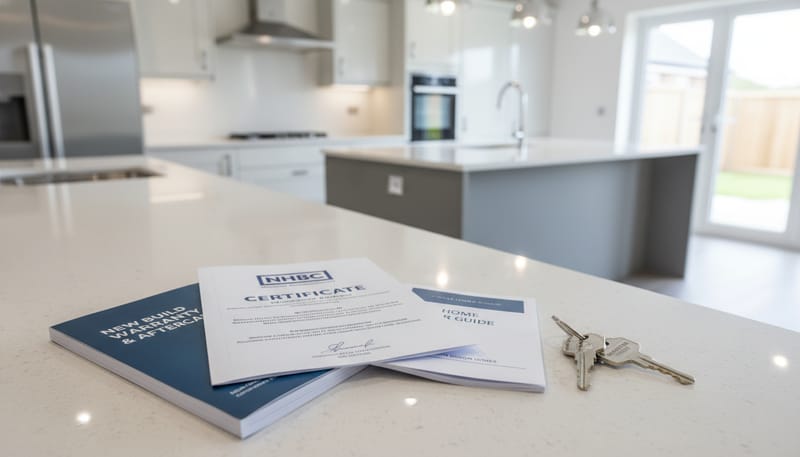
What Is a New Build Warranty?
If you are buying your first new build home, you might not realise that one of the biggest advantages of choosing new over older properties is the structural warranty that comes included with every new build in the UK. Think of it as an insurance policy specifically designed to protect you against major defects in the way your home was built — and it lasts for 10 years from completion.
Unlike buying a second-hand home where you rely entirely on a surveyor’s snapshot, a new build warranty means that an independent body has been inspecting the construction at key stages throughout the build process. If something goes wrong with the structure of your home, you are not left to fight alone — you have a warranty provider standing behind you.
Every mortgage lender in the UK requires a new build warranty to be in place before they will lend on the property, so you can be confident that your home will have one. The warranty is arranged and paid for by the developer, not by you, and it stays with the property — so if you sell within the 10-year period, the remaining coverage passes to the new owner automatically.
For first-time buyers, this warranty is an enormous safety net. You are making the biggest purchase of your life, and knowing that an independent third party has overseen the construction and will cover you against serious defects gives genuine peace of mind. This guide explains exactly what your warranty covers, how the aftercare process works, and what to do if you ever need to make a claim.
Why Warranties Matter More Than You Think
Many first-time buyers focus entirely on the purchase process — the reservation, mortgage, and conveyancing — and only discover the warranty exists when they collect their keys. That is understandable, but your warranty is one of the most valuable aspects of buying new. Here is why:
- Financial protection: Structural repairs to a home can cost tens of thousands of pounds. Your warranty covers these at no additional cost to you
- Pre-completion cover: If your developer faces financial difficulties before completing your home, your warranty protects your deposit and may fund another builder to finish the work
- Resale value: A valid warranty makes your home significantly easier to sell and mortgage within the 10-year period
- Independent oversight: The warranty provider sends inspectors to check the build quality at critical stages, adding an extra layer of quality assurance beyond the developer’s own checks
- Peace of mind: As a first-time buyer, knowing you have this protection lets you enjoy your new home rather than worrying about hidden problems
NHBC Buildmark: The UK’s Most Common New Build Warranty
The National House Building Council (NHBC) is the largest warranty provider in the UK, covering around 80% of all new build homes. Their warranty product is called Buildmark, and it provides a comprehensive 10-year protection package divided into three distinct phases. Understanding these phases is essential because the type of cover you receive — and who you contact about problems — changes depending on where you are in the warranty period.
The Three Phases of Buildmark
| Phase | Period | What It Covers | Who to Contact |
|---|---|---|---|
| Phase 1: Pre-Completion | From exchange to legal completion | Protects your deposit (up to £100,000) if the developer becomes insolvent before completing your home. Can also fund an alternative builder to finish the property | NHBC directly |
| Phase 2: Builder Warranty Period | Years 1 – 2 after completion | The developer must put right any defects or damage caused by their failure to build to NHBC standards, including issues with drainage, structure, weatherproofing, and internal finishes | Your developer’s aftercare team first; NHBC if the developer fails to act |
| Phase 3: NHBC Insurance | Years 3 – 10 after completion | NHBC provides direct insurance cover for physical damage caused by defects in specified parts of the home: foundations, load-bearing walls, roof structure, external render, floors, stairs, flues, and chimneys | NHBC directly |
Phase 1: Pre-Completion Protection
This phase begins when you exchange contracts and protects you if the worst happens — your developer goes into administration or liquidation before your home is finished. Under Phase 1, NHBC can:
- Refund your deposit (up to the insured amount, currently £100,000)
- Alternatively, arrange and fund another builder to complete your home to NHBC standards
- Cover any additional costs above the original purchase price, subject to policy limits
For first-time buyers who may have spent years saving their deposit, this protection is invaluable. While developer insolvency is relatively rare among established builders, knowing your money is protected removes a significant worry from the purchase process.
Phase 2: The First Two Years
The first two years after moving in are covered by the builder warranty period. During this time, your developer is responsible for fixing any defects that result from their failure to meet NHBC technical requirements. This is the period when most issues surface — things like minor plumbing leaks, heating problems, doors that stick as the building settles, or external drainage issues.
Key points about Phase 2:
- You report defects directly to your developer first, not to NHBC
- The developer has a duty to investigate and remedy genuine defects within a reasonable timeframe
- If your developer fails to respond or refuses to fix a valid defect, you can escalate to NHBC through their Resolution Service
- NHBC’s Resolution Service is free to use and will investigate the complaint independently
- If NHBC finds in your favour, they will require the developer to carry out the work — or, in some cases, NHBC will pay for the repairs directly
Phase 3: Years 3 to 10
After the two-year builder warranty period, NHBC takes over directly. From year 3 to year 10, Buildmark provides insurance against physical damage caused by defects in specified structural elements. This phase covers the big-ticket items — things like subsidence caused by defective foundations, structural movement in load-bearing walls, or a failing roof structure.
Phase 3 has a minimum claim value (currently £1,750 including VAT), so it is designed for significant structural issues rather than minor cosmetic problems. Claims are made directly to NHBC, who will send a surveyor to assess the damage and determine whether it falls within the policy coverage.
Alternative Warranty Providers: LABC, Premier Guarantee and More
While NHBC is the most common warranty provider, several other reputable organisations offer new build warranties in the UK. Your developer chooses the warranty provider, so you may find your home is covered by one of these alternatives. Rest assured — all approved warranty providers must meet the standards required by mortgage lenders, so whichever provider covers your home, you have robust protection.
Provider Comparison
| Provider | Total Cover Period | Builder Liability Period | Structural Insurance | Deposit Protection | Resolution Service |
|---|---|---|---|---|---|
| NHBC Buildmark | 10 years | Years 1 – 2 | Years 3 – 10 | Up to £100,000 | Yes (free) |
| LABC Warranty | 10 years | Years 1 – 2 | Years 3 – 10 | Up to £100,000 | Yes |
| Premier Guarantee | 10 – 12 years | Years 1 – 2 | Years 3 – 10 (or 12) | Up to £100,000 | Yes |
| Checkmate | 10 years | Years 1 – 2 | Years 3 – 10 | Up to £100,000 | Yes |
| ICW (Residential Warranty) | 10 years | Years 1 – 2 | Years 3 – 10 | Up to £100,000 | Yes |
LABC Warranty
LABC (Local Authority Building Control) Warranty is the second-largest provider in the UK. Their warranty works in a very similar way to NHBC Buildmark, with a 10-year structure divided into the same three phases. One distinction is that LABC warranties are backed by local authority building control inspections rather than NHBC’s own inspection regime, which some argue provides particularly thorough oversight given that local authority inspectors also enforce Building Regulations compliance.
Premier Guarantee
Premier Guarantee (part of the MD Insurance Group) offers 10-year and 12-year warranty options. Their policies are accepted by all major UK mortgage lenders. Premier Guarantee is particularly popular with smaller and medium-sized developers and has built a strong reputation for responsive customer service during the claims process. The optional 12-year policy provides two additional years of structural insurance beyond the standard 10-year term, which can be an attractive feature when you come to sell your home.
Checkmate and ICW
Checkmate offers 10-year structural warranties accepted by all Council of Mortgage Lenders (CML) approved lenders. They provide independent site inspections throughout construction and offer a straightforward claims process. Checkmate is often chosen by regional developers and housing associations. ICW (Insurance backed warranties for residential properties) similarly provides 10-year cover with build-stage inspections and is accepted by all major mortgage lenders in the UK.
Regardless of which provider covers your home, the core protection is very similar: deposit protection before completion, developer liability for the first two years, and structural insurance for years 3 to 10. Your solicitor will review the warranty details during the conveyancing process and confirm that the policy is acceptable to your mortgage lender.
The Developer’s 2-Year Defect Liability Period and Aftercare
The first two years in your new home are when you have the broadest protection. During this period, your developer is directly responsible for rectifying any defects caused by workmanship or materials that fail to meet the warranty provider’s technical standards. Understanding how the aftercare process works will help you get issues resolved quickly and without frustration.
What the Defect Liability Period Covers
During years 1 and 2, the developer must put right defects including:
- Plumbing and heating system faults
- Electrical issues (faulty sockets, light fittings, wiring problems)
- Doors and windows that do not open, close, or lock properly
- Render or brickwork defects
- Drainage problems and blocked drains caused by construction debris
- Roof leaks or missing tiles
- Gaps around door frames, skirting boards, or window seals
- Sticking doors caused by settlement (beyond normal drying shrinkage)
- Rising damp or penetrating damp caused by construction defects
How to Report Defects
Every developer has an aftercare process, and following it correctly makes everything smoother:
- Document the defect: Take clear photographs and note exactly where the problem is, when you first noticed it, and how it is affecting you
- Contact the aftercare team: Use the developer’s designated reporting method — this is usually an online portal, app, email address, or phone number given to you on completion day
- Get a reference number: Always request a reference or ticket number for every report so you can track progress
- Allow reasonable access: The developer will need to send contractors to inspect and fix the issue. Be flexible with access where possible
- Follow up: If you have not received a response within the developer’s stated timeframe (usually 5–10 working days for non-urgent issues), chase with your reference number
- Escalate if needed: If the developer is unresponsive or refuses to fix a valid defect, contact your warranty provider’s resolution service
Developer Aftercare Portals and Apps
Most major developers now offer digital aftercare platforms that make reporting and tracking defects straightforward. These typically allow you to:
- Submit defect reports with photos and descriptions
- Track the status of each reported issue
- Book appointments for contractor visits
- Access your home’s user manual and appliance guides
- View your warranty documentation
- Communicate directly with your site’s aftercare team
When you move into your new home, make sure you register on the aftercare portal and save the contact details in a safe place. Knowing how to reach the right team quickly can save you considerable time and stress if an issue arises.
Expected Response Times
| Issue Type | Expected Response | Examples |
|---|---|---|
| Emergency | Within 24 hours | Total heating failure in winter, major water leak, no hot water, gas leak (call National Gas Emergency for gas) |
| Urgent | Within 3 – 5 working days | Partial heating failure, minor leak, external door not locking securely, toilet not functioning |
| Routine | Within 10 – 28 working days | Sticking internal doors, cracked tile, minor cosmetic issues, sealant failures |
| Seasonal / Non-urgent | Next appropriate season | Landscaping issues, external paintwork, fencing repairs (weather-dependent work) |
These timeframes are guidelines. The Consumer Code for Home Builders (which all major warranty providers require developers to follow) sets out standards for aftercare response times and quality. If your developer consistently misses these timescales, the Consumer Code provides a formal complaints and adjudication process.
What IS and ISN’T Covered by Your Warranty
One of the most common sources of frustration for new homeowners is discovering that something they expected the warranty to cover is actually excluded. Understanding the boundaries of your cover from the outset will help you set realistic expectations and avoid disappointment.
- ✓ Structural defects (foundations, load-bearing walls, floors)
- ✓ Roof structure and weatherproofing failures
- ✓ Below-ground drainage defects
- ✓ Rising or penetrating damp from construction defects
- ✓ Defective flue or chimney construction
- ✓ Staircase structural failure
- ✓ External render or cladding failure
- ✓ Pre-completion deposit protection (developer insolvency)
- ✗ Normal drying-out shrinkage cracks (hairline plaster cracks)
- ✗ General wear and tear
- ✗ Consumer appliances (boiler manufacturers have separate warranties)
- ✗ Landscaping, fencing, and turfing
- ✗ Damage caused by your own alterations or neglect
- ✗ Condensation caused by lifestyle factors
- ✗ Cosmetic finishes after year 2 (paint, grout discolouration)
- ✗ Damage from storms, floods, or other natural events (home insurance covers these)
Understanding the Grey Areas
Some issues fall into grey areas that confuse many first-time buyers:
Shrinkage cracks: New build homes dry out over the first 12 to 24 months, which causes minor hairline cracks in plaster. These are completely normal and are not a defect. Most developers will fill and touch up significant shrinkage cracks as part of a year-one courtesy visit, but they are not obligated to under the warranty. The key distinction is between hairline cracks (normal shrinkage, typically less than 2mm) and structural cracks (wider than 5mm, stepped along mortar joints, or affecting structural elements), which are covered.
Condensation and mould: New build homes are very airtight thanks to modern building regulations, which is excellent for energy efficiency but means you need to manage ventilation carefully. Condensation on windows and mould in corners is usually caused by lifestyle factors (drying clothes indoors, not using extractor fans, blocking trickle vents) rather than construction defects, so it is generally not covered by the warranty. However, if condensation is caused by a defective ventilation system or missing damp-proof course, that is a construction defect and would be covered.
Boiler and appliance failures: Your boiler, kitchen appliances, and other installed products have their own manufacturer warranties which are separate from the structural warranty. Keep all the appliance documentation from your home demonstration and register products where required. Boiler manufacturer warranties typically run for 2 to 10 years depending on the brand and model.
Maintaining Your Warranty and Making a Claim
Your new build warranty is not entirely unconditional. There are certain things you must do — and certain things you must avoid — to keep your warranty valid throughout the 10-year period. Understanding these rules from day one protects your coverage and avoids nasty surprises later.
Do’s and Don’ts to Protect Your Warranty
- ✓ Keep your warranty documents safe and accessible
- ✓ Report defects promptly and in writing
- ✓ Maintain your home according to the homeowner manual
- ✓ Service your boiler annually (separate manufacturer warranty)
- ✓ Use qualified professionals for any work you commission
- ✓ Keep records and photos of any issues that develop
- ✓ Ventilate your home properly (use extractors, open trickle vents)
- ✗ Remove or alter load-bearing walls without professional advice
- ✗ Block air vents, trickle vents, or drainage channels
- ✗ Build extensions or conservatories without notifying your warranty provider
- ✗ Carry out DIY plumbing or electrical work that requires certification
- ✗ Ignore small issues that could become major structural problems
- ✗ Pave over drainage inspection chambers or soakaways
- ✗ Delay reporting defects (time limits apply for some claims)
Making a Warranty Claim: Step-by-Step
If you discover a defect that you believe is covered by your warranty, following the correct claims process improves your chances of a swift resolution:
- Identify whether you are in Phase 2 or Phase 3: This determines who to contact first. In years 1–2, contact your developer. In years 3–10, contact your warranty provider directly
- Document everything: Photograph the defect from multiple angles. Note when you first noticed it. If it is getting worse over time, take dated photos to show progression. Measure any cracks with a ruler for reference
- Report to the correct party: During the builder warranty period (years 1–2), submit a written defect report to your developer’s aftercare team with photos and a clear description. During years 3–10, contact your warranty provider (NHBC, LABC, Premier Guarantee, etc.) to start a claim
- Keep copies of all correspondence: Save every email, letter, and text message. Note dates and times of phone calls and what was discussed
- Allow access for inspection: The developer or warranty surveyor will need to visit your property to assess the issue. Be as accommodating as possible with appointment times
- Get the decision in writing: Whether the claim is accepted or rejected, ask for the decision in writing with clear reasons
- Use the resolution or appeals process: If your claim is rejected and you disagree, all warranty providers have an appeals or dispute resolution process. The Consumer Code for Home Builders also provides an independent adjudication service
Typical Claim Timelines
| Stage | Typical Timeframe | What Happens |
|---|---|---|
| Report submitted | Day 1 | You submit your claim with photos and documentation |
| Acknowledgement | Within 5 working days | The warranty provider or developer confirms receipt and assigns a reference number |
| Inspection arranged | Within 10 – 20 working days | A surveyor or contractor is sent to inspect the defect |
| Decision issued | Within 10 working days of inspection | You receive a written decision on whether the claim is covered |
| Repair work | Varies (typically 4 – 12 weeks) | If accepted, repair work is arranged and completed |
| Appeal (if rejected) | Within 6 months of decision | You can appeal through the warranty provider’s dispute resolution process |
The Year 2 Inspection and Developer Insolvency Protection
Two critical topics that every first-time buyer should understand are the importance of the year 2 inspection and what happens if your developer goes out of business during or after the build.
Your Year 2 Inspection: Do Not Miss This
The end of year 2 is the most important deadline in your warranty timeline. Once the two-year builder warranty period expires, the developer’s obligation to fix defects becomes significantly more limited. From year 3 onwards, only major structural defects are covered under the warranty provider’s insurance policy — routine defects, minor issues, and anything that is not structural will no longer be the developer’s responsibility.
This is why you should arrange a thorough inspection of your home before the second anniversary of your completion date. Many buyers hire a professional snagging inspector for this purpose, and it is some of the best money you can spend as a homeowner.
Year 2 Inspection Checklist
At minimum, check these areas before your 2-year builder warranty expires:
- External walls: Look for cracks in render, loose or damaged brickwork, gaps around window and door frames
- Roof: Check for missing or slipped tiles (use binoculars from ground level), blocked or leaking guttering, damage to fascias and soffits
- Windows and doors: Test every window and door for smooth operation, check seals and weatherstripping, ensure all locks work correctly
- Internal walls and ceilings: Note any cracks wider than 2mm, stains indicating possible water ingress, or bulging plaster
- Plumbing: Check under all sinks for leaks, test all taps for consistent flow and temperature, flush all toilets, inspect silicone seals around baths and shower trays
- Heating: Run the heating system and check that all radiators heat evenly, test the hot water, ensure the thermostat and programmer work correctly
- Drainage: Run water in all sinks, baths, and showers simultaneously and check that water drains freely without backing up
- Electrics: Test all sockets and switches, check the consumer unit for any tripped breakers, ensure smoke and carbon monoxide alarms function
- External areas: Inspect driveways and pathways for excessive cracking or sinking, check fencing and boundary treatments, look at garden drainage
Report every defect you find to your developer before the 2-year anniversary, even if the issues seem minor. Once reported before the deadline, the developer remains obligated to address them even if the actual repair happens after year 2. Our snagging checklist can help you conduct a thorough review.
What Happens If Your Developer Goes Bust?
This is a fear many first-time buyers have, and the good news is that your warranty provides strong protection in this scenario. Here is what happens depending on when the insolvency occurs:
Before completion (Phase 1): Your deposit is protected up to £100,000. The warranty provider may arrange for another builder to complete your home. If completion is not possible, you receive your deposit back.
During years 1–2 (Phase 2): If the developer becomes insolvent and cannot fulfil their aftercare obligations, your warranty provider steps in. NHBC, for example, will take over responsibility for defects that would have been the developer’s duty to fix. You contact the warranty provider directly instead of the (now-defunct) developer.
During years 3–10 (Phase 3): Nothing changes. You are already dealing directly with the warranty provider for structural claims during this period, so the developer’s financial status is irrelevant.
This is one of the strongest reasons why a new build warranty is so valuable — it is independent of the developer. Even if the worst happens, your home remains protected. This is also why mortgage lenders insist on a warranty being in place: it protects their security (your home) as well as your investment.
The Consumer Code and Your Rights as a Buyer
Beyond the warranty itself, every new build buyer in the UK is protected by the Consumer Code for Home Builders. All major warranty providers — NHBC, LABC, Premier Guarantee, and others — require their registered developers to comply with this Code, which sets out minimum standards for the way developers treat their customers.
What the Consumer Code Guarantees
The Code covers your entire journey, from pre-purchase through to aftercare:
- Clear and accurate information: Developers must provide truthful information about the home, the development, and the purchasing process before you reserve
- Reliable timescales: Developers must give realistic completion dates and keep you informed of any changes
- A fair reservation agreement: The terms must be fair and transparent, with a cooling-off period
- Professional after-sales service: Developers must have a documented aftercare procedure and deal with defect reports professionally and within reasonable timescales
- A complaints process: If you are unhappy with how the developer handles an issue, the Code provides a formal complaints procedure and access to an independent adjudicator
You can read more about warranty structures and how they connect to the Consumer Code in our detailed guide. The important thing to know is that you are not solely reliant on goodwill — there are formal standards and enforcement mechanisms protecting you.
Connecting Your Warranty to the Bigger Picture
Your warranty is just one part of the protection framework around your new build purchase. As a first-time buyer, it helps to understand how everything fits together:
Your structural warranty is the backbone, but it works alongside other protections. Make sure your buildings and contents insurance is in place from day one to cover events like storms, flooding, and accidental damage that the structural warranty does not.
Having a professional snagging inspection carried out shortly after you move in — and again before the year 2 deadline — is one of the best ways to make sure you identify all defects while the developer is still liable. Understanding the full new build buying process will also help you ask the right questions about warranty coverage before you commit to a purchase.
Frequently Asked Questions
Do I need to pay for my new build warranty?
No. The structural warranty is arranged and paid for by the developer as part of the construction process. The cost is built into the purchase price of the home. You do not pay any premiums, excesses, or fees for the warranty itself. The only cost you might incur is if you hire a professional snagging inspector (£300–£600) to help identify defects — which is entirely optional but highly recommended, especially before the year 2 deadline.
Can I choose my own warranty provider?
No. The developer selects the warranty provider for the entire development, and all homes on that development will be covered by the same provider. However, all providers accepted by UK mortgage lenders offer broadly similar levels of protection. Your solicitor will review the warranty as part of the conveyancing process to confirm it meets your lender’s requirements. If you have concerns about a particular provider, discuss them with your solicitor before exchange.
What happens to my warranty if I sell my home within 10 years?
The warranty automatically transfers to the new owner for the remainder of the 10-year period. You do not need to do anything special to arrange this — the cover follows the property, not the person. This is a significant selling point when marketing your home, as it reassures potential buyers (and their mortgage lenders) that the property is protected. Make sure you pass your warranty documentation to the new owner as part of the sale.
My developer says hairline cracks are “normal settling” — is that true?
Yes, to a degree. New build homes do experience drying-out shrinkage during the first 12 to 24 months as residual moisture from the construction process evaporates. This commonly causes small hairline cracks in plaster (typically less than 2mm wide) and minor gaps between skirting boards and walls. These are considered normal and are not defects covered by the warranty. However, cracks wider than 5mm, stepped cracks following mortar lines in brickwork, or cracks that appear to be getting progressively worse could indicate a structural issue and should be reported to your developer immediately. When in doubt, take photographs, measure the crack, and report it — it is always better to report something that turns out to be normal than to ignore a genuine structural problem.
What should I do if I am unhappy with my developer’s aftercare response?
Start by putting your complaint in writing to the developer’s customer services director, clearly outlining the issue, what you have already reported, the timeline of events, and what resolution you expect. If this does not produce a satisfactory result, you have several escalation options: contact your warranty provider’s resolution service (NHBC, LABC, etc.), use the Consumer Code for Home Builders’ independent adjudication service, or contact the developer’s registered warranty scheme. Keep detailed records of all correspondence throughout the process. Most issues are resolved without needing to go beyond the warranty provider’s resolution service.
Your Warranty Is Your Safety Net — Know It and Use It
As a first-time buyer, your new build warranty is one of the most valuable protections you have, yet it is also one of the least understood. By reading this guide, you are already better prepared than most new homeowners to navigate the warranty and aftercare process with confidence.
The key takeaways to remember are: your warranty lasts 10 years and is divided into three phases; the first two years offer the broadest protection while the developer is directly responsible; and the year 2 deadline is the single most important date to mark in your calendar. Report every defect before that anniversary, get a professional snagging inspection done, and keep thorough records of everything.
Understanding your warranty also connects to the broader new build buying journey. It sits alongside your purchase timeline, your financial planning through budgeting beyond the deposit, and the practical steps of moving into your new home. Each piece supports the others, and together they give you a comprehensive safety net.
Do not be afraid to use your warranty and aftercare services — that is exactly what they are there for. Report issues promptly, document them thoroughly, and follow the correct process. Developers expect a certain volume of aftercare requests on new developments, and the vast majority of defects are resolved smoothly. Your new build home comes with protections that older properties simply cannot match, and that is something worth feeling confident about.