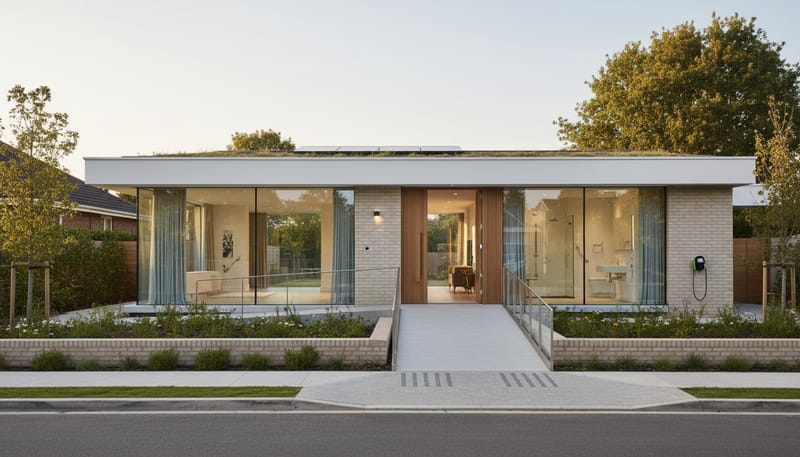
How Developers Are Creating Accessible and Inclusive Homes
Published by New-Builds Team
The UK housebuilding industry is undergoing a profound shift in how it thinks about accessibility and inclusive design. Far from being an afterthought or a planning condition to be minimised, accessible design is increasingly recognised by leading developers as a core element of quality home building that benefits everyone, from young families with pushchairs to older residents who want to age in place and people with disabilities who deserve the same freedom and dignity in their homes as anyone else. The regulatory framework has evolved significantly, with Approved Document Part M of the Building Regulations establishing three categories of accessible design, and local planning authorities increasingly requiring higher accessibility standards through their local plans. Major housebuilders including Barratt Developments, Taylor Wimpey, Persimmon, Bellway, Redrow, and a host of specialist and regional developers are responding positively, investing in design, training, and construction processes that deliver genuinely inclusive homes at scale.
This comprehensive guide explores every dimension of accessible and inclusive home design in the UK new build sector. We examine the regulatory framework, the practical design features that make homes accessible, the developers who are leading the way, and the positive impact on communities and residents. Whether you are looking for a home that will accommodate a wheelchair user, seeking a property that will support you as you age, or simply want a well-designed home with generous circulation space and step-free access, understanding the accessible homes landscape will help you make an informed choice. For related content on quality standards across the industry, see our guide to new build quality improvements in 2026.
Accessible Homes: Key Numbers
Understanding Part M: The Accessibility Categories
Approved Document Part M of the Building Regulations for England sets out the accessibility requirements for new dwellings, establishing three categories of progressively higher accessibility standards. Understanding these categories is essential for buyers seeking accessible homes and for anyone interested in how the housebuilding industry is responding to the accessibility challenge.
M4(1): Visitable Dwellings
M4(1) is the baseline standard that applies to all new homes. It requires level or gently sloping approach to the principal entrance, accessible entrance doors of adequate width, a WC at entrance level, and sufficient width for corridors and internal doors to allow wheelchair passage at entrance level. M4(1) ensures that any new home is at minimum visitable by a person using a wheelchair, even if it is not designed for full wheelchair accessibility throughout. While M4(1) represents a significant improvement over the pre-2015 standards, it is now widely regarded as a minimum rather than an aspiration, and the government has signalled its intention to raise the baseline to M4(2) in future building regulations updates.
M4(2): Accessible and Adaptable Dwellings
M4(2) represents a substantial step up from M4(1) and is increasingly being required by local planning authorities as a condition of planning permission. M4(2) homes are designed to be accessible and adaptable, meaning they can be easily modified to meet the changing needs of occupants over their lifetime without requiring major structural work. Key features of M4(2) homes include step-free access to the dwelling and throughout the entrance storey, wider doorways and corridors throughout (minimum 900mm clear opening for doors), level thresholds at all external doors, a bathroom at entrance level that is capable of being adapted into a wet room, walls reinforced to support future installation of grab rails, and switches and sockets at accessible heights. M4(2) essentially delivers the principles of the former Lifetime Homes Standard within a building regulations framework.
M4(3): Wheelchair User Dwellings
M4(3) is the highest accessibility standard and is designed specifically for wheelchair users. M4(3) homes provide a fully wheelchair-accessible living environment with enhanced circulation spaces, wheelchair-accessible kitchens and bathrooms, lower worktops, adapted storage, wider parking spaces, and specific requirements for room layouts and door operations that accommodate wheelchair movement. M4(3) is divided into two sub-categories: M4(3)(2)(a) for wheelchair-adaptable dwellings, which are designed to be readily adapted for wheelchair use, and M4(3)(2)(b) for wheelchair-accessible dwellings, which are provided fully fitted for immediate wheelchair occupation. M4(3) homes are typically required as a percentage of affordable housing on larger developments, with the allocation managed by the housing association in consultation with the local authority's occupational therapy team.
The National Planning Policy Shift
The government announced in 2023 its intention to make M4(2) the mandatory minimum standard for all new homes in England through changes to the Building Regulations. While the implementation timetable has been subject to consultation and refinement, the direction of travel is clear: accessible and adaptable design will become the default rather than the exception. This policy shift reflects compelling demographic evidence including the ageing population, the prevalence of disability, and the simple economic argument that building accessible homes from the outset is far cheaper than retrofitting them later. Estimates suggest that building to M4(2) adds approximately 1,000 to 1,500 pounds to the cost of a typical house, while adapting an M4(1) home to the same standard after construction can cost 15,000 to 25,000 pounds or more.
In advance of the national requirement, many local planning authorities have already adopted M4(2) policies through their local plans. London's planning framework requires 90 percent of new homes to meet M4(2) and 10 percent to meet M4(3), and numerous other local authorities including Manchester, Birmingham, Bristol, Leeds, and many district councils have introduced similar requirements. The result is that the proportion of new homes being built to M4(2) or higher standards has increased dramatically in recent years, rising from an estimated 25 percent in 2020 to approximately 75 percent in 2025/26.
Design Features That Make Homes Accessible
The practical design features that make homes accessible and adaptable are surprisingly straightforward and, when integrated into the design from the outset, have minimal impact on the overall appearance and feel of the home. Indeed, many accessible design features are simply good design features that benefit all occupants, regardless of age or ability. Understanding these features can help buyers recognise and appreciate the accessibility qualities of new build homes they are considering.
Approach and Entrance
Accessible design begins before you step inside the home. A level or gently ramped approach from the car parking area to the front door, with a firm, slip-resistant surface, ensures that the home can be reached safely by anyone, including wheelchair users, people with mobility impairments, and parents with pushchairs. The parking provision itself should include at least one space that is wider than standard (at least 3.3 metres for M4(2)) to allow door opening and wheelchair transfer. The entrance door should be at least 850mm clear opening width, with a level threshold that eliminates any step up into the home. A covered entrance with good lighting and a level landing area of at least 1,500mm by 1,500mm allows wheelchair users to position themselves comfortably while operating the door.
Internal Circulation
Inside the home, accessible design is primarily about providing enough space for comfortable movement and ensuring that doors, corridors, and rooms are sized to accommodate wheelchair users and people with mobility aids. M4(2) requires minimum corridor widths of 1,050mm (compared to the 900mm minimum under M4(1)), clear door openings of at least 775mm throughout (rising to 850mm for M4(3)), and turning circles of at least 1,500mm diameter in key rooms. These dimensions may sound technical, but in practice they create homes that simply feel more spacious and easier to move around, an improvement that every occupant appreciates regardless of their mobility status.
Kitchens and Bathrooms
Kitchens and bathrooms are the areas where accessible design has the most visible impact and where thoughtful design makes the greatest difference to the lives of people with disabilities. M4(2) kitchens must provide clear manoeuvring space, accessible worktop heights, and layouts that allow wheelchair approach to key appliances and work surfaces. M4(2) bathrooms must be capable of adaptation to a wet room configuration without structural alteration, which is achieved by ensuring that the floor and wall construction can support the necessary waterproofing and drainage. Wall reinforcement for future grab rail installation is also required, and the bathroom should provide enough space for a carer to assist if needed.
M4(3) kitchens go further, providing worktops at wheelchair-accessible heights (typically 850mm or adjustable), pull-out worktops, accessible storage, and adapted appliance positioning. M4(3) bathrooms are designed for full wheelchair use from the outset, with roll-in showers, grab rails, accessible basins, and sufficient space for wheelchair transfer and carer assistance. These features, while designed for wheelchair users, also benefit anyone with temporary mobility impairment, such as a recovering surgical patient, and they provide long-term peace of mind for anyone planning to age in place.
Accessible Design Features Comparison
| Feature | M4(1) | M4(2) | M4(3) |
|---|---|---|---|
| Level access entrance | ✓ | ✓ | ✓ |
| Wider doorways throughout | ✗ | ✓ | ✓ |
| Step-free access all storeys | ✗ | Adaptable | ✓ |
| Bathroom adaptable to wet room | ✗ | ✓ | ✓ |
| Wheelchair-height worktops | ✗ | ✗ | ✓ |
| 1500mm turning circles | ✗ | Key rooms | ✓ All rooms |
Developers Leading on Accessible Design
While all major developers are required to meet the accessibility standards specified in their planning permissions, some have gone further by embedding accessible design into their company strategies, investing in specialist expertise, and adopting design approaches that exceed minimum requirements. These developers recognise that accessible design is not just a regulatory obligation but a commercial opportunity, as the demand for accessible homes far outstrips supply and the demographic trends driving that demand are only strengthening.
Barratt Developments
Barratt has been proactive in adapting its house type range to meet M4(2) requirements across all its developments, not just those where it is required by planning policy. The company's design team has worked to ensure that M4(2) compliance is achieved without compromising the internal layout or aesthetic appeal of its homes, demonstrating that accessible design and attractive design are entirely compatible. Barratt's approach to M4(3) wheelchair-accessible homes has also been commended, with the company working closely with housing association partners and local authority occupational therapists to ensure that wheelchair homes meet the specific needs of their allocated residents.
Taylor Wimpey
Taylor Wimpey has invested in research and development to understand how accessible design can be integrated into its standard house types most effectively. The company's sustainability and design teams have collaborated on a comprehensive review of the M4(2) and M4(3) requirements, resulting in updated house type designs that deliver accessibility without significantly increasing unit costs or reducing room sizes. Taylor Wimpey has also invested in training for its site teams, ensuring that the accessibility features specified in the designs are correctly implemented during construction, an area that has historically been a challenge for the industry.
Specialist and Regional Developers
Some of the most innovative work in accessible design is being done by specialist and regional developers. McCarthy Stone and Churchill Retirement Living, the UK's two largest retirement housing developers, build all their homes to enhanced accessibility standards as a matter of course, incorporating features such as level-access showers, wider corridors, and emergency call systems as standard. These developers have deep expertise in designing for older people and their homes provide a benchmark for accessible design in the mainstream housebuilding sector. Among regional developers, Lovell Partnerships, a subsidiary of Morgan Sindall, has built a strong reputation for delivering high-quality accessible homes through its partnership work with housing associations and local authorities, and Hill Group has been recognised for its approach to inclusive design on its London and East of England developments.
Age-Friendly Design and Lifetime Homes
The concept of Lifetime Homes, developed by the Joseph Rowntree Foundation and the Habinteg Housing Association, has been hugely influential in shaping the UK's approach to accessible design. Although the formal Lifetime Homes Standard has been superseded by the Part M categories, its principles remain relevant and continue to influence design thinking across the sector. The core idea is simple but powerful: homes should be designed to be comfortable, convenient, and adaptable for people at all stages of life, from a young couple starting a family to an older person with reduced mobility.
With the UK's population ageing rapidly (the Office for National Statistics projects that the number of people aged 65 and over will increase from 12.4 million in 2024 to over 15 million by 2040), the demand for age-friendly housing is growing substantially. Leading developers are responding by designing homes that incorporate age-friendly features as standard, including step-free access, ground-floor bedroom and bathroom provision, good natural lighting, easy-to-use controls and switches, and gardens and outdoor spaces that are manageable and safe. These features are not marketed as disability adaptations but as lifestyle enhancements that make homes more comfortable and convenient for everyone.
Inclusive Communities: Beyond the Individual Home
Truly inclusive design extends beyond the individual home to encompass the wider development and community. Developers are increasingly designing developments where streets, paths, public spaces, and community facilities are accessible to everyone, including wheelchair users, people with visual impairments, older residents, and families with young children. This includes providing smooth, well-maintained footpaths with dropped kerbs at crossing points, ensuring that play areas are designed for inclusive play that accommodates children with disabilities, creating public seating at regular intervals for people who need to rest, and ensuring that community facilities such as community centres, shops, and healthcare facilities are fully accessible.
Wayfinding and legibility are important aspects of inclusive community design. Developments where routes are clear, signage is large and well-contrasted, and landmarks are distinctive help people with cognitive impairments and visual impairments to navigate confidently. Lighting design that provides even, glare-free illumination of paths and public spaces enhances safety and confidence for everyone, particularly older residents and people with sight loss. The integration of public transport links and local amenities within walking or wheeling distance of homes reduces dependence on private cars and improves independence for people who cannot drive.
Several developments have been recognised for their inclusive community design. Berkeley Group's developments in London have been praised for their approach to inclusive public realm design, and the company has published guidance on inclusive placemaking that other developers can draw upon. Barratt's partnership with the Design Council has included a focus on inclusive design principles, and the company's masterplanning guidance now incorporates accessibility as a core consideration alongside traditional design factors. For more on developer investment in community amenities, see our article on developer investment in local infrastructure.
The Economics of Accessible Design
One of the most important arguments for building accessible homes from the outset is the economic case. Research by the government, the NHBC Foundation, and academic institutions consistently shows that the additional cost of building to M4(2) standards is modest when incorporated into the design from the outset, typically adding between 500 and 1,500 pounds per dwelling depending on the house type and the extent to which the developer's standard designs already incorporate accessible features. This compares extremely favourably with the cost of retrospective adaptation, which can range from 15,000 to 50,000 pounds or more for significant modifications such as installing a stairlift, widening doors, converting a bathroom to a wet room, or building a ground-floor extension.
Beyond the direct construction costs, there are significant economic benefits to building accessible homes that accrue to the wider health and social care system. When people can live safely and independently in an accessible home, the demand for residential care, hospital admissions resulting from falls, and expensive home adaptations funded by local authority Disabled Facilities Grants is reduced. The government estimates that the total cost to the NHS and social care system of falls and accidents in unsuitable housing runs to billions of pounds each year, and investing in accessible homes from the outset represents a highly cost-effective prevention strategy.
Smart Home Technology and Accessibility
Smart home technology is opening up new possibilities for accessible living that go beyond the physical design of the home. Voice-controlled systems allow people with limited mobility or dexterity to operate lights, heating, door locks, curtains, and entertainment systems without needing to reach switches or handles. Automated lighting that responds to movement patterns can reduce fall risk for older residents by ensuring that paths to the bathroom and kitchen are always illuminated at night. Video doorbells and remote-controlled door locks allow people with mobility impairments to see and admit visitors without needing to reach the front door. Telecare and telehealth systems integrated into the home's technology infrastructure can monitor health indicators and alert carers or emergency services if an incident occurs.
Several developers are beginning to integrate these technologies as standard features rather than optional upgrades. McCarthy Stone has been a leader in this area, incorporating emergency call systems, door entry video systems, and connected home features into its retirement developments. Among mainstream housebuilders, Barratt and Taylor Wimpey have both explored smart home technology integration, and as the costs of these systems continue to fall, their inclusion in standard specifications is likely to become more widespread. The intersection of smart technology and accessible design represents one of the most exciting frontiers in inclusive home building, with the potential to dramatically improve independence and quality of life for people with disabilities and older residents.
Challenges and Opportunities
Despite the significant progress documented in this article, challenges remain in delivering accessible homes at the scale needed to meet demand. The supply of M4(3) wheelchair-accessible homes remains insufficient relative to the needs of wheelchair users on local authority housing waiting lists, and there is an ongoing need for more M4(3) homes across both affordable and market tenures. The training and skills required to build accessible homes correctly are not yet universal across the construction workforce, and there are instances where the accessibility features specified in designs are not correctly implemented during construction, reducing their effectiveness.
However, the opportunities are substantial. The ageing population creates a growing market for accessible homes that forward-thinking developers can serve profitably. The government's commitment to raising the mandatory accessibility baseline to M4(2) will create a level playing field across the industry, removing any competitive disadvantage for developers who have already adopted higher standards. The integration of smart home technology creates exciting possibilities for enhancing accessibility beyond what physical design alone can achieve. And the growing public awareness of accessibility issues, driven by campaigns from organisations like Habinteg, Leonard Cheshire, and the RNIB, is creating consumer demand for accessible homes that the market is beginning to respond to.
Looking Ahead: The direction of travel is clear, and it is positive. Accessible and inclusive design is moving from a specialist consideration to a mainstream expectation, embedded in building regulations, planning policy, and developer practice. The UK housebuilding industry is demonstrating that it can deliver homes that work for everyone, at scale, and without compromising on design quality or commercial viability. For buyers, this means more choice, better quality, and greater confidence that the home they purchase will serve them well throughout their lives.
For more information on related topics, explore our guides to developer partnerships with housing associations and the New Homes Quality Board's role in raising industry standards.
Accessible Housing in Scotland, Wales, and Northern Ireland
While the Part M framework applies specifically to England, the devolved nations each have their own accessibility requirements that are driving similar improvements in accessible housing delivery. Scotland's building regulations include accessibility requirements through Section 4 of the Technical Handbooks, which sets standards for accessible and adaptable housing that are broadly comparable to M4(2) in England. The Scottish Government's Housing to 2040 strategy includes a commitment to ensuring that all new homes are designed to be accessible and adaptable, and Scottish developers have responded positively to these requirements. CALA Homes, Springfield Properties, and Persimmon's Scottish division have all been commended for their approach to accessible design within the Scottish regulatory framework.
Wales has adopted an increasingly progressive approach to accessible housing through its Development Quality Requirements (DQR), which apply to all homes funded through the Social Housing Grant programme. The DQR requirements go beyond the minimum standards in the Welsh Building Regulations and include provisions for Lifetime Homes principles, enhanced space standards, and wheelchair-accessible design on a proportion of homes. The Welsh Government's ambition is to create an inclusive housing stock that serves all residents throughout their lives, and the DQR framework provides a practical mechanism for achieving this ambition. Developers operating in Wales, including Redrow (which is headquartered in Flintshire), Persimmon, and Taylor Wimpey, have adapted their house types and processes to meet these enhanced requirements.
Northern Ireland operates under its own building regulations framework, with Part R covering access and facilities for disabled people. The Department for Communities has consulted on strengthening accessibility requirements for new homes, with proposals that would align Northern Ireland more closely with the enhanced standards being adopted in England, Scotland, and Wales. The overall direction across all four nations of the UK is towards higher mandatory accessibility standards, reflecting a consensus that accessible and adaptable design should be a standard feature of all new homes rather than an exception.
The Role of Housing Associations in Accessible Delivery
Housing associations play a particularly important role in the delivery of accessible homes, both through their own development programmes and through their partnership work with private developers. Housing associations are typically the landlords and managers of M4(3) wheelchair-accessible homes delivered through Section 106 agreements, and they work closely with local authority occupational therapy teams to ensure that these homes are allocated to the households that need them most. The specification and design of M4(3) homes is often agreed between the developer, the housing association, and the occupational therapist, ensuring that the home meets the specific needs of its intended occupant.
Several housing associations have established themselves as leaders in accessible housing delivery. Habinteg Housing Association is a specialist accessible housing provider that has pioneered inclusive design principles and works with developers across the country to deliver high-quality accessible homes. Places for People, one of the UK's largest housing associations, has committed to delivering all its new homes to M4(2) standard and maintaining a portfolio of M4(3) homes to meet wheelchair user demand. Peabody, formed through the merger of Peabody and Catalyst, has adopted comprehensive design standards that exceed minimum accessibility requirements and include provisions for inclusive community design, age-friendly features, and smart home technology integration.
The accessible housing landscape in the UK is undergoing a transformation that reflects changing demographics, evolving policy, and growing recognition that good design should work for everyone. Developers large and small are rising to the challenge, investing in the design expertise, construction skills, and technological innovation needed to deliver homes that are genuinely inclusive. For buyers seeking accessible homes, the range of options has never been wider, the quality has never been higher, and the protections for ensuring that accessible features are correctly delivered have never been stronger. This is an area where the UK housebuilding industry is making measurable and meaningful progress, and the benefits will be felt by millions of people for decades to come.