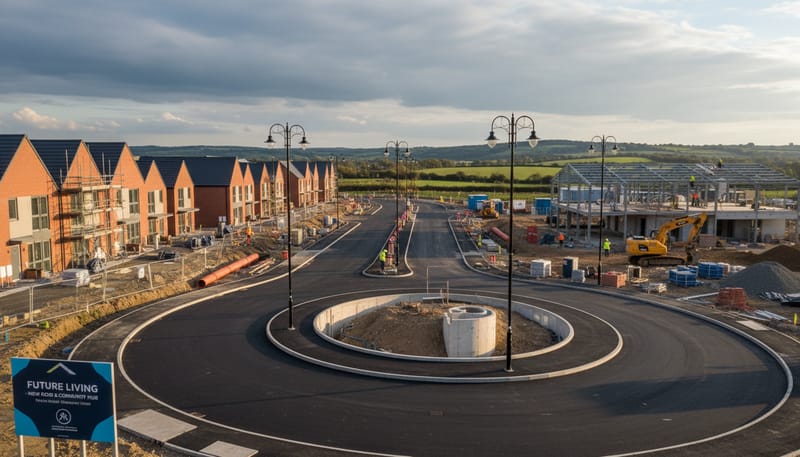
Developer Investment in Local Infrastructure and Amenities
Published by New-Builds Team
When a new housing development takes shape in a UK community, the homes themselves are only part of the story. Behind the scenes, a substantial and often underappreciated stream of investment flows from developers into the local infrastructure and amenities that make those communities functional, attractive, and sustainable places to live. Through Section 106 agreements, the Community Infrastructure Levy (CIL), and direct infrastructure delivery, UK housebuilders contribute billions of pounds each year to funding new schools, healthcare facilities, roads and transport improvements, parks and green spaces, sports facilities, community centres, and a wide range of other public amenities. This investment is not voluntary charity; it is a structured, regulated, and transparent contribution that is negotiated as part of the planning process and secured through legally binding agreements. But the scale and positive impact of these contributions is genuinely remarkable, and it is a story that deserves to be told more fully.
This comprehensive guide examines how developer infrastructure contributions work, the scale of investment being made, the types of infrastructure and amenities that are funded, and the impact on communities. We draw on data from national government statistics, local authority reports, and developer disclosures to build a detailed picture of an aspect of housebuilding that often flies under the radar. Whether you are a prospective buyer wanting to understand what infrastructure is planned for a development you are considering, a community member wanting to understand how developer contributions benefit your area, or simply interested in the economics of housing delivery, this article provides a thorough and data-driven overview. For related content on how developers work with housing providers, see our guide to developer partnerships with housing associations.
Developer Infrastructure Investment at a Glance
Understanding Section 106 Agreements
Section 106 (S106) of the Town and Country Planning Act 1990 is the primary mechanism through which developers make direct contributions to local infrastructure and services. When a developer applies for planning permission for a residential scheme, the local planning authority can require the developer to enter into a S106 agreement that specifies the infrastructure contributions and other obligations that must be fulfilled as a condition of the permission. These obligations are negotiated between the developer, the local authority, and sometimes other bodies such as the county council (for education and highways), the NHS (for healthcare), and the Environment Agency (for flood mitigation).
S106 obligations can take two forms: financial contributions, where the developer pays a sum of money to the local authority to fund specific infrastructure; and in-kind provision, where the developer directly builds or provides infrastructure as part of the development. On large-scale developments, in-kind provision is common for items such as new roads, parks, play areas, and sometimes even schools and health centres. On smaller developments, financial contributions are more typical, with the money pooled with other developer contributions to fund larger infrastructure projects that serve the wider area.
The scale of S106 contributions has grown significantly over the past decade, reflecting both increasing development volumes and rising expectations from local communities and planning authorities. Government data shows that approximately 4.1 billion pounds in S106 agreements were entered into during 2024/25, covering affordable housing provision (which represents the single largest S106 category by value, as covered in our article on developer partnerships with housing associations), education, transport, healthcare, open space, community facilities, and a range of other local priorities.
The Community Infrastructure Levy
The Community Infrastructure Levy (CIL) was introduced in 2010 as a complementary mechanism to Section 106, providing local authorities with a more standardised and predictable source of infrastructure funding from development. Unlike S106, which is negotiated on a site-by-site basis, CIL is charged at a fixed rate per square metre of new development, set by the local authority through a charging schedule. The CIL rates are based on an assessment of local development viability and infrastructure needs, and they are published in advance so that developers know exactly what they will be required to pay.
CIL receipts have grown substantially since introduction, with total collections across England reaching approximately 3.1 billion pounds in 2024/25. The revenue is used to fund a wide range of infrastructure projects identified in the local authority's infrastructure funding plan, including transport, education, healthcare, flood defences, green infrastructure, and community facilities. A portion of CIL receipts (15 percent, or 25 percent in areas with a neighbourhood plan) is passed directly to the parish or neighbourhood council where the development takes place, providing local communities with direct control over how some of the infrastructure funding is spent.
Where the Money Goes: Infrastructure Categories
Developer contributions fund an extraordinarily wide range of infrastructure and amenities, reflecting the diverse needs of the communities where new homes are built. Understanding where the money goes helps prospective buyers appreciate the full value that new development brings to an area and helps communities understand the tangible benefits that housing growth delivers.
Education
Education is typically the largest single infrastructure category funded through S106 contributions after affordable housing. New housing developments generate additional demand for school places, and developers are required to contribute to the cost of providing those places through either financial contributions to the county or unitary council's school place programme or, on larger developments, the direct provision of new schools. The cost of education contributions can be substantial: in many areas, the standard charge is between 3,000 and 8,000 pounds per dwelling, depending on the mix of house types and the local cost of school provision. On a major development of 2,000 homes, education contributions can total 10 to 16 million pounds, often funding the construction of entirely new primary and secondary schools that serve both the new development and the wider community.
Major developers have delivered impressive education infrastructure in recent years. Barratt Developments has contributed to the construction of over 40 new schools across its developments in the past five years. Taylor Wimpey's contribution to the Sherford development in Devon includes a new secondary school and multiple primary schools serving a planned community of 5,500 homes. Persimmon's North West division has funded multiple school expansions across Lancashire and Greater Manchester. These contributions are transforming the educational landscape in growth areas and ensuring that school capacity keeps pace with housing delivery.
Healthcare
Healthcare contributions fund additional GP surgery capacity, dental provision, and mental health services to serve the additional population generated by new development. The NHS and local clinical commissioning groups (now integrated care boards) work with local planning authorities to assess the healthcare impact of proposed developments and negotiate appropriate contributions. On larger developments, developer contributions have funded entirely new health centres that provide a range of primary care services under one roof. On smaller developments, contributions are typically used to expand existing GP surgeries or fund additional consulting rooms and equipment.
The typical healthcare contribution ranges from 400 to 1,200 pounds per dwelling, depending on local circumstances and the capacity of existing healthcare provision. While these figures may seem modest individually, when aggregated across a large development or an area experiencing significant housing growth, they fund meaningful improvements in healthcare capacity. The NHS Healthy New Towns programme, which ran from 2016 to 2019 but continues to influence practice, demonstrated how new development can be a catalyst for innovative healthcare delivery, with health centres, pharmacies, and wellbeing services designed into developments from the outset.
Transport and Highways
Transport contributions are among the most visible forms of developer infrastructure investment, funding new roads, junction improvements, pedestrian and cycle routes, bus services, and contributions to rail station capacity. The transport impact of new development is assessed through Transport Assessments submitted as part of the planning application, and the resulting highway works and transport contributions are secured through S106 agreements and highway agreements under Section 278 of the Highways Act 1980.
The scale of transport investment can be remarkable. Large strategic developments often include the construction of entirely new road networks, roundabouts, signalised junctions, and bus routes. For example, developer contributions funded the new Elizabeth line stations that serve major developments in East London, and developments along the A14 corridor in Cambridgeshire have contributed tens of millions to the improvement of this strategically important road. Taylor Wimpey, Barratt, and Bellway have all funded significant road infrastructure as part of their major developments, and the quality and capacity of this infrastructure has improved considerably as planning authorities and highway engineers have become more sophisticated in their requirements.
Parks, Green Spaces, and Biodiversity
The provision of parks, green spaces, play areas, and biodiversity enhancements is a standard requirement on all significant residential developments. Developer contributions fund the creation and long-term maintenance of these green amenities, which are essential for the health and wellbeing of residents and the ecological health of the local environment. Since the introduction of mandatory Biodiversity Net Gain (BNG) in early 2024, developers are required to deliver at least a 10 percent net increase in biodiversity value on or near their development sites, creating an additional driver for investment in green infrastructure.
The green infrastructure provided on new developments has become increasingly sophisticated, moving well beyond simple grass areas and conventional play equipment. Leading developers are now incorporating features such as sustainable drainage systems (SuDS) that double as attractive water features, wildflower meadows, community orchards, allotments, woodland planting, and ecological corridors that connect the development to the wider green network. Barratt Developments has committed to a 25 percent BNG target on its new developments, exceeding the mandatory minimum. Taylor Wimpey has invested in biodiversity action plans across its developments, and Bellway has partnered with wildlife trusts to enhance the ecological value of its sites. For a detailed look at this topic, read our article on developer commitments to biodiversity and green spaces.
Community Facilities
Developer contributions frequently fund community centres, sports facilities, libraries, and other social infrastructure that enriches community life. On larger developments, these facilities may be built directly by the developer and transferred to a community trust or local authority for ongoing management. On smaller developments, financial contributions are pooled to fund improvements to existing community facilities in the surrounding area. The provision of community facilities is particularly important on large new developments, where a strong community identity and social infrastructure can take time to develop and the availability of meeting spaces, sports facilities, and cultural venues can make a significant difference to residents' quality of life from day one.
Sports provision is a major component of community infrastructure contributions. Developers fund the construction of football pitches, cricket squares, tennis courts, multi-use games areas, indoor sports halls, and changing facilities, as well as contributing to the improvement of existing sports facilities in the vicinity. Sport England works with local authorities to assess the sports facility needs generated by new development and to ensure that contributions are used effectively. The contribution levels are typically calculated using Sport England's Playing Pitch Calculator and Indoor Sports Facility Calculator, providing a standardised and evidence-based approach to determining the investment required.
Typical S106 Contributions Per Dwelling
| Category | Typical Range | National Avg |
|---|---|---|
| Education (Primary + Secondary) | £3,000 - £8,000 | £5,400 |
| Transport / Highways | £2,000 - £12,000 | £5,800 |
| Open Space / Play Areas | £1,500 - £5,000 | £3,200 |
| Healthcare | £400 - £1,200 | £780 |
| Community Facilities | £500 - £2,500 | £1,400 |
| Sports Facilities | £300 - £1,800 | £950 |
Developer-by-Developer Infrastructure Investment
The largest UK housebuilders make substantial infrastructure contributions each year, reflecting both the volume of homes they build and the scale of the developments they deliver. Understanding the level of investment made by individual developers provides context for the positive impact that new housing development has on local communities and infrastructure.
Case Studies: Infrastructure in Action
Looking at specific examples helps illustrate the scale and diversity of developer infrastructure contributions in practice. These case studies show how major developments are delivering genuine community benefit alongside new homes.
Sherford, Devon
Sherford is one of the largest new communities under construction in the UK, a planned town of 5,500 homes being developed by a consortium including Taylor Wimpey and Vistry Group on the eastern edge of Plymouth. The infrastructure investment associated with Sherford is extraordinary: the development includes four new primary schools, a new secondary school, a community health hub, a town centre with shops and commercial space, extensive parks and sports facilities including a community sports hub, a network of walking and cycling routes, and significant highway improvements including new link roads and junction upgrades. The total infrastructure investment exceeds 150 million pounds, funded through a combination of S106 contributions, CIL, and Homes England funding. Sherford demonstrates how large-scale development can create an entirely new community with the full range of infrastructure and services that residents need.
Beaulieu, Chelmsford
Countryside Partnerships (now part of Vistry Group) and L&Q are delivering the Beaulieu development in Chelmsford, Essex, a scheme of 3,600 homes that includes a remarkable package of community infrastructure. Developer contributions are funding a new railway station (Beaulieu Park station on the Great Eastern Main Line), a new secondary school, two primary schools, a neighbourhood centre with shops and community facilities, and over 100 acres of public open space including a new country park. The investment in a brand new railway station, expected to serve over one million passengers per year once completed, demonstrates the transformative potential of developer infrastructure contributions when they are invested at scale and in the right locations.
Ebbsfleet Garden City, Kent
Ebbsfleet Garden City is a nationally significant development of up to 15,000 homes across multiple sites in north Kent, with several major developers including Barratt, Redrow, and Bellway involved. The development benefits from existing world-class transport connections through Ebbsfleet International station (with high-speed rail links to London and Eurostar services to continental Europe), and developer contributions are funding new schools, healthcare facilities, community centres, parks, and the creation of a new town centre. The Ebbsfleet Development Corporation oversees the overall placemaking vision, ensuring that developer contributions are coordinated to create a cohesive and well-serviced community rather than a collection of individual housing estates.
The Bigger Picture: Across the UK, developer infrastructure contributions are funding the construction of approximately 200 new schools, 50 health centres, and thousands of kilometres of new roads, cycle paths, and pedestrian routes every year. This investment, running to billions of pounds annually, represents one of the most significant sources of infrastructure funding in the country and is a direct result of housebuilding activity.
The Neighbourhood Share: Community-Controlled Funding
One of the most innovative aspects of the infrastructure funding system is the neighbourhood share of CIL, which gives local communities direct control over a portion of the developer contributions generated by new development in their area. In areas with a neighbourhood plan, 25 percent of CIL receipts are passed to the parish or community council, while in areas without a neighbourhood plan, the share is 15 percent. This neighbourhood portion can be spent on a wide range of local priorities, as determined by the community itself, including improvements to local parks, village halls, sports facilities, road safety measures, environmental enhancements, and community events.
The neighbourhood share has empowered local communities to deliver improvements that reflect their specific needs and priorities, and it has helped to build local support for development by demonstrating the tangible benefits that new housing brings. Examples of neighbourhood share spending include new playground equipment in village recreation grounds, refurbishment of community halls, installation of traffic calming measures, planting of street trees, purchase of community notice boards and benches, and funding for local sports clubs and community groups. While the individual amounts may be modest compared to the larger infrastructure projects funded through S106 and strategic CIL, the neighbourhood share provides a visible and direct connection between new development and local community benefit.
Regional Variations in Infrastructure Investment
The scale and nature of developer infrastructure contributions varies significantly across the UK, reflecting differences in land values, development viability, planning policies, and infrastructure needs. In London and the South East, where land values are highest, the total value of S106 and CIL contributions per dwelling is substantially higher than in other regions, reflecting the greater capacity of these markets to support infrastructure charges. However, the relationship between infrastructure contributions and development viability is carefully managed to ensure that the overall level of contributions does not prevent housing from being delivered.
Average S106/CIL Per Dwelling by Region
Transparency and Monitoring
Transparency in how developer contributions are collected and spent has improved markedly in recent years, driven by government reforms and public demand for accountability. Local authorities in England are now required to publish annual Infrastructure Funding Statements (IFS) that detail the S106 and CIL contributions they have received, allocated, and spent during the reporting period. These statements are publicly available and provide a clear picture of how developer contributions are being used to fund infrastructure in each area.
The requirement to publish Infrastructure Funding Statements has exposed both good and less good practice in how local authorities manage developer contributions. Some authorities have been found to be holding significant unspent S106 balances, prompting questions about whether contributions are being deployed quickly enough to keep pace with development and community need. In response, many authorities have invested in improved S106 monitoring systems and dedicated officers to ensure that contributions are collected on time, allocated to appropriate projects, and spent within the timescales specified in the S106 agreement. Developers have also become more proactive in monitoring the use of their contributions, seeking assurance that the infrastructure they are funding is actually being delivered.
What This Means for Homebuyers
For prospective new build buyers, understanding the infrastructure contributions associated with a development can provide valuable insight into the quality and sustainability of the community you are buying into. A development with substantial S106 commitments for education, healthcare, transport, and community facilities is likely to be a well-planned, well-serviced community that will be an attractive place to live for years to come. Conversely, a development where infrastructure contributions have been reduced through viability negotiations may lack some of the amenities that enhance quality of life.
Buyer Tip: When considering a new build purchase, ask the developer or your solicitor about the Section 106 agreement for the development. This document sets out the infrastructure contributions that the developer is required to make, including new schools, healthcare provision, transport improvements, and public open space. The S106 agreement is a public document and your solicitor should review it as part of the conveyancing process. Understanding what infrastructure is planned can help you assess whether the development will be a well-serviced community with the amenities your family needs.
The scale of developer investment in local infrastructure is one of the most significant but often overlooked benefits of new housing development. Every new home built in the UK generates a contribution to the schools, healthcare facilities, transport networks, parks, and community spaces that make our communities function. This investment, running to billions of pounds each year, is transforming the infrastructure landscape across the country and creating better places for everyone to live. As the housebuilding industry continues to grow and standards continue to rise, the positive impact of developer infrastructure investment will only become more significant.
For further reading on related topics, explore our articles on new build quality improvements in 2026, the New Homes Quality Board, and how developers are creating accessible and inclusive homes.