Developer Partnerships with Housing Associations
Published by New-Builds Team
The relationship between private housebuilders and housing associations has become one of the most productive partnerships in UK housing delivery. Across the country, developers including Barratt Developments, Taylor Wimpey, Persimmon, Bellway, Vistry Group, and dozens of regional builders are working hand-in-hand with registered providers of social housing to create mixed-tenure communities that offer homes for purchase alongside affordable rent and shared ownership options. These partnerships are not peripheral activities; they are central to how housing gets built in England, Wales, and Scotland, delivering tens of thousands of affordable homes each year through Section 106 agreements, strategic land partnerships, joint ventures, and increasingly sophisticated collaboration models that benefit all parties including, most importantly, the families and individuals who need an affordable home.
This guide examines every facet of the developer-housing association partnership landscape in 2026. We explore the mechanisms through which affordable housing is delivered, the scale of contributions being made by the housebuilding sector, the partnership models that are proving most effective, and the impact on communities. Whether you are a prospective shared ownership buyer, a housing professional, or simply interested in understanding how affordable homes get built, this article provides a comprehensive and data-driven overview. For further context on quality standards across all tenure types, see our article on new build quality improvements in 2026.
Affordable Housing Delivery at a Glance
Understanding Section 106: The Foundation of Affordable Delivery
Section 106 (S106) of the Town and Country Planning Act 1990 is the primary mechanism through which private developers contribute to affordable housing delivery. When a developer applies for planning permission for a residential scheme above a certain threshold (typically 10 or more homes, or sites above 0.5 hectares), the local planning authority can require a proportion of homes to be provided as affordable housing through a Section 106 agreement. The typical affordable housing requirement ranges from 20 to 40 percent of total units depending on local plan policy, site viability, and local housing need, though in some high-demand areas such as parts of London, the requirement can reach 50 percent.
The S106 mechanism has proven remarkably effective at delivering affordable homes within mixed-tenure developments. In 2024/25, approximately 48 percent of all new affordable homes delivered in England were provided through S106 agreements, making it the single largest source of affordable housing supply. The homes delivered through S106 are typically transferred to a housing association partner at a discounted price (usually around 60 to 70 percent of open market value), with the housing association then managing them as affordable rent, social rent, or shared ownership properties. The developer's contribution effectively represents a cross-subsidy from the open market sales on the same development, and the viability of this model depends on land values, construction costs, and local market conditions.
The negotiation of Section 106 agreements involves careful viability assessment to ensure that the affordable housing requirement does not render the overall scheme unviable. Developers submit viability appraisals that model the costs and revenues of the proposed scheme, and these are scrutinised by the local authority (often with the assistance of independent viability consultants) to determine the maximum affordable housing contribution that can be delivered while still allowing a reasonable developer profit margin. This process has become increasingly professionalised and transparent, with many local authorities publishing viability protocols and appointing dedicated S106 officers to manage the process. The result is that a greater proportion of the available development value is being captured for affordable housing than in previous years.
Partnership Models: How Developers and HAs Work Together
The partnerships between developers and housing associations take many forms, ranging from straightforward S106 transfers through to complex joint venture arrangements. Understanding these models helps explain how affordable housing gets delivered at scale and why the quality and integration of affordable homes within mixed-tenure developments has improved so significantly in recent years.
Standard Section 106 Transfer
In the most common arrangement, the developer builds affordable homes as part of its planning obligation and transfers them to a housing association upon completion. The developer and housing association agree the transfer terms early in the development process, typically during or shortly after the planning stage. The housing association pays a discounted price for the homes, which is funded through a combination of the association's own resources and grant funding from Homes England (or its equivalents in Wales and Scotland). The homes are built by the developer to the same standards as the open market homes, and the housing association takes on the management and maintenance responsibilities after transfer. This model is efficient and well-understood, and it accounts for the majority of affordable homes delivered through developer-HA partnerships.
Strategic Land Partnerships
Increasingly, housing associations are partnering with developers at the land acquisition stage rather than waiting for S106 obligations to be triggered. In a strategic land partnership, the housing association and developer jointly identify and acquire land for development, sharing the risk and reward of the planning and development process. This model allows the housing association to secure a larger allocation of affordable homes than would typically be achieved through S106 alone, and it gives the developer a more certain route to disposal for the affordable units. Strategic land partnerships have become particularly common in areas where land prices are high and S106 viability negotiations are challenging, as they allow affordable housing requirements to be addressed more creatively and with greater flexibility.
Joint Ventures
Joint ventures represent the deepest form of collaboration between developers and housing associations. In a joint venture, both parties invest equity and share decision-making throughout the development process, from land acquisition through to sales and lettings. Vistry Group has been a pioneer in this area, establishing major joint ventures with housing associations including Sovereign Housing Association, Hyde Housing, and Bromford Housing. These partnerships have delivered thousands of homes across mixed tenures, with Vistry's construction expertise combined with the housing association's affordable housing management capabilities. The Vistry Partnerships division, which focuses specifically on affordable and partnership housing, has become one of the largest developers of affordable homes in the UK, demonstrating that this business model can operate at scale and deliver commercially attractive returns alongside significant social impact.
Barratt Developments has also been active in the partnership space, working with housing associations across the country to deliver affordable homes as part of its large-scale developments. The company's partnerships division maintains relationships with over 60 housing associations and delivers approximately 4,500 affordable homes per year. Taylor Wimpey has adopted a similar approach, with its dedicated partnerships team working with registered providers to maximise affordable housing delivery on its developments. Bellway, Persimmon, and Redrow all maintain partnership teams that specialise in working with housing associations, reflecting the importance of this business stream to the sector.
Partnership Model Comparison
| Model | Scale | HA Involvement | Risk Sharing |
|---|---|---|---|
| S106 Transfer | High | Post-build | Low |
| Strategic Land | Medium | Pre-planning | Medium |
| Joint Venture | Large | Full lifecycle | High |
| Package Deal | Variable | Land provision | Medium |
Shared Ownership: Opening the Door to Homeownership
Shared ownership has become one of the most important affordable tenure types delivered through developer-housing association partnerships, providing a route to homeownership for households that cannot afford to buy outright on the open market. Under shared ownership, the buyer purchases an initial share of the home (typically between 25 and 75 percent) and pays rent to the housing association on the remaining share. The buyer can increase their share over time through a process known as staircasing, eventually owning the home outright if they choose.
The shared ownership model was reformed in 2021 with the introduction of the new model lease, which reduced the minimum initial share from 25 percent to 10 percent, introduced a 10-year initial repair responsibility for the housing association, and allowed staircasing in 1 percent increments. These reforms have made shared ownership more accessible and attractive, and the tenure has seen strong demand since their introduction. In 2024/25, approximately 18,000 new shared ownership homes were delivered, representing 27 percent of all new affordable homes and marking a 15 percent increase on the previous year.
Major housing associations active in shared ownership delivery include L&Q, Peabody, Sovereign Housing Association, Metropolitan Thames Valley, Clarion Housing Group, Hyde Housing, Home Group, Bromford, and Places for People. These organisations work closely with developers to ensure that shared ownership homes are well-integrated within mixed-tenure developments and built to the same standards as open market homes. The quality of shared ownership properties has improved markedly in recent years, driven by the New Homes Quality Code requirements that apply equally to all tenures and by the housing associations' own quality expectations, which have been significantly raised following regulatory scrutiny of social housing standards.
Social and Affordable Rent Delivery
While shared ownership attracts significant attention, the delivery of homes for social rent and affordable rent remains a critical component of developer-housing association partnerships. Social rent homes are let at rents determined by a government formula that is typically 50 to 60 percent of market rent levels, making them the most affordable tenure type for low-income households. Affordable rent homes are let at up to 80 percent of market rent, with the higher rent levels enabling housing associations to borrow more against the rental income and therefore deliver more homes. In 2024/25, approximately 32,000 new social and affordable rent homes were delivered, with the majority secured through S106 agreements on developer-led schemes.
The tenure mix within S106 affordable housing packages is determined through negotiation between the developer, local authority, and housing association partner. Local authorities typically specify their preferred tenure mix in their local plan, based on an assessment of local housing need. In many areas, there is strong policy support for social rent homes, reflecting the acute shortage of genuinely affordable rented accommodation. Developers and housing associations work together to deliver the required tenure mix while maintaining scheme viability, sometimes using grant funding from Homes England's Affordable Homes Programme to bridge the gap between what the developer can provide through S106 and what the housing association needs to deliver the social rent component.
Affordable Housing Tenure Split (2024/25)
First Homes: The Newest Affordable Tenure
First Homes, introduced in June 2021, represent the newest addition to the affordable housing landscape and are now a regular feature of developer-housing association partnership schemes. First Homes are sold to first-time buyers at a discount of at least 30 percent from market value, with the discount secured in perpetuity through a Section 106 agreement. The discount passes to subsequent purchasers when the original buyer sells, ensuring that First Homes remain affordable for future generations. Local authorities can increase the discount to 40 or 50 percent in areas where affordability pressures are most acute, and they can also set local income and price caps to ensure that the homes are targeted at the households most in need.
Government policy requires that at least 25 percent of all affordable housing delivered through S106 agreements is provided as First Homes, with the remainder divided between affordable rent, social rent, and shared ownership according to local plan policy and need. This requirement has been integrated into the development planning process across England, and major developers have adapted their partnership strategies accordingly. While First Homes are typically sold directly by the developer rather than transferred to a housing association, housing associations often play a supporting role in the marketing and allocation process, helping to identify eligible buyers and providing support through the purchasing journey.
Leading Developers in Partnership Housing
Several UK housebuilders have established particularly strong reputations for partnership housing delivery, investing in dedicated teams, systems, and relationships that enable them to deliver affordable homes efficiently and at scale. Understanding which developers excel in this area can be valuable both for housing association partners seeking new collaborations and for buyers considering affordable tenure homes on developer-led schemes.
Vistry Group
Vistry Group stands out as the UK developer most fully committed to the partnership housing model. Following its acquisition of Countryside Properties in 2022 and subsequent strategic restructuring, Vistry has positioned partnerships housing at the heart of its business, with its Partnerships division accounting for a growing share of group output. Vistry Partnerships delivers homes across all affordable tenures, working with over 50 housing association partners and Homes England. The company's integrated model, combining land sourcing, planning, construction, and disposal within a single division, enables efficient delivery and strong returns. Vistry completed approximately 8,200 partnership homes in 2024/25, making it one of the largest affordable housing developers in the country.
Barratt Developments
Barratt Developments maintains an extensive partnership housing operation, delivering approximately 4,500 affordable homes per year through relationships with over 60 housing associations. The company's dedicated Partnerships team works alongside its regional operating businesses to ensure that affordable housing delivery is planned and executed to the same standards as open market housing. Barratt's scale and national coverage mean that it can offer housing association partners a consistent quality of product across multiple regions, which is particularly valuable for housing associations that operate across wide geographies.
Taylor Wimpey, Bellway, and Others
Taylor Wimpey's partnership housing delivery has grown steadily, with the company working with over 40 housing associations to deliver around 3,800 affordable homes per year. Bellway has also expanded its partnership operations, delivering approximately 3,200 affordable homes annually, with a particular focus on shared ownership and affordable rent. Persimmon delivers around 3,000 affordable homes per year, and the company's quality improvement programme has made it an increasingly attractive partner for housing associations that previously had concerns about build quality. Among medium-sized developers, Keepmoat Homes (now part of the MJ Gleeson Group) and Strata Homes have carved out strong niches in partnership housing, specialising in delivering affordable and starter homes on brownfield and regeneration sites.
Annual Affordable Housing Output by Major Developer
Quality and Design in Partnership Housing
One of the most significant developments in recent years has been the marked improvement in the quality and design of affordable homes delivered through developer-housing association partnerships. Gone are the days when affordable housing was visibly different from or inferior to open market homes on the same development. Today, best practice demands that affordable homes are indistinguishable from market homes in terms of their external appearance, internal specification, and build quality. This principle of tenure blindness is now enshrined in planning policy in many local authorities and is a condition of Homes England grant funding.
Housing associations have raised their specification requirements considerably, expecting developers to deliver homes that meet not just minimum building regulation standards but also the association's own design standards and the Nationally Described Space Standard (NDSS). Major housing associations including L&Q, Clarion, Peabody, and Hyde all publish detailed employer's requirements that specify everything from kitchen and bathroom layouts to storage provision, energy performance, and accessibility. These requirements ensure that residents of affordable homes enjoy the same quality of living environment as their neighbours in market homes. The New Homes Quality Code applies equally to all tenure types, providing an additional layer of quality assurance that benefits all buyers and residents regardless of tenure.
Homes England and Grant Funding
Homes England, the government's housing delivery agency, plays a central role in facilitating developer-housing association partnerships through its grant programmes and strategic interventions. The Affordable Homes Programme (AHP), the current iteration of which runs from 2021 to 2026 with a budget of 11.5 billion pounds, provides capital grant to housing associations and local authorities to support the delivery of affordable homes. This grant typically supplements the discounted price paid by housing associations for S106 units, enabling the delivery of lower-rent tenures (particularly social rent) that would not be viable through cross-subsidy alone.
Homes England also operates strategic partnerships with the largest housing associations, providing multi-year funding commitments that give associations the confidence to enter into long-term development agreements with private developers. These strategic partnerships, which involve housing associations committing to deliver agreed volumes of affordable homes over a five-year period in return for guaranteed grant allocation, have been particularly effective at scaling up delivery. Major strategic partners include L&Q, Clarion, Peabody, Sovereign, Hyde, Bromford, Places for People, and Home Group, each of which has committed to delivering thousands of affordable homes through their Homes England partnership agreements.
Funding Scale: The 2021-2026 Affordable Homes Programme has a budget of 11.5 billion pounds, making it the largest investment in affordable housing in a decade. This funding supports the delivery of up to 180,000 affordable homes across England, with a particular focus on homes for social rent and shared ownership in areas of highest need.
Community Impact: Building Mixed, Sustainable Neighbourhoods
The positive community impact of developer-housing association partnerships extends well beyond the provision of affordable homes. By creating mixed-tenure developments where affordable and market homes sit side by side, these partnerships build diverse, resilient communities that avoid the social segregation associated with large single-tenure estates. Research by the Joseph Rowntree Foundation, the Chartered Institute of Housing, and the National Housing Federation consistently shows that mixed-tenure developments deliver better outcomes for residents across all tenures, including higher levels of community cohesion, lower rates of anti-social behaviour, better maintenance of shared spaces, and stronger local economies.
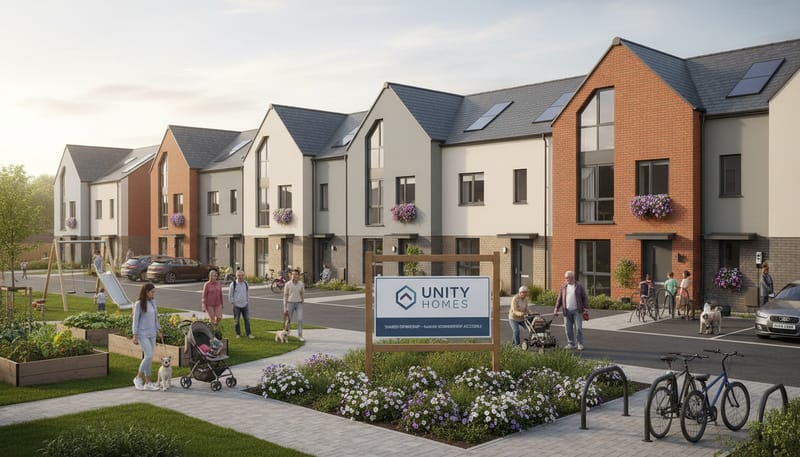
The design of mixed-tenure developments has evolved considerably, with developers and housing associations working together to create genuinely integrated communities rather than segregated enclaves. Best practice requires affordable homes to be dispersed throughout the development rather than clustered in a separate area, to share the same external design language as market homes, and to have equal access to communal facilities, green spaces, and infrastructure. Developer contributions through Section 106 and the Community Infrastructure Levy also fund supporting infrastructure such as schools, healthcare facilities, parks, and transport improvements, creating places where people want to live regardless of tenure. For more on this topic, read our detailed guide on developer investment in local infrastructure and amenities.
Regional Variations in Partnership Delivery
The scale and nature of developer-housing association partnerships vary significantly across the UK, reflecting differences in land values, affordability pressures, planning policies, and the organisational landscape of housing associations in each region. In London and the South East, where affordability pressures are most acute, S106 affordable housing requirements are typically higher (often 35 to 50 percent), and the range of affordable tenures delivered is broader, including significant volumes of social rent, London Affordable Rent, and shared ownership. The Greater London Authority plays an active role in shaping affordable housing delivery through its planning powers and grant programmes, and large London-based housing associations such as L&Q, Peabody, and Notting Hill Genesis are major development partners for housebuilders operating in the capital.
In the Midlands and North of England, where land values are lower, the viability challenges are different and the partnership models have evolved accordingly. S106 affordable housing requirements are typically lower (20 to 30 percent), but developers often deliver a higher proportion of affordable rent homes, reflecting the greater need for rented accommodation at below-market rents. Housing associations such as Bromford, Stonewater, Riverside, Great Places, and Together Housing are active partners in these regions, and their local knowledge and community connections are valuable assets in creating successful mixed-tenure developments.
Scotland and Wales have their own distinct affordable housing frameworks. In Scotland, housing associations (known as Registered Social Landlords) work within a planning framework that typically requires 25 percent affordable housing on major sites, and the Scottish Government's Affordable Housing Supply Programme provides substantial grant funding. In Wales, the Welsh Government's Social Housing Grant programme supports housing association delivery, and the planning framework requires affordable housing contributions that are assessed on a site-by-site basis. In both nations, the relationship between developers and housing associations is well-established and productive, delivering thousands of affordable homes each year.
The Future of Developer-HA Partnerships
The outlook for developer-housing association partnerships is strongly positive. The government's commitment to increasing housing supply, combined with acute affordability pressures across much of the UK, means that the demand for affordable homes will remain strong for the foreseeable future. The evolution of partnership models, from simple S106 transfers to sophisticated joint ventures and strategic collaborations, reflects an industry that is becoming increasingly creative and effective in addressing the affordable housing challenge.
Several trends are likely to shape the future of partnerships. First, the growing emphasis on for-profit registered providers entering the affordable housing market is creating new partnership opportunities, with organisations like Legal & General Affordable Homes, Sage Housing, and Heylo Housing offering developers alternative routes to disposing of affordable units. Second, the increasing use of modern methods of construction in affordable housing delivery promises to reduce costs and improve quality, making partnerships more viable in areas where land values have traditionally made affordable housing delivery challenging. Third, the integration of sustainability requirements into affordable housing standards, including the Future Homes Standard, is driving developers and housing associations to collaborate more closely on energy-efficient design and low-carbon heating systems.
The role of housing associations is also evolving, with many moving from being primarily landlords and managers to becoming active development partners who bring land, capital, and expertise to the table alongside private developers. This evolution is creating deeper, more productive partnerships that deliver more homes, better quality, and stronger communities. For buyers considering shared ownership or other affordable tenure homes, the quality and range of options has never been better, reflecting the maturity and effectiveness of the partnerships that deliver them.
For related insights, explore our articles on how developers are creating accessible and inclusive homes and the New Homes Quality Board's role in raising standards across all tenure types.
Sustainability in Partnership Housing
Developer-housing association partnerships are increasingly at the forefront of sustainable housing delivery. Housing associations, many of which have ambitious net-zero commitments, are pushing developers to deliver homes with higher energy performance standards than the minimum required by building regulations. This collaborative dynamic is accelerating the adoption of low-carbon technologies including air source heat pumps, solar photovoltaic panels, and high-performance insulation systems across all tenure types. Clarion Housing Group, the UK's largest housing association with over 125,000 homes under management, has committed to achieving net-zero carbon across its entire stock by 2050, and its partnership specifications for new homes require energy performance that significantly exceeds Part L minimums. Similarly, L&Q has introduced sustainability requirements for all its developer partners that include minimum SAP ratings, mandatory renewable energy provision, and enhanced fabric performance standards.
The financial logic of building more sustainable affordable homes is compelling. Residents of affordable housing are disproportionately affected by energy costs, and homes with lower running costs deliver immediate, tangible benefits to some of the most financially vulnerable households. Research by the National Housing Federation estimates that the average affordable home built to current energy standards saves its occupants approximately 800 to 1,200 pounds per year in energy costs compared to a home built to pre-2013 standards. When these savings are scaled across the 66,000 affordable homes delivered annually, the aggregate financial benefit to low-income households is substantial, running to tens of millions of pounds each year.
The Regulatory Framework and Future Reform
The regulatory framework governing affordable housing delivery through developer partnerships continues to evolve, with several significant reforms on the horizon. The government's proposed Infrastructure Levy, intended to replace both CIL and the affordable housing component of S106, has been the subject of extensive consultation and debate. Under the proposed system, the Infrastructure Levy would be charged at a flat rate on development value, with local authorities using a portion of the receipts to purchase affordable homes on the open market or directly from developers. Advocates argue that this approach would simplify the system and reduce viability disputes, while critics express concern that it could reduce affordable housing delivery in areas where the levy rate does not generate sufficient funds to purchase homes at market prices.
The Social Housing Regulation Act 2023 has also had significant implications for housing associations that partner with developers. The Act strengthened the powers of the Regulator of Social Housing, introduced new consumer standards covering safety, quality, transparency, and tenant engagement, and created a framework for regular inspections of housing associations' performance. These requirements are raising the bar for housing associations' management of the homes they receive from developer partners, with implications for the specifications and handover standards that housing associations expect. The overall direction of regulatory reform is towards higher standards, greater transparency, and stronger consumer protection, all of which reinforce the positive trajectory that developer-housing association partnerships have been following in recent years.
The Affordable Homes Programme continues to be the primary source of government grant funding for partnership housing delivery, and the scale of the programme reflects the government's recognition that private-sector partnerships are essential to meeting affordable housing need. With an 11.5 billion pound budget for the current programme period, Homes England is supporting housing associations to work with developers on an unprecedented scale, and the pipeline of partnership schemes in development provides confidence that delivery will continue to grow. For buyers considering shared ownership or other affordable tenures, the combination of developer quality, housing association management, and regulatory oversight provides a robust framework that supports confident and informed purchasing decisions.