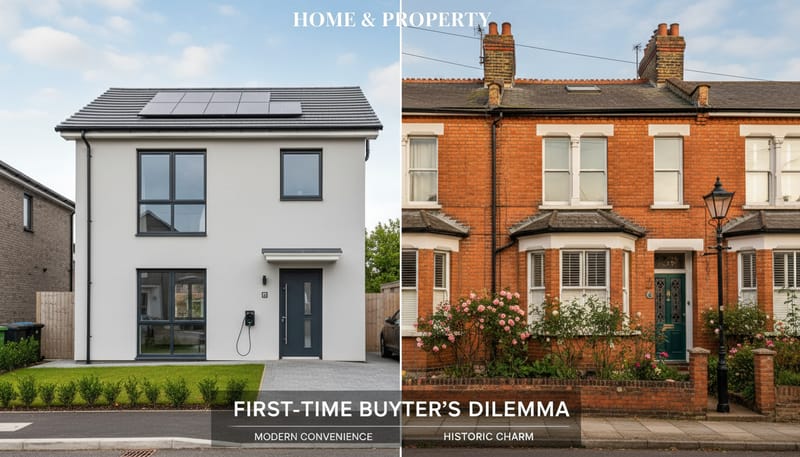
Purchase Price: What You Get for Your Money
New Build
New builds typically carry a 10–20% "new build premium" over comparable older properties in the same area. On a £300,000 new build, an equivalent Victorian terrace or 1990s semi might be £250,000–£270,000. You're paying more per square metre for a new build — sometimes significantly more.
However, this premium buys you: no chain (faster, more certain purchase), a 10-year warranty, modern building regulations compliance, energy efficiency, and access to developer incentives and government schemes that can offset thousands.
Older Property
Your money goes further in terms of space. A £300,000 budget gets you a larger home in most areas if you buy resale. Victorian, Edwardian, and even 1930s houses typically have larger rooms, higher ceilings, bigger gardens, and more character than new builds at the same price.
But the lower price often comes with hidden costs: renovation, repairs, lower energy efficiency, and no warranty. A "bargain" £250,000 house that needs £30,000 of work isn't cheaper — it's just harder to budget for.
Verdict
If you want maximum space and character, older properties win on price per square metre. If you want certainty, minimal upfront costs, and scheme access, new builds justify the premium for many first-time buyers.
Energy Efficiency and Running Costs
New Build
New builds must meet current building regulations, which means they're typically EPC A or B rated. Triple-glazed windows, high levels of insulation, heat pumps or efficient boilers, and airtight construction mean annual energy bills of £800–£1,200 on a typical 3-bed house.
Many new builds also come with solar panels, smart thermostats, and energy-efficient appliances as standard. The savings compound year after year.
Older Property
The average UK home is EPC D rated. A Victorian terrace or 1930s semi might be EPC E or F without upgrades. Annual energy bills of £1,800–£3,000+ are common on older properties with single glazing, poor insulation, and ageing boilers.
You can improve an older property's efficiency (cavity wall insulation: £1,000–£2,000, loft insulation: £500–£1,000, double glazing: £4,000–£8,000, new boiler: £3,000–£5,000), but the total retrofit cost can run to £10,000–£20,000+ — and you still may not match a new build's performance.
Verdict
New builds win convincingly on energy efficiency. Over 10 years, the energy savings alone (£600–£1,800 per year) can total £6,000–£18,000 — a meaningful offset to the new build premium.
Space and Layout
New Build
Modern new builds are designed for efficiency, not generosity. Room sizes have shrunk significantly over the decades. The average new build 3-bed house has around 80–90 sq m of floor space, compared to 90–110 sq m for a comparable 1930s semi. Bedrooms described as "doubles" on the plan may barely fit a double bed and a wardrobe.
Open-plan living areas are standard, which can make the downstairs feel spacious, but there's often limited storage space — a common complaint from new build owners.
Older Property
Older homes generally offer more space per pound. Higher ceilings (2.7m+ in Victorian/Edwardian homes vs 2.4m standard in new builds) make rooms feel significantly larger. Separate reception rooms offer flexibility. Built-in storage (understairs cupboards, alcoves, cellars) is more common.
Layouts may not suit modern living without work — galley kitchens, separate dining rooms, and bathrooms only accessible through bedrooms are common in unrenovated older homes.
Verdict
If space is your priority, older properties offer more of it at the same price. New builds compensate with efficient layouts and open-plan designs, but they are objectively smaller.
Maintenance and Upkeep
New Build
In the first 2 years, the developer must fix defects under the NHBC warranty. Years 3–10 cover structural issues. In practical terms, a new build owner spends very little on maintenance in the first 5–10 years — no replumbing, no rewiring, no damp treatment, no roof repairs.
Ongoing maintenance is limited to decorating, garden upkeep, and annual boiler servicing. Budget £500–£1,000 per year for the first decade.
Older Property
Older homes demand more. A general rule of thumb is to budget 1–2% of the property value per year for maintenance — that's £2,500–£5,000 annually on a £250,000 house. Common costs in the first few years of ownership:
- Boiler replacement: £3,000–£5,000
- Roof repairs: £1,000–£10,000
- Rewiring: £3,000–£5,000
- Replumbing: £2,000–£4,000
- Damp treatment: £1,000–£5,000
- Window replacement: £4,000–£8,000
A homebuyer's survey (£400–£700) before purchase will flag the biggest issues, but surprises still happen — dry rot behind the plaster, asbestos in the garage roof, or subsidence that only appears after heavy rain.
Verdict
New builds win on maintenance costs — dramatically so in the first decade. Over 10 years, a new build owner might spend £5,000–£10,000 on upkeep. An older property owner could spend £25,000–£50,000. This is arguably the biggest financial advantage of buying new.
The Buying Process
New Build
No chain, fixed price (limited negotiation), and a structured process: reservation → exchange → completion. Developer incentives can offset fees. Government schemes (First Homes, Shared Ownership, Own New Rate) are primarily available on new builds.
Downsides: tight exchange deadlines (usually 28 days), less room for price negotiation, and potential construction delays on off-plan purchases.
Older Property
Chains can (and do) collapse. The process takes longer on average — 12–16 weeks from offer to completion. You can negotiate on price (especially in a buyer's market), and there's no developer deadline forcing the pace.
You'll need a homebuyer's survey or full structural survey (£400–£1,500) to identify problems — something that's not necessary on new builds (which have the NHBC warranty instead).
Verdict
New builds offer a faster, more certain purchase process with better financial support options. Older properties offer more negotiation room but more uncertainty.
Resale Value and Investment
New Build
New builds often lose value slightly in the first 1–2 years as the "new build premium" fades. A property bought for £300,000 might only fetch £280,000–£290,000 if you needed to sell within the first year. After 3–5 years, values typically recover and grow in line with the local market.
This matters if your plans might change. If there's a chance you'll need to move within 2–3 years, the initial value dip is a real financial risk.
Older Property
Older properties don't have the new build premium, so there's no initial dip. If you buy well (good location, competitive price), the value should track the market from day one. Properties with renovation potential can gain value quickly — a £20,000 kitchen extension on a £250,000 house could add £40,000+ in value.
Verdict
Older properties are generally safer short-term investments. New builds are better long-term (lower running costs, warranty, energy efficiency), but you need to plan on staying at least 3–5 years to absorb the initial premium.
Location and Availability
New Build
New build developments are typically on the edges of towns or on brownfield sites. This can mean less central locations with longer commutes, fewer established amenities, and an "unfinished" feel if the development is still being built.
On the plus side, new developments often come with new infrastructure — roads, parks, schools, shops — and many are designed around sustainable transport and green spaces.
Older Property
Older homes are everywhere — including the established town centres, leafy suburbs, and village locations where new developments don't exist. If location is your top priority, the resale market gives you far more choice.
Verdict
If you want a specific established area, the resale market offers more options. If you're flexible on location and want modern infrastructure, new developments can offer excellent planned communities.
Character and Personalisation
New Build
New builds look… new. Clean lines, neutral colours, standardised designs. Some people love this; others find it soulless. You can personalise with paint and furniture, but the underlying architecture is modern and uniform. On a street of identical house types, your home looks like your neighbour's home.
If you buy early enough (off-plan or early in the build stage), you can choose finishes — kitchen colours, bathroom tiles, flooring. But structural changes are rarely possible.
Older Property
Period features (fireplaces, coving, sash windows, original floorboards, garden walls) give older homes character you can't replicate. Every home on the street is different. Many first-time buyers love the idea of putting their stamp on an older home — even if the reality involves more work than they expected.
Verdict
This is entirely personal. If you want character and individuality, buy old. If you want clean, modern, and minimal fuss, buy new. Neither is objectively better.
The Cost Comparison: £300,000 Budget Over 10 Years
Let's compare a £300,000 new build 3-bed house with a £260,000 older 3-bed house (similar area, leaving £40,000 for renovation/improvements).
New Build (£300,000)
- Purchase price: £300,000
- Stamp duty (FTB): £0
- Legal fees: £0 (developer pays as incentive)
- Survey: £0 (NHBC warranty covers structural)
- Maintenance (10 years): ~£7,500
- Energy bills (10 years at £1,000/yr): ~£10,000
- Total 10-year cost: ~£317,500
Older Property (£260,000 + £40,000 renovation)
- Purchase price: £260,000
- Stamp duty (FTB): £0
- Legal fees: £2,000
- Survey: £500
- Renovation: £40,000 (new kitchen, bathroom, boiler, decorating)
- Maintenance (10 years): ~£30,000
- Energy bills (10 years at £2,000/yr): ~£20,000
- Total 10-year cost: ~£352,500
The Difference
Over 10 years, the new build is ~£35,000 cheaper to own despite the higher purchase price. The savings come from lower maintenance (£22,500 difference), lower energy bills (£10,000 difference), and free legal fees and surveys.
Of course, the older property may have more space, a better location, and character that the new build lacks. And if you enjoy renovating, the older property offers creative satisfaction that a new build never will.
Which Should You Choose?
Buy a New Build If…
- You want a simple, predictable buying process with no chain
- Low maintenance and known costs matter to you
- You want to use a government scheme (First Homes, Shared Ownership, Own New Rate)
- Energy efficiency and low bills are a priority
- You plan to stay at least 3–5 years (to absorb the new build premium)
- You don't want to deal with renovation or unexpected repairs
Buy an Older Property If…
- Space and character are your top priorities
- You want a specific established location (central, leafy suburb, village)
- You enjoy or are willing to project-manage renovation
- You want more negotiation room on price
- You might need to sell within 1–3 years
- You're comfortable with higher ongoing maintenance costs
The Bottom Line
There's no universally "right" answer. New builds and older properties suit different buyers at different stages of life. The best approach is to view both — visit new build show homes and older properties on the same day, in the same budget range, in the same area. The contrast will make your priorities clear very quickly.
For the complete guide to buying a new build as a first-time buyer, see our comprehensive FTB guide. For the specific mistakes to avoid, read the 15 costliest FTB mistakes on new builds.