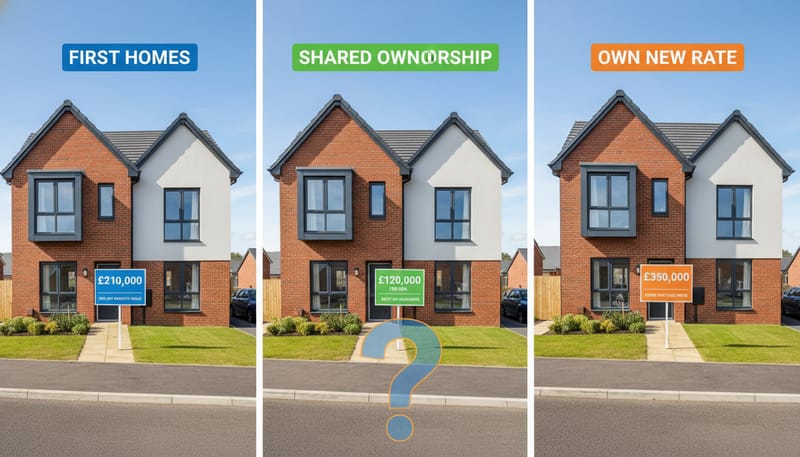
A Quick Recap: Why Help to Buy Is No Longer an Option
The Help to Buy equity loan scheme closed to new applicants in England on 31 October 2022 (completions by 31 March 2023). At its peak it helped over 380,000 households, but it was widely criticised for inflating new build prices. Scotland, Wales, and Northern Ireland ran their own variants, all of which have since wound down or been replaced.
If you already have a Help to Buy equity loan, you can still read our guide on managing and repaying it. But if you're buying now, the three schemes below are your main alternatives.
How Each Scheme Works — The Basics
Shared Ownership
You buy a share of a new build home (usually 25–75%) and pay rent on the remainder to a housing association. Over time you can "staircase" — buying additional shares until you own 100%. Shared Ownership is available across England through registered housing providers and is typically sold on designated plots within larger developments.
- Minimum share: 25% (some providers now offer 10% under newer rules)
- Rent on unowned share: Capped at 2.75% of the housing association's share per year
- Deposit required: Typically 5–10% of your share (not the full property price)
- Available on: New builds and some resale Shared Ownership properties
- Eligibility: Household income under £80,000 (£90,000 in London), first-time buyers prioritised but not always required
First Homes
First Homes is an English government scheme that offers new build properties at a minimum 30% discount to market value. The discount is locked to the property in perpetuity — when you sell, the next buyer gets the same percentage off. First Homes are sold through participating developers, often as a percentage of affordable housing within Section 106 agreements.
- Discount: At least 30% below market value (local authorities can set 40% or 50%)
- Price cap after discount: £250,000 nationally, £420,000 in London
- Deposit required: Typically 5–10% of the discounted price
- Eligibility: First-time buyers, household income under £80,000 (£90,000 in London), must use a mortgage for at least 50% of the discounted price
- Resale restriction: Must sell at the same percentage discount to another eligible first-time buyer
Own New Rate
Own New Rate is a newer scheme backed by the UK government where the developer subsidises your mortgage interest rate for the first few years. The developer uses a portion of the purchase price to 'buy down' the rate with the lender, typically reducing your monthly payments significantly in the early years when affordability is tightest.
- Typical rate reduction: Rates of around 1.5–2.5% for the initial 2–5 year fixed period (compared to standard rates of 4–5%+)
- You own 100%: No equity loan, no shared ownership — full ownership from day one
- Deposit required: Standard mortgage deposit (usually 5–15%)
- Available on: New builds from participating developers only
- Eligibility: No income cap; open to first-time buyers and home movers
Head-to-Head Comparison: £300,000 New Build Property
Let's see how these three schemes play out on the same £300,000 new build home, assuming a first-time buyer with £15,000 in savings and a household income of £55,000.
Scenario 1: Shared Ownership (40% Share)
- Your share: 40% = £120,000
- Deposit: 10% of your share = £12,000
- Mortgage needed: £108,000
- Monthly mortgage payment: ~£570 (at 4.5% over 30 years)
- Monthly rent on unowned 60%: ~£412 (2.75% of £180,000 ÷ 12)
- Total monthly housing cost: ~£982
- Service charge: Typically £100–£200/month on top (varies by development)
- Stamp duty: £0 on the initial share for first-time buyers (under £425,000 threshold)
Scenario 2: First Homes (30% Discount)
- Purchase price: £210,000 (30% off £300,000)
- Deposit: 5% = £10,500
- Mortgage needed: £199,500
- Monthly mortgage payment: ~£1,053 (at 4.5% over 30 years)
- Monthly rent: £0 — you own 100%
- Total monthly housing cost: ~£1,053
- Stamp duty: £0 for first-time buyers (under £425,000 threshold)
Scenario 3: Own New Rate (Subsidised Mortgage)
- Purchase price: £300,000 (full price)
- Deposit: 5% = £15,000
- Mortgage needed: £285,000
- Monthly payment (years 1–3): ~£1,136 (at ~2% subsidised rate over 30 years)
- Monthly payment (year 4 onward): ~£1,505 (if rate reverts to ~4.5%)
- Monthly rent: £0 — you own 100%
- Total monthly housing cost: ~£1,136 initially, rising to ~£1,505
- Stamp duty: £0 for first-time buyers (under £425,000 threshold)
What the Numbers Show
Lowest monthly cost: Shared Ownership wins on monthly outgoings at ~£982, but remember you only own 40% of the home. Adding a typical service charge of £150 brings it to ~£1,132.
Best value for full ownership: First Homes gives you 100% ownership at the lowest total monthly cost (£1,053), provided you can find an eligible property and meet the criteria.
Easiest to access: Own New Rate has no income cap and is available to movers as well as first-time buyers, making it the most broadly accessible option.
Building Equity: The Long-Term Picture
Monthly costs only tell part of the story. How quickly you build equity — and what happens when you sell — varies dramatically between these schemes.
Shared Ownership: Slow Equity Growth
Your mortgage payments only build equity in the share you own. If the property increases in value, your unowned share becomes more expensive to staircase into. On a £300,000 property that rises to £350,000 over five years, buying the remaining 60% would cost £210,000 rather than £180,000. You're essentially chasing a moving target.
There's also the rent — roughly £5,000 per year in our example — which builds no equity at all. Over 10 years that's £50,000+ paid with nothing to show for it if you haven't staircased.
First Homes: Full Equity, Capped Gains
Every mortgage payment builds equity in a home you fully own. However, when you sell, the 30% discount passes to the next buyer. If your home doubles in value, you only benefit from 70% of that growth. On a property that rises from £210,000 to £420,000 (market value £600,000), your gain is £210,000 — compared to £300,000 had you bought at full price without the restriction.
This is a genuine trade-off: a lower entry price in exchange for capped upside. For many first-time buyers, the ability to get on the ladder sooner outweighs the theoretical lost gain.
Own New Rate: Full Equity, Full Gains
You own 100% from day one with no resale restrictions. Every pound of mortgage repayment and every pound of price growth is yours. The catch is affordability: you're borrowing more, so if interest rates are high when your subsidised period ends, your monthly costs could jump significantly.
The Costs You Might Not Expect
Each scheme has hidden or overlooked costs that can affect your total spend over the years.
Shared Ownership Hidden Costs
- Rent increases: Rent typically rises annually by RPI + 0.5%, though the government has proposed capping this at CPI. Over 10 years, your rent could be 30–40% higher than at the start.
- Staircasing fees: Each time you buy more shares, you need a RICS valuation (£300–£500), potentially new legal work, and sometimes a new mortgage deal.
- Service charges: On new build flats especially, these can be £2,000–£4,000+ per year and are payable on top of rent and mortgage.
- Selling restrictions: The housing association usually has a nomination period to find a buyer before you can sell on the open market, which can slow down sales.
First Homes Hidden Costs
- Resale pool: You can only sell to another eligible first-time buyer at the discounted price. If demand is low in your area, this could limit your buyer pool and slow your sale.
- Mortgage availability: Not all lenders offer mortgages on First Homes properties yet, which could limit your remortgage options.
- Improvement value: Any money you spend improving the property is also subject to the discount restriction — if you add a £20,000 extension, you effectively only get £14,000 of that back when selling.
Own New Rate Hidden Costs
- Rate reversion: When the subsidised period ends (usually after 2–5 years), you move to a standard rate. If rates have risen, your monthly payments could increase substantially.
- Higher purchase price: Some argue developers price Own New Rate homes slightly higher to offset the subsidy cost. Compare the price per square foot against similar non-scheme properties.
- Remortgage timing: You need to plan your remortgage before the subsidised period ends. Early repayment charges may apply if you remortgage during the fixed term.
Which Scheme Suits Which Buyer?
Choose Shared Ownership If…
- You have a small deposit and modest income and need the lowest possible monthly costs
- You're comfortable renting part of your home while gradually buying more
- You see the property as a stepping stone rather than a forever home
- You're buying in a high-cost area where full ownership is out of reach
Choose First Homes If…
- You want 100% ownership from the start at a genuinely reduced price
- You're a first-time buyer with a household income under £80,000
- You're happy with the resale restriction and don't mind a potentially smaller buyer pool when you sell
- You can find an eligible property in your preferred area (availability varies significantly by location)
Choose Own New Rate If…
- You want full ownership with no restrictions on resale
- You're confident your income will grow to absorb higher payments when the subsidised rate ends
- You're a home mover as well as a first-time buyer (no income cap or first-timer requirement)
- You want the simplest structure — a normal mortgage on a normal purchase, just with a better initial rate
Can You Combine These Schemes?
Generally, these schemes are mutually exclusive — you can't use First Homes and Shared Ownership on the same property. However, you can combine any of them with other financial tools:
- Lifetime ISA: Use your £1,000/year government bonus toward your deposit on any scheme (subject to the £450,000 property price cap)
- Developer incentives: Many builders offer extras like paid stamp duty, free upgrades, or deposit contributions alongside these schemes. See our guide on combining government schemes with developer incentives
- Gifted deposits: Family gifted deposits are accepted on all three schemes, subject to lender requirements
Practical Steps to Get Started
- Check your eligibility: Use our scheme eligibility guide to see which schemes you qualify for
- Get a mortgage agreement in principle: Speak to a broker who specialises in new build purchases — they'll know which lenders support each scheme
- Compare specific developments: Not all schemes are available on all developments. Use our new build search to find properties and check what schemes are offered
- Run the numbers for your situation: The examples above use a £300,000 property, but your local prices, deposit size, and income will change the picture significantly
- Factor in your timeline: If you plan to move within 5 years, the resale restrictions on First Homes and staircasing costs on Shared Ownership matter more than if you're staying long term
The Bottom Line
There's no single "best" scheme — each one makes financial sense for a different type of buyer. Shared Ownership offers the lowest entry point but the highest long-term cost and complexity. First Homes gives you full ownership at a genuine discount, but with resale restrictions that could limit your flexibility. Own New Rate keeps things simple with no ownership strings, but you need to plan for higher payments when the subsidy period ends.
The important thing is to compare these options against each other and against buying without any scheme. Sometimes a standard 5% deposit mortgage on a slightly cheaper property gives you more freedom than a scheme-assisted purchase on a more expensive one. A good mortgage broker who understands new builds can model all the scenarios for you.
For a full overview of every government support option available in 2026, see our complete guide to government schemes for new build buyers.