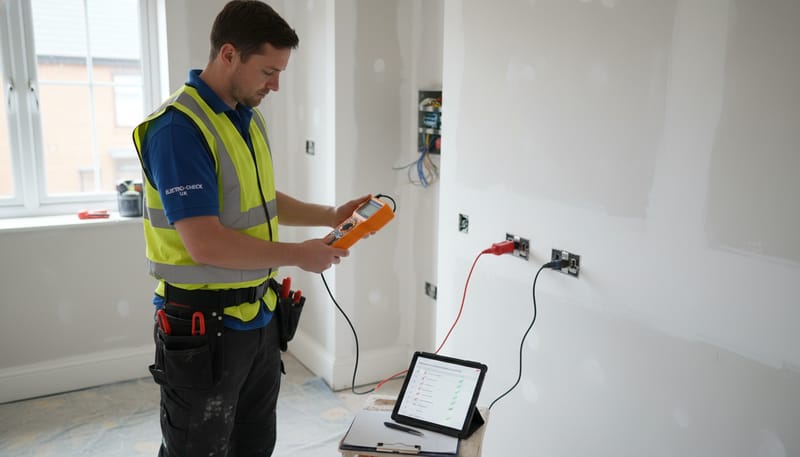
Why Electrical Defects Are Among the Most Serious Snags
Electrical defects in new build homes are not merely inconvenient – they can be genuinely dangerous. Faulty wiring, missing safety devices, and non-compliant installations pose real risks of electric shock, fire, and even fatality. Despite being subject to rigorous Building Regulations (Part P) and mandatory inspection by a qualified electrician, new build electrical installations are a surprisingly common source of snagging issues. Many defects are cosmetic or functional, but a significant minority relate to safety compliance and should be treated with the utmost urgency.
All new build electrical work must comply with BS 7671 (the IET Wiring Regulations) and Building Regulations Approved Document Part P. On completion, the electrician must issue an Electrical Installation Certificate (EIC), which should be included in your handover pack. This certificate confirms that the installation has been designed, constructed, inspected, and tested in accordance with the regulations. If it’s missing, raise this immediately as a critical snagging item. For a broader view of the snagging process, see our complete guide to snagging a new build home.
Socket Placement and Switch Operation
Socket and switch defects are among the most commonly reported electrical snags in new build homes. While individually minor, they can be incredibly frustrating to live with and may indicate broader quality control issues with the electrical installation.
Test every socket using a plug-in socket tester (available for around £15 from any DIY store). This simple device plugs into each socket and uses indicator lights to confirm correct wiring (live, neutral, and earth all connected properly). A missing earth connection is a serious safety defect that must be reported immediately. Check that all switches operate smoothly, that two-way and intermediate switching works correctly (staircase and landing lights are common failure points), and that dimmer switches have smooth, full-range operation without buzzing or flickering. Sockets should be firmly mounted, level, and free from paint or plaster contamination.
Consumer Unit and Circuit Protection
The consumer unit (commonly called the fuse box) is the nerve centre of your home’s electrical system. In new builds, it should be a modern, metal-clad unit with residual current devices (RCDs) or residual current breakers with overcurrent protection (RCBOs) protecting every circuit. Proper labelling and configuration of the consumer unit is a legal requirement, yet it’s one of the most frequently defective areas found during snagging inspections.
Open the consumer unit cover and check that every circuit breaker is clearly labelled with the circuit it protects (e.g., “Upstairs lights”, “Kitchen sockets”, “Cooker”). Vague labels like “spare” or blank labels are unacceptable. Test each RCD by pressing the test button – it should trip immediately, cutting power to the protected circuits. Reset it and confirm power is restored. If any RCD fails to trip on test, this is a critical safety defect requiring immediate attention. The consumer unit should be easily accessible (not blocked by furniture or stored items) and mounted at a height that allows comfortable operation.
Light Fittings and Extractor Fans
Lighting and ventilation defects are extremely common in new builds. Light fittings that flicker, buzz, or fail to operate correctly are frustrating but also potentially indicative of deeper wiring issues. Extractor fans are critical to preventing condensation and mould growth, particularly in bathrooms and kitchens, and their incorrect installation is a frequent Building Regulations compliance failure.
Test every light fitting in the property, including loft lights, under-cabinet kitchen lights, and any external lights. LED downlights should provide even illumination without visible flickering. If any lights buzz or flicker, this may indicate a wiring fault, an incompatible dimmer switch, or a defective LED driver. Extractor fans in bathrooms must operate either continuously at a trickle rate or be linked to the light switch with an overrun timer of at least 15 minutes (per Building Regulations Part F). Check that every fan is actually extracting air by holding a tissue to the grille – it should be drawn towards the fan. If it blows outwards or has no effect, the ducting may be blocked, disconnected, or the fan may be wired in reverse.
Smoke Detectors, CO Alarms, and Fire Safety
Fire safety systems in new builds are governed by Building Regulations Approved Document B and must include interlinked smoke and heat detectors in specified locations. Since October 2022, carbon monoxide alarms are also mandatory in all rooms containing a fixed combustion appliance (such as a gas boiler). These are non-negotiable safety requirements, and any shortcomings must be treated as critical defects.
Test every smoke detector, heat detector, and CO alarm by pressing the test button. In an interlinked system (mandatory in new builds), triggering one detector should cause all others in the property to sound. If they don’t interlink, this is a Building Regulations compliance failure. Check that smoke detectors are fitted on every storey in the circulation space (hallway, landing), that a heat detector is installed in the kitchen (not a smoke detector, which would cause nuisance alarms), and that a CO alarm is present in any room containing a gas boiler or gas fire. Detectors should be ceiling-mounted, at least 300mm from any wall or light fitting, and should be mains-powered with battery backup. For more on common safety defects, see our common defects guide.
EV Charging Points and Data Infrastructure
Since June 2022, all new homes in England with associated parking must include an electric vehicle charge point as standard (Building Regulations Part S). This is a relatively new requirement, and installation quality varies significantly. Meanwhile, adequate broadband and data cabling infrastructure is increasingly essential in modern homes, yet is often poorly specified or installed in new builds.
The EV charge point should be a minimum 7kW (Mode 3) unit mounted on an external wall or a dedicated post near your parking space. Check that it has its own dedicated circuit in the consumer unit, that any smart functionality connects to Wi-Fi, and that the cable reach covers your typical parking position. Common defects include non-functional units (often a wiring fault at the consumer unit), missing manufacturer registration (which voids the warranty), and poorly sealed cable entries that could allow water ingress.
Outdoor Lighting and the EICR Certificate
External lighting is often an afterthought in new build installations, but it’s subject to the same standards as internal wiring. All outdoor electrical fittings must be suitably IP-rated for their location (typically IP44 or higher for exposed positions), properly sealed against moisture ingress, and protected by an RCD. Common defects include motion sensor lights that don’t activate correctly, bulkhead lights positioned too low (creating a collision hazard), and inadequately sealed cable entries through external walls.
The Electrical Installation Certificate (EIC) is arguably the most important electrical document in your handover pack. It should detail every circuit in the property, the test results for each circuit, and a declaration that the installation complies with BS 7671. If you do not receive this at handover, escalate immediately – without it, you have no proof that the electrical installation is safe and compliant. Some buyers also commission an independent EICR (Electrical Installation Condition Report) as part of their snagging process. While the new installation should pass without issue, an independent test provides an additional layer of assurance and can identify defects that were missed during the original testing. For guidance on your warranty rights, see our NHBC warranties guide, and for the full snagging process, see our new build snagging checklist.
Reporting and Prioritising Electrical Defects
When reporting electrical snagging issues, it’s important to prioritise them correctly. Safety-critical defects – such as non-functional RCDs, missing smoke detectors, exposed wiring, or dead circuits – should be reported separately from cosmetic issues and flagged as urgent, safety-related items requiring immediate attention.
For all other electrical snags, include as much detail as possible: the room, the specific fitting or socket, the nature of the fault, and a photograph. If a socket fails the plug-in tester, note the specific fault indicator (missing earth, reversed polarity, etc.). If a light flickers, note whether it’s intermittent or constant, and whether it occurs on a dimmer circuit. This detail helps the electrician diagnose the issue without multiple visits.
All electrical repair work should be carried out by a Part P registered electrician, and any modifications to the installation should be recorded on a Minor Works certificate. Do not accept a general handyman carrying out electrical repairs – this is both unsafe and non-compliant with Building Regulations. Your developer is obligated to use qualified tradespeople for all electrical work. If you have concerns about the safety of your electrical installation at any point, you have the right to refuse access until a qualified electrician has made the situation safe. For more on escalating unresolved defects with your developer, see our common defects guide and our new build handover guide.