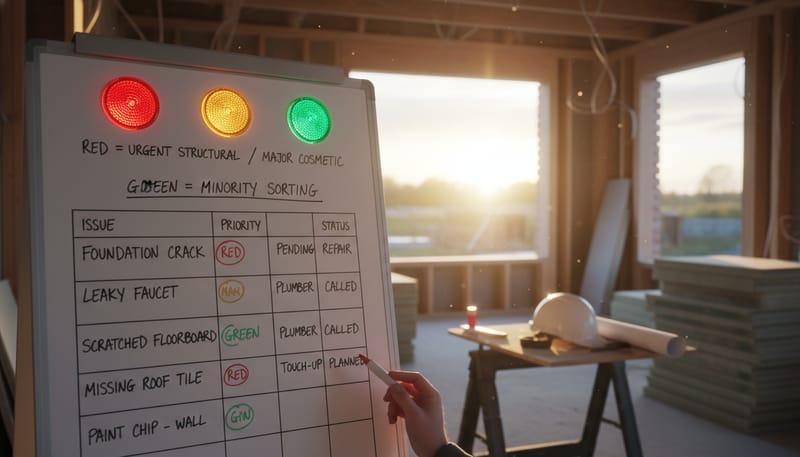
Why Prioritisation Is Essential in Snagging
A typical new build snagging inspection uncovers anywhere from 50 to over 200 individual items. Presenting a developer with a flat, unnumbered list of 150 defects is almost guaranteed to produce a poor response — the maintenance team won’t know where to start, genuinely urgent items get lost among cosmetic niggles, and the sheer volume can feel overwhelming enough that progress stalls entirely.
Smart prioritisation transforms your snagging report from a complaint list into a professional action plan. By categorising each defect by severity, you demonstrate to the developer that you understand the difference between a safety-critical issue that needs immediate attention and a paint blemish that can be scheduled at mutual convenience. This approach earns credibility, accelerates the most important repairs, and ultimately gets everything fixed faster.
This guide explains a practical four-tier prioritisation system, gives you real-world examples of each category, and covers the developer’s legal obligations by severity level. Whether you’re using a professional snagging inspector or working through our snagging checklist yourself, this framework will help you get the right things fixed in the right order.
Priority 1: Critical and Structural Issues
Critical issues are defects that pose an immediate risk to the health, safety or structural integrity of the property and its occupants. These require the most urgent response and should be reported to the developer immediately by phone or in person, followed up in writing within 24 hours. Do not wait until you have compiled a complete snagging report to raise P1 items.
Structural defects include significant cracking to load-bearing walls (cracks wider than 5mm, stepped cracking following mortar joints, or cracking that runs through bricks rather than just mortar), visible deflection in beams or lintels, bouncy or sagging floors that suggest inadequate joist sizing, and evidence of foundation movement such as doors and windows that have gone out of square across the whole property rather than individually.
Safety-critical items include: non-functioning smoke or carbon monoxide alarms, exposed or incorrectly wired electrical connections, gas installations without a valid Gas Safe certificate, missing or loose balustrades on stairs or balconies (especially above ground floor), absent fire stopping between floors or at party walls, missing or incorrectly installed cavity barriers, and any evidence of water ingress causing an immediate electrical or slip hazard.
If you identify a gas safety concern, do not attempt to investigate further — call the Gas Emergency Service on 0800 111 999. For electrical hazards, avoid touching the affected fitting and call a qualified electrician. Report the issue to the developer simultaneously, but do not wait for their response before making the property safe. These items are covered under the developer’s contractual obligations and the NHBC warranty from day one.
Priority 2: Major Functional Issues
Functional issues are defects that don’t pose an immediate safety risk but significantly affect the usability, comfort or proper functioning of the home. These should be repaired promptly, typically within 7 to 14 days, and the developer should provide a firm commitment to a repair date when they acknowledge your report.
Common P2 items include: external doors that don’t lock properly (a security issue), windows that won’t close fully or have failed sealed units (energy efficiency and weather protection), heating systems that don’t function correctly or don’t heat all rooms adequately, plumbing leaks (even slow ones that are causing damp or damage), hot water system failures, drainage problems causing standing water against the property, and ventilation systems that are noisy, non-functional or incorrectly ducted.
Damp and moisture-related issues deserve special attention at P2 level, even when they appear minor. A small damp patch on a wall might indicate a missing or incorrectly lapped cavity tray, a failed DPC, or a plumbing leak behind the plasterboard. Left unaddressed, damp will worsen, potentially causing mould growth (a health hazard) and structural damage to timber components. Always report damp promptly and insist on the cause being identified, not just the symptom being treated.
Energy efficiency defects also fall into P2 when they’re significant enough to affect comfort or running costs. If your home feels noticeably draughty in certain areas, if rooms don’t heat up despite the system running continuously, or if you see condensation forming on the inside of windows in moderate weather, these suggest insulation, airtightness or ventilation defects that need investigation.
Priority 3 and 4: Minor Quality and Cosmetic Issues
Priority 3 (Minor Quality) items are defects in workmanship that don’t affect the function of the home but fall below the standard a reasonable buyer would expect. These include: doors that stick or rub, uneven or poorly finished plasterwork, cracked or chipped tiles, poor-quality grouting, kitchen units that are slightly misaligned, drawers that don’t close smoothly, worktop joints that are visible or poorly sealed, skirting boards with gaps at joints, and window reveals that haven’t been finished properly.
Priority 4 (Cosmetic Finish) items are the very minor imperfections: small paint spots or drips, filler that’s visible in certain light, minor scuffs on door frames, tiny chips in worktops, and similar items. While these should still be recorded and reported, they represent the lowest priority tier and the developer is entitled to schedule them at mutual convenience rather than dropping everything to attend.
The distinction between P3 and P4 is largely about the standard of workmanship. A door that catches on the carpet and needs planing is P3 — it should work properly but isn’t functionally broken. A tiny paint drip on a skirting board that you need to get on your knees to spot is P4 — it’s not perfect, but it’s within the range of what could reasonably occur during a construction project and won’t bother most people. Recording P4 items shows thoroughness, but being reasonable about their urgency builds goodwill with the developer’s team.
Items That Worsen If Left: The Hidden Urgency
Some defects don’t seem urgent initially but can deteriorate significantly if not addressed promptly. Identifying these “ticking clock” items and escalating their priority is a key skill in snagging management.
Damp and water ingress is the number one “worsen if left” category. A small leak from a poorly sealed window or a missing cavity tray might initially show as a faint damp mark. Left for a few months, it can soak through plasterboard, cause black mould, damage timber lintels or wall plates, and require extensive remedial work including replastering, timber treatment and mould remediation. What could have been a £100 sealant repair becomes a £5,000 or more intervention.
Drainage defects are another escalating risk. If rainwater is pooling against the property due to incorrect ground levels, missing drainage or blocked gullies, it can gradually saturate the subsoil around the foundations. Over time, this leads to differential settlement, structural cracking and, in the worst cases, underpinning requirements costing tens of thousands of pounds. Check external drainage during or after rainfall — this is one area that the common defects guide covers in detail.
Missing or damaged sealant around windows, doors, bathrooms and kitchens will deteriorate with UV exposure and movement. Silicone sealant that has pulled away from the surface allows water behind it, and once water gets behind tiles or into wall cavities, the damage can be extensive before it becomes visible. A quick check of all sealant during your inspection can prevent significant problems later.
Developer’s Legal Obligations by Severity
UK developers have legal obligations to deliver a home that is fit for purpose and built to a reasonable standard. These obligations derive from several sources: the sale contract, the Consumer Rights Act 2015, the Defective Premises Act 1972, NHBC Standards (where applicable), and the Building Regulations.
Under the Consumer Rights Act 2015, the home must be of satisfactory quality, fit for purpose and as described. If a defect means the home fails any of these tests, you have a right to have it remedied. For P1 and P2 defects, the developer is generally expected to respond urgently — safety issues within 24–48 hours, functional issues within 14 days. For P3 and P4 items, a reasonable timeframe (typically 28–56 days) is acceptable.
The Defective Premises Act 1972 (as amended by the Building Safety Act 2022) provides that anyone who carries out work on a dwelling owes a duty to ensure the work is done in a professional manner with proper materials, so that the dwelling is fit for habitation when completed. Critically, the limitation period for claims under this Act was extended to 15 years by the Building Safety Act 2022 for retrospective claims and 15 years prospectively, giving homeowners significantly more time to pursue claims for serious defects.
Under the NHBC Buildmark warranty, the developer is contractually obligated to repair defects reported during the first two years that breach NHBC Standards. If the developer fails to do so, NHBC can step in under their Resolution Service. From year 3 onwards, NHBC itself takes over liability for structural defects covered by the insurance policy. The same principle applies to LABC Warranty, Premier Guarantee and other providers, though the exact terms vary — always read your specific policy.
The practical takeaway is this: you have strong legal protections as a new build buyer, but exercising them effectively depends on proper documentation. Record everything, prioritise intelligently using the framework in this guide, and don’t let any item — however minor it seems — go unreported during the warranty period. Refer to our handover guide for a complete picture of your rights and the developer’s obligations at each stage.