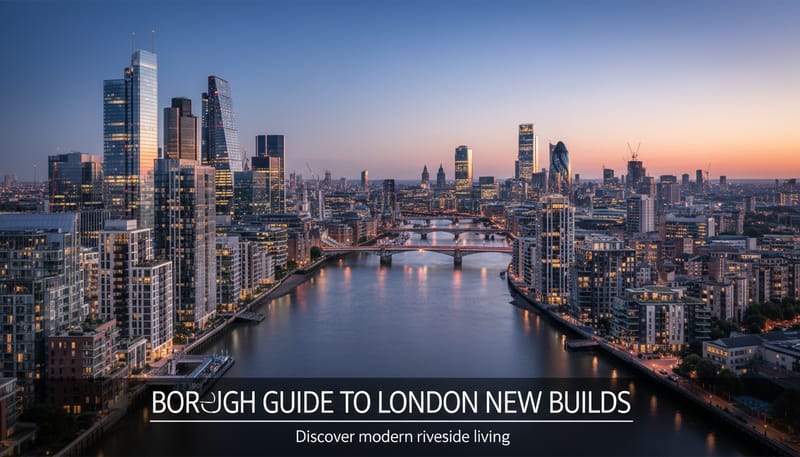
London New Build Market Overview
London's new build market has distinct characteristics that set it apart from the rest of the UK:
- Average new build price: approximately £525,000 across Greater London — but this masks huge variation (Outer London from ~£300,000; Zone 1 from ~£700,000+)
- Apartment-dominated: the majority of new builds in London are apartments, particularly within Zones 1-3. New build houses are mainly in Outer London boroughs
- Shared ownership is mainstream: approximately 40% of new build sales in London involve shared ownership, particularly for first-time buyers
- Leasehold standard for flats: virtually all new build apartments are leasehold. Ground rent reforms (Leasehold Reform Act 2024) have capped ground rents on new leases to a peppercorn (zero), but service charges and management remain significant costs
- Developer incentives: vary by market conditions and development stage. In buyer-friendly periods, developers may offer stamp duty contributions, furniture packages, or specification upgrades. In strong markets, incentives are minimal
- Off-plan buying common: many London new builds are sold off-plan (before construction is complete), often 12-24 months before completion. This requires careful mortgage timing
New Build Prices by London Zone
London's pricing follows a predictable pattern based on proximity to the centre, with some important exceptions where regeneration creates pockets of relative value:
| Zone | New Build Apartment (avg) | New Build House (avg) | Typical Boroughs |
|---|---|---|---|
| Zone 1 | £700,000 - £1,500,000+ | Extremely rare | Westminster, City, Southwark (north), Camden (south) |
| Zone 2 | £450,000 - £750,000 | £750,000+ | Hackney, Tower Hamlets, Lambeth, Islington, Wandsworth |
| Zone 3 | £350,000 - £550,000 | £500,000 - £700,000 | Lewisham, Greenwich, Ealing, Waltham Forest |
| Zone 4 | £300,000 - £450,000 | £400,000 - £600,000 | Croydon, Hounslow, Redbridge, Enfield |
| Zones 5-6 | £250,000 - £380,000 | £350,000 - £500,000 | Barking & Dagenham, Havering, Bexley, Bromley (outer), Hillingdon |
Prices are indicative ranges for new build properties in early 2026. Shared ownership shares start from significantly less — see the shared ownership section below.
Best Areas for New Build Buyers: Where the Value Is
Value in London means different things depending on your budget. These areas offer the strongest combination of price, growth potential, and liveability within their respective price bands:
Best value under £350,000 (apartments)
Barking & Dagenham
- Price range: £250,000 - £340,000 (apartments)
- Why now: Barking Riverside is one of London's largest regeneration projects — 10,800 new homes with a new Overground station (opened 2022). Still London's most affordable borough with Zone 4 transport links
- Transport: District/Hammersmith line, Overground extension, c2c to Fenchurch Street (20 mins)
- Watch out for: Amenities in newer areas are still developing — check what's actually open vs planned
Thamesmead
- Price range: £275,000 - £350,000 (apartments)
- Why now: Peabody's £8bn regeneration plan is transforming this area. The DLR extension to Thamesmead (planned) would be transformative — prices could move sharply when confirmed
- Transport: Currently bus-reliant, which is why prices are low. The planned DLR extension and Crossrail 2 would fundamentally change this
- Watch out for: Transport commitment is not yet confirmed — buying here is partly a bet on infrastructure delivery
Woolwich
- Price range: £300,000 - £370,000 (apartments)
- Why now: Elizabeth Line has cut journey times to the West End to under 20 minutes. Royal Arsenal Riverside is a mature development with established amenities. New Woolwich town centre development adding further retail and leisure
- Transport: Elizabeth Line, DLR, Southeastern rail — exceptional connectivity for the price
- Watch out for: Service charges on riverside developments can be high (£3,000-£5,000 per year)
Best value £350,000 - £500,000 (apartments and some houses)
Tottenham Hale
- Price range: £350,000 - £450,000 (apartments); houses from ~£500,000
- Why now: Massive regeneration around the rebuilt Tottenham Hale station. Direct Victoria line access (15 mins to King's Cross). Multiple new developments with retail, leisure, and public space improvements
- Transport: Victoria line (fast into Central London), Overground, direct trains to Stansted Airport
Walthamstow / Leyton
- Price range: £370,000 - £480,000 (apartments); houses from ~£500,000
- Why now: 'Awesomestow' reputation well established — independent restaurants, breweries, and cultural venues. The Walthamstow Wetlands nature reserve adds green appeal. Leyton is the next area along the Central line catching spillover
- Transport: Victoria line (Walthamstow), Central line (Leyton), Overground
East Ham / Canning Town
- Price range: £330,000 - £420,000 (apartments)
- Why now: Canning Town is being transformed by the Hallsville Quarter regeneration. Close to the Royal Docks enterprise zone and Silvertown Quays development. Excellent DLR and Jubilee line access
- Transport: Jubilee line, DLR, close to City Airport
Best value £500,000+ (houses and premium apartments)
Greenwich Peninsula
- Price range: £450,000 - £650,000 (apartments); houses limited
- Why now: The Peninsula is one of London's largest regeneration sites with 15,000+ new homes planned. The Design District opened with 16 buildings for creative businesses. Riverside location with Thames Clipper river bus access
- Transport: Jubilee line (North Greenwich), Elizabeth Line (nearby Woolwich), Thames Clipper
Canada Water
- Price range: £500,000 - £700,000 (apartments)
- Why now: British Land's £4bn masterplan creating a new town centre. Zone 2 location with Jubilee and Overground. Walking distance to Bermondsey's restaurants and Peckham's culture
- Transport: Jubilee line, Overground — Zone 2 connectivity at Zone 3 prices (historically)
Kidbrooke (Blackheath borders)
- Price range: £400,000 - £600,000 (apartments and houses)
- Why now: Kidbrooke Village has transformed a former estate into a leafy, park-rich development with good schools. Houses (rare in Zone 3 new builds) are available. Adjacent to Blackheath's village atmosphere
- Transport: Southeastern rail to London Bridge (15 mins), buses to Lewisham (Jubilee/DLR)
Major Regeneration Areas to Watch
These areas have significant investment committed that could drive price growth over the next 5-10 years:
Old Kent Road (Southwark)
Up to 20,000 new homes planned along the Old Kent Road corridor, linked to the potential Bakerloo line extension. If the tube extension is confirmed, this area — currently Zone 2 prices without Zone 2 transport — would see dramatic growth. The risk is that the extension keeps getting delayed.
Meridian Water (Enfield)
10,000 new homes on the site of the former Meridian Water industrial estate. New rail station opened 2019. The development is phased over 20+ years but early phases are available. Prices are among the lowest in London for new build with a direct rail link.
Brent Cross Town
Major regeneration of the Brent Cross area creating a new town centre with 6,700 homes, offices, and community facilities. Thameslink station (Brent Cross West) opened 2023, providing direct access to King's Cross in 12 minutes. This is one of the most significant live regeneration projects in North London.
Silvertown / Royal Docks
The Royal Docks are London's largest enterprise zone, attracting businesses including City Hall (relocated from Southwark). Silvertown Quays is a major mixed-use development. The area benefits from DLR, Elizabeth Line (Custom House), and London City Airport. Still relatively affordable for Zone 3 with enormous growth potential.
Convoys Wharf (Deptford)
3,500 new homes on the former naval dockyard site. Riverside location with river bus access planned. Close to increasingly fashionable Deptford High Street. One of South East London's largest single sites.
Shared Ownership in London
Shared ownership is how a large proportion of London first-time buyers get onto the ladder. Here's how it works for new builds:
How it works
- You buy a share of the property (typically 25-75%) and pay rent on the remainder to a housing association
- You can 'staircase' (buy more shares) over time, eventually owning 100%
- You need a mortgage for your share plus a deposit (typically 5-10% of your share, not the full value)
- Income caps apply — currently £90,000 household income in London
What it costs in practice
| Full Property Value | 25% Share | 5% Deposit (on share) | Mortgage Needed | Approx Monthly (mortgage + rent + service charge) |
|---|---|---|---|---|
| £350,000 | £87,500 | £4,375 | £83,125 | £1,200 - £1,500 |
| £450,000 | £112,500 | £5,625 | £106,875 | £1,500 - £1,800 |
| £550,000 | £137,500 | £6,875 | £130,625 | £1,800 - £2,200 |
Shared ownership pros and cons for new builds
Advantages:
- Dramatically lower deposit and mortgage requirement — the only way many Londoners can buy
- New build shared ownership properties are often in the same developments as full-market units, with the same specification
- Stamp duty only payable on your share (or you can elect to pay on the full value to avoid future charges when staircasing)
- You benefit from any price increases on the full property value, not just your share
Disadvantages:
- Total monthly cost (mortgage + rent + service charge) can be similar to or higher than renting a comparable property
- Selling a shared ownership property is more complex — the housing association typically has first refusal and the process takes longer
- Staircasing to 100% in London can be unaffordable if the property has appreciated significantly — you buy further shares at current market value
- Ground rent is zero (peppercorn) on new leases, but service charges still apply and can be substantial (£2,000-£5,000+ per year in London)
- Some lenders restrict which shared ownership schemes they'll lend on — not all lenders participate
Stamp Duty for London New Build Buyers
Stamp duty is a significant cost in London because of the high purchase prices. Here's how it works from April 2025:
First-time buyers
- No stamp duty on the first £300,000
- 5% on the portion between £300,001 and £500,000
- If the property costs more than £500,000, you don't qualify for FTB relief and pay standard rates
This means a first-time buyer purchasing a £450,000 new build apartment pays £7,500 in stamp duty. At £500,000, it's £10,000. Above £500,000, you fall out of FTB relief entirely and pay standard rates — potentially £15,000+ on a £550,000 property.
Standard buyers (not FTB)
| Price Band | SDLT Rate |
|---|---|
| Up to £125,000 | 0% |
| £125,001 - £250,000 | 2% |
| £250,001 - £925,000 | 5% |
| £925,001 - £1,500,000 | 10% |
| Over £1,500,000 | 12% |
Additional property surcharge
If you already own a property (anywhere in the world), you pay an additional 5% surcharge on top of the standard rates. On a £400,000 London buy-to-let, that adds £20,000 to the purchase cost — factor this into any investment yield calculations.
Developer incentive tip
If a developer offers a 'stamp duty contribution' as an incentive, this is often more tax-efficient than a price reduction. A £10,000 stamp duty contribution doesn't reduce the property price (and therefore doesn't affect the lender's valuation), while a £10,000 price discount could trigger a down-valuation. Discuss incentive structuring with your mortgage broker.
Transport: The Elizabeth Line Effect
The Elizabeth Line (Crossrail), fully operational since 2023, has reshaped London's property map. Areas that previously felt distant from central London are now 15-25 minutes from the West End, and new build prices have responded accordingly:
- Woolwich — prices rose sharply post-opening. New builds that launched at £350,000 during construction now list at £420,000+
- Custom House (Royal Docks) — among the most affordable Elizabeth Line stations, with new builds from £300,000
- Abbey Wood — the eastern terminus has seen significant new development, with prices still below the Woolwich level
- Forest Gate / Manor Park — East London areas with Elizabeth Line access that remain more affordable than equivalent West London stations
- Ealing Broadway / West Ealing — West London beneficiaries with stronger existing amenities but higher starting prices
The lesson: buying near a new transport link before or shortly after opening captures the strongest growth. For London new build buyers in 2026, the equivalent opportunities are the potential Bakerloo line extension (Old Kent Road, Lewisham) and the DLR extension to Thamesmead — but both remain unconfirmed.
Service Charges and Hidden Costs
Service charges on London new build apartments are significant and often higher than buyers expect. Typical ranges:
| Development Type | Annual Service Charge | Includes |
|---|---|---|
| Standard apartment block | £2,000 - £3,500 | Building insurance, communal cleaning, lift maintenance, management fee |
| Development with concierge | £3,500 - £5,000 | Above plus 24-hour concierge, post room |
| Premium development (gym, pool, etc.) | £5,000 - £8,000+ | Above plus leisure facilities, landscaped gardens, resident events |
| Estate management charge (houses) | £500 - £2,000 | Roads, shared green spaces, play areas, street lighting (not adopted by council) |
Critical point: service charges are not included in mortgage affordability calculations by most lenders, but they reduce your disposable income significantly. A £4,000 annual service charge is £333 per month — equivalent to the interest on roughly £80,000 of mortgage at current rates. Factor service charges into your affordability planning alongside council tax.
Always request the development's service charge budget before reserving. First-year charges are often lower (developer subsidy during sales period), with increases from year 2 onwards once the residents' management company takes over.
London New Build Buying Tips
Practical advice specific to buying new in London:
1. Reserve early in development launches
London developers typically release homes in phases. Phase 1 usually offers the lowest prices (the developer needs early sales to secure construction finance). By phase 3 or 4, prices may have risen 5-15%. Sign up to developer mailing lists and housing association registers (for shared ownership) before launch dates.
2. Check the section 106 obligations
Large London developments must include affordable housing under planning conditions (section 106 agreements). This means your development will include a mix of tenures — private sale, shared ownership, affordable rent, and social rent. This isn't a negative (mixed communities are healthy), but understand the mix and check whether affordable units are in a separate core or integrated throughout.
3. Get a professional snagging inspection
London new builds are not immune from defects — in fact, the pace of construction in some developments can increase defect rates. Book a professional snagging inspection before or immediately after completion. Use our snagging checklist as a starting point.
4. Understand the lease before you commit
New build apartments in London are sold leasehold. Key things to check:
- Lease length: should be 990+ years on new builds (some older conversions may be shorter)
- Ground rent: must be peppercorn (zero) on leases granted after 30 June 2022 under the Leasehold Reform Act
- Service charge cap or dispute mechanism: how charges are set and challenged
- Subletting restrictions: if you might want to let the property in future, check the lease allows it
- Pet policy: some developments restrict pets entirely; others allow with conditions
5. Consider the mortgage offer validity carefully
Off-plan purchases in London often have long completion timescales. Standard mortgage offers last 3-6 months, which may not be enough. Ensure your chosen lender offers extended validity or be prepared to reapply. Rates may have changed by then.
6. Visit at different times
A show flat visit on a quiet Saturday morning won't tell you about the building site noise from the next phase, the nightclub on the corner, or the traffic at rush hour. Visit the area on a weekday evening and a weekend to get the real picture.
London for Buy-to-Let Investors
London's rental market is the strongest in the UK — tenant demand far exceeds supply, and void periods are minimal. However, the investment maths is different from northern cities:
- Lower yields: 3.5-4.5% gross yield vs 5-8% in Manchester, Liverpool, or Glasgow
- Higher entry cost: a London buy-to-let apartment costs £350,000-£500,000+ vs £130,000-£200,000 in Liverpool or Newcastle
- Higher stamp duty: the 5% surcharge on a £400,000 London property is £20,000 — which buys a 10% deposit in some northern cities
- Stronger capital growth potential: London's constrained supply and global appeal historically delivers stronger long-term appreciation
- Lower void risk: tenant demand in London is virtually guaranteed in most areas — finding a tenant is rarely the problem
London buy-to-let makes sense for investors prioritising capital growth and security over immediate yield. For income-focused investors, the northern cities typically deliver better returns.
Summary: Where to Buy a New Build in London
| Budget | Best Areas | Property Type |
|---|---|---|
| Under £300,000 | Barking Riverside, Thamesmead, Abbey Wood, Meridian Water | 1-2 bed apartments (full ownership or shared ownership) |
| £300,000 - £400,000 | Woolwich, Tottenham Hale, Canning Town, Brent Cross Town | 1-2 bed apartments |
| £400,000 - £550,000 | Walthamstow, Greenwich, Canada Water, Kidbrooke | 2 bed apartments, some 3 bed |
| £550,000+ | Hackney Wick, Lewisham, Bermondsey, Nine Elms | Premium apartments, some houses in Outer London |
| Shared ownership (any budget) | Available across most regeneration areas | 25-75% share of apartments £350,000-£550,000 |
Further Reading
- Best Cities in the UK to Buy a New Build Home — how London compares to Manchester, Birmingham, Leeds, and 8 other cities
- Mortgage Affordability Guide — how much you can borrow and strategies to maximise your budget
- The Mortgage Application Process — step-by-step from DIP to completion
- Complete Snagging Guide — your rights and how to report defects in your new London home