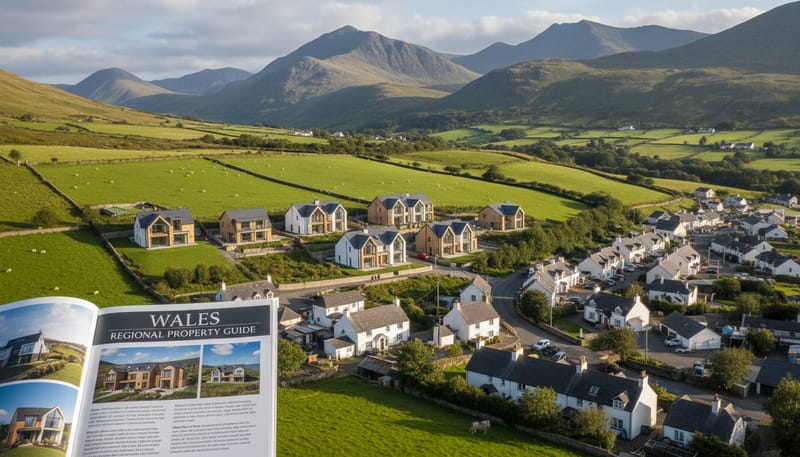
Why Choose Wales for Your New Build?
Wales has much to offer new build buyers, and its appeal extends far beyond simply being cheaper than England. The country combines genuine affordability with a quality of life that attracts people from across the UK, including a growing number of remote workers and retirees who have discovered that their budgets go significantly further west of the border.
Cardiff, the capital, has evolved into a confident, cosmopolitan city with a thriving food scene, world-class sports venues, and a growing reputation as a creative and tech hub. The BBC’s decision to base major productions including Doctor Who and Casualty at its Roath Lock studios has brought creative industries to the forefront, while the financial services sector continues to grow with major employers including Admiral Group (headquartered in Cardiff) and Legal & General.
Beyond the cities, Wales offers three national parks (Snowdonia, the Brecon Beacons/Bannau Brycheiniog, and the Pembrokeshire Coast), over 750 miles of coastline, and a cultural heritage that gives the country its unique character. The Welsh language, spoken by approximately 29% of the population, adds a distinctive dimension to daily life, particularly in the north and west, and bilingual education is available throughout the country.
Land Transaction Tax vs Stamp Duty
Wales replaced stamp duty with Land Transaction Tax (LTT) in April 2018, introducing its own system of property transaction taxes administered by the Welsh Revenue Authority. The rates and bands differ from both English stamp duty and Scottish LBTT, so it’s essential to understand the Welsh system when budgeting for your purchase.
The key advantage for many Welsh new build buyers is the higher zero-rate threshold. With no LTT payable on the first £225,000 of a purchase, many entry-level and mid-range new builds in Wales attract no transaction tax at all. This represents a significant saving for first-time buyers and those buying at the more affordable end of the market. However, for properties above £225,000, LTT can be higher than SDLT, particularly in the £225,000-£400,000 range where the 6% rate applies.
Help to Buy Wales: A Different Scheme
Wales has operated its own Help to Buy scheme, separate from the English version, with its own rules, eligibility criteria, and price caps. The Welsh Government’s approach to housing support has sometimes been more generous than England’s, and understanding the differences is crucial if you’re considering a new build purchase in Wales.
Help to Buy – Wales has provided shared equity loans of up to 20% of the purchase price on new build homes, available to both first-time buyers and existing homeowners. The property price cap has been set at £300,000, and the loan is interest-free for the first five years. This scheme has been instrumental in making new builds accessible to buyers who might otherwise struggle with deposit requirements.
One significant advantage of the Welsh scheme is that it has not been restricted to first-time buyers only, unlike the later phases of the English equivalent. This means that existing homeowners looking to move to a new build in Wales may also be eligible for support. The scheme is administered by the Development Bank of Wales, and applications are made through participating developers.
Cardiff: Wales’s Growing Capital
Cardiff is the engine of the Welsh economy and has grown dramatically in confidence, ambition, and population over the past two decades. The capital offers everything you’d expect from a major city — excellent restaurants, cultural venues, professional sports at the Principality Stadium, and a growing employment market — but at a scale that feels manageable and welcoming rather than overwhelming.
Cardiff Bay, once a declining docklands area, has been transformed into one of the most vibrant waterfront developments in the UK. The area now houses the Senedd (Welsh Parliament), the Wales Millennium Centre, and numerous restaurants, bars, and leisure facilities alongside extensive residential development. New build apartments in Cardiff Bay typically start from around £175,000 for a one-bedroom unit, with premium waterfront two-bedroom apartments reaching £325,000.
The northern suburbs of Cardiff, including Whitchurch, Rhiwbina, Llandaff, and Cyncoed, are the most sought-after family areas. These neighbourhoods offer tree-lined streets, excellent schools, and easy access to the countryside, while remaining within 20 minutes of the city centre. New build opportunities here are limited and command premium prices, with four-bedroom detached houses typically costing between £400,000 and £600,000.
Cardiff New Build Prices
Cardiff Growth Areas
- Plasdwr — Major new garden village development in NW Cardiff, 7,000+ homes
- Cardiff Bay — Continued waterfront development, apartments and townhouses
- Pontprennau — Family-focused suburban new builds, good schools
- St Mellons — Large-scale developments, more affordable entry point
- Lisvane/Thornhill — Northern edge, semi-rural feel, premium pricing
Plasdwr, a major new garden village development in north-west Cardiff, is one of the largest residential projects in Wales. This development plans to deliver over 7,000 new homes alongside schools, shops, community facilities, and green spaces over the coming decades. Multiple developers are involved, including Redrow and Persimmon, offering a range of house types and prices. Early phases have attracted strong demand from families drawn to the combination of new-build quality, green surroundings, and proximity to Cardiff’s amenities.
Swansea, Newport, and the M4 Corridor
The M4 corridor running through South Wales is the country’s economic spine, connecting Cardiff, Newport, and Swansea and providing access to Bristol, the South West, and London. Towns and cities along this route offer a range of new build opportunities at varying price points, with generally excellent connectivity.
Swansea, Wales’s second city, offers a combination of urban amenities and outstanding natural beauty. The Gower Peninsula, Britain’s first designated Area of Outstanding Natural Beauty, is literally on Swansea’s doorstep, while the city’s own waterfront has been extensively redeveloped. New build prices in Swansea are significantly lower than Cardiff, with two-bedroom apartments available from approximately £140,000 and three-bedroom houses from around £195,000.
Newport, situated between Cardiff and the English border, has long been Wales’s most undervalued city. However, significant investment — including the International Convention Centre at the Celtic Manor Resort, the Friars Walk shopping centre, and major transport improvements — is gradually transforming its image. New build homes in Newport offer outstanding value, with three-bedroom houses available from as little as £180,000, making it one of the most affordable city locations in the whole of southern Britain.
The South Wales Valleys: Regeneration and Opportunity
The South Wales Valleys — the network of narrow valleys running north from Cardiff, Newport, and Swansea — represent both the most affordable and most complex part of the Welsh property market. These communities, built on coal mining and heavy industry, suffered devastating economic decline in the latter decades of the 20th century but are now seeing renewed investment and the first signs of genuine regeneration.
For new build buyers, the Valleys offer prices that are among the lowest in Britain. Two-bedroom new build houses can be found from as little as £120,000, and even four-bedroom detached homes are available from around £220,000 in some locations. The closest valleys to Cardiff — including the Taff Vale (Pontypridd, Treforest) and the Rhymney Valley (Caerphilly, Bargoed) — offer the best combination of affordability and connectivity, with rail services into Cardiff city centre taking 25-40 minutes.
The South Wales Metro, a major transport investment programme, is set to transform connectivity across the Valleys with electrified rail lines, new stations, and more frequent services. This project has the potential to significantly boost property values in areas that gain improved connections, making the Valleys an area to watch for buyers with a medium to long-term outlook. Areas like Caerphilly, Pontypridd, and Aberdare are likely to benefit most from the Metro improvements.
Wrexham, Bridgend, and Beyond
Wrexham, in North East Wales, offers a very different proposition to the South Wales cities. As the largest town in North Wales, Wrexham serves as a regional centre with its own university, a newly-promoted football club (which has brought global attention to the town), and strong cross-border connections to Chester, Liverpool, and Manchester. New build homes in Wrexham are affordable, with three-bedroom houses available from around £185,000.
Bridgend, positioned on the M4 between Cardiff and Swansea, is another area with significant new build activity. The town benefits from excellent motorway access and direct rail services, while maintaining its own identity distinct from the two larger cities. New build developments here tend to focus on family housing, with three-bedroom semi-detached homes available from approximately £195,000.
Further west, Llanelli and Carmarthen offer lower prices still. Llanelli, on the Loughor estuary, has benefited from the Millennium Coastal Path and growing outdoor tourism, while Carmarthen, as the oldest town in Wales, combines historic character with a thriving market town atmosphere. New build homes in these western Welsh towns can offer exceptional value, with family houses available from £160,000 to £250,000.
Major Developers Active in Wales
Wales benefits from the presence of both national housebuilders and developers with strong local roots. Notably, Redrow — one of the UK’s largest housebuilders — has its headquarters in Flintshire, North Wales, giving it deep connections to the Welsh market. Persimmon is also highly active across Wales, with numerous developments throughout South and North Wales.
Lovell, a partnership and affordable housing specialist, is particularly active in Wales, working with housing associations and local authorities to deliver mixed-tenure developments. Their presence helps ensure that new build options exist at every price point across the country. For advice on evaluating different developers, see our guide on what to expect from major UK developers.
Average Prices Across Wales
Transport, Lifestyle, and Bilingual Considerations
Transport in Wales is dominated by the M4 corridor in the south, with limited motorway coverage elsewhere. The A55 expressway serves North Wales, providing fast access to Chester, Liverpool, and Manchester. Rail services include the Great Western Railway main line from London Paddington to Swansea via Cardiff and Newport, and Transport for Wales services connecting communities across South, Mid, and North Wales.
The South Wales Metro, once fully operational, will significantly improve public transport across the Cardiff Capital Region, making communities in the Valleys and along the main lines more accessible. Cardiff Airport, at Rhoose in the Vale of Glamorgan, offers a growing range of domestic and international flights, though many Welsh residents also use Bristol Airport, which is just across the Severn Bridge.
The Welsh language is an important consideration for anyone moving to Wales. While the majority of Welsh people speak English as their primary language, Welsh is spoken by approximately 900,000 people and is the language of daily life in many communities, particularly in the north and west. All official communication in Wales is bilingual, road signs are in both languages, and Welsh-medium education is available throughout the country. For families with children, the opportunity to access bilingual education is often seen as a significant benefit, providing children with a unique cultural and linguistic skill.
Living in Wales — Strengths
- ● Significantly more affordable than English equivalents
- ● Outstanding natural beauty and outdoor lifestyle
- ● Rich cultural heritage and strong community spirit
- ● Growing economy, especially in Cardiff and the M4 corridor
Living in Wales — Considerations
- ● Limited motorway network outside the M4 corridor
- ● Higher rainfall than most of England
- ● Slower property price growth historically
- ● Some rural areas have limited broadband speeds
Practical Tips for Buying in Wales
If you’re considering a new build purchase in Wales, here are essential points to keep in mind throughout your buying journey.
First, budget for LTT rather than stamp duty. The Welsh tax system is different, and using an English stamp duty calculator will give you the wrong figure. The Welsh Revenue Authority provides an official LTT calculator on its website, which you should use to get an accurate tax figure for your purchase price.
Second, check the current Help to Buy – Wales scheme details before assuming it will be available. The scheme has been extended and modified several times, and terms can change. Contact the Development Bank of Wales or check with your chosen developer for the latest information.
Third, understand that Welsh building regulations have diverged from English ones in some areas. Wales has introduced its own requirements around energy efficiency, water conservation, and fire safety that may differ from what English buyers are accustomed to. This can actually be a positive — Welsh new builds may incorporate features that are not yet required in England.
Finally, research the specific characteristics of your chosen area carefully. Wales is a small country with enormous regional variation, and the experience of living in cosmopolitan Cardiff is very different from rural Carmarthenshire or former mining communities in the Valleys. Our guide on how to research a location before buying a new build provides a detailed framework for assessing any area.
- ✓ Use the Welsh Revenue Authority LTT calculator for accurate tax figures
- ✓ Check current Help to Buy – Wales eligibility and terms
- ✓ Research South Wales Metro plans if buying in the Valleys
- ✓ Consider broadband speeds, especially in rural areas
- ✓ Visit in different weather conditions — Wales is wetter than England
- ✓ Explore Welsh-medium education options if you have children
Wales offers new build buyers a unique combination of affordability, natural beauty, and cultural richness that is genuinely hard to find elsewhere in the UK. Whether you’re drawn to the growing confidence of Cardiff, the coastal charm of Swansea, the value of the South Wales Valleys, or the cross-border convenience of Wrexham, this distinctive country has something for every buyer. With its own government setting housing policy, its own tax system, and its own support schemes, Wales is not simply an extension of the English property market — it’s a unique market that rewards those who take the time to understand its particular character and advantages.