Why Choose Liverpool for Your New Build Home?
Liverpool offers a compelling combination of affordability, culture, and growth potential that few UK cities can match. Property prices are substantially below the national average, yet the city’s economy is growing, its population is increasing, and major regeneration programmes are transforming entire districts. For buyers seeking value without compromising on lifestyle, Liverpool is an outstanding choice.
The city’s economy has diversified significantly from its maritime roots. Today, Liverpool is a major centre for financial and professional services, digital and creative industries, life sciences, and advanced manufacturing. Key employers include Unilever, Jaguar Land Rover (at nearby Halewood), and the Royal Liverpool University Hospital. The Knowledge Quarter, centred around the University of Liverpool and Liverpool John Moores University, is establishing the city as a hub for research and innovation.
Culturally, Liverpool punches well above its weight. As a UNESCO City of Music and European Capital of Culture (2008), the city boasts world-class venues including the Philharmonic Hall, FACT cinema, Tate Liverpool, and the legendary Cavern Club. The waterfront, a UNESCO World Heritage Site, provides a stunning backdrop that few cities can rival. Liverpool’s passionate sporting heritage — home to both Liverpool FC and Everton FC — adds another layer of excitement and community identity.
Key Fact: Liverpool has been identified by multiple property analysts as one of the UK’s top investment hotspots, with new build prices offering 40-50% discounts compared to equivalent properties in London and 20-30% below Manchester. Rental yields of 6-8% in city centre locations make it one of the strongest buy-to-let markets in the country.
Area-by-Area Breakdown: Where to Buy in Liverpool
Liverpool’s neighbourhoods offer remarkable diversity, from cutting-edge city centre living to leafy suburban communities with a village atmosphere. Each area has its own distinct personality and price profile. Here is a detailed guide to the key locations for new build buyers.
City Centre
Liverpool city centre has undergone a dramatic transformation, with thousands of new apartments built in recent years. The waterfront, Commercial District, and Ropewalks areas offer contemporary living with easy access to shops, restaurants, and cultural attractions. City centre apartments attract strong rental demand from young professionals and students, making them popular with investors. Key developments include Liverpool ONE adjacent schemes and new towers along the waterfront.
Baltic Triangle
Once a collection of derelict warehouses, the Baltic Triangle has become Liverpool’s coolest neighbourhood. This creative quarter is home to independent bars, street food markets, digital agencies, and artist studios. New build apartments here appeal to young professionals seeking an edgy, urban lifestyle. The area continues to evolve rapidly, with new residential schemes bringing modern design to the historic industrial fabric.
Ropewalks
Named after the rope-making industry that once dominated the area, Ropewalks is Liverpool’s nightlife and entertainment district centred around Bold Street, Seel Street, and Concert Square. New build apartments here offer the ultimate in city centre living, with restaurants, bars, and shops on the doorstep. It’s particularly popular with students and young professionals. Rental yields are among the highest in the city.
Woolton
One of Liverpool’s most desirable suburbs, Woolton is a conservation village with excellent schools, charming independent shops, and a strong community feel. Famous as the village where John Lennon met Paul McCartney, Woolton offers a quieter lifestyle while remaining well-connected to the city centre. New build developments here tend to be smaller-scale, featuring detached and semi-detached family homes from quality builders.
Crosby
Located on the Sefton coast north of Liverpool, Crosby is known for its sandy beach (home to Antony Gormley’s “Another Place” sculptures), excellent schools, and family-friendly atmosphere. The village centre has a good selection of shops and restaurants, and Crosby Merseyrail station provides quick access to the city centre. New build family homes here offer coastal living without compromising on urban convenience.
Formby
Formby is an affluent coastal town in Sefton, known for its beautiful beaches, red squirrel nature reserve, and pine woods. It’s one of Merseyside’s premium postcodes, attracting families and professionals seeking a semi-rural lifestyle with excellent schools and easy access to Liverpool (25 minutes by Merseyrail). New build homes here are typically executive-style detached properties from premium developers.
Speke & South Liverpool
Speke, located in South Liverpool near the airport, offers some of the most affordable new build options in the region. The area has benefited from significant regeneration investment, with the New Mersey Shopping Park and Estuary Business Park providing retail and employment. Jaguar Land Rover’s Halewood plant is nearby, supporting the local economy. For first-time buyers and those on tighter budgets, Speke provides genuine value with improving infrastructure and amenities.
Nearby areas like Garston and Allerton also offer affordable new build options with good transport connections via Merseyrail and the A561 corridor, making them viable commuter locations for city centre workers.
New Build Price Analysis: Liverpool by Area
One of Liverpool’s greatest strengths as a new build market is its affordability. Prices are substantially below the national average and significantly cheaper than Manchester, Birmingham, and Leeds. Here is a comprehensive comparison of new build prices across the city’s key areas.
Liverpool Waters and Waterfront Regeneration
Liverpool Waters is one of the most ambitious waterfront regeneration projects in Europe, transforming 60 hectares of former docklands into a vibrant mixed-use destination. Led by Peel Holdings, this £5.5 billion scheme will deliver up to 9,000 new homes, 315,000 square metres of office space, and major cultural and leisure facilities over a 30-year development programme.
Liverpool Waters Key Facts
The first phases of Liverpool Waters are already taking shape, with Princes Dock and Central Docks seeing significant development activity. The Everton Football Club stadium at Bramley-Moore Dock is a centrepiece project that will serve as a catalyst for further development in the northern docks area. For property buyers, Liverpool Waters represents a generational opportunity — early purchases in or near the regeneration zone are well-positioned for substantial capital growth as the project matures over the coming decades.
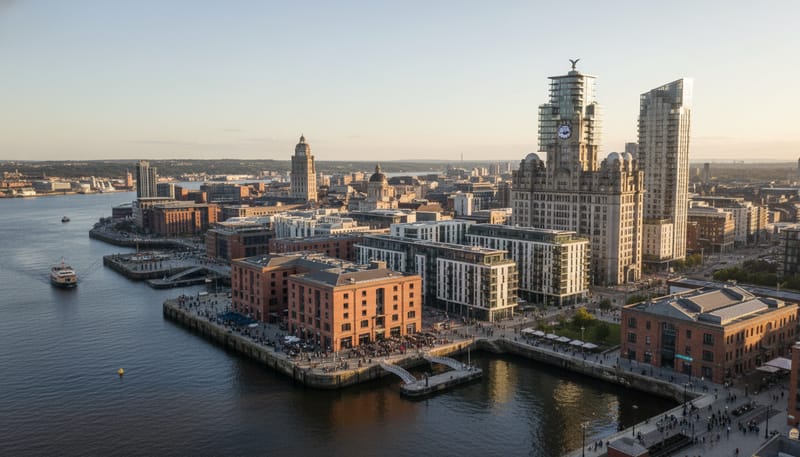
The wider waterfront regeneration extends beyond Liverpool Waters. The Albert Dock, already established as a major visitor destination, continues to see residential conversion and development. King’s Dock, home to the Exhibition Centre Liverpool and M&S Bank Arena, has attracted new residential schemes. And the iconic Pier Head, with the Three Graces, provides one of the most spectacular settings for urban living anywhere in the UK.
Transport Links and Connectivity
Liverpool benefits from excellent transport infrastructure that connects the city to the rest of the UK and beyond. The Merseyrail network, in particular, is one of the most efficient suburban rail systems in the country, providing frequent, reliable services across Merseyside.
Rail Services
Liverpool Lime Street is the city’s main terminus, providing direct services to London Euston (2hr 10min via Avanti West Coast), Manchester (50min), Birmingham (1hr 30min), and Leeds (1hr 30min). The station has been extensively refurbished and remains a key gateway to the city.
Merseyrail operates three lines (Wirral, Northern, and City) serving 67 stations across Merseyside. With trains every 15 minutes on most routes, it provides outstanding suburban connectivity. New rolling stock is being introduced, featuring walk-through trains with improved accessibility and passenger comfort.
Road and Air
The M62 provides a direct motorway link to Manchester (35 miles), Leeds, and the national motorway network. The M57 and M58 connect to the northern suburbs and Lancashire, while the Queensway and Kingsway Tunnels link Liverpool to the Wirral Peninsula.
Liverpool John Lennon Airport handles around 5 million passengers annually, serving destinations across Europe. Located in Speke, it provides affordable flights to holiday and business destinations. A bus service connects the airport to the city centre in approximately 30 minutes.
Future Connectivity: The proposed HS2 extension to Liverpool (or an equivalent high-speed connection) and the Northern Powerhouse Rail project would dramatically reduce journey times to Manchester, Leeds, and London. While timescales remain uncertain, any improvement in rail connectivity would be significantly positive for Liverpool’s property market and economic growth.
Schools and Education
Liverpool and Merseyside have a strong education landscape with many highly regarded schools at all levels. The city’s suburban areas, particularly Woolton, Crosby, and Formby, are especially popular with families seeking homes in the catchment areas of top-performing schools.
Liverpool is home to three universities: the University of Liverpool (a Russell Group institution), Liverpool John Moores University, and Liverpool Hope University. Together they bring over 60,000 students to the city, creating strong rental demand and contributing to the vibrant cultural life. The Knowledge Quarter, centred around the University of Liverpool campus, is also home to the Royal Liverpool University Hospital and the Liverpool School of Tropical Medicine, creating a major biomedical research cluster.
Lifestyle, Culture and Recreation
Liverpool’s cultural credentials are world-class. The city gave the world The Beatles, and music remains central to its identity. The Cavern Club, Philharmonic Hall, and numerous independent venues host live music every night of the week. The annual Sound City festival and Liverpool International Music Festival draw visitors from across the globe. Beyond music, the city boasts Tate Liverpool, the Walker Art Gallery, the World Museum, and the Museum of Liverpool — all free to visit.
The food and drink scene has exploded in recent years. Bold Street is a culinary destination in its own right, while the Baltic Triangle hosts regular street food markets. Liverpool ONE provides premium high-street shopping, and the independent shops of Lark Lane and Woolton Village offer a more boutique experience. Football fans benefit from having two Premier League clubs on their doorstep, with Anfield and Goodison Park (soon to be the new Bramley-Moore Dock stadium) creating unrivalled matchday atmospheres.
Developer Spotlight: Who’s Building in Liverpool?
Liverpool’s regeneration story has attracted a diverse range of developers, from national housebuilders delivering suburban family homes to specialist apartment developers transforming the city centre. Here are the key players currently active in the Liverpool market.
Peel Holdings
The driving force behind Liverpool Waters, Peel is one of the UK’s largest property companies. Their £5.5 billion masterplan for the docklands will transform the northern waterfront into a world-class mixed-use destination over the coming decades, creating thousands of new homes and jobs.
Bellway Homes
Active across Merseyside, Bellway delivers both city centre apartments and suburban family homes. Their developments in locations like Halewood and Maghull offer well-designed homes with good specifications, aimed at families and second-time buyers seeking space and value.
Redrow Homes
North-West-based Redrow has a strong presence in the Liverpool region, particularly in suburban and semi-rural locations. Known for their Heritage Collection of traditionally-styled family homes, Redrow developments in areas like Formby and West Derby offer premium quality aimed at the family market.
Countryside Partnerships
Countryside works in partnership with housing associations and councils to deliver mixed-tenure developments across Liverpool. Their schemes often include affordable and shared ownership homes alongside private sale properties, making homeownership accessible to a broader range of buyers.
Investment Potential and Merseyside Growth
Liverpool is widely regarded as one of the UK’s strongest property investment markets. The combination of low entry prices, high rental yields, and significant regeneration investment creates a compelling case for both buy-to-let investors and owner-occupiers seeking capital growth. Several key factors underpin the city’s investment appeal.
Investment Strengths
- ✓ Rental yields of 6-8% in city centre
- ✓ £5.5 billion Liverpool Waters project
- ✓ 40-50% below London prices
- ✓ 60,000+ students driving rental demand
- ✓ New Everton stadium as regeneration catalyst
Considerations
- ✗ Oversupply risk in city centre apartments
- ✗ Some regeneration timelines are long-term
- ✗ Selective licensing in some areas
- ✗ Quality varies between developers
- ✗ HS2 connection remains uncertain
The wider Merseyside region is also showing strong growth. The Liverpool City Region Combined Authority, led by the Metro Mayor, is investing in transport, skills, and infrastructure to support economic development across the area. The Freeport designation for the Liverpool City Region provides additional incentives for businesses and is expected to boost employment and demand for housing in areas like Speke, Knowsley, and the Wirral waterfront. For more on property investment strategies, see our investment guide.
Tips for Buying a New Build in Liverpool
Liverpool’s new build market offers outstanding value, but buyers should approach their purchase with the same diligence as any major investment. Here are essential tips for navigating the Liverpool market successfully.
Due Diligence on City Centre Apartments
The city centre apartment market in Liverpool has seen rapid development, and not all schemes are equal. Research the developer’s track record, check management company reviews, and verify service charges before committing. Look for established developers with proven delivery records rather than off-plan schemes from unknown firms.
Consider Suburban Value
Liverpool’s suburban areas offer exceptional value for family buyers. With Merseyrail providing fast, frequent connections, areas like Woolton, Crosby, and Formby deliver a quality of life that rivals much more expensive commuter towns elsewhere in the UK. Don’t overlook these areas in favour of city centre glamour if your priority is space and schools.
Leverage Government Schemes
Liverpool’s affordable price points mean many new builds qualify for government schemes including First Homes (offering 30% discounts), Shared Ownership, and deposit unlock mortgages. These schemes are particularly accessible in Liverpool given the lower price base compared to southern cities.
Think Long-Term on Regeneration
If buying near a regeneration area like Liverpool Waters or the Ten Streets, understand that the full benefits may take 10-20 years to materialise. This can work strongly in your favour if you’re a long-term holder, but be realistic about the timeline and buy at a price that reflects current amenities rather than future promises.
Final Thoughts: Is Liverpool Right for You?
Liverpool is a city that rewards those who believe in its future. With property prices that offer genuine affordability, a cultural scene that rivals any city in the UK, and billions of pounds of regeneration investment reshaping the urban landscape, Liverpool’s new build market represents outstanding value. Whether you’re a first-time buyer seeking an affordable entry point, a family looking for suburban quality of life, or an investor targeting high rental yields, Liverpool has something to offer.
The city’s trajectory is unmistakably upward. Liverpool Waters, the new Everton stadium, the Knowledge Quarter expansion, and ongoing investment in Merseyrail and road infrastructure all point to a city that is only going to become more attractive and valuable. For those willing to see beyond preconceptions and look at what Liverpool actually is today — and what it’s becoming — the opportunities are exceptional.
Start your Liverpool property search today and discover why so many buyers are choosing this remarkable city. For more location guides, explore our area profiles for Bristol, Edinburgh, Sheffield, and Nottingham.