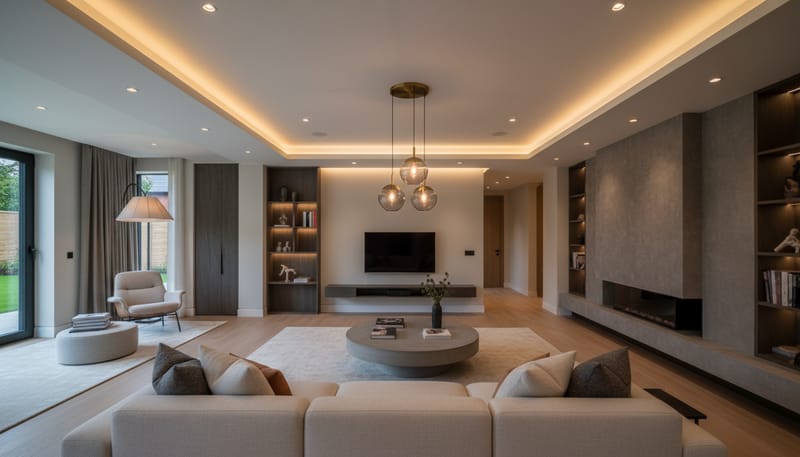
What Your Developer Provides as Standard
Before planning any upgrades, understand what your developer has already installed. New build homes across the UK — from volume builders like Barratt, Taylor Wimpey, Persimmon, and Bellway to premium developers like Redrow and David Wilson Homes — are handed over with lighting that meets Building Regulations and provides basic functionality. The wiring infrastructure behind the walls is excellent quality and installed to current BS 7671 standards; it is the fittings and scheme design where there is room for improvement.
Standard Developer Lighting Specification
- Bedrooms: Single pendant point with a basic white bayonet (B22) or Edison screw (E27) lamp holder — no shade or decorative fitting included
- Living/Dining Rooms: Single pendant point, occasionally with a dimmer switch on premium specifications but usually a standard on/off rocker switch
- Kitchen: 4–6 recessed LED downlights in a grid pattern, typically rated at 4,000K cool white and 600–800 lumens each
- Bathrooms: Single IP-rated ceiling light or 2–3 recessed LED downlights compliant with bathroom zone regulations
- Hallway and Landing: Single pendant point per floor or 1–2 recessed downlights in smaller hallways
- Exterior: Single bulkhead light at the front door, sometimes one at the rear patio door, plus any Building Regulation safety lighting
- Switches: Standard white plastic rocker switches throughout — no dimmers as standard unless specified in a premium upgrade package
- Wiring Infrastructure: Modern radial or ring circuits to current regulations, with capacity for additional points and circuits to be added later
Some developers offer lighting upgrade packages at the reservation stage, typically costing £500–£1,500. These usually add dimmer switches, additional downlight positions, and under-cabinet kitchen lighting. Developer upgrades are well worth considering because adding circuits and switch positions during the build is significantly cheaper than retrofitting after completion — the walls are still open and the electricians are already on site.
Premium Developer Extras
- LED downlights throughout: Rather than just kitchen and bathroom, premium specs may include recessed downlights in hallways, living rooms, and bedrooms
- Under-cabinet kitchen lighting: Hardwired LED strips beneath wall units, sometimes with a separate switch
- Dimmer switches in living areas: Living room and main bedroom fitted with trailing-edge LED-compatible dimmers
- External PIR security lighting: Motion-sensor floodlights at the rear and/or side of the property
- Decorative entrance pendant: A statement fitting in the hallway rather than a basic lamp holder
The Three Layers of Lighting
Professional lighting designers work with three distinct layers, and understanding this framework is the single most important concept for creating a well-lit home. Most new builds are handed over with only the first layer — ambient light — which is why rooms can feel flat and uninspiring even when beautifully furnished. Adding the second and third layers transforms the experience entirely.
- Ambient (General) Lighting: The overall background illumination that allows you to see and move safely around a room. Ceiling pendants, flush fittings, and recessed downlights all serve this purpose. Aim for 150–300 lumens per square metre in living areas and 300–500 lumens per square metre in kitchens and bathrooms
- Task Lighting: Focused, brighter light exactly where you need it for specific activities — cooking, reading, applying makeup, working at a desk. Under-cabinet strips, desk lamps, vanity lights, and bedside reading lights are all task lighting. This is the layer most commonly missing from new builds
- Accent (Decorative) Lighting: Draws the eye to features you want to highlight — artwork, architectural details, shelving displays, textured walls. Picture lights, LED strips inside cabinets, uplighters, and plinth lighting all create depth, warmth, and visual interest that separates a well-lit home from a beautifully lit one
Lighting Layers by Room — What to Install Where
| Room | Ambient Layer | Task Layer | Accent Layer |
|---|---|---|---|
| Kitchen | 6–8 recessed downlights (600–800 lm each) at 3,000K | Under-cabinet LED strips; island pendants hung 700–800mm above surface | Plinth lighting along base cabinets; in-cabinet LED strips behind glass doors |
| Living Room | Central pendant + 4–6 perimeter downlights on separate dimmed circuit | Floor lamp beside sofa; adjustable reading light | LED TV bias strip; picture lights; shelf-mounted LED strips |
| Bedroom | Pendant or flush fitting on dimmer at 2,700K | Wall-mounted bedside reading lights or table lamps | LED strip under headboard; decorative fairy lights in children’s rooms |
| Bathroom | 3–4 IP-rated recessed downlights at 3,000K | Illuminated mirror cabinet or flanking vanity wall lights | IP65 LED strip under freestanding bath or vanity unit |
| Hallway | Statement pendant or semi-flush fitting | Console table lamp for practical light | Wall washers; recessed LED step lights on staircase |
| Home Office | Dimmable ceiling light positioned off-axis from screen | Adjustable desk lamp or monitor-mounted light bar | Monitor bias LED strip to reduce eye strain |
| Garden / Patio | Wall lanterns at entrance; overhead festoon string lights | BBQ/cooking area spot light; pathway lights | Solar stake lights along borders; tree uplighters; recessed deck lights |
Colour Temperature Guide
Colour temperature is measured in Kelvin (K) and determines whether a room feels warm and cosy or bright and clinical. Getting this wrong is one of the most common lighting mistakes in new builds. The golden rule is consistency within each room — never mix colour temperatures in the same space, as it creates a jarring, uncomfortable atmosphere.
| Kelvin (K) | Description | Appearance | Best Use Cases | Avoid Using In |
|---|---|---|---|---|
| 2,200K–2,500K | Extra Warm White | Deep amber glow, similar to candlelight | Accent table lamps, bedside lamps, relaxing evening mood lighting | Kitchens, bathrooms, home offices, any task-oriented spaces |
| 2,700K | Warm White | Soft golden tone replicating traditional incandescent bulbs | Living rooms, bedrooms, dining rooms, hallways — the UK residential default | Garages, workshops, detailed craft areas |
| 3,000K | Neutral Warm White | Slightly crisper and cleaner than 2,700K, still warm | Kitchens, bathrooms, contemporary interiors where warmth plus clarity is needed | Generally suitable everywhere — a versatile choice |
| 4,000K | Cool White | Clean white light with a slight blue undertone | Home offices for focus, garages, utility rooms, laundry areas | Living rooms, bedrooms, dining rooms — feels cold and institutional |
| 5,000K–6,500K | Daylight | Very cool, bluish-white replicating midday sunshine | Art studios, sewing rooms, colour-matching tasks, photography setups | All habitable living spaces in the home |
For most UK new builds, 2,700K is the recommended default throughout living spaces and bedrooms, with 3,000K an excellent choice for kitchens and bathrooms where slightly crisper light aids practical tasks. Always check the Kelvin rating printed on packaging rather than relying on vague descriptions like “warm white,” which can vary significantly between manufacturers.
Room-by-Room Lighting Plans
Every room in your new build has different lighting needs, different activities, and different moods to support. Here is a detailed guide to creating a considered lighting scheme in each space, with specific product suggestions and realistic 2026 costs.
Kitchen Lighting Plan
The kitchen is the most demanding room for lighting because it serves multiple functions — food preparation, cooking, eating, socialising, homework, and household admin. Your developer will typically provide 4–6 recessed LED downlights in a grid pattern, which gives you a solid ambient foundation. For comprehensive kitchen design ideas, see our guide to new build kitchen design.
- Under-cabinet LED strips: The single most impactful kitchen upgrade. Eliminates worktop shadows cast by wall cabinets overhead. Plug-in adhesive kits from £15–£40; hardwired professional installation £200–£500 for a full kitchen run
- Island pendants: 2–3 pendants hung 700–800mm above the island surface, spaced 600–750mm apart. Budget options from Made.com at £35–£80 each; mid-range John Lewis Penelope from £60; designer Tom Dixon Beat from £275
- Plinth lighting: LED strips along the base of floor cabinets create a warm, floating glow that looks stunning in the evening. Adhesive strip kits cost just £20–£60
- In-cabinet lighting: LED strips or battery puck lights inside glass-fronted wall cabinets showcase crockery and glassware. From £10–£30 per cabinet
- Colour temperature: Use 3,000K throughout the kitchen for a warm yet functional atmosphere. Avoid mixing 4,000K downlights with 2,700K pendants
- Dimming: Install a dimmer on the main downlight circuit so you can lower ambient light when entertaining while accent and pendant lights provide atmosphere
Living Room Lighting Plan
The living room requires the most versatile lighting scheme because it serves so many functions — relaxing, watching television, reading, entertaining, and family time. The developer provides a single central pendant point, which is an excellent starting position but needs supplementing with at least two additional layers to feel complete.
- Central pendant: A statement shade or fitting that reflects your style and anchors the room. Fabric drum shades from John Lewis £45–£150; sculptural designs from Pooky £85–£250; iconic Tom Dixon Melt from £260
- Floor lamp beside sofa: Provides excellent reading light and a warm pool of lower-level illumination. John Lewis Bailey from £99; Anglepoise Original 1227 from £225; budget options from IKEA at £25–£60
- Table lamps: 2–3 lamps on side tables and consoles create layered warmth at a lower level than ceiling fittings. Budget £25–£80 each from Dunelm or John Lewis; designer £80–£250 from Pooky or Jim Lawrence
- TV bias lighting: LED strip behind the television reduces eye strain and adds a warm ambient glow. Govee kits from £15–£30; Philips Hue Play gradient lightstrip from £130
- Picture lights: Illuminate artwork for gallery-like drama and visual depth. Jim Lawrence brass/bronze options from £95–£175; budget rechargeable options from £20–£45
- Perimeter downlights: If the room is large or L-shaped, 4–6 downlights on a separate dimmed circuit supplement the pendant beautifully. £80–£120 per light installed
- Dimmer switch: Absolutely essential for the living room. LED-compatible trailing-edge dimmer from £15–£30
Bedroom Lighting Plan
Bedroom lighting should prioritise calm and relaxation while providing enough light for practical tasks like getting dressed and reading. Dimming is non-negotiable — you want bright light in the morning and a gentle glow at night. The developer provides a single central pendant point, which is your starting canvas. For budget furnishing ideas, see our guide to furnishing your new build on a budget.
- Pendant or flush fitting: Fabric shades in neutral tones diffuse light beautifully and suit the bedroom environment. Pooky gathered silk and linen shades from £65; budget drum shades from Dunelm £15–£40
- Bedside wall lights: Wall-mounted reading lights offer a cleaner, more contemporary look than table lamps. Astro Enna from £95; Astro Fuse from £70; Jim Lawrence Hammersmith from £108. A pair installed: £200–£400
- Bedside table lamps: The simpler plug-in alternative if you prefer not to have electrical work. From £25–£70 per lamp
- Under-bed LED strip: Creates a soft floating glow that serves as a gentle nightlight. Battery or USB-powered strips from £8–£20
- Dressing table task light: A small lamp or illuminated mirror on the dressing table for makeup application. From £25–£80
- Colour temperature: Stick to 2,700K throughout; consider 2,200K extra warm for bedside accent lamps for a deeply relaxing atmosphere
- Dimmer switch: Essential — swap the standard rocker for a trailing-edge LED dimmer at £15–£30
Bathroom Lighting — IP Ratings Explained
All bathroom lighting must comply with strict IP (Ingress Protection) ratings that specify water resistance based on proximity to water sources. Your developer will have installed compliant fittings that meet Building Regulations. Any changes or additions you make must also meet the appropriate IP rating for the relevant zone.
| Zone | Location Description | Minimum IP Rating | Voltage Requirement | Suitable Fitting Types |
|---|---|---|---|---|
| Zone 0 | Inside the bath or shower tray itself | IP67 | Maximum 12V | Submersible LED strips only |
| Zone 1 | Directly above the bath/shower to 2.25m from floor | IP45 or higher | 240V with 30mA RCD protection | IP-rated recessed downlights, sealed ceiling lights |
| Zone 2 | Extending 600mm horizontally from Zone 1 boundary | IP44 or higher | 240V with 30mA RCD protection | IP44 wall lights, illuminated mirrors, shaver lights |
| Outside Zones | Beyond Zone 2 (more than 600mm from bath/shower) | IP20 (standard indoor) | 240V standard | Any standard fitting — though IP44 throughout is recommended |
- Warm white downlights: If your developer installed cool white (4,000K) bathroom downlights, replace the bulbs with 3,000K GU10 LEDs for a warmer, spa-like feel. IP65-rated downlights installed: £80–£120 each
- Illuminated mirror cabinet: Combines storage with excellent, shadow-free task lighting. Roper Rhodes and HiB offer well-reviewed options from £200–£600
- Flanking vanity wall lights: Vertical lights either side of the mirror at face height provide the best possible illumination for shaving and makeup. Astro Mashiko from £85; Astro Belgravia from £115
- Under-bath LED strip: IP65-rated waterproof strip beneath a freestanding bath creates a luxurious floating glow. From £15–£40
- Heated demister pad: Prevents mirror fogging after showers; often integrated into illuminated mirror cabinets
- All bathroom electrical work: Must be carried out by a qualified Part P registered electrician — no exceptions for DIY
Hallway and Staircase Lighting
The hallway is the first space anyone sees when entering your home, and good lighting here creates a welcoming atmosphere that sets the tone for the entire house. Developers typically provide a single pendant point in the hallway and one on the landing — functional but rarely inspiring.
- Entrance hall pendant: A statement fitting creates a genuine sense of arrival. Jim Lawrence Compton from £175; Dar Lighting Ethan from £85; for double-height halls, Original BTC Drop from £185 or Tom Dixon Mirror Ball from £260
- Wall lights: Pairs flanking the hallway add warmth and depth without intruding on limited floor space. Dar Lighting and BHS from £30–£120 per fitting
- Staircase step lights: Recessed LED step lights set into the wall along the staircase provide gentle wayfinding at night and dramatic architectural detail. £40–£70 per light plus electrician installation
- Stairwell pendant: A pendant that drops through the stairwell from the upper landing creates a spectacular vertical statement in the right property
- Landing lighting: A flush or semi-flush ceiling light on the developer’s pendant point, supplemented by a console table lamp if space allows
- PIR motion sensor: Motion-activated lighting for nighttime trips — smart bulbs with motion detection or dedicated sensor switches from £15–£40
Home Office Lighting
With home and hybrid working now a permanent feature of UK working life, a well-lit home office is essential for productivity, concentration, and wellbeing. The lighting requirements differ from other rooms because you must minimise screen glare while providing sufficient light for reading, writing, and video calls.
- Desk position matters: Never place your desk directly below a recessed downlight — this creates harsh overhead glare on your screen and causes eye fatigue
- Desk lamp (most important fitting): BenQ ScreenBar from £89 (mounts on monitor, no desk space needed); Anglepoise Original 1227 from £195; budget IKEA Tertial from £9
- Adjustable colour temperature: LED desk lamps with tuneable white let you switch between 2,700K–3,000K for creative work and 4,000K–5,000K for detailed focus tasks
- Video call lighting: A ring light or soft panel light behind your monitor provides flattering, even facial illumination. Budget options from £15–£30
- Monitor bias lighting: An LED strip on the back of your screen softens the contrast between bright display and darker wall, reducing eye strain. Kits from £10–£30
- Ambient overhead: Keep ceiling lighting dimmable and positioned to either side of the desk, never directly above the screen
Garden and Outdoor Lighting
Outdoor lighting extends the usable hours of your garden and patio, provides security, and creates a welcoming approach to your home. Developers typically provide minimal exterior lighting, so there is enormous scope for improvement. For garden layout inspiration, see our guide to new build garden design.
- Front door lanterns: A pair of coach lights or contemporary wall lanterns flanking the front door creates an inviting entrance. Dar Lighting, Searchlight, and Jim Lawrence from £30–£120 each
- PIR security floodlights: LED floodlights with motion sensors above the garage and along the side return. Good-quality units from Screwfix or Wickes: £20–£50
- Solar path lights: Zero-wiring, zero-running-cost illumination along front paths and garden borders. From £3–£10 each
- Festoon string lights: Enormously popular for patios and dining areas. Outdoor-rated LED festoons for £20–£60 for a 10–15 metre run
- Low-voltage garden systems: Professional-quality schemes from Techmar and Lightpro without mains-voltage wiring. Starter kits from £100–£300 including transformer, cable, and fittings
- Recessed deck lights: Built into timber decking for subtle illumination. From £15–£30 per light
- Tree and wall uplighters: Dramatic accent lighting at the base of mature trees or textured walls using low-voltage LED spots
- Smart outdoor range: Philips Hue Outdoor and WiZ Outdoor fittings offer app control, colour, and scheduling for garden lighting
Bulb Types Comparison
Virtually all lighting in new build homes is now LED, but understanding the key specifications and alternatives helps you make informed purchasing decisions. Halogen bulbs are being phased out across the UK, and smart LEDs offer features that standard LEDs cannot match. Here is how the main technologies compare in 2026.
| Specification | Standard LED | Halogen (Being Phased Out) | Smart LED (Wi-Fi / Zigbee) |
|---|---|---|---|
| Cost per bulb | £2–£8 | £1–£4 | £8–£45 |
| Energy use (60W equivalent) | 7–10W | 42–46W | 7–10W |
| Annual running cost (3hrs/day) | £3–£4 | £15–£18 | £3–£4 |
| Rated lifespan | 15,000–50,000 hours | 2,000–4,000 hours | 15,000–25,000 hours |
| Dimmable | Most models (check packaging) | Yes (all) | Yes (via app, voice, or switch) |
| Colour temperature | Fixed at purchase (choose 2,700K/3,000K/4,000K) | Fixed warm (approx. 2,800K) | Tuneable 2,200K–6,500K from a single bulb |
| CRI (Colour Rendering Index) | 80–95+ | 100 (perfect) | 80–90 |
| UK availability | Universal — all retailers | Declining — being phased out | Widely available online and high street |
Key LED specifications to check when purchasing:
- Look at lumens for brightness, not watts. A 60W-equivalent LED produces approximately 800 lumens using only 9W
- Check the Kelvin (K) rating on the packaging — do not rely on “warm white” descriptions, which vary between brands
- Choose CRI 80+ minimum for all rooms; CRI 90+ for kitchens and bathrooms where accurate colour rendering matters
- Match the beam angle to the application: 15–25° for accent spotlights, 36–60° for recessed downlights, 90°+ for general ambient bulbs
- Verify dimmability before purchase if you plan to use dimmer switches — not all LED bulbs are dimmable
- Check the bulb cap type: B22 (bayonet) or E27 (Edison screw) for pendants; GU10 for recessed downlights
Smart Lighting Systems Comparison
Smart lighting has moved from a niche tech enthusiast product to a mainstream home improvement, and new build homes are particularly well suited because their modern wiring and consistent Wi-Fi infrastructure make installation straightforward. The three leading smart lighting systems for UK homes each offer distinct advantages at different price points.
| Feature | Philips Hue | LIFX | WiZ (by Signify) |
|---|---|---|---|
| Hub required | Yes — Hue Bridge (£50) | No — connects directly to Wi-Fi | No — connects directly to Wi-Fi |
| White-only bulb | From £13 | From £25 | From £8 |
| Tuneable white bulb | From £20 (White Ambiance) | From £30 | From £10 |
| Full colour bulb | From £35 | From £40 | From £12 |
| GU10 spotlight available | Yes | Yes | Yes |
| LED strip available | Yes — from £45 for 2m base kit | Yes — from £55 for 2m | Yes — from £20 for 2m |
| Outdoor range | Extensive (wall lights, path lights, spots) | Limited | Growing (selected models) |
| Amazon Alexa | Full support | Full support | Full support |
| Google Assistant | Full support | Full support | Full support |
| Apple HomeKit | Full support | Full support | Limited support |
| Matter protocol (2025+) | Yes | Yes | Yes |
| Starter kit cost | £60–£130 (Bridge + 2–4 bulbs) | N/A — buy bulbs individually | N/A — buy bulbs individually |
| Best for | Largest ecosystem, most reliable, best automation | Brightest output, no hub simplicity, colour quality | Best value for money, budget-friendly smart lighting |
For most new build homeowners, Philips Hue White Ambiance offers the best balance of functionality and reliability. The ability to tune colour temperature from 2,200K (relaxing evening) to 6,500K (energising morning) from a single bulb is genuinely transformative. For budget-conscious smart lighting, WiZ provides remarkable value at roughly half the cost. LIFX suits those who want the brightest output and prefer no separate hub.
Smart Switches: An Alternative Approach
- Lightwave smart dimmer: Fits standard UK back boxes, app and voice control. £55–£80 per switch plus Lightwave hub (£100)
- Philips Hue Wall Switch Module: Fits behind your existing light switch, allows Hue control without cutting power to bulbs. £35 each
- Hive Active Light switch: Integrates with the Hive smart home ecosystem. From £40
- Best for: Rooms with integrated LED ceiling fittings that cannot accept smart bulbs, and households where physical switches are preferred over app-only control
Dimmer Switches: The Simplest Game-Changer
If you make only one lighting upgrade in your new build, make it dimmer switches. The ability to control brightness transforms every room from a single-setting space into a versatile environment that adapts to different moods, times of day, and activities. Bright for cleaning and cooking, medium for family time, low for a relaxed evening — all from the same light fittings.
How to Add Dimmers — Step by Step
- Identify which rooms benefit most — living room, main bedroom, and dining area are the top priorities
- Purchase trailing-edge (LED-compatible) dimmer switches — never use older leading-edge dimmers designed for incandescent bulbs
- Check the dimmer’s minimum and maximum wattage rating matches your LED circuit load (most LED circuits are low wattage)
- For a like-for-like swap on an existing circuit (same location, same wiring), a competent DIYer can install
- For new circuits or switch positions, use a qualified Part P registered electrician
- Test dimming performance with your specific bulbs — some LED/dimmer combinations may cause flickering or buzzing
Dimmer Switch Options and Costs
- Basic rotary dimmer: £8–£15 from Screwfix or Wickes. Functional and effective
- Push-on/push-off with rotary dial: £15–£30. More intuitive daily operation
- Designer finishes (brushed brass, matt black, polished chrome): Dowsing & Reynolds, Hamilton, Forbes & Lomax from £25–£70 per switch — a subtle but noticeable touch of quality
- Smart dimmers (app + voice control): Lightwave from £55; Hive from £40. Control brightness without smart bulbs
Pendant vs Recessed: Choosing the Right Approach
One of the most common questions new build homeowners ask is whether to keep the developer’s pendant points or convert to recessed downlights. Both approaches have distinct advantages, and many rooms actually benefit from combining the two on separate circuits.
- Pendants: Create a focal point and visual interest. Ideal for dining tables, kitchen islands, hallways, and bedrooms. They add character and personality but provide directional light concentrated below the fitting
- Recessed downlights: Clean, minimal ceiling line. Even distribution across the room. Ideal for kitchens, bathrooms, and rooms with low ceilings. They make spaces feel larger but can feel flat without supplementary layers
- Combined approach (recommended): A statement pendant for character and visual anchor, plus perimeter downlights on a separate dimmed circuit for adjustable ambient wash. This gives maximum flexibility and visual depth
Pendant Sizing and Hanging Guide
- Sizing formula: Add the room’s length and width in metres, multiply by 10 — the result is the approximate ideal pendant diameter in centimetres. A 4m × 5m room suits approximately 90cm diameter
- Over dining tables: Pendant should be approximately two-thirds the table width, hung 700–800mm above the table surface
- Over kitchen islands: Individual pendants 200–300mm in diameter, spaced 600–750mm apart, hung 700–800mm above the island
- Standard ceiling height (2.4m): Bottom of pendant at least 2,100mm (7 feet) above the floor for comfortable clearance
- Higher ceilings: Raise the pendant proportionally — the fitting should visually occupy the upper third of the wall height, not hover at head height
LED Strip Lighting Options
LED strip lighting is one of the most versatile and affordable accent lighting tools available. Strips can be cut to custom lengths, are self-adhesive, and can transform under-cabinet kitchens, headboards, floating shelves, TV areas, bathrooms, and outdoor spaces with minimal effort and cost.
- Basic warm white strips (non-smart): Single colour, simple plug-in. From £8–£20 for 5m. Ideal for under-cabinet, under-bed, and shelf lighting
- Tuneable white strips: Adjustable colour temperature via remote. From £20–£40 for 5m
- RGB colour strips: Full colour spectrum with IR remote control. From £12–£30 for 5m
- Philips Hue Lightstrip Plus: Smart, tuneable white + full colour, app and voice controlled. From £45 for 2m base kit, with 1m extensions at £20
- WiZ LED Strip: Smart, colour + tuneable white, no hub needed, great value. From £20 for 2m
- IP65 waterproof strips: Essential for bathrooms, kitchens near water, and outdoor use. From £15–£35 for 5m
- COB (Chip-on-Board) strips: Dot-free, continuous light line for a premium, professional finish. From £15–£40 for 5m
- Aluminium profile channels: Mount strips inside channels with diffuser covers to eliminate visible LED dots and aid heat dissipation. From £5–£15 per metre
For the cleanest installation, always mount strips inside aluminium channels with frosted diffuser covers — this eliminates visible LED dots and gives a smooth, continuous light line. For kitchen use, choose strips rated at CRI 90+ so food colours appear natural and appetising under the light.
Electrician vs DIY: What You Can Do Yourself
Under Part P of the Building Regulations, homeowners can carry out certain minor electrical work without notification to Building Control. Understanding the boundary between safe DIY and professional work is essential for safety, legality, and protecting your new build NHBC Buildmark, Premier Guarantee, or LABC warranty. For snagging and warranty information, see our new build snagging guide.
Safe DIY Work (No Electrician Required)
- Replacing light switches with dimmer switches on existing circuits (like-for-like swap, same location)
- Swapping pendant lamp holders for different pendant fittings on the same wiring
- Changing flush or semi-flush ceiling lights at the same connection point
- Adding plug-in lighting — table lamps, floor lamps, plug-in under-cabinet LED strips
- Installing battery-operated or USB-powered lights (cabinet sensors, motion lights)
- Fitting adhesive LED strips powered by plug-in transformers
- Replacing standard bulbs with smart bulbs in existing fittings
Work Requiring a Qualified Electrician
- Installing new light fittings on new cables or circuits
- Adding recessed downlights where none previously existed
- Fitting wall lights on new wiring runs
- Any electrical work in bathrooms, near kitchen sinks, or outdoors
- Adding new switch positions or relocating existing switches
- Altering the consumer unit (fuse board)
- Installing outdoor lighting on new mains-voltage circuits
Electrician Costs for Common Lighting Work (2026)
| Job Description | Typical Cost (2026) | Estimated Time | Certificate Required |
|---|---|---|---|
| Install dimmer switch (professional, like-for-like) | £30–£50 per switch | 15–30 minutes | No (like-for-like swap) |
| Install single new recessed downlight | £80–£120 each | 30–60 minutes | Yes — Minor Works Certificate |
| Convert pendant point to downlight set (4–6 lights) | £300–£600 | Half day | Yes — Minor Works Certificate |
| Add new wall light point (including wiring) | £100–£160 per point | 1–2 hours | Yes — Minor Works Certificate |
| Hardwired under-cabinet kitchen lighting | £200–£500 | Half day | Yes — Minor Works Certificate |
| Bathroom lighting addition or modification | £150–£300 | 2–4 hours | Yes — Minor Works Certificate |
| New outdoor lighting circuit | £200–£400 | Half to full day | Yes — Electrical Installation Certificate |
| Staircase recessed step lights (6–8 units) | £400–£700 | Full day | Yes — Minor Works Certificate |
| Electrician hourly rate (UK average, 2026) | £40–£60 per hour | — | — |
Always verify your electrician’s registration by checking the NICEIC, NAPIT, or ELECSA scheme websites. Keep all certificates safely — they are required when you sell the property, and your solicitor will request them during conveyancing. Uncertified electrical work could affect your new build warranty cover.
Full-House Lighting Upgrade: Cost Breakdown
Here is a realistic, itemised cost breakdown for upgrading the lighting in a typical three-bedroom new build home in the UK in 2026, presented at three budget levels to suit every household.
| Upgrade Item | Budget Refresh (£200–£600) | Considered Upgrade (£800–£2,500) | Comprehensive Scheme (£3,000–£8,000+) |
|---|---|---|---|
| Pendant shades / flush fittings (4–5 rooms) | £80–£400 | £150–£600 | £300–£1,200 (designer brands) |
| Dimmer switches | £30–£60 (2 rooms) | £100–£300 (whole house) | £200–£500 (designer finishes) |
| Under-cabinet kitchen lighting | £15–£40 (plug-in strip) | £200–£500 (hardwired) | £200–£500 (hardwired + plinth) |
| Kitchen island pendants (2–3) | — | £100–£400 | £300–£800 (designer) |
| Table lamps and floor lamps | £30–£100 | £100–£300 | £200–£600 |
| Bedside wall lights (pair, installed) | — | £200–£400 | £200–£400 |
| Additional recessed downlights | — | — | £300–£800 |
| Bathroom illuminated mirror | — | — | £200–£600 |
| Smart lighting system | — | £50–£200 (2–3 rooms) | £400–£1,200 (whole house) |
| External and garden lighting | — | £40–£200 | £200–£800 |
| Staircase step lights (6–8) | — | — | £400–£700 |
| Electrician labour (all new circuit work) | — | £100–£400 | £400–£1,500 |
| Total Estimated Investment | £200–£600 | £800–£2,500 | £3,000–£8,000+ |
The budget refresh delivers immediate, noticeable results for under £600 and requires no electrician whatsoever. The considered upgrade creates a lighting scheme that feels planned and professional. The comprehensive scheme transforms every room with designer fittings, full smart control, and custom electrical work — a whole-house transformation.
Lighting Trends for UK New Builds in 2026
The UK lighting market continues to evolve rapidly, with several key trends shaping how new build homeowners are approaching their lighting schemes this year. Here are the developments worth knowing about.
- Human-centric lighting: Tuneable white smart bulbs that shift automatically from warm 2,200K in the evening to cool 5,000K during the day, supporting natural circadian rhythms, sleep quality, and daytime alertness
- Warm minimalism: Clean recessed lighting combined with warm 2,700K colour temperatures and natural materials — brass, oak, rattan, and linen — in pendant and shade designs
- Sculptural statement pendants: Lighting as art — large-scale organic shapes, handblown glass, and textured ceramics from designers like Tom Dixon, &Tradition, and Ferm Living
- Integrated LED furniture: Shelving units, headboards, vanity units, and kitchen cabinets with built-in LED strips — no separate fittings or aftermarket installation required
- Matter protocol adoption: The universal smart home standard enabling Hue, LIFX, WiZ, and all other brands to interoperate seamlessly, eliminating ecosystem lock-in for consumers
- Rechargeable portable lamps: Cordless LED table lamps from brands like Zafferano and Lexon that can be moved freely around the home and garden without cables. From £30–£120
- Fluted and ribbed glass shades: Textured glass that creates beautiful light patterns on surrounding walls and ceilings, adding visual interest through light play rather than colour
- Matt black and dark bronze finishes: Moving away from chrome and brushed nickel toward darker, warmer metalwork — particularly popular in contemporary new build interiors
- Outdoor room design: Treating patios and covered garden spaces as fully-lit rooms with layered ambient, task, and accent schemes rather than just a single security floodlight
- Energy usage monitoring: Smart lighting systems that track and report energy consumption in real time, supporting the growing focus on efficiency and reduced running costs
10 Quick Lighting Wins Under £50 Each
You do not need a large budget to make immediate, noticeable improvements to your new build lighting. These ten changes require no electrician, can each be completed in under an hour, and cost less than £50 apiece.
- Swap all cool white bulbs for 2,700K warm white in every living space — from £2–£5 per bulb, transformative effect
- Add a plug-in under-cabinet LED strip in the kitchen — adhesive-backed kits from £15–£40
- Place a table lamp on a living room side table for a second light source at a lower level — from £25–£50
- Stick an LED strip behind the TV for bias lighting that reduces eye strain — from £10–£25
- Replace the builder’s plain pendant lamp holder with an attractive shade or fitting — from £15–£45
- Install solar-powered path lights along the front path — a pack of 6 from £15–£30
- Fit a battery-operated motion sensor light inside wardrobes or under-stairs storage — from £8–£15
- Install a dimmer switch in the living room (DIY like-for-like swap) — trailing-edge LED dimmer from £10–£25
- Add rechargeable LED candles to the bathroom for relaxing evening ambience — from £10–£20
- Place a floor lamp beside the sofa for dedicated reading light and a warm glow — from £30–£50
Common Lighting Mistakes to Avoid
Knowing what not to do is just as important as knowing what to do. These are the most common lighting mistakes seen in UK new builds — all of them are easily avoidable with a little planning.
- Relying on a single light source per room: The standard new build configuration and the primary reason rooms feel flat. Always aim for at least two light sources per room — ideally representing all three lighting layers
- Mixing colour temperatures in the same room: A 2,700K pendant combined with 4,000K downlights creates a jarring, uncomfortable visual clash. Pick one Kelvin value per room and apply it consistently to every fitting
- Skipping dimmer switches: Fixed on/off overhead lighting is the single biggest limitation of standard new build specification. Dimmers cost under £30 and completely transform a room’s versatility
- Choosing undersized fittings: A small pendant disappears in a large room and fails to make visual impact. Use the sizing formula: room length + width in metres, multiplied by 10, equals ideal pendant diameter in centimetres
- Ignoring the hallway: The very first space visitors see when they enter your home. A statement pendant or well-positioned wall lights here set the tone for the entire house
- Using cool white (4,000K+) in living spaces: Makes living rooms and bedrooms feel clinical, harsh, and unwelcoming. Stick to 2,700K–3,000K for all habitable rooms
- Forgetting task lighting in the kitchen: Overhead downlights cast your own shadow onto worktops when you stand beneath them. Under-cabinet LED strips solve this problem instantly
- Positioning downlights in rows of two: Two downlights in a line create dark spots between and around them. Use odd numbers (3, 5) or a balanced grid pattern for even coverage
- Not checking LED dimmer compatibility: LED bulbs require trailing-edge dimmers. Using older leading-edge dimmers causes flickering, buzzing, and dramatically shortened bulb lifespan
- Over-lighting with too many bright downlights: A room flooded with undimmed downlights feels like a commercial showroom. Use dimmers on all circuits, and supplement with table and floor lamps for a warm, residential atmosphere
Room-by-Room Lighting Plan — Quick Reference
Use this summary table when planning your lighting scheme. It brings together the recommended colour temperature, priority upgrades, and budget estimate for every room in a typical three-bedroom new build.
| Room | Recommended Colour Temperature | Priority Upgrades | Budget Estimate (Per Room) |
|---|---|---|---|
| Kitchen | 3,000K | Under-cabinet strips, island pendants, plinth lighting, dimmer on downlights | £200–£1,200 |
| Living Room | 2,700K | Statement pendant, dimmer switch, floor lamp, 2–3 table lamps, TV bias strip | £100–£800 |
| Main Bedroom | 2,700K | Dimmer switch, bedside wall lights or table lamps, attractive pendant shade | £80–£500 |
| Spare Bedrooms | 2,700K | Attractive pendant shade, one bedside table lamp | £40–£200 |
| Bathroom | 3,000K | Illuminated mirror cabinet, warm white downlights to replace cool white | £100–£600 |
| Hallway | 2,700K | Statement pendant or wall lights, PIR sensor for nighttime | £50–£400 |
| Staircase | 2,700K | Recessed step lights, stairwell pendant for drama | £100–£700 |
| Home Office | 4,000K (task) / 2,700K (ambient) | Quality desk lamp, monitor bias lighting strip | £30–£250 |
| Garden / Patio | 2,700K–3,000K | Front door lanterns, festoon lights, solar path lights | £50–£800 |
Final Thoughts
Lighting is one of the most rewarding areas of new build personalisation because improvements are immediately visible, relatively affordable, and genuinely transformative. Your developer provides a solid electrical infrastructure and functional base lighting — which gives you an excellent foundation to build on.
Start with the simple wins: dimmer switches, better pendant shades, and a few well-chosen table and floor lamps. Then layer in task lighting where you need it most — the kitchen worktops, the home office desk, and the bedside. Finally, add accent lighting to create depth, warmth, and visual interest — LED strips behind the TV, picture lights above artwork, and plinth lighting in the kitchen.
You do not need to do everything at once. Many of the most effective lighting improvements — smart bulbs, plug-in LED strips, portable rechargeable lamps — can be added gradually as your budget allows, without any electrical work whatsoever. The goal is not to create a showroom but to create a home that feels warm, welcoming, and perfectly lit for the way your household actually lives. Take time to notice which activities happen where, which corners feel dark, and which moments of the day your lighting falls short — then address those specific needs. A thoughtfully lit home is one of life’s quiet luxuries, and in a new build, you have the perfect blank canvas to get it right.