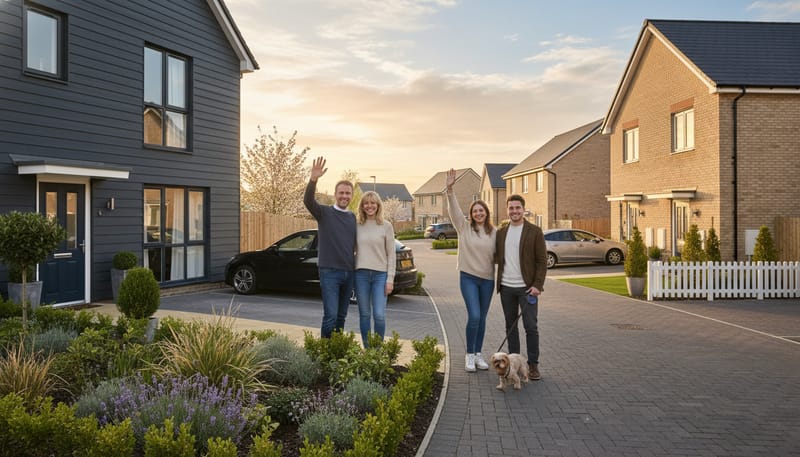
Neighbour Relations and Etiquette on New Build Estates
Moving onto a new build estate is a unique social experience. Unlike buying in an established neighbourhood where the community is already formed, a new build estate means that everyone is arriving at roughly the same time, into homes that look remarkably similar, with no established precedents for how things should work. This blank slate offers tremendous opportunity — you can help shape a genuinely supportive, friendly community from the ground up — but it also brings challenges that you would not encounter in an established area.
From parking disputes and boundary confusion to noise complaints and communal area responsibilities, new build estates have their own particular set of neighbourly issues. This guide covers everything you need to know about building positive relationships with your new neighbours, understanding your rights and responsibilities, navigating common flashpoints, and contributing to a thriving community on your new estate. Whether you are on a 50-home development by Taylor Wimpey or a 500-home Barratt estate, the principles are universal.
The Unique Social Dynamics of a New Build Estate
A new build estate creates a social environment unlike any other. Every household is in a state of transition — unpacking, decorating, learning the layout, dealing with snagging lists, and adjusting to a new home. Many residents will be first-time buyers experiencing homeownership for the first time. Others may have relocated for work and know nobody in the area. Families with young children mix with young professionals and downsizing retirees. This diversity is both the greatest strength and the greatest challenge of new build estate living.
The phased nature of construction adds another dimension. On a large estate, the first residents may move in years before the final homes are completed. This means living alongside an active construction site — with the noise, dust, heavy vehicles, and temporary fencing that entails — while simultaneously trying to establish a peaceful home life. It also means that the community is constantly growing and changing as new households arrive, each bringing their own expectations and habits.
Understanding these dynamics is the first step towards building positive neighbour relations. Everyone on a new estate is going through the same adjustment period, and a little patience, understanding, and goodwill goes a long way. The bonds formed in these early days can become the foundation of lasting friendships and a genuinely supportive community.
The Top Flashpoints on New Build Estates
Certain issues come up repeatedly on new build estates across the UK. Understanding these common flashpoints in advance allows you to navigate them proactively rather than reactively.
1. Parking
Parking is, without question, the number one source of friction on new build estates. Modern planning policies often restrict the number of parking spaces per home to encourage sustainable transport, which means that an estate of three and four-bedroom family homes might have only 1.5 or 2 allocated spaces per plot. When a household has two or three cars (not unusual for a family with working teenagers), the overflow inevitably ends up on shared roads, in visitor spaces, or blocking other residents’ access.
The first step is to understand who owns and manages the roads and parking areas on your estate. On some new build estates, the roads are adopted by the local council (meaning they become public highways), in which case normal parking rules apply and enforcement is handled by the council. On others, the roads remain private and are managed by a management company, which sets its own parking rules and enforcement procedures. Check your transfer deed and any management company documentation to understand which applies to your estate.
Parking Dos
- ✓ Use your allocated spaces before using the road
- ✓ Park within your own plot boundaries
- ✓ Ask neighbours before parking near their property
- ✓ Direct visitors to designated visitor spaces
- ✓ Keep garages clear for parking (if applicable)
Parking Don’ts
- ✗ Block driveways (even partially)
- ✗ Park on grass verges or landscaped areas
- ✗ Claim ownership of road spaces outside your home
- ✗ Use passive-aggressive notes on windscreens
- ✗ Block emergency vehicle access on narrow roads
2. Boundaries and Fencing
Boundary disputes are common on new build estates because the boundaries between plots can be unclear, especially during the construction phase when temporary fencing may differ from the final arrangement. The definitive record of your boundaries is the title plan registered with HM Land Registry, which your solicitor should have provided at completion. This plan shows the extent of your property with a red line boundary.
New build transfer deeds often include a ‘T-mark’ on the title plan showing which party is responsible for maintaining each boundary fence or wall. If the T-mark points towards your property, you are responsible for that boundary. If it points towards your neighbour’s property, they are responsible. If there is no T-mark, the responsibility may be shared or unclear — in which case, a cooperative approach with your neighbour is the best policy.
Common boundary issues on new build estates include:
- ● Fence replacement and upgrade: If you want to replace the developer’s basic fencing with something more substantial, you should discuss this with the affected neighbour first. You may only make changes to fences you are responsible for.
- ● Planting near boundaries: Trees and hedges planted too close to a boundary can cause disputes when they grow. As a rule of thumb, keep significant plantings at least 1 metre from boundary fences and be prepared to maintain anything that overhangs your neighbour’s property.
- ● Garden use near shared boundaries: Placing trampolines, barbecues, fire pits, or play equipment close to shared boundaries can affect your neighbours’ enjoyment of their garden. Consider the position and impact before installing.
- ● Drainage and water runoff: Altering the landscape or adding paving in your garden can redirect water runoff towards a neighbour’s property. You are legally responsible for any damage caused by water runoff from changes you make to your land.
3. Noise
New build homes are built to current building regulations, which include minimum standards for sound insulation between dwellings. However, regulations set a minimum, not a luxury standard, and many new build owners are surprised by how much sound travels between semi-detached houses, terraces, and apartments. The party wall (the shared wall between two homes) may meet technical standards but still transmit bass-heavy music, voices, and footsteps more than you would expect.
On a new build estate, noise also comes from external sources during the construction phase — building work often starts at 7:30am and continues until 5:30pm on weekdays, with occasional Saturday mornings. This is covered by the conditions of the developer’s planning permission and is something you must accept if you move onto an estate that is still being built. However, construction noise outside these permitted hours can be reported to the local council’s environmental health team.
4. Bins and Waste
Bin storage and collection are surprisingly contentious on new build estates. The compact frontages of many new build homes leave limited space for bins, and the sight (and smell) of multiple wheelie bins permanently stationed at the front of a house is a common source of frustration. Add in overflowing bins, missed collections, and confusion about collection days on a new estate where the council is still establishing the route, and you have a recipe for neighbourly tension.
Best practice is to store your bins out of sight (in the rear garden, garage, or side passage) and bring them to the collection point only on the morning of collection or the evening before. After collection, retrieve your bins promptly rather than leaving them on the pavement all day. If your estate has communal bin stores (common on apartment developments), use them correctly — do not leave bags outside the bins, recycle properly, and report any issues (broken bin lids, overflowing stores) to the management company promptly.
5. Gardens and Exterior Appearance
The uniform appearance of new build homes means that any deviation from the norm stands out. An unkempt front garden, a brightly coloured front door, or visible storage of building materials or vehicles can affect the appearance of the whole street and, by extension, property values. While you have the right to do as you please with your own property (subject to planning rules and any restrictive covenants), being mindful of the collective aesthetic is a neighbourly consideration.
Many new build estates have restrictive covenants in the transfer deeds that govern aspects of external appearance. Common restrictions include prohibitions on caravans or commercial vehicles being parked on driveways, requirements to maintain front gardens to a certain standard, restrictions on satellite dishes visible from the street, and limitations on the size and position of sheds or outbuildings. Check your transfer deed carefully and comply with any covenants — they are legally enforceable and ignoring them can lead to costly disputes with the management company or other residents.
Management Companies: Love Them or Loathe Them
Many new build estates are managed by a management company that is responsible for maintaining communal areas, landscaping, play areas, drainage systems, and unadopted roads. As a homeowner on the estate, you are required to pay an annual management fee (sometimes called a service charge or estate charge) that funds these services. Typical fees range from £100 to £600+ per year depending on the scale of communal amenities and the standard of maintenance provided.
Management companies are one of the most divisive aspects of new build estate living. Supporters argue they ensure communal areas are well-maintained, protecting property values and providing amenities that the local council would not. Critics point to high fees, poor value for money, lack of transparency, and the feeling of paying for services that were once the responsibility of the local authority.
Advantages of Management Companies
- ✓ Professional maintenance of communal areas
- ✓ Consistent standard of estate appearance
- ✓ Enforcement of estate rules (parking, noise, etc.)
- ✓ Can improve property values through well-maintained communal areas
Common Complaints
- ✗ Rising fees with limited explanation
- ✗ Poor quality maintenance for the price charged
- ✗ Lack of resident input into decision-making
- ✗ Difficulty switching management companies
Since 2022, the Leasehold Reform (Ground Rent) Act 2022 has banned ground rent on new leasehold properties, and the government has signalled further reforms to protect homeowners from excessive estate management charges. The proposed Freehold Homeowners Bill (announced in the 2023 King’s Speech) would give freehold homeowners on managed estates the right to challenge unreasonable charges and take over the management of their estate. Until these reforms are fully enacted, your best defence is to engage actively with the management company, attend any residents’ meetings, review annual accounts, and challenge any charges that seem unreasonable.
Building Community: Practical Steps
A strong community does not happen by accident — it requires people who are willing to take the initiative and create opportunities for residents to connect. If you are the type of person who enjoys community involvement, a new build estate offers a blank canvas to create something genuinely positive.
Resolving Disputes: A Step-by-Step Approach
Even on the friendliest estate, disputes occasionally arise. How you handle them determines whether they remain minor irritations or escalate into full-blown neighbour wars. The following approach is recommended by mediation services and community organisations across the UK.
Living Through the Construction Phase
If you move onto an estate while construction is still ongoing (which is the case for the majority of new build purchases), you need to prepare for a period of shared existence with a building site. This can last from a few months to several years on larger developments, and it requires a specific mindset and some practical strategies.
Get to know the site manager and keep their contact details handy. They are your first point of contact for any issues related to the ongoing construction work — noise outside permitted hours, construction vehicles blocking access, excessive dust, damage to your property from construction activity, or safety concerns about the boundary between the building site and the residential area. A constructive relationship with the site manager makes it much easier to resolve issues quickly.
During the construction phase, expect temporary road closures, periodic disruption to utilities (water, electricity, internet), construction traffic on roads you use daily, and a generally dusty, muddy environment around the periphery of the building site. Keep a record of any significant disruption and any damage to your property or vehicle caused by construction activity. The developer is responsible for any damage caused by their construction work and should have contractor’s liability insurance to cover it.
Being a Good New Build Neighbour: A Quick Reference Guide
Good neighbourliness is not complicated, but it does require a conscious effort, particularly in the early days of a new estate when habits and expectations are being established. Here is a quick reference guide to being a great neighbour on a new build estate.
✓ Respect parking by using your allocated spaces and never blocking others
✓ Keep noise reasonable and warn neighbours before parties or major DIY
✓ Maintain your property — front garden, bins, and exterior appearance
✓ Be considerate with pets — clean up after dogs, manage barking
✓ Communicate directly — talk to your neighbour before escalating any issue
✓ Accept reasonable compromises — living in proximity requires flexibility
✓ Offer help when you see a neighbour struggling with shopping, deliveries, or DIY
✓ Collect parcels for neighbours when they are out (if offered)
✓ Engage with the community — join the group chat, attend events, contribute ideas
Frequently Asked Questions
Final Thoughts
Living on a new build estate is an exercise in community building. You have the rare opportunity to help shape a neighbourhood from scratch, and the relationships you build in the early months will set the tone for years to come. The fundamental principles are simple: introduce yourself, be considerate, communicate directly and respectfully, follow the estate rules, and contribute positively to the community. Not every neighbour will become a friend, and that is perfectly fine — the goal is respectful coexistence and mutual consideration.
Remember that everyone on a new estate is going through the same adjustment. The drying-out period, the snagging lists, the construction noise, the missing streetlights, the unfinished roads — these shared challenges can actually be a bonding experience if approached with humour and patience. Some of the most enduring friendships are forged in adversity, and the mild adversity of early new-build-estate living is no exception.
For more practical advice on new build homeownership, explore our guides to seasonal maintenance, storage solutions, managing the drying-out period, and insurance for your new build home.