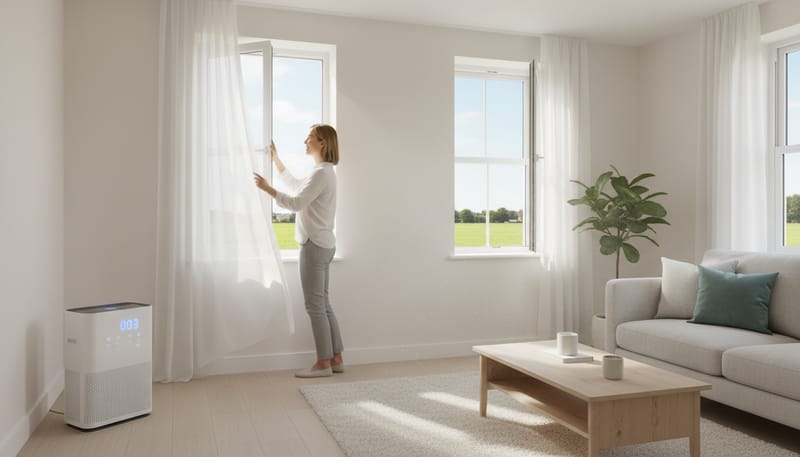
What Causes “New Build Smell”?
The “new build smell” is caused by off-gassing — the release of volatile organic compounds (VOCs) from building materials and finishes. VOCs are chemicals that evaporate easily at room temperature, becoming gases that you can smell and breathe. Virtually every material in your new build home releases some level of VOCs, though the concentration and duration vary enormously between products.
In a new build, this off-gassing is at its most intense because everything is new simultaneously. In an older home, materials have already completed most of their off-gassing over years or decades. In your new build, the paint was applied weeks ago, the carpets were laid days ago, the kitchen cabinets were installed recently, and the sealants around windows and sanitaryware are still curing. All of these materials are releasing their highest concentrations of VOCs at the same time, creating a cumulative effect that produces the distinctive new build smell.
This is compounded by the fact that modern new builds are extremely airtight. Under Building Regulations Part L (conservation of fuel and power), homes must be well sealed to minimise heat loss. While this is excellent for energy efficiency and keeping bills low, it means that VOCs released indoors do not escape as quickly as they would in a draughtier older home. The combination of brand-new materials and a well-sealed building envelope creates the perfect conditions for elevated indoor VOC levels in the first few weeks after completion.
The Formaldehyde Question
Of all the VOCs in a new build home, formaldehyde attracts the most concern. Formaldehyde is a naturally occurring organic compound that is also used extensively in building materials, particularly in the resins that bind together MDF (medium-density fibreboard), chipboard, and plywood. Since MDF and chipboard are the core materials used in most new build kitchen cabinets, bathroom vanity units, internal doors, skirting boards, and fitted wardrobes, formaldehyde exposure is essentially unavoidable in a new build home.
The good news is that formaldehyde levels in modern buildings are typically very low. UK and European regulations have progressively tightened limits on formaldehyde emissions from building products. Most MDF and chipboard used in UK construction now meets the E1 emission class standard (EN 13986), which limits formaldehyde emissions to 0.1 mg/m³ of air. Some premium products meet the even stricter E0.5 or F**** (four-star) Japanese standard. At these levels, formaldehyde concentrations in a well-ventilated new build are well below the World Health Organisation’s guideline of 0.1 mg/m³ (30-minute average).
However, formaldehyde off-gassing is temperature and humidity dependent — it increases in warm, humid conditions. This means that formaldehyde levels can spike during hot summer weather, when heating is turned up high, or if the house has been closed up for an extended period without ventilation. This is why some homeowners notice the “new smell” returning on hot days even weeks after moving in.
How to Reduce Formaldehyde Exposure
- ● Keep your MVHR system running continuously
- ● Open windows daily for at least 15–30 minutes
- ● Maintain indoor temperature below 23°C
- ● Keep humidity between 40–60% (use a hygrometer)
- ● Leave new furniture doors and drawers open to air out
Formaldehyde Sensitivity Symptoms
- ● Eye irritation or watering
- ● Scratchy or dry throat
- ● Headaches (particularly when waking up)
- ● Nasal irritation or congestion
- ● Symptoms improve when you leave the house
Carpet Off-Gassing: What You Need to Know
New carpets are one of the most noticeable sources of off-gassing in a new build. The distinctive “new carpet smell” is primarily caused by a chemical called 4-phenylcyclohexene (4-PCH), which is a by-product of the latex backing used on most carpets. Other compounds released include styrene (from synthetic fibres), formaldehyde (from adhesives), and various other volatile compounds from dyes and stain treatments.
The good news is that carpet off-gassing is most intense in the first 24 to 72 hours after installation and declines rapidly over the following two to four weeks. By six to eight weeks, most of the detectable off-gassing has occurred. If you are particularly sensitive to these chemicals, the best strategy is to ensure maximum ventilation during the first few days after carpet installation — open all windows, run MVHR on boost, and if possible, avoid spending extended periods in newly carpeted rooms for the first 48 hours.
Paint and Coating VOCs
Fresh paint is often the most immediately noticeable smell in a new build. Modern water-based emulsion paints used on walls and ceilings have significantly lower VOC levels than the solvent-based paints of previous decades, thanks to EU regulations (the Decorative Paints Directive) that have progressively limited VOC content. Most emulsion paints used by UK housebuilders now contain less than 30 g/L of VOCs, compared to 300–400 g/L in some older formulations.
However, oil-based gloss and satinwood paints, which are still commonly used on woodwork (doors, skirting boards, window frames), have higher VOC levels. These can take longer to fully cure and off-gas, sometimes several weeks. If the paint smell in your new build is particularly strong near woodwork rather than walls, this is likely the cause.
When you come to redecorate, you can minimise VOCs by choosing paints labelled as “minimal VOC” or “zero VOC.” UK brands like Little Greene, Earthborn, and Auro offer genuinely low-VOC paints. Dulux and Farrow & Ball have also reduced VOC levels across their ranges. For your first redecoration of a new build, water-based alternatives to oil-based gloss (such as Dulux Quick Dry Satinwood) offer good results with significantly lower VOC emissions.
Building Regulations Part F: Your Right to Fresh Air
Building Regulations Approved Document Part F (ventilation) sets out the legal requirements for ventilation in new dwellings in England and Wales. It exists specifically to ensure that new homes have adequate fresh air provision to maintain acceptable indoor air quality, including the dilution of pollutants from building materials and occupant activities.
Part F requires all new homes to have a ventilation system capable of providing both background (trickle) ventilation and extract ventilation from wet rooms. In well-sealed modern new builds, this is typically achieved through MVHR (Mechanical Ventilation with Heat Recovery) or MEV (Mechanical Extract Ventilation) systems. The key requirement is that the system must be capable of delivering a whole-house ventilation rate sufficient to dilute internal pollutants, typically expressed as a minimum air change rate of 0.5 air changes per hour (ACH) for a dwelling.
Practical Ventilation Strategies
While your mechanical ventilation system provides continuous background ventilation, there are additional strategies you can use to accelerate the off-gassing process and improve indoor air quality during the critical first few months in your new build.
Ventilation Strategy for the First 3 Months
Air Purifiers: Do You Need One?
Air purifiers have become increasingly popular, and many new build homeowners consider buying one to address new build smells. Whether you need one depends on your sensitivity to VOCs, the severity of the odours, and whether you have specific health conditions like asthma or allergies.
It is important to understand that not all air purifiers are effective against VOCs. Standard HEPA filter purifiers are excellent at removing particulate matter (dust, pollen, pet dander) but do nothing to remove gaseous pollutants like formaldehyde and other VOCs. To remove VOCs, you need a purifier with an activated carbon filter. The more activated carbon in the filter, the more effective it is — look for purifiers with substantial carbon filters (200g or more) rather than the thin carbon sheets found in budget models.
UK-available purifiers worth considering for new build air quality include the Dyson Purifier Big Quiet Formaldehyde (which has a catalytic formaldehyde filter that does not need replacing), the Philips 3000i series (good activated carbon filter), and the Blueair DustMagnet (excellent particle removal with reasonable VOC capability). Budget options like the Levoit Core 300S offer HEPA plus thin carbon filters, which help with odours but are less effective against formaldehyde specifically. Running costs for replacement filters typically range from £30 to £80 per year depending on the model.
Monitoring Your Indoor Air Quality
If you are concerned about air quality in your new build, you can measure it. Consumer-grade indoor air quality monitors have become affordable and increasingly accurate, giving you real data rather than relying on your nose alone. These devices typically measure CO2 (carbon dioxide), PM2.5 (fine particulate matter), temperature, and humidity. Some more advanced models also measure TVOCs (total volatile organic compounds) and formaldehyde specifically.
Recommended air quality monitors available in the UK include the IKEA VINDSTYRKA (£35, measures PM2.5, TVOC, temperature, humidity), the Airthings View Plus (£250, measures CO2, PM2.5, VOCs, radon, humidity, temperature), and the Temtop M10 (£60–£80, measures PM2.5, formaldehyde, TVOC). Having real data helps you make informed decisions about ventilation and reassures you that your air quality is within safe limits.
Normal vs Concerning Smells
While most new build smells are completely normal and harmless, some odours can indicate a genuine problem that requires investigation. Knowing the difference is important for your safety and peace of mind.
Houseplants and Natural Air Quality
The idea that houseplants can purify indoor air gained widespread attention after NASA’s 1989 Clean Air Study identified several species that could remove specific pollutants from sealed chambers. However, subsequent research has shown that in real-world conditions, the air-purifying effect of houseplants is negligible compared to mechanical ventilation. You would need hundreds of plants in a single room to achieve meaningful pollutant reduction.
That said, houseplants offer genuine benefits in a new build home beyond air purification. They improve humidity (helpful in often-dry centrally heated new builds), reduce stress, and make the space feel more alive and established. Species like peace lilies, spider plants, snake plants (Sansevieria), and pothos are easy to care for, thrive in indoor conditions, and will add character to your new home even if their air-purifying powers are overstated. Consider them a complement to, not a replacement for, proper ventilation.
Health Considerations and Who Is Most At Risk
For the vast majority of people, the VOC levels in a new build home are not dangerous and cause no lasting health effects. Short-term exposure may cause mild irritation — scratchy eyes, dry throat, occasional headaches — but these symptoms typically resolve as the home airs out over the first few weeks.
However, certain groups are more sensitive to indoor air pollutants and may experience more pronounced symptoms. These include people with asthma or other respiratory conditions, individuals with chemical sensitivities (Multiple Chemical Sensitivity, or MCS), pregnant women, babies and young children, and elderly people. If anyone in your household falls into these categories, it is worth being more proactive about ventilation during the first few months — running MVHR on boost, opening windows regularly, and considering an air purifier with activated carbon filtration.
Reducing VOCs When You Decorate and Furnish
As you personalise your new build home, every new item you bring in contributes its own VOC load. New furniture, mattresses, soft furnishings, and household products all off-gas to varying degrees. Being aware of this allows you to make choices that minimise your overall VOC exposure.
- ✓ Choose solid wood furniture over chipboard/MDF where budget allows
- ✓ Look for OEKO-TEX certified textiles (curtains, bedding, upholstery)
- ✓ Use low-VOC or zero-VOC paints (Little Greene, Earthborn, Auro)
- ✓ Unwrap and air new mattresses in a ventilated room for 24–48 hours before sleeping on them
- ✓ Choose natural fibre carpets (wool) over synthetic where possible
- ✓ Use fragrance-free or plant-based cleaning products
- ✓ Avoid plug-in air fresheners and heavily scented candles (these add VOCs)
- ✓ Wash new curtains and bedding before use to remove finishing chemicals
The Drying-Out Period
Beyond off-gassing, new build homes also go through a drying-out period that can last six to twelve months or even longer. During construction, enormous quantities of water are used in concrete, mortar, plaster, screed, and paint. A typical new build home can contain up to 5,000 litres of excess construction moisture that needs to evaporate after completion. This moisture release can cause its own set of issues, including a musty or damp smell, condensation on windows and walls, and warping or cracking of timber and plaster as they dry and settle.
The drying-out period is entirely normal and is not a defect. Your developer should have informed you about it during the handover process. During this period, it is especially important to maintain consistent heating (keeping the house above 15°C even when you are out) and good ventilation. Avoid drying clothes indoors without a vented tumble dryer or dehumidifier, as this adds significant moisture to the air that compounds the drying-out issue.
When to Escalate Concerns
While most new build smells are normal, there are circumstances where you should take action beyond simply airing the house.
- ✓ Chemical smells persist at full strength beyond 8 weeks despite active ventilation
- ✓ You or family members experience persistent headaches, nausea, or breathing difficulties
- ✓ Symptoms improve significantly when you leave the house and return when you come back
- ✓ You detect a sewage, gas, burning, or electrical smell (these are never normal)
- ✓ Black mould appears on walls, ceilings, or in corners
- ✓ Your MVHR or ventilation system is not working, has been switched off by the developer, or was never properly commissioned
- ✓ Air quality monitor readings consistently show TVOC or formaldehyde above recommended levels
If you have concerns, your first point of contact should be your developer’s after-sales or customer care team. They should arrange for your ventilation system to be checked and, if necessary, recommissioned. If the developer is unresponsive, escalate to the NHBC (or your warranty provider) under the Buildmark warranty. For persistent health symptoms, consult your GP and mention that you have recently moved into a new build — they can refer you to an environmental health specialist if needed.
Living in a new build that smells strongly of new materials can feel disconcerting, especially when headlines about “sick building syndrome” and formaldehyde make everything sound alarming. The reality is far more reassuring. The vast majority of new build smells are completely normal, result from well-understood chemistry, and fade naturally over a matter of weeks. By maintaining good ventilation, understanding the sources of odours, monitoring air quality if you are concerned, and knowing when a smell genuinely warrants investigation, you can enjoy your beautiful new home with confidence. The smell will fade; the memories you make in it will not.