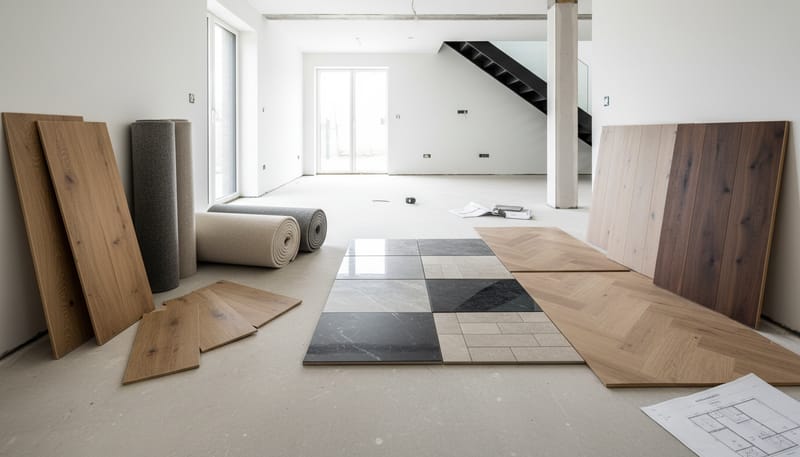
What Developers Provide as Standard
Most major UK housebuilders include a basic flooring package as part of the purchase price. Understanding what is included helps you decide where to accept the standard provision and where an upgrade delivers the most value. Developer-provided flooring is chosen for broad appeal, durability, and cost efficiency — and in many cases, particularly for wet areas, the standard specification is perfectly serviceable for the first few years.
Many developers also offer a choices or extras programme during the build phase, allowing you to upgrade flooring before completion. This is genuinely convenient because upgraded flooring is fitted into an empty house with no furniture to navigate, no dust disruption, and no time off work. It is always worth reviewing the upgrade options available to you. For more on what to expect during your purchase, see our guide to the new build buying process in the UK.
| Area | Developer Standard | Typical Upgrade Options | Upgrade Cost Indication |
|---|---|---|---|
| Kitchen / Utility | Basic ceramic tiles or sheet vinyl | Porcelain tiles, LVT, engineered wood | £30–£60/m² additional |
| Bathrooms / Ensuites / WC | Ceramic wall and floor tiles (300×300mm) | Larger-format porcelain, premium ceramic | £20–£50/m² additional |
| Bedrooms | Basic twist-pile carpet (polypropylene, neutral) | Wool-blend carpet, upgraded nylon | £10–£25/m² additional |
| Living / Dining Room | Basic twist-pile carpet (neutral shade) | LVT, engineered wood, premium carpet | £25–£55/m² additional |
| Hallway / Landing | Basic carpet | LVT, porcelain tiles, engineered wood | £25–£50/m² additional |
| Stairs | Basic carpet | Upgraded carpet, stair runner | £8–£15 per tread additional |
Flooring Types: Master Comparison Table
Before diving into the detail of each flooring type, this master comparison table gives you a high-level overview of how the five main options stack up against each other across the criteria that matter most in a new build home.
| Criteria | LVT (Click) | Carpet | Porcelain Tile | Engineered Wood | Laminate |
|---|---|---|---|---|---|
| Supply Cost (per m²) | £28–£65 | £12–£55 | £20–£70 | £35–£95 | £15–£38 |
| Fitted Cost (per m²) | £45–£100 | £22–£75 | £55–£130 | £55–£120 | £28–£50 |
| Durability | High | Medium | Very High | High | Medium–High |
| Water Resistance | Waterproof | Poor | Waterproof | Moderate | Poor–Moderate |
| Warmth Underfoot | Warm | Very Warm | Cool (warm with UFH) | Warm | Neutral |
| Sound Absorption | Good | Excellent | Poor | Moderate | Moderate |
| UFH Compatibility | Good | Acceptable | Excellent | Good (glued) | Good |
| Maintenance | Low | Medium | Low | Medium | Low |
| Lifespan | 15–25 years | 8–15 years | 25–50+ years | 20–40 years | 10–20 years |
| Can Be Refinished? | No | No | No | Yes (2–3 times) | No |
Luxury Vinyl Tile (LVT) in Detail
LVT has become one of the most popular flooring choices in UK new builds over the past decade. It combines the realistic appearance of natural wood or stone with exceptional practicality: fully waterproof, warm underfoot, quiet to walk on, and available in an extraordinary range of designs. Modern rigid-core (SPC) LVT clicks together as a floating floor without adhesive, making installation faster and less disruptive than traditional glue-down products.
Leading UK LVT Brands Compared
| Brand | Key Range | Supply Cost (per m²) | Installation | Warranty | Standout Feature |
|---|---|---|---|---|---|
| Karndean | Korlok (rigid click) | £40–£55 | Click / Glue | 20 years | Extra-wide planks (225mm), K-Core technology |
| Karndean | Knight Tile | £25–£35 | Glue-down | 15 years | Affordable entry to Karndean quality |
| Amtico | Signature | £55–£80 | Glue-down | 25 years | Widest design library; bespoke patterns |
| Amtico | Form (rigid click) | £35–£50 | Click | 20 years | Premium click LVT; made in Coventry |
| Quick-Step | Livyn Balance | £25–£38 | Click (Uniclic) | 25 years | Integrated underlay; strong DIY option |
| Moduleo | Impress Click | £22–£40 | Click | 20 years | Excellent budget-to-mid-range value |
| Polyflor | Camaro Loc | £30–£45 | Click | 20 years | British-made; realistic wood effects |
LVT Pros
- Fully waterproof: Suitable for every room including bathrooms, kitchens, and utility areas
- Warm and comfortable underfoot: Softer feel than tile or stone, with good thermal retention
- Outstanding design variety: Realistic wood, stone, marble, concrete, and patterned options
- Scratch-resistant: Tough wear layer protects against daily scuffs and furniture marks
- Compatible with underfloor heating: Both click and glue-down formats work well with UFH systems
- Easy maintenance: Sweep and damp-mop; no sealing or oiling required
- Quick installation: Click systems can be fitted in a day per room
- Sound-absorbing: Rigid-core products with integrated underlay reduce impact noise
LVT Cons
- Not real wood or stone: While highly realistic, it lacks the genuine texture and ageing character of natural materials
- Furniture indentation: Heavy items without felt pads can leave permanent marks
- Expansion gaps required: Click LVT needs perimeter gaps covered by skirting or beading
- Lower-cost products can look artificial: Budget LVT may lack convincing texture in strong natural light
- Cannot be refinished: Once the wear layer is damaged, the plank must be replaced
Carpet: Types, Costs, and Where to Use
Carpet remains the most popular choice for bedrooms, living rooms, and stairs in UK homes, and nothing else delivers the same combination of warmth, softness, sound insulation, and that cosy feeling underfoot on a cold morning. Modern carpets are far more stain-resistant and hardwearing than their predecessors thanks to advances in fibre technology.
Carpet Fibre Types at a Glance
- Wool (100% or 80/20 blend): Naturally soft, flame-retardant, and stain-resistant thanks to lanolin. Excellent resilience; recovers from furniture marks. £25–£60/m². Top brands: Cormar, Brockway, Westex, Adam Carpets
- Polypropylene: Most affordable fibre. Bleach-cleanable and stain-resistant but flattens more readily and feels less luxurious. £10–£22/m². Top brands: Abingdon Flooring, Associated Weavers
- Nylon (polyamide): Most durable synthetic. Excellent resilience, good stain resistance when treated. Best for halls, stairs, and landings. £18–£40/m². Top brands: Invictus, Mohawk
- Triexta (SmartStrand): Newer fibre with built-in stain protection (not topical coating). Outstanding softness and durability. Partly plant-based. £22–£45/m². Top brand: Mohawk SmartStrand
Carpet Pile Types
- Twist pile: The all-rounder. Tightly twisted, heat-set yarn that hides footprints and wears well in every room. Most popular choice for new builds
- Loop pile (Berber): Extremely hardwearing with a flat, textured surface. Ideal for halls and stairs. Can snag on pet claws
- Velvet (plush): Smooth, dense short-pile with a luxurious look. Shows footprints. Best in low-traffic bedrooms only
- Saxony: Longer, softer pile than twist. Feels indulgent underfoot. Best for master bedrooms and formal rooms
Carpet Pros
- Warmest flooring option: Provides genuine thermal insulation and comfort
- Best sound insulation: Absorbs impact noise and airborne sound more effectively than any hard floor
- Soft and safe: Ideal for young children and elderly family members; cushions falls
- Wide price range: Options for every budget from £12/m² to £60+/m²
- Non-slip on stairs: Carpet remains the safest stair-covering option
- Quick fitting: A professional fitter can carpet an entire house in one to two days
Carpet Cons
- Not water-resistant: Spills must be dealt with immediately; not suitable for wet areas
- Staining risk: Untreated fibres absorb liquid and can stain permanently
- Shorter lifespan: Typical residential carpet lasts 8–15 years depending on fibre and traffic
- Dust mites and allergens: Carpet traps more allergens than hard flooring, a consideration for allergy sufferers
- Fading: Some fibres (particularly wool) can fade in strong direct sunlight over time
Underlay Matters
Never underestimate underlay. A quality underlay transforms even a modest carpet, adding cushioning, warmth, and lifespan. For new builds, choose a high-density PU foam underlay with a minimum density of 130 kg/m³ and a thickness of 9–12mm for bedrooms and living rooms. For stairs, opt for a thinner, denser underlay (8–10mm at 145 kg/m³ minimum) that provides support without making treads spongy. Recommended products: Cloud 9 Cumulus (£5–£7/m²), Tredaire Dreamwalk (£6–£9/m²).
Porcelain and Ceramic Tiles
Tiles are the gold standard for bathrooms, ensuites, kitchens, utility rooms, and hallways where water resistance, durability, and easy cleaning are non-negotiable. In 2026, the trend continues towards larger formats — 600×600mm and 600×1,200mm — that create a contemporary, open look with fewer grout lines. Porcelain tiles fired at 1,200–1,400°C have a water absorption rate below 0.5%, making them virtually impervious to moisture.
Porcelain vs Ceramic
- Porcelain: Denser, harder, water absorption under 0.5%. Frost-proof. Best for floors, wet areas, high traffic. Higher cost and harder to cut
- Ceramic: Softer, more porous, lighter. Adequate for walls and low-traffic areas. More affordable and easier for DIY cutting
Tile Pros
- Virtually indestructible: Porcelain tiles can last 25–50+ years with minimal wear
- Completely waterproof: Ideal for every wet area in the home
- Best UFH conductor: Tiles heat up quickly and distribute warmth evenly
- Hygienic: Non-porous surface resists bacteria and allergens
- Design flexibility: Wood-effect planks, marble-effect, concrete-look, and patterned options
- Low maintenance: Sweep and mop with pH-neutral cleaner
Tile Cons
- Cold without UFH: Hard and cool to the touch unless paired with underfloor heating
- Hard underfoot: Less comfortable for standing for long periods; dropped items break easily
- Professional fitting essential: Large-format tiles require experienced tilers and perfectly level subfloors
- Higher installed cost: Fitting is labour-intensive, especially for complex patterns
- Grout maintenance: Grout lines require periodic sealing and can stain over time
UK Tile Retailers and Brands
- Topps Tiles: Largest UK specialist with 300+ stores. Own-brand porcelain from £20–£50/m². Price-match guarantee
- Mandarin Stone: Premium natural stone and porcelain. Design-led collections from £40–£100/m²
- Tile Giant: Competitive prices, £15–£40/m². Part of Travis Perkins group
- Walls and Floors: Online retailer, warehouse in Staffordshire. Porcelain from £12/m²
- Porcelanosa: Spanish manufacturer, UK showrooms. Premium range £40–£90/m²
- RAK Ceramics: Strong wood-effect porcelain plank range, £25–£55/m²
Engineered Wood Flooring
Engineered wood delivers the authentic beauty and character of real timber in a format designed to cope with the conditions found in modern heated homes. Its cross-laminated construction — a top layer of real hardwood (typically 3–6mm) bonded to a plywood or HDF core with alternating grain directions — provides dimensional stability that solid wood simply cannot match. This makes it a strong option for new builds, including those with underfloor heating.
Engineered Wood Pros
- Genuine timber beauty: Real hardwood surface with natural grain, knots, and character
- Can be refinished: A 4–6mm wear layer can be sanded and refinished 2–3 times, giving a potential lifespan of 25–40+ years
- Dimensionally stable: Cross-laminated core resists warping and expansion far better than solid wood
- UFH compatible: Works well with underfloor heating, particularly when glued directly to screed
- Adds property value: Real wood flooring is a desirable feature that adds perceived value
- Wide design range: From pale Scandinavian ash to deep fumed oak and herringbone patterns
Engineered Wood Cons
- Moisture sensitive: Not suitable for bathrooms; spills in kitchens must be cleaned promptly
- Higher cost: Premium engineered oak costs £55–£95/m² supply only
- Maintenance required: Oiled finishes need re-oiling every 1–2 years in high-traffic areas
- Can scratch: Softer than porcelain or LVT; grit and pet claws can mark the surface
- Professional fitting recommended: Especially for glued installation over UFH and herringbone patterns
Top UK Engineered Wood Brands
- Woodpecker Chepstow: Herringbone and wide-plank oak. £55–£80/m². Widely available through Flooring Superstore
- V4 Wood Flooring: UK-based specialist. Alpine and Deco collections. £45–£75/m²
- Ted Todd: Premium British brand. Create collection allows full customisation. £60–£120/m²
- Elka: Affordable engineered oak with 3mm wear layer. £30–£40/m². Entry-level real wood option
- Havwoods: Premium global brand. Extensive oak and exotic species range. £65–£130/m²
Laminate Flooring
Laminate has evolved significantly from the shiny, artificial products of the early 2000s. The best modern laminates feature embossed-in-register (EIR) textures that align the surface texture with the printed design, creating a surprisingly realistic look and feel. It offers the appearance of wood or stone at the lowest cost point of any hard floor option.
Laminate consists of an HDF core with a photographic design layer and a melamine wear layer. It clicks together as a floating floor and is the easiest option for confident DIY installers. However, standard laminate is not waterproof — water that penetrates the joints causes the HDF core to swell permanently. Several brands now offer water-resistant ranges (such as Quick-Step Impressive Ultra with HydroSeal) that improve moisture tolerance for kitchens.
Laminate Pros
- Most affordable hard floor: Mid-range supply from £15–£35/m²
- Easy DIY installation: Click system can be fitted by a competent homeowner in a weekend
- Extremely scratch-resistant: Melamine wear layer withstands heavy daily traffic
- UFH compatible: Works well over underfloor heating with suitable thin underlay
- Good brand warranties: Quick-Step, Pergo, and Egger offer 20–30 year residential warranties
Laminate Cons
- Not waterproof: Standard laminate swells irreparably if water penetrates joints — unsuitable for bathrooms
- Cannot be refinished: Once the wear layer is gone, the floor must be replaced entirely
- Harder, more resonant sound: Produces a hollow tapping noise underfoot without quality underlay
- Lower perceived value: Real estate agents note that laminate adds less value than real wood or quality LVT
Underfloor Heating Compatibility
Many new build homes now include underfloor heating (UFH) as standard, particularly on the ground floor. This is an excellent feature that provides even, comfortable warmth without radiators, but it directly influences your flooring choices. Different materials conduct heat at different rates, and the total thermal resistance of your floor covering must stay within the UFH system manufacturer’s specified maximum (typically 0.15 m²K/W for water-based systems). For more on how UFH contributes to energy efficiency, see our guide to EPC ratings in new build homes.
| Flooring Type | UFH Rating | Thermal Resistance | Recommended Install Method | Notes |
|---|---|---|---|---|
| Porcelain / Ceramic Tile | Excellent | Very Low (~0.01 m²K/W) | Adhesive on screed | Best heat conductor; ideal UFH partner |
| Natural Stone | Excellent | Very Low (~0.02 m²K/W) | Adhesive on screed | Excellent thermal mass; stores heat well |
| LVT (Glue-down) | Good | Low (~0.04 m²K/W) | Full adhesive bond | No underlay layer; efficient heat transfer |
| LVT (Click) | Good | Low–Medium (~0.07 m²K/W) | Floating on thin underlay | Use UFH-approved underlay only |
| Engineered Wood (Glued) | Good | Medium (~0.09 m²K/W) | Flexible adhesive on screed | Preferred method for UFH; no insulating underlay |
| Engineered Wood (Floating) | Acceptable | Medium–High (~0.12 m²K/W) | Floating on thin underlay | Underlay reduces efficiency; use thinnest possible |
| Laminate | Good | Medium (~0.08 m²K/W) | Floating on thin underlay | Use UFH-specific underlay (max 1mm) |
| Carpet (thin twist + dense underlay) | Acceptable | High (~0.15+ m²K/W) | Gripper rods + thin underlay | Combined tog must stay below 1.5; system works harder |
| Thick/deep-pile carpet | Not recommended | Very High | N/A | Insulates against heat; UFH becomes inefficient |
| Solid Wood | Not recommended | High | N/A | Prone to excessive expansion and contraction |
Room-by-Room Suitability Matrix
Every room has different functional requirements, traffic patterns, and moisture exposure. This matrix shows the best, good, and unsuitable flooring options for each area of a typical new build home.
| Room | Best Choice | Good Alternatives | Avoid | Key Requirement |
|---|---|---|---|---|
| Hallway / Landing | LVT, Porcelain tile | Engineered wood, Laminate | Velvet-pile carpet | Durability, easy cleaning |
| Living Room | Engineered wood, LVT | Carpet, Porcelain tile | — | Comfort, aesthetics |
| Kitchen / Kitchen-Diner | Porcelain tile, LVT | Engineered wood (with care) | Carpet, Standard laminate | Waterproof, hardwearing |
| Master Bedroom | Carpet (wool or SmartStrand) | Engineered wood + rug, LVT + rug | — | Warmth, softness, quiet |
| Children’s Bedrooms | LVT, Laminate | Carpet (stain-treated) | — | Durability, easy cleaning |
| Bathroom / Ensuite | Porcelain tile | LVT | Carpet, Laminate, Eng. wood | Fully waterproof |
| Utility / Boot Room | Porcelain tile, LVT | Sheet vinyl | Carpet, Eng. wood | Waterproof, heavy-duty |
| Stairs | Carpet (twist or loop pile) | LVT planks, Stair runner | Polished tile, Laminate | Grip, sound, safety |
| Home Office | LVT, Engineered wood | Carpet, Laminate | — | Chair-castors friendly |
| Conservatory | Porcelain tile, LVT | Engineered wood | Carpet | UV stable, temp. tolerant |
For open-plan kitchen-living areas, running the same flooring throughout both zones creates visual continuity and makes the space feel larger. LVT and porcelain are the strongest choices here, as they handle both the kitchen’s moisture demands and the living area’s comfort needs. A large rug in the seating area adds softness and defines the zone. For design ideas, see our new build kitchen design guide.
DIY vs Professional Fitting: Costs Compared
Some flooring types lend themselves to confident DIY installation while others demand professional expertise. Getting this wrong can void warranties, damage materials, and create problems with underfloor heating. This table compares fitting costs and DIY suitability for each option.
| Flooring Type | Professional Fitting Cost (per m²) | DIY Difficulty | DIY Feasible? | Notes |
|---|---|---|---|---|
| LVT (Click) | £8–£15 | Easy–Moderate | Yes | Click system straightforward; cutting around pipework needs care |
| LVT (Glue-down) | £12–£22 | Moderate–Hard | Advanced DIY only | Adhesive application requires experience; permanent |
| Carpet | £4–£8 (+ £8–£15/tread for stairs) | Hard | Not recommended | Stretching, gripper rods, stair fitting need professional tools |
| Porcelain Tile | £30–£65 | Hard | Not recommended | Large-format tiles require wet saw, levelling, and experience |
| Engineered Wood (Floating) | £10–£18 | Easy–Moderate | Yes | Click system similar to laminate; herringbone adds complexity |
| Engineered Wood (Glued) | £15–£25 | Moderate–Hard | Advanced DIY only | Adhesive selection and application critical over UFH |
| Laminate | £8–£14 | Easy | Yes — best DIY option | Most forgiving click system; ideal beginner project |
Installation Tips for Any Flooring
- Acclimatise materials: Store flooring in the room where it will be fitted for at least 48 hours before installation to allow it to adjust to the room’s temperature and humidity
- Check the subfloor: Ensure screed is dry (relative humidity below 75% for most floors, 65% for wood), level (within 3mm over 2 metres), and clean of debris
- Use the correct underlay: Each flooring type has specific underlay requirements, especially over UFH. Using the wrong underlay can void the product warranty
- Leave expansion gaps: All floating floors (click LVT, laminate, floating engineered wood) need a 10–15mm gap around all walls and fixed objects to allow for natural expansion
- Start from the straightest wall: This ensures your first row is true and the rest of the floor aligns correctly
- Stagger joints: Offset plank joints by at least 300mm between rows for structural integrity and a natural appearance
- Plan doorway transitions first: Measure and plan how flooring will meet at doorways between rooms before you start cutting
The Drying-Out Period: Critical for New Builds
Fresh screed in a new build home contains significant moisture — approximately 15–20 litres per square metre — that must evaporate before impervious flooring is laid. Rushing this stage is one of the most common and costly mistakes new build homeowners make. Laying flooring on damp screed causes tiles to lift, wood to warp and buckle, adhesive to fail, and trapped moisture to grow mould beneath the surface.
Drying Time Guide
- Sand and cement screed (65–75mm): Allow approximately 1 day per mm for the first 40mm, then 2 days per mm beyond that. A 65mm screed needs roughly 90 days minimum under ideal conditions — in practice, 3–6 months depending on ventilation and season
- Anhydrite (liquid) screed: Self-levelling screed popular with developers. Dries more slowly than sand-and-cement. Requires surface laitance sanding before any flooring is laid. Confirm screed type with your developer
- Moisture test: A hygrometer sealed on the screed surface for 72 hours measures relative humidity. Target: below 75% RH for most flooring, below 65% RH for wood
To accelerate drying, keep windows open for several hours daily, run any mechanical ventilation system continuously, and follow the UFH commissioning protocol provided by your developer (gradually increasing water temperature over several weeks). For more on managing the drying-out period, see our guide to decorating a new build home.
Transition Strips and Thresholds
Where two different floor types meet — for example, LVT in the kitchen transitioning to carpet in the hallway — you need a transition strip (also called a threshold bar or door bar) to create a clean, safe, and professional join. Getting transitions right makes a significant difference to the overall quality of a flooring installation.
- T-bar profile: Used where two floating floors of similar height meet. Creates a neat bridge between the two surfaces. Available in aluminium, brass, and wood-effect finishes. £5–£15 per strip
- Ramp profile: Used where a thicker floor meets a thinner one (e.g., tiles stepping down to LVT). Creates a gentle slope to eliminate a trip hazard. £6–£18 per strip
- Z-bar profile: Used where carpet meets a hard floor. The carpet is tucked under one side of the bar. £4–£10 per strip
- Matching-finish strips: Karndean, Amtico, Quick-Step, and most engineered wood brands sell matching transition strips in the same colour and texture as their flooring ranges. These cost more but create a seamless, coordinated look
- Undercut door frames: Professional fitters undercut (trim) the bottom of door frames so the flooring can slide underneath for a clean finish, rather than cutting flooring to fit around the frame profile
Common Mistakes to Avoid
- Laying flooring on damp screed: The number-one mistake. Always moisture-test before installation, even if the developer says the screed is dry
- Skipping acclimatisation: Fitting wood or laminate straight from the packaging causes gaps and buckling as the material adjusts to room conditions
- Choosing carpet for kitchens or bathrooms: No matter how stain-resistant, carpet in wet areas leads to odour, mould, and premature replacement
- Using thick underlay with UFH: Excessive underlay insulates against the heating system, wasting energy and reducing comfort. Always check tog ratings
- Not leaving expansion gaps: Floating floors that butt against walls will buckle when they expand. The perimeter gap is covered by skirting and is invisible
- Choosing flooring based on photos alone: Always request physical samples and view them in your home’s actual lighting before committing
- Ignoring the subfloor: An uneven subfloor causes hard floors to crack, click joints to separate, and tiles to sound hollow. Levelling compound costs far less than re-laying a floor
- Mixing too many flooring types: Using more than two or three different flooring types throughout a home creates a fragmented, busy feel. Consistency generates flow
- Forgetting transition strips in the budget: Transitions, thresholds, and beading are small costs individually but add up across a whole house. Budget £80–£150 for a typical three-bed home
- Not protecting new floors during the move: Lay cardboard or protective film over freshly installed flooring on moving day to prevent scratches from furniture legs and heavy items
Maintenance by Flooring Type
Proper maintenance keeps your investment looking its best and extends the lifespan of every floor in your home.
| Flooring Type | Daily / Weekly Care | Periodic Maintenance | Products to Use | Products to Avoid |
|---|---|---|---|---|
| LVT | Sweep or vacuum; damp mop weekly | Deep clean with manufacturer’s cleaner quarterly | Karndean Clean, Amtico FloorCare | Steam mops (unless approved), bleach |
| Carpet | Vacuum 2–3 times per week | Professional deep clean every 12–18 months | Scotchgard stain protector, 1001 spot cleaner | Excessive water, harsh chemicals |
| Porcelain Tile | Sweep; mop with pH-neutral cleaner | Re-seal grout lines every 2–3 years | LTP Porcelain Floor Tile Cleaner | Acidic cleaners, abrasive pads |
| Engineered Wood (Oiled) | Sweep; damp mop with wood cleaner | Re-oil every 1–2 years in traffic areas | Osmo Wash & Care, Bona Oil Refresher | Excess water, vinegar, steam mops |
| Engineered Wood (Lacquered) | Sweep; damp mop with wood cleaner | Full sand and re-lacquer every 10–15 years | Bona Wood Floor Cleaner | Abrasive pads, polish (builds up residue) |
| Laminate | Sweep or vacuum; damp (not wet) mop | None required; replace when worn | Manufacturer’s laminate cleaner | Excess water, wax, polish, steam mops |
Whole-Home Cost Calculator (2026 UK Prices)
The following table estimates total flooring costs for a typical three-bedroom new build home with approximately 80 m² of total floor area, using a practical combination of materials for different rooms. All figures include supply, professional fitting, underlay or adhesive where applicable, and transitions.
| Zone | Area (m²) | Budget Option | Budget Cost | Mid-Range Option | Mid Cost | Premium Option | Premium Cost |
|---|---|---|---|---|---|---|---|
| Kitchen / Utility (12 m²) | 12 | Sheet vinyl | £240 | Click LVT (Moduleo) | £600 | Porcelain tile (600×600) | £1,200 |
| Living / Dining (22 m²) | 22 | Laminate (Quick-Step) | £770 | Click LVT (Karndean Korlok) | £1,320 | Engineered oak (Woodpecker) | £1,980 |
| Hallway / Landing (10 m²) | 10 | Laminate | £350 | Click LVT | £600 | Engineered herringbone | £1,100 |
| Bedrooms x 3 (28 m²) | 28 | Polypropylene carpet | £700 | Nylon twist + quality underlay | £1,260 | Wool-blend twist + premium underlay | £1,960 |
| Bathroom + Ensuite (8 m²) | 8 | Ceramic tile | £400 | Porcelain tile | £640 | Large-format porcelain | £960 |
| Stairs (12 treads) | — | Polypropylene carpet | £180 | Nylon twist carpet | £280 | Wool stair runner | £500 |
| Transitions / Trims | — | Standard aluminium | £80 | Colour-matched | £120 | Brand-matched | £180 |
| TOTAL (approx.) | £2,720 | £4,820 | £7,880 | ||||
Add 10% to material quantities for cutting waste, breakages, and pattern matching. These estimates exclude removal of any existing developer flooring and disposal costs (typically £100–£250 if needed).
2026 UK Flooring Trends
The flooring market continues to evolve. Here are the key trends shaping choices in UK new build homes in 2026.
- Herringbone everywhere: Once reserved for period homes, herringbone-pattern LVT and engineered wood has become the default aspirational choice for hallways, living areas, and kitchens. Brands like Karndean, Amtico, and Woodpecker all offer dedicated herringbone ranges
- Warm, natural tones: Cool grey flooring is fading in favour of warm oaks, honey tones, and natural mid-browns that create a cosy, organic feel. Limed and whitewashed finishes remain popular for lighter schemes
- Extra-wide and extra-long planks: Wider boards (200mm+) and longer planks (1,800mm+) in both engineered wood and LVT create a sense of spaciousness with fewer visible joints
- Large-format tiles (600×1,200mm+): Bigger tiles mean fewer grout lines and a cleaner, more contemporary look. Popular in open-plan kitchen-diners and hallways
- Sustainable and recycled materials: Growing demand for flooring with recycled content, FSC-certified timber, and lower embodied carbon. Ted Todd and Havwoods lead on sustainability credentials for engineered wood
- Textured, brushed, and hand-scraped finishes: Smooth, perfect finishes are giving way to surfaces that look and feel lived-in — brushed oak, hand-scraped textures, and wire-brushed grains that add warmth and character to new build interiors
- Waterproof innovation in laminate: Quick-Step’s HydroSeal technology and Pergo’s AquaSafe range are pushing laminate into kitchens and utility rooms where it was previously unsuitable
- Integrated underlay products: More LVT and laminate products ship with built-in underlay, reducing installation steps and ensuring correct UFH compatibility
For more ideas on creating a beautiful interior in your new home, explore our guides to colour schemes for new build homes and new build kitchen design.