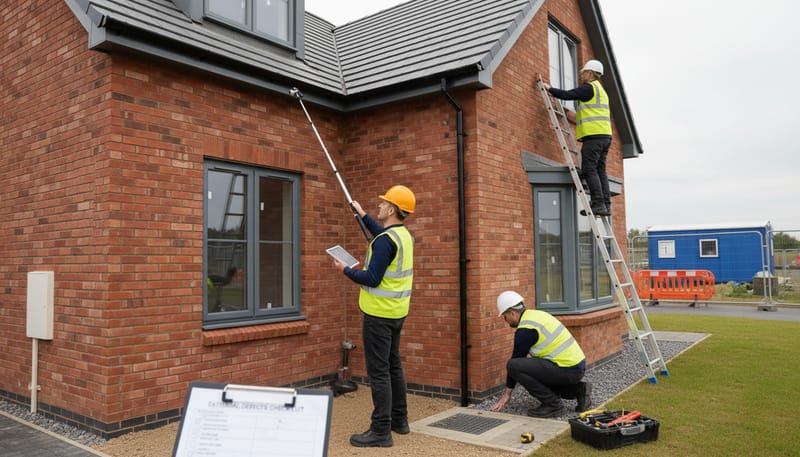
Why the Exterior Inspection Matters
When most people think of snagging, they picture chipped paint, wonky skirting boards, and scratched kitchen worktops. But some of the most expensive and consequential defects in a new build home are found on the outside. Exterior defects left unaddressed can lead to water ingress, structural damage, and costly repairs that far exceed anything you’d face from a cosmetic issue inside the property.
The exterior of your new build is your first line of defence against the British weather — and given the UK’s average annual rainfall of over 1,100mm, that defence needs to be watertight. From the ridge tiles on your roof down to the drainage at foundation level, every element plays a role in keeping your home dry, warm, and structurally sound. A single missed defect, such as a poorly sealed window or inadequate pointing, can allow moisture to penetrate the building envelope and cause problems that take years to manifest and thousands of pounds to fix.
This comprehensive exterior snagging checklist will walk you through every area you need to inspect, explain what to look for, and highlight the most common defects found on new build homes across the UK. Whether you’re conducting a DIY inspection or preparing for a professional visit, use this guide to ensure nothing is overlooked.
Brickwork and Pointing
Brickwork is one of the most visible elements of your new build’s exterior, and defects here are among the most common snagging issues found by inspectors. Start by standing back from the property and looking at the overall brickwork from a distance. Are the courses level and consistent? Do the walls appear plumb (vertical) without any bowing or leaning? Major alignment issues are rare in new builds but do occur, particularly on gable ends and around window openings.
Move closer and examine the mortar joints (pointing). The pointing should be consistent in depth, profile, and colour across the entire property. Common defects include gaps in the mortar, crumbling or sandy joints that haven’t cured properly, and inconsistent joint widths that suggest rushed work. Pay particular attention to areas around windows and doors, where the brickwork meets different materials, and at damp-proof course (DPC) level — the horizontal line of moisture barrier typically found two or three courses above ground level.
Check for any cracked or chipped bricks. While the occasional minor chip is cosmetic, cracked bricks — particularly if they follow a pattern (such as stepping diagonally up the wall) — can indicate structural movement and should be flagged as a priority. Also look for staining, efflorescence (white salt deposits), or mortar smears on the brick face, which indicate poor workmanship during construction.
If your property has any areas of stone cladding, decorative brickwork, or feature panels, inspect these with extra care. These elements are often installed by different subcontractors to the main bricklaying team, and the junctions between materials are common failure points for water ingress.
Render and External Finishes
Many modern new builds use render systems — either traditional sand-and-cement or newer through-colour silicone renders — on some or all external walls. Render defects are common in new builds and can be particularly problematic if they allow water behind the render layer.
Inspect all rendered surfaces for cracks, bulges, and hollow spots. Hairline cracks (under 0.5mm) in fresh render may be acceptable as the material cures, but anything wider should be flagged. Tap the render surface gently with your knuckles — it should sound solid throughout. A hollow or drumming sound indicates the render has debonded from the substrate, which will eventually lead to cracking and potential water ingress.
Check that the render finish is consistent in colour and texture across all walls. Patches of different colour or texture usually indicate repair work or different application batches, which may not be a defect per se but can be aesthetically unacceptable. Around windows and doors, the render should be neatly finished with appropriate trims or beading, and there should be no gaps where water could penetrate behind the render layer.
At ground level, ensure the render stops at least 150mm above the finished ground level to comply with Building Regulations Approved Document C. Render taken too close to the ground can bridge the damp-proof course and allow moisture to wick up into the wall structure. This is a surprisingly common defect in new builds, particularly where landscaping or path levels have been raised after the render was applied.
Roofline, Guttering, Fascias, and Soffits
The roof is arguably the most critical element of your home’s exterior, and defects here can lead to significant water damage if left unchecked. While a full roof inspection requires a professional with ladder access or a drone, you can check a surprising amount from ground level using binoculars.
Start with the ridge line at the very top of the roof. The ridge tiles should be straight, evenly spaced, and bedded in mortar (or dry-fixed with mechanical fixings on newer builds). Check for any tiles that appear to be sitting higher or lower than their neighbours, which could indicate loose bedding. At the verge (the edge of the roof on a gable end), tiles should overhang slightly and be secured with mortar or dry verge clips.
Scan the main roof slopes for any cracked, slipped, or missing tiles. New build roofs should be pristine, so any visible damage suggests poor installation or damage from construction activity after the tiles were laid. Check around roof penetrations such as the chimney, soil vent pipe, and any rooflights or skylights — these are common points for water ingress.
Guttering should run in a straight, continuous line with a slight fall towards the nearest downpipe. Look for joints that are gaping or misaligned, brackets that are missing or loose, and any evidence of water overflow (staining on the wall below the gutter). Downpipes must be securely fixed to the wall with appropriate brackets and should connect directly to the underground drainage system via a shoe fitting at the base.
Fascia boards and soffits should be straight, level, and free from damage. Check that all joints are tight and that there are no gaps where birds or insects could nest. Soffits typically include ventilation strips or circular vents that provide airflow to the roof void — ensure these are present and not blocked by paint, debris, or insulation from inside the loft.
Windows and Doors (Exterior View)
While windows and doors are thoroughly checked during the internal inspection, the exterior view reveals different defects that are easy to miss from inside. Walk around the entire property and examine every window and external door from outside.
The mastic sealant (silicone) around windows and door frames is one of the most important weatherproofing elements on your home. Check that it’s applied in a continuous, neat bead with no gaps, bubbles, or areas where it has pulled away from the frame or the surrounding wall. Mastic should be flexible when gently pressed — if it’s already hard and cracked, it was likely applied in unsuitable conditions or is the wrong product for the application.
Look at the window sills from outside. They should slope away from the building to shed water, and there should be a drip groove on the underside of projecting sills to prevent water running back towards the wall. Missing drip grooves are a common defect that can cause persistent damp below the window. For stone or concrete sills, check for cracks, chips, and proper mortar joints at the ends.
Check that trickle vents (the small ventilation slots at the top of window frames) are present and operational. Since the 2021 update to Building Regulations Part F, trickle vents are required on all replacement and new windows in England. They should open and close smoothly and be free from paint or mortar contamination.
For external doors, examine the threshold strip and weatherbar at the base. These should create a complete seal when the door is closed, preventing draughts and water ingress. Check that door frames are plumb and that there’s an appropriate DPC or cavity tray above every door and window opening.
Drainage, Paths, and Driveways
External drainage and hardstanding are among the last elements to be completed on a new build, which means they’re often rushed to meet completion deadlines. Defects in these areas are extremely common and can cause serious problems including flooding, subsidence, and damage to foundations.
Start with surface water drainage. Your property should have a clear drainage plan that directs rainwater away from the building. Check that all gullies (the drain covers at ground level where downpipes discharge) are free of debris, sit flush with the surrounding surface, and drain freely when you pour water into them. Blocked or incorrectly graded gullies are one of the top five exterior defects found on new builds.
Inspect the manhole covers and inspection chambers within your boundary. Lift them if possible to check that the pipework connections are sound, there’s no debris or builders’ waste in the chamber, and the benching (the sloped concrete that channels waste to the pipe) is smooth and properly formed. It’s not uncommon to find rubble, broken tiles, or even discarded food packaging in drainage chambers on new build sites.
Paths and driveways should be level (with appropriate falls for drainage), free from cracks and trip hazards, and properly edged. For block paving, check that the blocks are tightly butted together with kiln-dried sand in the joints, and that the overall surface is even without any sunken areas. Tarmac driveways should have a smooth, consistent finish without any roller marks, segregation (areas where the aggregate has separated), or standing water after rain.
Where paths meet the house, there should always be a gap or movement joint — hard surfaces butted directly against the wall can bridge the DPC and cause damp problems. The finished level of paths, patios, and drives should be at least 150mm below the DPC to comply with building regulations.
Fencing and Landscaping
Boundary treatments and landscaping are frequent sources of snagging issues, partly because they’re often the very last items completed on a development and partly because the specification in your sales contract may be vague about exactly what’s included.
Check your contract and site plan to confirm which boundaries are your developer’s responsibility. Typically, one or two boundaries will be fenced by the developer, with the remainder being your responsibility or belonging to neighbouring plots. Fencing should be straight, level (or stepped on sloping ground), and securely fixed with concrete posts or properly treated timber posts set in concrete. Fence panels should be the correct height as specified in your contract (usually 1.8 metres for rear boundaries) and made from the specified material.
Turfing is one of the areas where new build buyers most frequently report problems. The turf should be laid on a properly prepared topsoil base of at least 150mm depth, free from stones, rubble, and construction debris. It should be rolled and watered at the time of laying, and there should be no gaps between turves. Unfortunately, many developers lay turf over subsoil, builders’ rubble, or compacted clay, which leads to poor drainage, patchy growth, and a lawn that never truly establishes.
If your contract includes planting, check that all specified trees and shrubs have been planted, are the correct species, and appear healthy. Developers are typically required to replace any planting that fails within the first 12 months (the “defects liability period” for landscaping), so photograph everything at handover as a baseline.
Final Exterior Checks
Before wrapping up your exterior inspection, there are several additional items that are easily overlooked but important for the complete picture.
Meter boxes and service entries: Check that gas and electricity meter boxes are securely fitted, the doors close properly, and the locks work. Service entries (where pipes and cables enter the building) should be sealed with appropriate mastic or foam to prevent water and vermin ingress.
Air bricks and ventilation: Sub-floor air bricks (the small vented bricks near ground level) must be clear and unobstructed. These provide essential ventilation to the void beneath suspended timber ground floors and the absence or blockage of air bricks can lead to rot, damp, and timber decay. Count the air bricks and check they match the building regulations requirement of one air brick per 1.5 metres of wall length.
External taps and lights: Test any external tap points and lighting fixtures. External taps should have isolating valves inside the property and non-return valves to prevent contamination of the mains water supply. External lights should operate correctly from their respective switches and be appropriate IP-rated fixtures for outdoor use.
Retaining walls: If your property has any retaining walls — common on sloping sites — check for signs of movement, cracking, or leaning. Retaining walls should have adequate drainage (weep holes) to prevent water pressure building up behind them. This is a structural element and any defects should be treated as high priority.
Finally, take an overall step back and look at your property from the street. Does it look finished? Are there any areas of incomplete work, missing items, or elements that don’t match the show home or sales brochure specification? Refer to your contract specification and any upgrade options you purchased to ensure everything has been delivered as promised. Document any shortfalls with photographs and add them to your snagging list alongside the technical defects.