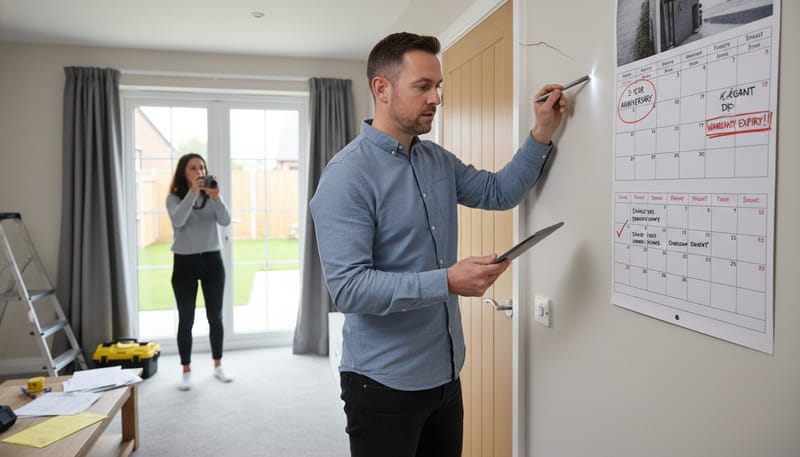
The Critical Two-Year Window You Cannot Afford to Miss
Every new build home in the United Kingdom comes with a warranty that includes a defect rectification period — most commonly two years under the NHBC Buildmark scheme. During these first 24 months, your developer is contractually obligated to repair any defects that breach the warranty provider’s standards. Once this period expires, the developer’s direct obligation ends, and only structural defects covered by the warranty insurer remain claimable for the remaining 8 years.
Many homeowners focus heavily on snagging at handover but then forget about the second year entirely. This is a costly mistake. Some defects only become apparent after the home has been lived in through all four seasons — settlement cracks that appear as the building dries out, heating performance issues that only surface in the depths of winter, and drainage problems that reveal themselves during sustained rainfall. Your second-year inspection is your last chance to have these items fixed at the developer’s expense.
This guide tells you exactly what to check in your second year, how to submit your report before the deadline, and which issues are most commonly discovered after 12–24 months of occupancy. Think of it as insurance for your insurance — a small investment of time that can save you thousands of pounds in the years ahead.
Understanding the NHBC Two-Year Defect Period
The NHBC Buildmark warranty operates in three distinct phases, and understanding the boundaries between them is crucial for protecting your investment.
Phase 1 (Pre-completion) protects your deposit if the developer becomes insolvent before completing the home. Phase 2 (Years 1–2) is the defect rectification period where the developer is responsible for fixing any defects that breach NHBC Standards relating to workmanship, materials or design. This is the broadest period of cover and the one you need to maximise. Phase 3 (Years 3–10) is structural insurance provided directly by NHBC, covering only structural defects or damage caused by structural defects — things like subsidence, wall tie failure, roof structure failure and similar.
The critical difference between Phase 2 and Phase 3 is scope. In years 1–2, you can claim for virtually any defect that falls below NHBC Standards: dripping taps, sticking doors, faulty electrics, poor tiling, inadequate insulation, drainage problems — the full range. From year 3 onwards, only structural issues are covered. This means anything non-structural that you don’t report by the end of month 24 becomes entirely your financial responsibility. For comprehensive guidance on what the warranty covers, see our NHBC warranties guide.
What’s Different in Year 2 vs Year 1
Your initial snagging inspection at handover focused primarily on visible defects — paint, plaster, tiles, kitchen fitting, bathroom finishes and obvious functional issues. By the time you reach your second year, the home has been through a very different set of stresses. It has been heated and cooled through seasonal cycles, materials have dried out and moved, the ground has continued to settle, and you’ve discovered how the home actually performs in daily life.
The most important year-2 issues are those caused by settlement and thermal movement. New build homes take 12–24 months to “settle” as the structure adjusts to its loads, the ground consolidates, and materials reach equilibrium moisture content. During this period, small cracks commonly appear at junctions between walls and ceilings, around door and window frames, and at changes of material. Most of these are cosmetic and expected — but some indicate more significant issues that need professional assessment.
The key indicators of normal settlement vs concerning movement are: hairline cracks (less than 1mm wide) at plasterboard junctions are normal; cracks wider than 2mm, diagonal cracks following mortar joints, or cracks that are wider at one end than the other may indicate differential settlement and should be investigated. Always photograph and measure cracks during your year-2 inspection and compare with any documented at year 1.
Settlement and Shrinkage: What Only Shows After 12 Months
New construction materials contain moisture that gradually evaporates during the first year of occupation. This drying process causes timber to shrink, plasterboard to contract slightly, and concrete to undergo minor dimensional changes. The effects are cumulative and often don’t become visible until 6–18 months after completion.
Common settlement and shrinkage defects to look for in year 2 include:
Gaps between skirting boards and floors: As the timber floor joists dry and shrink, the floor level drops slightly relative to the walls. This creates gaps between the skirting board (fixed to the wall) and the floor. Gaps up to 2–3mm are generally considered within tolerance, but larger gaps should be filled or the skirting refixed.
Nail pops in plasterboard: The timber studs behind plasterboard walls shrink as they dry, causing the nails or screws that hold the plasterboard to “pop” through the surface. These appear as small bumps or circles in the paintwork. They’re very common and easily fixed, but they do need to be filled and repainted.
Gaps at door architraves and window boards: Where timber trims meet plasterwork, shrinkage can open gaps that weren’t visible at handover. Similarly, staircase components may develop squeaks or creaks as the timber structure dries and joints loosen slightly. These are all reportable items during the defect period.
Door and window binding: Conversely, some doors and windows that worked perfectly at handover may begin to stick or bind as the structure settles unevenly. This can indicate differential settlement if it affects multiple openings on the same wall, or it may simply need the hinges adjusting or the door edge planing.
Seasonal Issues: What Each Season Reveals
One of the strongest arguments for a thorough year-2 inspection is that you will have experienced all four seasons by then. Each season subjects the home to different stresses and reveals different potential defects.
Winter is the most revealing season for energy performance and heating defects. If your home has rooms that never reach a comfortable temperature despite the heating running, if you see condensation streaming down windows, or if cold spots appear on walls, these all indicate insulation, airtightness or heating system defects. Run your heating continuously for a few days during the coldest period and note any rooms that underperform. Check for draughts by holding a candle or incense stick near window edges, door frames, electrical sockets on external walls, and loft hatches — movement in the flame indicates air leakage.
Rainfall at any time of year tests your drainage, roofing and weather protection. After heavy rain, inspect the loft space with a torch for any signs of water ingress. Check that gutters are discharging correctly and not overflowing at joints. Look at the ground around the property for standing water or saturated areas. Inspect garage floors and any below-ground rooms for seepage. These checks are particularly important because drainage defects can cause structural damage over time and may transition from a year-2 defect claim to an expensive year-3+ problem if missed.
How to Submit Your Year-2 Snagging Report
Your year-2 report should follow the same documentation standards as your original snagging inspection. Photograph every defect with context and close-up shots, provide clear written descriptions with location, defect and severity, and organise the report by room. For guidance on documentation techniques, refer to our snagging checklist.
The critical difference with a year-2 report is timing. You must submit before the defect period expires. Ideally, carry out your inspection 2–3 months before the end of month 24 — this gives you time to compile the report and allows the developer time to schedule and complete repairs before the deadline. If you discover defects in the final weeks, submit immediately even if the report isn’t perfectly polished — getting items on record before the deadline is more important than presentation.
Address your report to the developer’s customer care or after-sales team. Clearly state that the items are being reported under the defect rectification period of your NHBC Buildmark (or equivalent) warranty, and reference your warranty certificate number. Request written acknowledgement and a proposed repair schedule. Send by email for a timestamped record, and consider sending a copy by recorded delivery post as well.
If the developer disputes any items, or if you’re unsure whether a defect falls within the warranty scope, contact your warranty provider directly. NHBC, LABC Warranty and other providers all have helplines and can advise on whether specific defects are covered. If the developer refuses to act and you believe the items are legitimate, escalate to NHBC’s Resolution Service or your provider’s equivalent dispute process. Don’t let the deadline pass while waiting for the developer to respond — the act of submitting the report in time is what preserves your right to a remedy.
Deadline Awareness and Protecting Your Rights
The single most important thing about second-year snagging is the deadline. Once the 24-month defect rectification period expires, the developer’s obligation to fix non-structural defects ends. Knowing your exact deadline — and working backwards from it — is essential.
Your defect period starts from the date of legal completion, not the date you moved in or the date of your first snagging inspection. Check your completion statement or NHBC warranty certificate for the exact start date, then count forward 24 months. Mark this date in your calendar, phone reminders and any other system you use — it is arguably the most important date in your first two years of homeownership.
Here is a recommended timeline for your second year:
Month 12: Do a walkthrough noting any new issues since handover. Check for settlement cracks, seasonal problems and any unresolved items from your original snagging report. This is a preliminary check, not your final inspection.
Month 18: Review your notes from month 12. Have any cracks widened? Has the heating performed well through winter? Are there any new damp patches? Update your records.
Month 21: Carry out your comprehensive year-2 inspection. Go through every room systematically, check all external areas, review seasonal performance notes, and compile your report.
Month 22: Submit your report to the developer. Include all items — both new defects and any unresolved items from previous reports. Request acknowledgement and a repair schedule.
Month 23–24: Follow up on any items not yet resolved. If the developer is unresponsive, escalate to your warranty provider. Make sure every reportable defect is formally on record before the period expires.
After the 24-month deadline, only structural defects are covered under the insurance phase of your warranty (years 3–10). Structural defects are narrowly defined and typically include: subsidence, heave or landslip affecting foundations, structural collapse or serious disrepair of load-bearing elements, defects in weather protection to external walls or roof causing water ingress, and defects in below-ground drainage serving the property. Everything else — sticking doors, cracked tiles, faulty appliances, leaking taps, poor decoration — is your responsibility from year 3 onwards. For a full understanding of your warranty coverage, consult our NHBC warranties guide and handover guide.