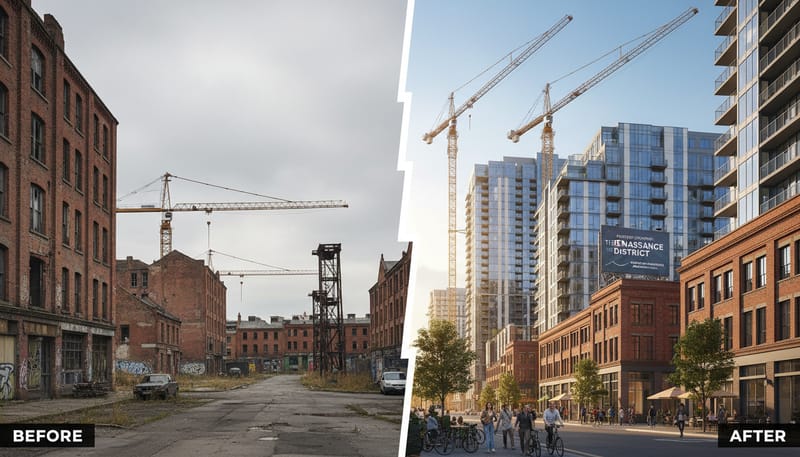
Regeneration is the single most powerful catalyst for property price growth in the United Kingdom. When billions of pounds of public and private investment flow into an area — transforming transport infrastructure, creating new employment hubs, building cultural and leisure destinations, and replacing derelict sites with vibrant new communities — the impact on surrounding property values can be extraordinary. Investors who identify regeneration areas early, before the full impact is reflected in property prices, can achieve capital returns that dramatically outperform the broader market. Across the UK in 2025, there are more major regeneration programmes under way than at any point in recent history, creating a wealth of opportunities for investors who know where to look and how to evaluate them.
This guide provides an in-depth analysis of the UK's most significant regeneration zones, the infrastructure projects driving them, and the investment opportunities they create for new build property buyers. From the transformative effect of the Elizabeth Line on east London and the Home Counties to the multi-billion-pound city-centre reinventions happening in Manchester, Birmingham, Leeds, and Sheffield, we will examine how regeneration creates value, how to identify the best investment windows, and crucially, how to manage the risks that come with investing in areas that are still evolving. Whether you are an experienced property investor expanding your portfolio or a newcomer seeking above-average returns, understanding regeneration is essential to making informed investment decisions.
How Regeneration Creates Property Value
Before examining specific regeneration areas, it is important to understand the mechanisms through which regeneration drives property price growth. This understanding helps you evaluate the potential of any regeneration opportunity, not just the ones highlighted in this guide.
The Regeneration Investment Cycle
Regeneration follows a broadly predictable cycle, and understanding where an area sits in this cycle is crucial for timing your investment. Investing too early carries execution risk (the regeneration may not happen as planned), while investing too late means most of the value uplift has already been captured.
Major UK Regeneration Zones in 2025
The following analysis covers the most significant regeneration programmes currently under way across the UK, each representing meaningful investment opportunities for new build property buyers.
Manchester: The UK's Northern Powerhouse Capital
Manchester is arguably the UK's most dynamic regeneration story outside London. The city has attracted more than £5 billion in development investment since 2018, transforming entire districts and creating one of the most vibrant urban centres in Europe. Multiple interconnected regeneration programmes are reshaping the city:
Developer: Co-op Group / Hermes
Scope: 20-acre mixed-use neighbourhood with 1,500+ homes, offices, retail
Phase: Under construction
New build yields: 5.5-6.5%
Developer: Far East Consortium / Manchester CC
Scope: 15,000 homes across multiple neighbourhoods
Phase: Early phases under construction
New build yields: 5.5-7.0%
Developer: U+I, Manchester CC, LCR
Scope: 1,500 homes, offices, Mayfield Park (first new public park in over 100 years)
Phase: Park open, residential under construction
New build yields: 5.0-6.0%
Developer: Peel Group
Scope: Expansion with 2,500+ homes, studios, workspace
Phase: Established + Phase 2 under way
New build yields: 5.0-5.8%
Manchester has delivered some of the strongest property price growth in the UK over the past decade, with ONS data showing average house prices increasing by over 55% between 2014 and 2024. New build apartment prices in the city centre have risen from approximately £180-£220 per square foot to £300-£420 per square foot over the same period. The pipeline of regeneration projects suggests this growth trajectory has further to run, particularly in emerging districts like Victoria North where pricing still offers a discount to mature city-centre locations.
Birmingham: The Big City Plan and HS2
Birmingham is undergoing one of Europe's largest urban transformation programmes, driven by the Big City Plan, the completed Commonwealth Games legacy, and the impending arrival of HS2 (though timelines have been revised). The city has attracted enormous investment, with the city centre growing by 25% in area through the expansion of the commercial core.
| Area | Investment | Key Features | Yields |
|---|---|---|---|
| Smithfield | £1.9bn | 17-acre former wholesale market site. 3,000 homes, leisure, retail | 5.5-6.5% |
| Curzon Street / HS2 Quarter | £1.5bn+ | HS2 terminus area. 4,000 homes, 36,000 jobs | 5.0-6.0% |
| Digbeth | £1bn+ | Creative quarter. Former industrial area transforming into mixed-use | 5.5-7.0% |
| Perry Barr | £700m | Commonwealth Games Athletes Village. 1,400 homes legacy | 5.5-6.5% |
| Eastside | £1.5bn | City Park, new tech campus, residential towers | 5.0-6.0% |
Leeds: South Bank and Beyond
Leeds South Bank is one of the UK's largest city-centre regeneration projects, effectively doubling the size of the city centre. Spanning 253 hectares south of the River Aire, the area is being transformed from a mix of industrial land and surface car parks into a vibrant mixed-use district.
Key developments include the Temple district (formerly Quarry Hill), the Tetley site on the waterfront, and the area surrounding the new Leeds HS2 station (though HS2 eastern leg uncertainty has introduced some planning complications). Despite this, Leeds continues to attract major employers — financial and legal services, tech companies, and the Channel 4 national headquarters — all of which support strong rental demand. New build 2-bed apartments in the city centre currently command gross yields of 5.5-6.5%, with capital growth forecasts from Savills and JLL suggesting 20-28% over the next five years.
London: Elizabeth Line and East London Transformation
The Elizabeth Line (Crossrail), which opened in stages between 2022 and 2023, has already demonstrated the transformative impact of major transport infrastructure on property values. Stations along the route — from Abbey Wood in the southeast through Woolwich, Custom House, and Canary Wharf to the West End, Paddington, and out to Ealing and beyond — have seen significant price uplifts.
| Station | Avg Price 2017 | Avg Price 2024 | Growth |
|---|---|---|---|
| Abbey Wood | £280,000 | £410,000 | +46% |
| Woolwich | £310,000 | £430,000 | +39% |
| Custom House | £290,000 | £395,000 | +36% |
| Ealing Broadway | £495,000 | £620,000 | +25% |
| Reading | £310,000 | £380,000 | +23% |
Source: Land Registry Price Paid Data. Figures represent average property prices in the immediate station area.
Beyond the Elizabeth Line, other London regeneration zones creating new build investment opportunities include the Old Oak Common/Park Royal development area (the largest regeneration project in London, with 25,000 new homes planned around the future HS2/Elizabeth Line interchange), the Greenwich Peninsula (15,000 homes), and Barking Riverside (10,800 homes with a new Overground extension). For investors seeking London exposure at lower entry points than central locations, these regeneration zones offer compelling value.
Sheffield: Heart of the City and Beyond
Sheffield's Heart of the City II is a £480 million transformation of the city centre, delivering new offices, residential buildings, hotels, public spaces, and retail. The project has already attracted major employers including HSBC (relocating their UK headquarters functions) and numerous tech companies. New build apartment yields in Sheffield city centre reach 5.5-7.0%, among the highest in any major English city, and with property prices still significantly below Manchester, Birmingham, and Leeds, there is considerable room for growth.
Liverpool: Ten Streets and the Knowledge Quarter
Liverpool's regeneration story spans multiple interconnected projects. The Ten Streets creative district in the north docks area is a £500 million transformation of the area between the city centre and Everton's new stadium at Bramley-Moore Dock. The Knowledge Quarter around Paddington Village is bringing research, healthcare, and education jobs to the city centre. Meanwhile, the £5.5 billion Liverpool Waters project promises to transform 60 hectares of dockland into a new city district over the coming decades.
Infrastructure Projects Driving Growth
Major infrastructure projects are the backbone of many regeneration programmes. Understanding which projects are funded, under construction, and on schedule is critical for assessing regeneration investment opportunities.
| Project | Budget | Status | Investment Impact |
|---|---|---|---|
| HS2 Phase 1 (London-Birmingham) | £58bn+ | Under construction | Transformative for Old Oak Common, Birmingham Curzon |
| Elizabeth Line (Crossrail) | £19bn | Operational | Ongoing value uplift at all stations |
| Manchester Bee Network (Metrolink) | £1.2bn+ | Expanding | Enhanced connectivity across Greater Manchester |
| West Midlands Metro Extension | £450m | Under construction | Links Digbeth, Eastside, and future HS2 station |
| Northern Powerhouse Rail | £12bn+ | Planning stage | Transformative if delivered; connecting northern cities |
Risk Factors in Regeneration Investment
Regeneration investing offers above-average return potential, but it also carries specific risks that differ from investing in established areas. Understanding and managing these risks is essential for protecting your capital.
The most effective way to mitigate regeneration risk is to invest in areas where the fundamentals already support your investment, and the regeneration provides upside. If the property works as an investment based on current rents, current transport links, and current amenities — and the regeneration simply makes it better — you have a much more robust proposition than if you are entirely dependent on future improvements that may or may not materialise on schedule. Apply the comprehensive due diligence framework from our evaluation guide to ensure the investment stands on its own merits before layering in regeneration upside.
How to Research Regeneration Opportunities
Successful regeneration investing requires thorough research using authoritative sources. Here are the key resources every investor should consult:
- Local Authority Planning Portals: Every council publishes planning applications and decisions online. Search for major development applications in your target area to understand the pipeline.
- Local Plans: Each council's Local Plan sets out the vision for development over a 15-20 year period. These documents identify regeneration priority areas, housing targets, and infrastructure plans.
- LEP (Local Enterprise Partnership) Strategies: LEPs publish economic development strategies that highlight investment priorities and growth sectors for their areas.
- Transport for London / National Rail / Highways England: Official sources for transport infrastructure project status, timelines, and funding.
- Savills, JLL, CBRE Research: These property consultancies publish regular reports on regeneration areas, including capital growth forecasts and rental yield analysis.
- ONS / Land Registry: Official data on property prices, transactions, and demographic trends by area.
- Homes England: The government's housing accelerator, which funds and supports major housing and regeneration projects across England.
Frequently Asked Questions
Conclusion
Regeneration areas represent some of the most compelling investment opportunities in the UK property market. The combination of infrastructure investment, employment creation, amenity improvement, and environmental enhancement can deliver capital growth that dramatically outperforms stable, established areas. For new build property investors, regeneration zones are particularly attractive because the new developments being delivered are specifically designed for the area's evolving demographic, incorporating modern specifications, energy efficiency, and lifestyle amenities that appeal to the tenants and buyers who drive demand in these areas.
The key to successful regeneration investing is thorough research, patient timing, and disciplined risk management. Invest where the fundamentals already support your returns, and treat the regeneration as upside rather than the sole basis for your investment case. Build a diversified portfolio that includes both regeneration plays and established locations, and maintain a long-term perspective — the biggest regeneration gains often take 5-10 years to fully materialise.
To build a comprehensive understanding of new build investment, combine the insights from this guide with our articles on evaluating new build developments, investing as an overseas buyer, and long-term wealth building through new build property.