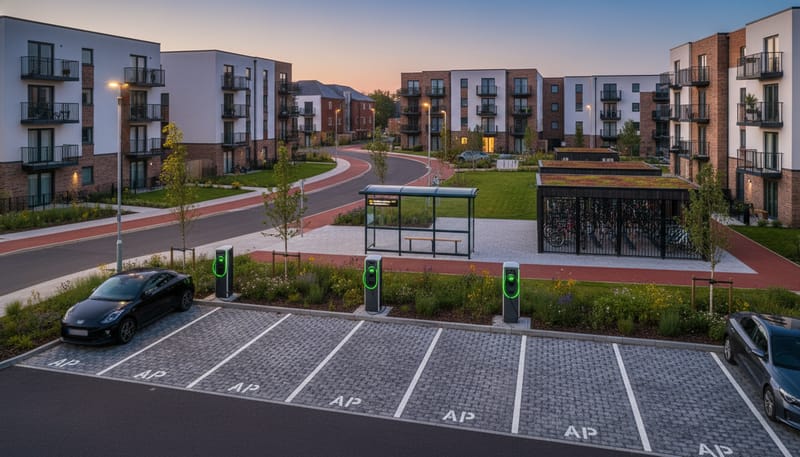
Parking is consistently one of the most contentious issues on new build developments across the UK. Whether it is the frustration of coming home to find no available spaces, disputes with neighbours over allocated bays, confusion about visitor parking rules, or the challenge of accommodating multiple cars on a development designed for a car-light future, parking problems can cause real friction within new build communities. At the same time, the way we travel is changing rapidly, with electric vehicles, cycling infrastructure, car clubs, and improved public transport all reshaping how residents of new developments move around. This comprehensive guide examines every aspect of parking and transport on UK new build estates — from the planning policies that determine how many spaces are provided, to your rights as a homeowner, practical solutions to common problems, and how to make the most of the sustainable transport options increasingly built into modern developments.
The reality is that parking provision on new build developments has been steadily declining for over a decade. National and local planning policies have pushed developers towards lower parking ratios, particularly on sites near public transport hubs and in urban areas. While the intention behind these policies — reducing car dependency, improving air quality, and making more efficient use of land — is broadly supported, the practical consequences for residents can be challenging. Many homeowners find that the parking provision on their development does not match the reality of how their household uses cars, leading to overflow parking on surrounding streets, neighbourly disputes, and a daily battle for space.
How Parking Provision Is Determined
The number of parking spaces on a new build development is determined during the planning process, guided by local planning policy and national guidance. Each local authority sets its own parking standards, typically expressed as a ratio of spaces per dwelling by dwelling type (number of bedrooms) and location (urban, suburban, rural). These standards have changed significantly over the past two decades, moving from prescriptive minimums (you must provide at least X spaces) to maximums (you must not exceed X spaces) and, more recently, to a more flexible approach based on individual site assessment.
In 2001, the government’s Planning Policy Guidance Note 13 (PPG13) introduced maximum parking standards for new developments, explicitly aiming to reduce car use by limiting parking provision. This led to many developments being built with significantly fewer spaces than the number of cars their residents would eventually own. While PPG13 was superseded by the National Planning Policy Framework (NPPF) in 2012, which took a more balanced approach, the legacy of the maximum standards era continues to affect many developments built between 2001 and 2015.
The current NPPF (revised 2023) states that local authorities should set their own parking standards, taking into account the accessibility of the development, the type, mix, and use of the development, the availability of and opportunities for public transport, local car ownership levels, and the need to ensure an adequate provision of spaces for charging plug-in and other ultra-low emission vehicles. In practice, this means parking provision varies enormously across the country, from zero-car developments in central London to two or more spaces per dwelling in rural locations.
Allocated vs. Unallocated Parking
New build developments use different parking allocation systems, and the system in place on your estate significantly affects your daily experience. Understanding the differences is important both when buying a new build and when dealing with parking issues after moving in.
- ✓ Guaranteed space always available
- ✓ No daily competition for spaces
- ✓ Easier to install home EV charging
- ✗ May not be near your front door
- ✗ Can’t use empty neighbour’s space
- ✗ Enforcement disputes if blocked
- ✓ Flexible — park wherever is convenient
- ✓ More efficient use of total spaces
- ✓ No wasted empty allocated bays
- ✗ No guarantee of a space, especially evenings
- ✗ Can lead to aggressive space “guarding”
- ✗ Difficult to plan EV charging
EV Charging on New Build Developments
Since June 2022, Building Regulations in England (Part S) require that every new home with an associated parking space must have an electric vehicle charge point. This is a significant change that affects all new build developments with allocated parking. For developments with unallocated parking, at least one charge point must be provided for every five spaces, with cable routes installed to allow easy future charging installation for all other spaces.
The minimum specification under Part S requires a Mode 3 charge point delivering at least 7kW, with a Type 2 connector socket. This is a “fast” charge point that can fully charge a typical EV from empty in 5–8 hours, making it ideal for overnight home charging. Most developers install a basic untethered charge point (you use your own cable) to meet the requirement, though some premium developments offer tethered chargers or higher-capacity units.
For apartment developments with communal parking, EV charging can be more complex. Some developments install shared charging stations in the car park, which may require a payment system or booking arrangement. Others install charge points in each allocated space. Where developments have underground or enclosed car parks, additional ventilation and fire safety measures may be required for EV charging, which some developers have used as a justification for providing fewer charge points than the regulations require.
Common Parking Problems and Solutions
Parking disputes are a major source of stress on new build developments. Here are the most common problems and practical solutions for each.
Understanding Your Parking Rights
Your parking rights on a new build development depend on the legal arrangement that governs parking on your estate. There are several different models, and understanding which applies to you is essential for resolving disputes and protecting your interests.
Parking space included in your title: If your allocated parking space is specifically identified in your title deeds (as part of the property you purchased), you have the strongest possible rights. The space is legally yours, and anyone parking in it without your permission is trespassing. You can take reasonable steps to prevent unauthorised use, including installing a lockable parking post.
Parking right in your lease or transfer deed: If your right to a parking space is granted by a clause in your lease or transfer deed, rather than being part of your title, the right is still legally enforceable but may have conditions attached. For example, the lease may specify that the management company can reallocate spaces or that spaces must be used only for private cars (not commercial vehicles or caravans).
No allocated space — communal parking: If your development uses unallocated communal parking, you typically have a right to park in one of the communal spaces but no right to any specific space. The management company usually manages the communal parking area and can set rules about usage, time limits, and enforcement. If the number of communal spaces is insufficient, the management company should work with residents to find solutions, but this is often where conflict arises.
Sustainable Transport on Modern Developments
Modern planning policy encourages new build developments to provide a range of sustainable transport options as alternatives to private car use. These are often secured through planning conditions or Section 106 agreements (legal agreements between developers and local authorities that fund community infrastructure). Understanding and making use of these options can reduce your dependence on a car, save money, and contribute to a more pleasant living environment on your estate.
Garage and Driveway Considerations
If your new build home comes with a garage or driveway, you might think parking problems do not apply to you. However, there are several issues specific to garages and driveways on new build estates that are worth being aware of.
Garage sizes: Many new build single garages are too small to comfortably park a modern car, let alone open the doors and get out. The minimum internal dimension for a garage to count as a parking space in most local authority standards is 6m x 3m (some specify 6m x 2.6m), but many new builds provide garages at or just above this minimum. A standard family car like a Volkswagen Golf is 4.28m long and 1.79m wide — add door opening space and it becomes clear why many homeowners use their garage for storage rather than parking. Some local authorities no longer count garages as parking spaces in their calculations, acknowledging this reality.
Driveway length: Short driveways that can only accommodate one car, or that require you to park partly across the pavement, are a common source of frustration. Check the dimensions carefully before purchasing and consider whether the driveway is long enough for your largest vehicle without overhanging the footpath. On some developments, covenants prohibit parking on the road outside your house, which makes driveway length even more critical.
Garage conversions: If you are considering converting your garage into living space (a very popular modification), be aware that your covenants may prohibit it, and that losing a parking space may cause problems for you and your neighbours. Some new builds have a planning condition specifically preventing garage conversions to protect parking provision on the development. Check your planning conditions and covenants before proceeding.
Estate Roads: Adoption, Speed Limits, and Maintenance
The roads on your new build estate may or may not have been adopted by the local highway authority. This affects not only who is responsible for maintaining them (see our guide to estate management companies for more on this), but also the rules around parking, speed limits, and enforcement.
Adopted roads: If the estate roads have been adopted (under a Section 38 agreement), they are public highways and subject to the Highway Code and all standard traffic laws. The local authority can enforce parking restrictions, yellow lines, and speed limits. Pavement parking may be prohibited (it is automatically illegal in London and subject to local rules elsewhere). The council is responsible for road maintenance, including pothole repairs and street lighting.
Unadopted roads: If the roads are unadopted (privately owned, usually by the management company or developer), different rules apply. Standard traffic laws may not apply in the same way, but the landowner can set their own rules about parking and vehicle use. Private parking enforcement companies may be contracted to enforce parking restrictions, issuing charge notices (not fines) to vehicles that breach the rules. Speed limits on unadopted roads are not legally enforceable in the same way as on public highways, though many developments install speed bumps and signage.
If the roads on your estate are unadopted and in poor condition, the management company should be maintaining them using your service charge contributions. If potholes, broken speed bumps, faded line markings, or damaged street lighting are not being addressed, raise this with the management company in writing and consider the complaint and challenge routes discussed in our estate management company guide.
Travel Plans and Developer Commitments
Most new build developments of 50 or more homes are required to produce a Travel Plan as part of their planning approval. A Travel Plan is a document that sets out how the development will encourage sustainable travel and manage the impact of resident car use on the surrounding road network. It typically includes commitments to provide cycle storage, car club spaces, public transport improvements, walking routes, and sometimes even incentives like free bus passes or cycle vouchers for new residents.
Many homeowners are unaware that a Travel Plan exists for their development, or that it includes specific commitments that the developer is legally required to deliver. Obtaining a copy of the Travel Plan (available from your local council’s planning portal) can be very useful, as it provides evidence of what was promised and a basis for challenging the developer or management company if commitments have not been met. Common Travel Plan commitments that are not always delivered include cycle storage installations, car club bay provision, bus service subsidies, pedestrian crossing improvements, and travel information packs for new residents.
- ☑ Number and location of car club bays committed
- ☑ Cycle storage provision (number, type, security)
- ☑ Public transport contributions or subsidies
- ☑ Pedestrian and cycle route connections to local amenities
- ☑ EV charging provision beyond regulatory minimum
- ☑ Travel information packs or new resident incentives
- ☑ Monitoring and review commitments (usually 5 years)
Parking for Flats and Apartment Blocks
Parking on apartment developments presents particular challenges. With higher density and lower parking ratios than house developments, the pressure on parking spaces in apartment blocks is often acute. Many apartment developments in urban areas are approved with very low parking ratios — sometimes as low as 0.3–0.5 spaces per flat — on the basis that residents will use public transport, walk, or cycle. In reality, car ownership among apartment residents is often higher than the planning assumptions suggest, leading to significant overflow and conflict.
Underground and podium car parks are increasingly common on apartment developments, offering secure, covered parking that does not take up surface land area. However, these can be expensive to maintain (lift mechanisms, lighting, ventilation, fire safety systems), and the costs are passed on to residents through the service charge. Monthly parking charges of £50–£200 per space on top of the service charge are common in urban apartment developments, particularly in London and major cities.
If you are buying a new build flat and parking is important to you, always check whether a parking space is included in the purchase price, whether there is an additional cost, and whether the space is secured by your lease or merely allocated by the management company (which may have the power to change allocations). Some apartment developments sell parking spaces separately, either as a one-off payment or as a monthly rental, and these costs should be factored into your budget.
Reducing Car Dependency: A Practical Guide
For many households on new build developments, reducing car use is not just an environmental choice but a practical necessity. With limited parking, high fuel costs, and improving alternatives, going from two cars to one — or even to zero — is increasingly viable for many households. Here are the realistic alternatives and the costs involved.
Future Trends in New Build Parking and Transport
The parking and transport landscape on new build developments is evolving rapidly, driven by technology, changing lifestyles, and government policy. Several trends are likely to shape how future developments are designed and how existing estates adapt.
Parking and transport on new build developments will remain a hot topic for years to come. While the direction of travel is clearly towards reduced car dependency and more sustainable transport, the transition will take time, and many current homeowners face real daily challenges that need practical solutions now. By understanding your rights, engaging with your management company, and making the most of the alternatives available, you can navigate the parking challenges of new build living while contributing to a more sustainable future for your community.